Compost Tumbler vs Worm Farm: Which One Should You Buy?
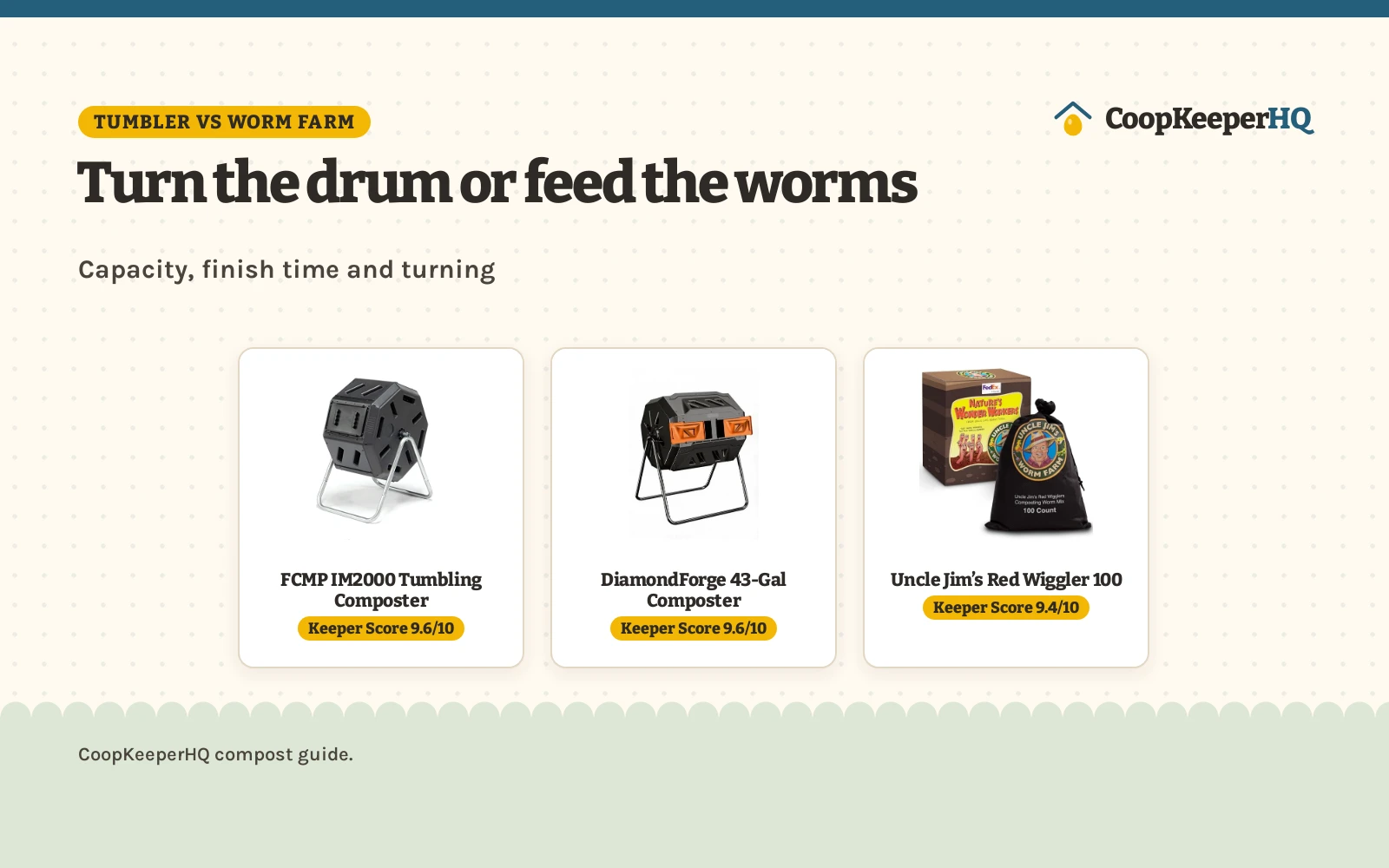
Compost tumbler vs worm farm, compared on two tumblers and a starter pack of worms: capacity, finish time, turning and which keeper each suits.

On this page
Top picks at a glance
As an Amazon Associate I earn from qualifying purchases.
- 1
 FCMP Outdoor IM2000 Tumbling Composter, 22 Gallon9.6/10View on Amazon
- 2
 DiamondForge 43-Gal Dual Chamber Composter9.6/10View on Amazon
- 3
 Uncle Jim’s Worm Farm 100 Count Red Wiggler9.4/10View on Amazon
Compost tumbler vs worm farm verdict: Choose a compost tumbler for coop bedding and yard waste that needs turning and heat, as the FCMP example shows with its 22 gallon drum and 2 week finish in hot sunny conditions. Choose a worm farm for food scraps that worms turn into castings, as the Uncle Jim’s example shows with 100 red wigglers and castings richer in phosphates, nitrogen and potash than average lawn soil.
Both turn coop waste into garden compost, but they do it differently. A tumbler mixes bedding and scraps with air and heat, and a worm farm lets red wigglers eat scraps and leave castings. This compost tumbler vs worm farm comparison covers the two systems, then the examples from the listings we reviewed.
CoopKeeperHQ earns a commission if you buy through our links, at no added cost to you. Affiliate disclosure.
The examples
| # | Product | Keeper Score | Buy |
|---|---|---|---|
| 1 | FCMP Outdoor IM2000 Tumbling Composter, 22 Gallon | 9.6/10 | Buy on Amazon |
| 2 | DiamondForge 43-Gal Dual Chamber Composter | 9.6/10 | Buy on Amazon |
| 3 | Uncle Jim’s Worm Farm 100 Count Red Wiggler | 9.4/10 | Buy on Amazon |
FCMP Outdoor IM2000 Tumbling Composter, 22 Gallon
A 22 gallon tumbling composter in black, made in Canada from 100% post-consumer recycled plastic, with a one year limited warranty.
Who it's for: keepers who want a small tumbler for garden, kitchen and yard waste with a fast finish.
Who should skip it: anyone who needs a larger drum or a dual chamber for continuous composting.
FCMP Outdoor lists the IM2000 tumbling composter in Black, 22 Gallon, made in Canada from 100% post-consumer recycled plastic. The maker states a total capacity of approximately 22.5 gallons (3 cu ft), a large opening with a removable door, deep fins that break up clumps and mix oxygen in, and aeration holes. The tumbler turns 5 to 6 times every 2 to 3 days, and compost can finish in as little as 2 weeks in hot sunny conditions with a proper balance of ingredients. It weighs 17.2 pounds, measures 24.0 by 19.0 by 30.0 inches, and carries a one year limited replacement warranty on manufacturing defects.
Pros
- Tumbling design avoids digging and mixing by hand
- Compost can finish in as little as 2 weeks in hot sunny conditions
- Large opening and removable door for adding scraps and removing compost
- 100% post-consumer recycled, UV-inhibited, BPA-free polypropylene
Cons
- Needs turning 5 to 6 times every 2 to 3 days
- 22.5 gallon total capacity, smaller than the 43 gallon DiamondForge
- Black is the only color stated
- One year limited warranty covers manufacturing defects only
DiamondForge 43-Gal Dual Chamber Composter
A 43 gallon dual chamber tumbling composter with a steel frame, 360° rotation and 2 sliding doors.
Who it's for: keepers who want continuous composting with a larger drum and a steel frame.
Who should skip it: anyone who needs a quicker finish or a stated warranty term.
DiamondForge lists this dual chamber composter in Black Orange, 43 Gallon, with a steel frame, 2 sliding doors and an aeration system. The maker states a 360° rotating design with deep aeration fins, an 8-panel structure, and assembly in 20 minutes. The black finish maximizes heat and sunlight absorption, and compost can be produced in 4 to 6 weeks with basic proper maintenance. It weighs 25.0 pounds and measures 26.2 by 23.6 by 36.5 inches. No warranty term is stated.
Pros
- Dual chambers let one side compost while the other takes fresh scraps
- 360° rotating design with deep aeration fins
- Assembles in 20 minutes
- BPA-free plastic body with a robust steel frame
Cons
- No warranty term is stated
- 25.0 pounds, heavier than the 22 gallon FCMP
- Black Orange is the only color stated
- Compost takes 4 to 6 weeks, longer than the FCMP 2 week finish
Uncle Jim’s Worm Farm 100 Count Red Wiggler
A starter pack of 100 red wiggler composting worms that turn food scraps into worm castings.
Who it's for: keepers who want to start a worm farm with food scraps and rich castings.
Who should skip it: anyone who needs a worm bin included or a stated warranty term.
Uncle Jim’s Worm Farm lists this starter pack of 100 red wiggler composting worms for garden soil or fishing. The maker states the worms are harvested from worm beds that are decades old and may contain different earthworm species, and that the worms work all layers of the compost. The worm castings are 7 times richer in phosphates, 5 times richer in nitrogen, and 11 times richer in potash than average lawn soil. The farm has been in business for over 50 years on over 40 acres of land. The pack weighs 0.125 pounds.
Pros
- Red wigglers work all layers of the compost, not just the top
- Worm castings are 7 times richer in phosphates than average lawn soil
- Castings are 5 times richer in nitrogen and 11 times richer in potash
- Starter pack of 100 worms for a garden or farm
Cons
- No bin is included, so the keeper needs a worm bin or bed
- No warranty term is stated
- Beds may contain different earthworm species, not only red wigglers
- 100 count suits a starter bin, not a large worm farm
Other options for the coop
 Werph 54 Gallon Large Outdoor Compost TumblerCheck price on Amazon
 Good Ideas Compost Wizard Jr. TumblerCheck price on Amazon
 RSI Maze Two Stage Compost TumblerCheck price on Amazon
 Lifetime 60076 50 gal Compost TumblerCheck price on Amazon
 Uncle Jim's Worm Farm 1000 Count Red Wiggler Composting WormsCheck price on Amazon
 Miracle-Gro Dual Chamber Compost TumblerCheck price on Amazon
Compost tumbler vs worm farm: side by side
| System | Keeper Score | Capacity | Finish | Warranty |
|---|---|---|---|---|
| FCMP IM2000 Tumbling Composter | 9.6/10 | 22.5 gallons | 2 weeks | One year limited |
| DiamondForge 43-Gal Composter | 9.6/10 | 43 gallons | 4 to 6 weeks | Not stated |
| Uncle Jim’s Red Wiggler 100 | 9.4/10 | 100 count | Not stated | Not stated |
Capacities and sizes are manufacturer ratings, quoted as the listing words them, collected 14 November 2026.
How each one turns waste into compost
A tumbler makes the mixing easy. You turn the FCMP drum 5 to 6 times every 2 to 3 days, and compost can finish in as little as 2 weeks in hot sunny conditions with a proper balance of ingredients. The DiamondForge drum rotates a full 360° with deep aeration fins, and its dual chambers let one side compost while the other takes fresh scraps. Compost from the DiamondForge takes 4 to 6 weeks with basic proper maintenance.
A worm farm does no turning at all. The Uncle Jim’s red wigglers work all layers of the compost, not just the top few inches, and the food scraps they eat get digested and transformed into worm castings. The castings are 7 times richer in phosphates, 5 times richer in nitrogen, and 11 times richer in potash than average lawn soil. The worms here are a starter pack, so the keeper needs a bin or bed to put them in.
Capacity and size
| System | Capacity | Weight | Finish |
|---|---|---|---|
| FCMP IM2000 tumbler | 22.5 gallons | 17.2 pounds | 2 weeks |
| DiamondForge tumbler | 43 gallons | 25.0 pounds | 4 to 6 weeks |
| Uncle Jim’s worms | 100 count | 0.125 pounds | Not stated |
The 43 gallon DiamondForge holds more than the 22.5 gallon FCMP, and weighs 25.0 pounds against 17.2 pounds. The FCMP measures 24.0 by 19.0 by 30.0 inches, while the DiamondForge measures 26.2 by 23.6 by 36.5 inches. The worm pack weighs 0.125 pounds and holds 100 worms. Our best compost tumblers guide lists more tumblers by capacity.
What goes in, and what comes out
Tumblers take bulk waste. The FCMP takes garden, kitchen and yard waste, and the DiamondForge takes kitchen, garden and yard scraps, with both turning the load into finished compost. The FCMP finishes in as little as 2 weeks in hot sunny conditions, while the DiamondForge takes 4 to 6 weeks. See how to compost chicken poop for the full routine.
Worms take food scraps. The Uncle Jim’s red wigglers eat food scraps and waste in the compost bin and turn them into worm castings, a nutrient-rich material for lawns and gardens. Our best worm farm guide lists worm bins and starter packs.
Flock fit
FCMP IM2000 Tumbling Composter
DiamondForge 43-Gal Composter
Uncle Jim’s Red Wiggler 100
FAQ for the flock
Is a compost tumbler or worm farm better for coop waste?
It depends on the waste. A tumbler suits bedding and yard waste that needs turning and heat, with the FCMP finishing in as little as 2 weeks in hot sunny conditions. A worm farm suits food scraps, which red wigglers turn into castings richer in phosphates, nitrogen and potash than average lawn soil.
How often do you turn a compost tumbler?
Follow the maker’s guidance for the drum you own. The FCMP listing says to turn it 5 to 6 times every 2 to 3 days. The DiamondForge listing describes a 360° rotating design with deep aeration fins.
How many worms do you need to start a worm farm?
The Uncle Jim’s starter pack in this comparison holds 100 red wiggler composting worms. The farm has been in business for over 50 years on over 40 acres of land.
Do worm castings help the garden?
The maker states the castings from these red wigglers are 7 times richer in phosphates, 5 times richer in nitrogen, and 11 times richer in potash than average lawn soil. The castings come from food scraps the worms eat and digest.
How the Coop Score came out
Each example is scored on performance, build, value, safety and warranty, using only what the listing publishes. Only the FCMP states a warranty term. The weights are on our How We Pick page.
| Product | Keeper Score | Perf. /35 | Build /25 | Value /25 | Safety /10 | Warranty /5 |
|---|---|---|---|---|---|---|
| FCMP IM2000 Tumbling Composter | 9.6 | 30 | 21 | 21 | 5 | 3 |
| DiamondForge 43-Gal Composter | 9.6 | 29 | 21 | 20 | 5 | 0 |
| Uncle Jim’s Red Wiggler 100 | 9.4 | 26 | 19 | 20 | 0 | 0 |
Keeper Scores run between 9.2 and 9.8. We spread weighted point totals across that window proportionally, so a product with more points always lands higher.
Which should you choose?
Choose a compost tumbler if you have bedding and yard waste to turn, you want finished compost in weeks and you can turn the drum every few days, as the FCMP example shows with its 2 week finish in hot sunny conditions.
Choose a worm farm if you have food scraps to feed worms and want castings for the garden, as the Uncle Jim’s example shows with 100 red wigglers.
Wash your hands after handling birds, eggs or equipment, supervise children around the flock, and check local rules on flock size and roosters before you buy. For sick birds, call a poultry veterinarian or your state extension office. See CDC backyard poultry guidance. Read our Safety Disclaimer.
More coop guides
- Best Compost Tumblers (2026): 5 Dual Chamber Picks for the Coop
- Best Worm Farm (2026)
- Compost Tumbler vs Compost Bin: Which One Should You Buy?
- Worm Farm vs Compost Bin: Which One Should You Buy?
- Single vs Dual Chamber Compost Tumbler: Which One Should You Buy?
- Best Chicken Bedding for Composting (2026): 5 Picks Compared
- How to Compost Chicken Poop at Home
- Compost Bin for Beginners: What to Buy
- How Does Compost Bin Work: A Backyard Guide
- Wood vs Plastic Compost Bin: Which One Should You Buy?
See every coop cleaning and compost guide and the composting guides.