Digital vs Analog Incubator Thermometer: Which Hatches Better?
Digital vs analog incubator thermometer: digital gives exact readings, humidity and min/max memory; analog needs no batteries. Use both.

On this page
Top picks at a glance
As an Amazon Associate I earn from qualifying purchases.
- 1
 BN-LINK Reptile Thermostat Temperature ControllerView on Amazon
- 2
 HATUSOKU Digital Thermometer with External SensorView on Amazon
- 3
 Weewooday 12 Pcs Digital Humidity Meter with Probe LCDView on Amazon
- 4
 Weewooday 3 Pcs Digital Humidity Meter with Probe LCDView on Amazon
- 5
 IncuTherm™ Plus Digital Thermometer and Hygrometer for EggView on Amazon
- 6
 Egg-O-Meter™View on Amazon
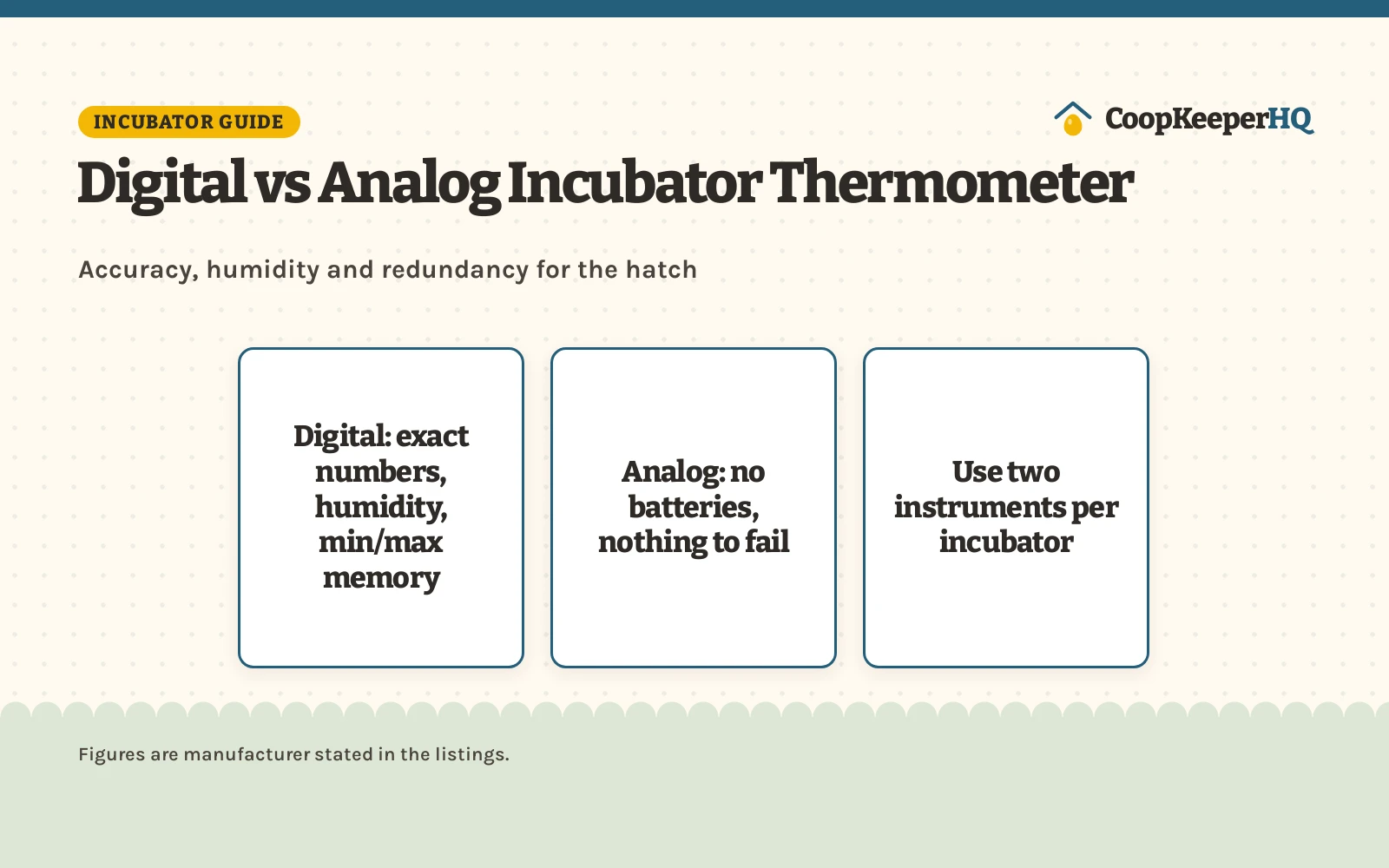
Digital vs analog incubator thermometer comes down to what you need to know: digital thermometers give you an exact number, humidity readings and min/max memory, while analog thermometers give you a needle on a dial with no batteries and nothing to fail. For hatching eggs, where a few degrees decide the hatch, most keepers use digital: the IncuTherm Plus below tracks min and max temperature and humidity with a remote probe, and the Weewooday meters read -58 to 158 degrees Fahrenheit with humidity from 10% to 99%RH. Analog still earns its place as a cheap backup that never needs a battery.
Other options for the coop
 BN-LINK Reptile Thermostat Temperature ControllerCheck price on Amazon
 HATUSOKU Digital Thermometer with External SensorCheck price on Amazon
 Weewooday 12 Pcs Digital Humidity Meter with Probe LCDCheck price on Amazon
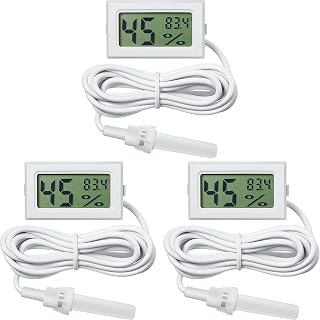 Weewooday 3 Pcs Digital Humidity Meter with Probe LCDCheck price on Amazon
 IncuTherm™ Plus Digital Thermometer and Hygrometer for EggCheck price on Amazon
 Egg-O-Meter™Check price on Amazon
CoopKeeperHQ earns a commission if you buy through our links, at no added cost to you. Read our affiliate disclosure.
Digital vs analog incubator thermometer: the short answer
Digital wins for hatching. Egg incubation needs temperature held steady and humidity tracked, and digital units do both: the Weewooday listings state temperature accuracy around 2 degrees Fahrenheit and humidity accuracy around 5%, with readings every 10 seconds. The IncuTherm Plus adds min/max memory so you can see overnight swings. Analog thermometers are simpler and need no power, but they show temperature only, and reading a needle to the degree is guesswork. Use digital as your main instrument and keep an analog as backup.
Why digital suits incubators
Three features matter for eggs. First, humidity: the Weewooday meters state a 10% to 99%RH range, and the IncuTherm Plus monitors temperature and humidity together, which matters because hatch rates depend on both. Second, min/max memory: the IncuTherm Plus records the highest and lowest readings, so you can spot a nighttime dip without watching the incubator. Third, remote probes: the IncuTherm Plus, the HATUSOKU with its 59-inch sensor cord, and the Weewooday meters with probes all let you read the display outside the incubator while the sensor sits with the eggs. See our hygrometer for egg incubator guide.
Where analog still works
An analog thermometer is the simple backup: no battery to die mid-hatch and no electronics to fail. It can still drift over time, so check it against your digital unit now and then. Hang one in the incubator next to your digital unit and you have an independent check. If the digital reads oddly, the analog tells you whether the incubator or the instrument is at fault. For the price of a coffee, that redundancy is worth it.
Accuracy and what the numbers mean
The listings state their accuracy plainly. The Weewooday meters claim about 2 degrees Fahrenheit on temperature and about 5% on humidity. The HATUSOKU states plus or minus 1 degree Celsius with a -40 to 158 degree Fahrenheit range. The KETOTEK states plus or minus 0.5 degrees Celsius or Fahrenheit over a -58 to 230 degree Fahrenheit range with USB power. For hatching, where the target band is narrow, the tighter the stated accuracy the better, and two instruments that agree beat one expensive one. Our egg hatching temperature guide covers the targets.
Power, probes and displays: what the listings offer
Power is the first practical question. The KETOTEK runs on USB power, so it stays on as long as the incubator does, while the HATUSOKU runs on a single AAA battery, the Veanic units on alkaline batteries, and the IncuTherm Plus on battery power with the probe inside the incubator and the display outside. A battery unit dies quietly, so a USB-powered instrument or a battery unit with a low-battery warning is worth the extra setup.
Probe design is the second. The HATUSOKU’s 59-inch sensor cord puts the sensor with the eggs and the display where you can read it; the IncuTherm Plus works the same way with its remote probe. The Weewooday meters use probes that the listing says are not waterproof, so keep them out of the water channels. Probes read the air right at the eggs, which is the number that matters, rather than the air at the incubator lid.
Ranges tell you whether a unit suits incubation at all. The Weewooday meters cover -58 to 158 degrees Fahrenheit with 10% to 99%RH humidity; the HATUSOKU covers -40 to 158 degrees Fahrenheit at plus or minus 1 degree Celsius; the KETOTEK covers -58 to 230 degrees Fahrenheit at plus or minus 0.5 degrees with a switchable Celsius/Fahrenheit display. Any of these covers incubation temperatures with room to spare; the differences are in stated accuracy and whether humidity is included.
Thermostats versus thermometers
A thermometer measures; a thermostat controls. The BN-LINK listing is a thermostat, not a thermometer: it switches a heater on and off to hold a set temperature across a 40 to 108 degree Fahrenheit range, handling up to 1000W at 8.3A on 120V, ETL listed, with a 3.94 ft power cord and a 4.92 ft probe. If your incubator’s built-in control is unreliable, a thermostat like this runs the heater while your thermometer verifies the result. The listing states a 12-month replacement term.
How many to buy
Buy at least two measuring devices per incubator: a digital thermometer-hygrometer with min/max memory as the main instrument, and a second unit or an analog as a cross-check. The Weewooday listings come in 3-packs and 12-packs, and the Veanic in a 2-pack, so outfitting several incubators or placing sensors at different heights is cheap. Place probes at egg height, not at the top of the incubator where warm air collects. See our brooder thermometer picks for after the hatch.
FAQ for the flock
Is digital or analog better for incubators?
Digital, because it shows humidity and tracks min/max, which analog cannot do. Keep an analog as a battery-free backup.
How accurate should an incubator thermometer be?
The listings state 2 degrees Fahrenheit for the Weewooday meters, plus or minus 1 degree Celsius for the HATUSOKU, and plus or minus 0.5 degrees for the KETOTEK. Tighter stated accuracy is better for hatching.
Do I need a humidity reading?
Yes. Hatch rates depend on humidity as well as temperature, and digital meters like the Weewooday and IncuTherm Plus measure both.
What is the difference between a thermostat and a thermometer?
A thermometer measures temperature; a thermostat like the BN-LINK switches a heater on and off to hold a set temperature across its 40 to 108 degree Fahrenheit range.
Where should the probe go?
At egg height inside the incubator, with the display outside for easy reading. The IncuTherm Plus and HATUSOKU are designed exactly for this.
More coop guides
Related: our egg incubators with automatic turners and automatic egg turners guides.