Electric Netting vs Welded Wire Fence: Which One Should You Buy?
Portable electric netting and permanent welded wire fence compared for chicken runs, with four welded wire rolls from current listings ranked for the job.

On this page
Top picks at a glance
As an Amazon Associate I earn from qualifying purchases.
- 1
 Electric Poultry Netting Fence9.5/10View on Amazon
- 2
 Kicari Green Metal Garden Fence9.6/10View on Amazon
- 3
 Black PVC Coated Welded Wire Fence 36" x 50' RollView on Amazon
- 4
 Black PVC Coated Welded Wire Fence 24" x 25' RollView on Amazon
- 5
 Farm Fence 6ft x 100ft Heavy Zinc Coating Field Wire FencingView on Amazon
- 6
 Welded Wire Fence 48inx50ftView on Amazon
- 7
 Black PVC Coated Welded Wire Fence 3FTView on Amazon
- 8
 Green Metal Fence Post 4 feetView on Amazon
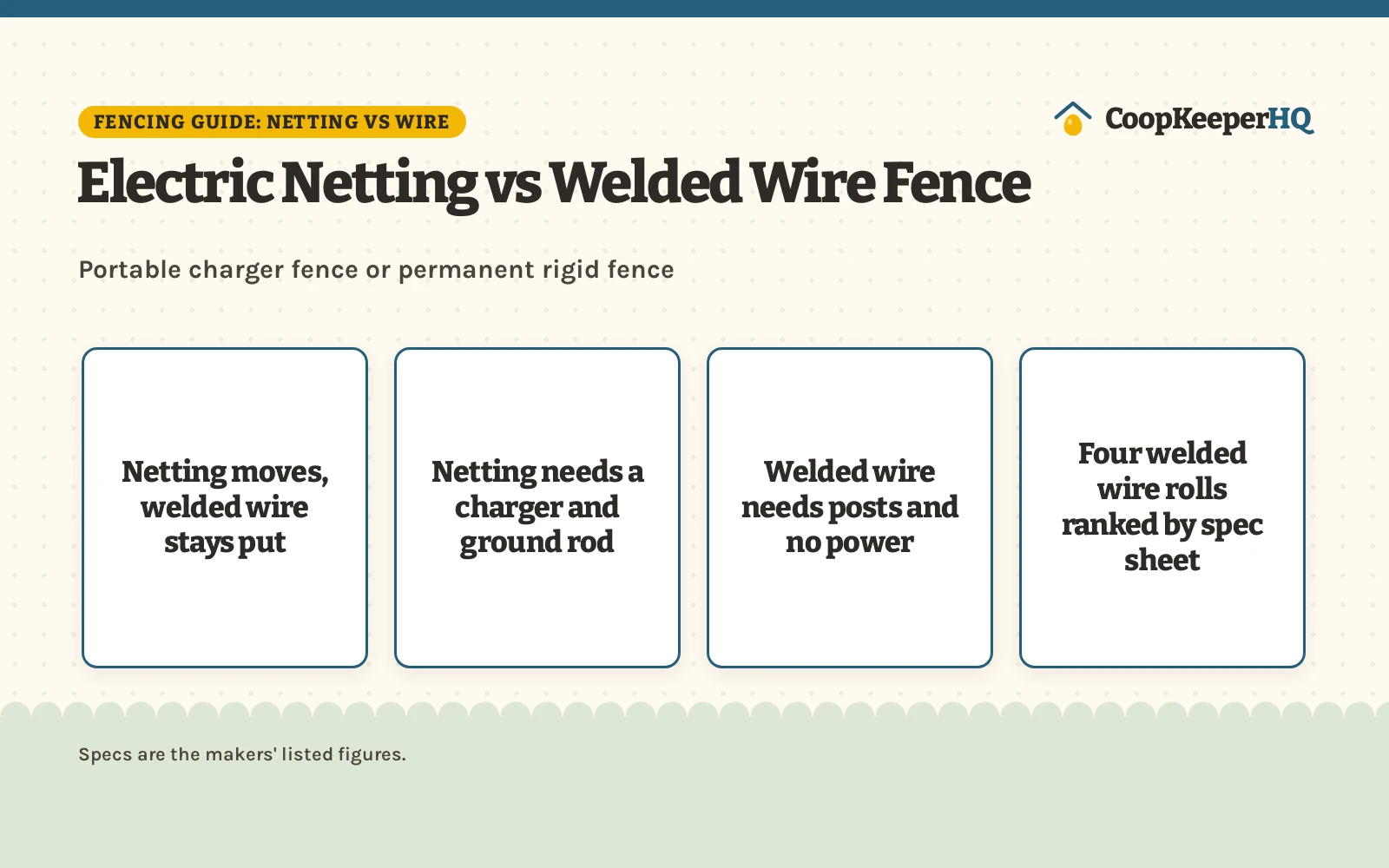
Morning chores tell you fast which fence you wish you had bought. When the flock needs fresh grass every few days, a fence you can roll up and carry wins the day. When the run stays put all year, a fence that stands through wind and weather on its own wins instead. That is the whole decision inside electric netting vs welded wire fence: a portable barrier that runs on a charger, or a permanent rigid fence that needs no power at all.
Other options for the coop
 Black PVC Coated Welded Wire Fence 36" x 50' RollCheck price on Amazon
 Black PVC Coated Welded Wire Fence 24" x 25' RollCheck price on Amazon
 Farm Fence 6ft x 100ft Heavy Zinc Coating Field Wire FencingCheck price on Amazon
 Welded Wire Fence 48inx50ftCheck price on Amazon
 Black PVC Coated Welded Wire Fence 3FTCheck price on Amazon
 Green Metal Fence Post 4 feetCheck price on Amazon
CoopKeeperHQ earns a commission if you buy through our links, at no added cost to you. Affiliate disclosure.
Electric netting vs welded wire fence: the quick answer
Choose electric netting when the fence must move. It goes up fast, comes down fast and lets you rotate the flock across fresh ground, which keeps one patch from turning to bare dirt. It needs a charger and a ground rod to work, so plan for that hardware from the start; our ground rod guide and hot wire fence insulators picks cover the supporting parts.
Choose welded wire fence when the run has a permanent home. It needs no power, no charger and no daily attention once it is fastened to posts. The four rolls below are all welded wire listings, ordered from the strongest spec sheet to the weakest, so you can see what current listings actually state about gauge, mesh and roll length.
Where electric netting earns its keep
Electric netting suits keepers who rotate pasture. A movable fence lets the flock work fresh ground while the old patch recovers, and the whole fence can shift in an afternoon. It also suits rented land or shared yards where digging post holes is not an option. The trade is attention: it needs a working charger, the charge path must stay clear of heavy weeds, and gates need a plan, such as an electric fence gate lock, so daily entry stays simple.
Netting is a daytime ranging tool more than a night fortress. Birds still belong shut inside a solid coop after dark, whatever fence surrounds the run. If your main worry is what comes over or under the fence at night, read that as a vote for the permanent option below.
Where welded wire fence earns its keep
Welded wire suits a fixed run. The welds hold the grid rigid, so it resists sagging and keeps its shape between posts without constant re-tensioning. Galvanized wire with a stated zinc or vinyl coating stands up to weather, and once it is attached to plastic or steel fence posts it asks little of you. There is no charger to maintain and no power to lose in a storm.
The trade is permanence. A welded wire run does not move, so the ground inside it takes the full beating of the flock all year. It also comes in fixed heights and roll lengths, so measure the run first and buy to the measurements on the listing. If the goal is keeping small wild birds out of the feed as well, our poultry netting rolls guide compares lighter options.
Four welded wire rolls from current listings, ranked
Every listing below is a welded wire fence roll, ranked from the strongest stated spec sheet to the weakest. Specs are the maker’s own words; where a listing contradicts itself, the notes say so.
YARDGARD 14-gauge welded wire, 36 in. x 100 ft
The heaviest wire here: 14-gauge galvanized steel in a 36-inch by 100-foot roll with a 1-inch by 2-inch mesh. The maker states welded joints that resist sagging, bending and deformation, plus a zinc coating for rust resistance. At 81.8 pounds it carries the highest stated weight here, which is a handling con but also the point: this is the rigid permanent-run pick. It cuts, shapes and fastens to posts, frames or existing structures per the listing. No warranty term is stated.
FOREHOGAR vinyl-coated welded wire, 36 in. x 50 ft
A lighter-duty option: 36 inches by 50 feet with a 2-inch by 3-inch mesh. The inner wire is 16 gauge (1.5 mm), galvanized, then coated in black vinyl to 1.9 mm, which the maker calls rustproof. At 16.2 pounds for 150 square feet it is easy to carry, cut and roll back up for storage or transport. The roomy mesh suits garden borders and pet barriers more than keeping small chicks in or small predators out, so match it to the job. No warranty term is stated.
TONGMO 19-gauge welded wire, 48 in. x 100 ft
Tied for the tallest roll here at 48 inches high and 100 feet long, with a 1-inch square mesh of 19-gauge galvanized welded wire. The listing pitches it as poultry protection netting for rabbits, pigeons, chickens and duck runs, and notes it conforms to different shapes. A pair of gloves and wire cutters comes in the box, and the maker warns the cut edge stays sharp, so gloves matter. One wrinkle: the spec table lists the color as white while the title and bullets describe galvanized wire, so expect the galvanized finish the title promises. No warranty term is stated.
Falanava galvanized farm fence, 4 ft x 164 ft
The longest and tallest roll here: 4 feet by 164 feet of hot-dipped galvanized wire with mesh openings that get smaller toward the bottom to block rabbits, dogs, cats, chickens and foxes. Read the listing carefully, though: the title calls it a chain link fence, while the bullets say the wire is knotted by machine and also call it welded wire fencing, and the spec table dimensions do not match the 4-foot by 164-foot title. Trust the title and bullets over the spec table, and treat the knotted-versus-welded wording as unresolved. It disassembles and moves for pasture management per the maker. No warranty term is stated.
Use a charger rated for the length of netting you run, ground it as the manual describes and post warning signs where neighbors or children can reach the fence. Keep grass and weeds off the bottom strands, and never leave netting unpowered, because birds and wildlife can tangle in it. Read our Safety Disclaimer.
FAQ for the flock
Can electric netting protect chickens at night?
Netting is a daytime ranging fence. Shut the flock inside a solid coop at night no matter which fence you use, since darkness is when most predators work the run.
Does welded wire fence need a charger?
No. Welded wire is a physical barrier with no power involved, which is the main reason keepers pick it for permanent runs. Only electric netting needs a charger and a ground rod.
What gauge welded wire should a chicken run use?
Lower gauge numbers mean thicker wire. Of the listings here, 14-gauge is the thickest, 16-gauge sits in the middle and 19-gauge is the thinnest. Thicker wire holds its shape better and stands up to chewing and pushing, so match the gauge to how much pressure the fence will take.
How tall should the fence be?
The rolls here list 36-inch, 48-inch and 4-foot heights. Taller fence contains flightier birds and discourages jumpers better, while shorter rolls suit garden borders and low pens. Measure the run and buy to the listed height.
Will welded wire keep digging predators out?
Not on its own. Any ground-level fence, welded wire included, benefits from a buried apron or a skirt of wire laid flat against the ground outside the run, so diggers hit wire instead of soil. Fasten the apron to the bottom of the fence and weigh it down.
More coop guides
- Best Poultry Netting Rolls (2026): 4 Compared
- Plastic vs Steel Fence Posts: Which One Should You Buy?
- Galvanized vs Black Chicken Wire: Which Should You Buy?
- Best Hardware Cloth for Backyard Flock (2026): Five Compared
- Best Electric Fence Gate Lock (2026)
- Best Poultry Netting for Guinea Fowl (2026): 4 Compared
- Best Ground Rod for Electric Fence (2026)
- Best Hot Wire Fence Insulators (2026): 5 Picks
See the chicken run and fencing picks and the predator protection guides.