Hand vs Electric Egg Washer: Which One Should You Buy?
Hand vs electric egg washer compared for backyard flocks: what hand brushes and enzyme washes do, when a machine earns its keep, and how to keep eggs safe.

On this page
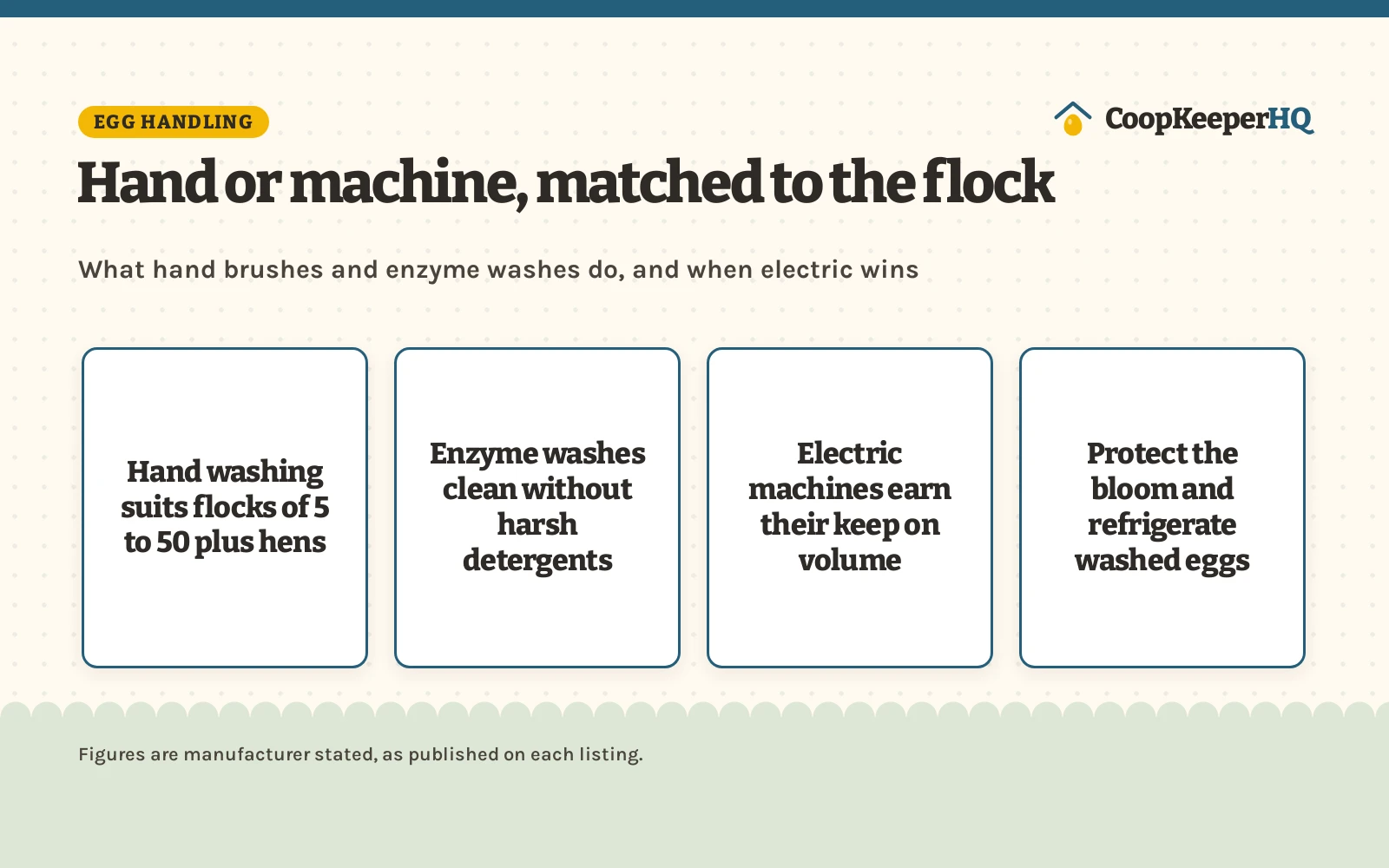
Hand vs electric egg washer comes down to flock size and how dirty the eggs get: hand washing with a brush or enzyme wash suits small flocks and lightly soiled eggs, while an electric washer earns its keep when dozens of eggs need cleaning every day. Both methods work; the wrong choice just wastes your time or your money. This guide walks through what each side involves, using concrete figures from six listings, so you can match the method to your flock.
As an Amazon Associate I earn from qualifying purchases. CoopKeeperHQ earns a commission if you buy through our links, at no added cost to you. Affiliate disclosure.
The quick answer
Wash by hand if you collect a basket a day: a brush and an enzyme wash handle it without a machine. Go electric if you run a bigger flock where hand washing every egg becomes a daily chore. The listings show the hand side clearly: the GoodEgg brush carries over 650 flexible silicone nubs and flips inside out to rinse, the CareFree Enzymes 33.9 oz bottle washes hundreds of eggs with a formula refined over 30 years, and the Manna Pro 16 oz enzyme wash is ready to use for backyard flocks. The electric side is a motorized machine that washes a batch at once, which no listing here describes, so the comparison below leans on the listings for hand gear and general explanation for electric machines.
What hand washing looks like
Hand washing is a brush, water and optionally an enzyme wash. The GoodEgg brush is a semicircular food-grade silicone tool, 1.5 by 1.5 by 2.4 inches at 1.6 ounces, dishwasher safe, with ribbed edges that reach into crevices and a hollow center that drains fast. The Lumkew brush uses soft nylon bristles in a 2.6 by 2.2 by 4.3 inch body at 0.1 kg, sized to fit chicken, duck and goose eggs, with feet that let it stand and drain by the sink. The Rite Farm scrubber is a palm-size round brush, 2.25 by 4.5 by 2.25 inches at 4 ounces, and the DoID Tag ships a 2-pack of soft silicone scrubbers, 3.93 by 3.93 by 1.18 inches at 1.76 ounces each, dishwasher safe with a hanging hole.
Enzyme washes do the chemical half. The CareFree Enzymes 33.9 oz bottle uses plant-based food-grade enzymes to remove dirt, bacteria, fecal matter, blood and protein residue, with no bleach, alcohol, parabens or synthetic fragrances, and the listing says it will not damage the bloom (cuticle). One bottle makes dozens of cleaning batches and easily washes hundreds of eggs, suited to backyard flocks of 5 to 50 plus hens. The Manna Pro 16 oz enzyme wash is a ready-to-use natural enzyme formula, 2.5 by 2.5 by 8 inches at 1.1 pounds, listed as suitable for refrigerated eggs and for fertilized eggs intended for incubation when used as directed.
What electric washing looks like
An electric egg washer is a motorized machine, usually a drum or a set of rotating brushes, that washes a batch of eggs at once with water and sometimes a sanitizing rinse. You load the eggs, run the cycle and unload them, which beats hand scrubbing when the daily count climbs. The trade-offs are real: parts that need cleaning and maintenance, power and water needs, and an overloaded or misadjusted machine can crack shells. No listing here describes an electric machine, so size that decision to your flock, not to a figure.
Hand vs electric egg washer: the real differences
The difference is throughput against simplicity. Hand washing costs little, needs no power and treats each egg gently; the GoodEgg and DoID Tag brushes are dishwasher safe and the enzyme washes need no special equipment. Electric washing handles volume: where hand washing scales with your patience, a machine scales with its drum. The CareFree listing frames the hand economics well, one bottle washing hundreds of eggs for flocks of 5 to 50 plus hens, which covers most backyard keepers without any machine at all.
Control is the other split. A hand brush lets you feel a thin shell and ease off; the Lumkew soft bristles are built for exactly that gentle touch. A machine treats every egg the same, which is fine for sturdy shells and risky for fragile ones. If you hatch, the Manna Pro note matters: an enzyme wash listed as suitable for fertilized eggs intended for incubation keeps the hand option viable for breeders.
When hand washing wins
Hand washing wins for small flocks, lightly soiled eggs and anyone who also hatches. A daily basket washes with the GoodEgg brush and water, and the enzyme wash handles the dirty ones without harsh detergents. Hand gear travels too: a brush rides along to the coop, while a machine stays where the power is. For flocks up to the 5 to 50 plus hens the CareFree listing names, hand washing covers the job.
When electric wins
Electric wins on volume and on labor. If you sell eggs and wash dozens daily, the hand routine becomes the longest chore of the day, and a machine trades that labor for its cost and upkeep. Electric also wins on consistency: every egg gets the same cycle, which suits a packing routine. The cost is the machine, the power, the water and the maintenance, plus the care to load it right so shells do not crack. Past the backyard scale, that trade is worth making.
Keeping eggs safe either way
Whichever side you pick, the rules are the same. Wash with water warmer than the egg so the contents do not contract and draw contaminants in. The GoodEgg listing phrases its demo as cool running water, but the food-safety rule is the warmer-water one: when a listing and the safety rule disagree, follow the safety rule. Protect the bloom where you can: the CareFree enzymes are listed as bloom-safe, a gentler choice than harsh detergents. Dry eggs before storing, refrigerate washed eggs, and retire any brush that starts shedding bristles.
Wash your hands after handling birds, eggs or equipment, supervise children around the flock, and check local rules on flock size and roosters before you buy. For sick birds, call a poultry veterinarian or your state extension office. See CDC backyard poultry guidance. Read our Safety Disclaimer.
FAQ for the flock
Do I need to wash farm eggs at all?
Only the dirty ones. Clean eggs from clean nests can go straight to the carton; wash the soiled ones with a brush or enzyme wash and refrigerate after washing.
Will washing remove the bloom?
Harsh detergents can; the CareFree Enzymes listing states its plant-based formula will not damage the bloom (cuticle). Gentle methods preserve more of the natural coating than aggressive scrubbing.
Can I wash hatching eggs?
The Manna Pro enzyme wash is listed as suitable for fertilized eggs intended for incubation when used as directed. Keep washing gentle and follow the product directions.
Hand or electric for a dozen hens?
Hand. A dozen hens sit well inside the 5 to 50 plus hen range the CareFree listing names for hand washing, and a brush plus enzyme wash handles the daily basket.
What about duck and goose eggs?
The Lumkew brush is listed as fitting chicken, duck and goose eggs with its soft bristles. Larger eggs just need the gentler touch the brush is built for.
How do I clean the brush itself?
The GoodEgg and DoID Tag brushes are dishwasher safe; the GoodEgg flips inside out to rinse. The Lumkew stands on its feet to drain and dry between uses.
- Best Egg Collecting Basket: Wire, Wood and Apron Picks
- Clear Plastic vs Paper Egg Cartons: Which One Should You Buy?
- Spiral Egg Skelter vs Egg Carton: Which Should You Buy?
Related: best egg collecting basket, clear plastic vs paper egg cartons and spiral egg skelter vs egg carton.