Small vs Large Quail Cage: Which One Should You Buy?
Small vs large quail cage compared: capacity, footprint, flexibility and features, with two Hatching Time examples.

On this page
Top picks at a glance
As an Amazon Associate I earn from qualifying purchases.
- 1
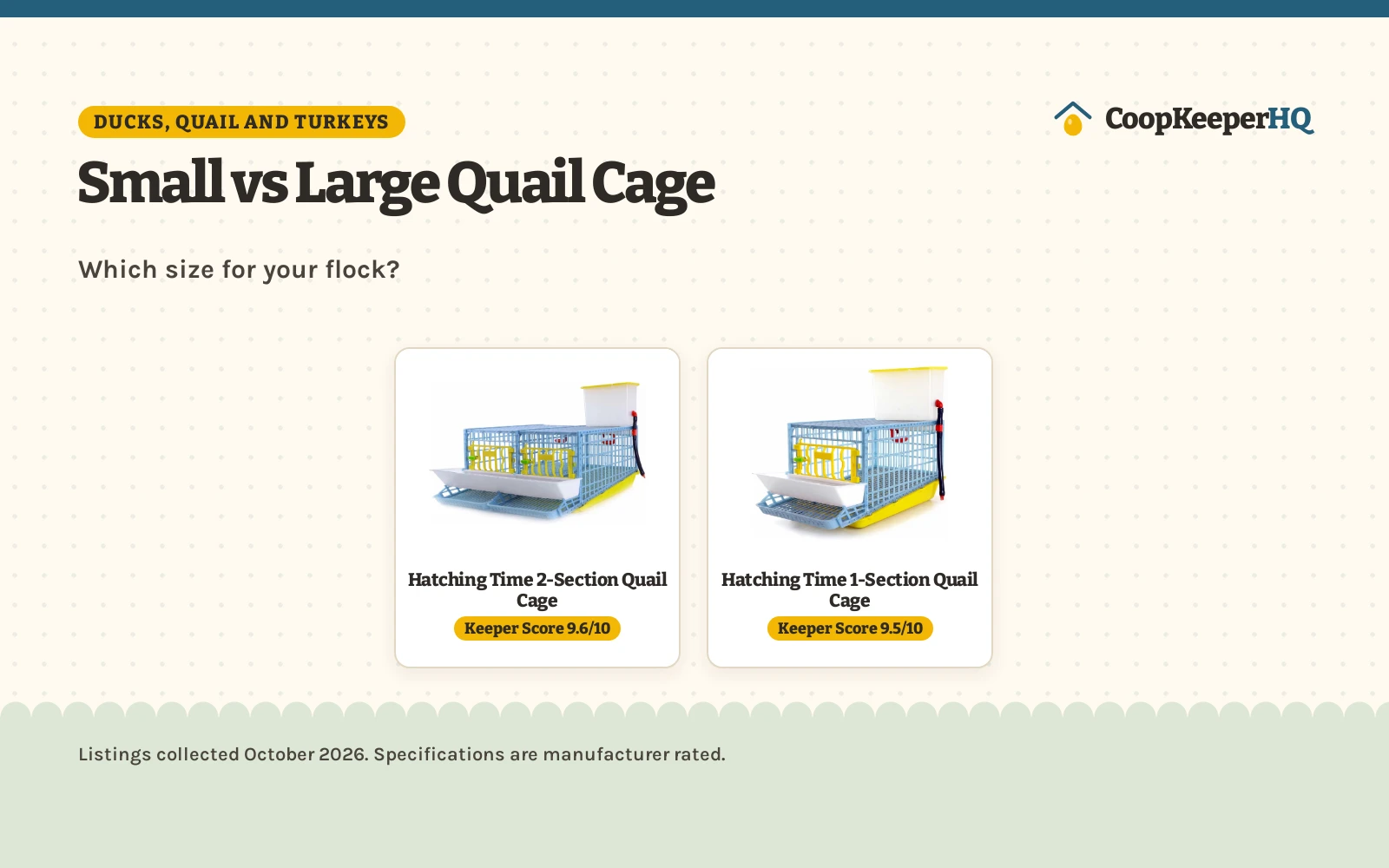
 Large example: 2 sections, up to 10 quail9.6/10View on Amazon
- 2
 Small example: 1 section, up to 5 quail9.5/10View on Amazon
Verdict: Pick the small cage for a handful of quail in a tight indoor space; pick the large cage for a bigger flock or two separate breeding groups. This small vs large quail cage comparison uses the Hatching Time one-section and two-section models as concrete examples.
CoopKeeperHQ earns a commission if you buy through our links, at no added cost to you. Affiliate disclosure.
Two examples

Large example: 2 sections, up to 10 quail
A 2-section quail breeding cage for up to 10 standard quail, 23.8 x 24 x 18.1 in, with removable middle wall, roll-out egg tray and gravity-fed watering.
The 2-section example houses up to 10 standard quail across two sections, 5 per section, with a removable middle wall for separate breeding groups or one open space. The sloped floor guides eggs to the roll-out tray, and a 1-gallon tank with 2 drinker cups feeds both sections.
It measures 23.8 x 24 x 18.1 in in blue polypropylene, power-washable, with a 1 Year Manufacturer's Warranty. It is not predator-proof.
Pros
- Holds up to 10 standard quail
- Removable wall for two groups
- 1-gallon tank and 2 drinker cups
- 1 Year Manufacturer's Warranty
Cons
- Larger footprint than the 1-section
- Not predator-proof
- Assembly required
- Indoor or sheltered use only

Small example: 1 section, up to 5 quail
A compact 1-section quail breeding cage for up to 5 standard quail, 11.8 x 24 x 18.1 in, with roll-out egg tray, waste tray and gravity-fed watering.
The 1-section example holds up to 5 standard quail in a compact 11.8 x 24 x 18.1 in footprint. The sloped Traditional floor guides eggs to the collection tray, with a removable waste tray below and gravity-fed watering.
It is blue polypropylene, power-washable, with a 1 Year Manufacturer's Warranty. It is not predator-proof.
Pros
- Compact 11.8-inch footprint
- Holds up to 5 standard quail
- Roll-out egg collection tray
- 1 Year Manufacturer's Warranty
Cons
- Single section, no divider
- Not predator-proof
- Assembly required
- Indoor or sheltered use only
Other options for the coop
 1 Additional Layer for Quail Breeding CageCheck price on Amazon
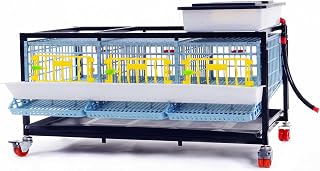 Hatching Time Quail Breeding Cage IndoorCheck price on Amazon
 2-in-1 Quail Feeder and Waterer for CageCheck price on Amazon
 RentACoop Chick2Chicken 5lb 2-Port Feeder and 1-Gal SmallCheck price on Amazon
 2 Additional Layers for Quail Breeding CageCheck price on Amazon
Small vs large quail cage: side by side
| Factor | Small: 1-Section | Large: 2-Section | Edge |
|---|---|---|---|
| Quail capacity | Up to 5 standard | Up to 10 standard | Large |
| Sections | 1 | 2 with removable wall | Large |
| Footprint | 11.8 x 24 x 18.1 in | 23.8 x 24 x 18.1 in | Small |
| Floor space | 11.8 x 17.3 in | 23.8 x 17.3 in | Large |
| Watering | Gravity-fed | 1-gal tank, 2 cups | Large |
| Warranty | 1 Year | 1 Year | Tie |
These figures are the coop makers’ own ratings, read from each listing on 22 October 2026. “Not stated” means the listing does not give the figure.
Capacity
The small example holds up to 5 standard quail in one section. The large example holds up to 10 standard quail across two sections, with 5 per section. For larger birds, the listing recommends 3 per section on both. If the flock is 5 or fewer, the small suffices; a flock above that limit needs the large. The large also suits keeping two breeding groups separate via the removable middle wall. Both are sized for standard quail; the Traditional flooring is intended for regular-size birds, with a Jumbo flooring option for larger jumbo birds on both models.
Who each suits
The small suits hobby keepers, classrooms and first-time keepers with a laying flock or small breeding group. The listing names hobby keepers, classrooms and small breeding setups. The large suits breeding programs, hobby flocks and classroom setups managing more birds or two groups. For a classroom project, the small is easier to place, stock and maintain; for a breeding program selecting and splitting pairs, the large with its divider is the working tool.
Footprint
The small example measures 11.8 in L x 24 in W x 18.1 in H with 11.8 x 17.3 in floor space. The large measures 23.8 in L x 24 in W x 18.1 in H with 23.8 x 17.3 in floor space. The large is about twice as long; width and height match. For a garage corner or classroom, the small fits where the large will not. Both need an indoor or enclosed shelter; neither is predator-proof.
Flexibility
The large has a removable middle wall, letting the keeper run two separate sections or open the interior into one larger hutch-style space as the flock setup changes. The small is a single fixed section. For breeding programs that split and combine groups through the season, the large adapts; for a stable laying flock, the small is simpler and easier to manage.
Egg collection and watering
Both have sloped Traditional floors guiding eggs to a roll-out collection tray and a removable waste tray below. Both include gravity-fed watering. The large adds a 1-gallon water tank, 2 drinker cups, water-line components and a front feeding trough for both sections. The small lists gravity-fed watering without tank details. For daily care across more birds, the large is better equipped.
Build and cleanup
Both are polypropylene that will not rust like metal panels and can be power-washed. Both are blue, require assembly, and carry a 1 Year Manufacturer’s Warranty. Build quality does not separate the two models; size and interior configuration do. The removable waste tray below keeps routine cleanup simple and separates egg collection from the mess below, on both models.
Placement
Both are sized for indoor or sheltered use: homes, garages, barns, sheds or other enclosed shelters. Neither is predator-proof, so outdoor placement needs protection. The small fits a shelf or tight corner; the large needs a bench or table with about twice the length. Measure the available space carefully before choosing.
What to check before you buy
Measure the space first: the 1-section example lists an 11.8 by 24 in footprint with 11.8 by 17.3 in floor space, and the 2-section example lists 23.8 by 24 in with 23.8 by 17.3 in floor space. Both listings state the cage is best placed indoors or in an enclosed shelter, and both state it is not predator-proof, so an outdoor spot needs a predator-proof run or coop around it.
Count the birds against the stated capacity: up to 5 standard quail in the 1-section, up to 10 in the 2-section, and 3 per section for larger birds on both. The 2-section adds a removable middle wall for two breeding groups or one open space; the 1-section has no divider. If the flock may grow, the divider is the feature to pay for.
Check the watering setup: both list gravity-fed watering, and the 2-section adds a 1-gallon water tank, 2 drinker cups, water-line components and a front feeding trough. Both list assembly as required. Both have sloped Traditional floors with roll-out egg trays and removable waste trays below; the Traditional flooring is intended for regular-size quail, with a Jumbo flooring option for larger jumbo birds. Both carry a 1 Year Manufacturer’s Warranty and are built from power-washable polypropylene that will not rust like metal panels.
FAQ for the flock
How many quail fit in a small cage?
The Hatching Time 1-section example holds up to 5 standard quail. For larger birds, the listing recommends 3 per section. Match the cage to the flock size; overcrowding stresses the birds. For a growing flock, the 2-section example holds up to 10.
Can I keep two breeding groups in one cage?
The 2-section example has a removable middle wall for keeping breeding groups separate, or open it for one larger space. The 1-section has no divider. For separate groups, the large is the pick.
Are these cages predator-proof?
No. Both listings state the cage is not predator-proof and is best placed indoors or in an enclosed shelter. For outdoor use, a predator-proof run or coop is needed. The polypropylene construction resists rust but not teeth and claws.
Do both have the same warranty?
Yes. Both the 1-section and 2-section examples carry a 1 Year Manufacturer’s Warranty. Warranty does not separate the two models; choose on flock capacity and available footprint instead.
How do I collect eggs from these cages?
Both have sloped Traditional floors that guide laid eggs forward to a roll-out collection tray, with a removable waste tray below. Retrieve eggs from the front without ever reaching deep into the cage.
Is assembly difficult?
Both listings state assembly is required but give no assembly time. The cages are polypropylene panels with a gravity-fed watering system, a roll-out egg tray and a removable waste tray, so expect to fit the panels, trays and water line together. The 2-section adds the removable middle wall to the build. If in doubt, check the listing photos for the assembled layout before ordering.
How the Coop Score came out
Each cage is scored on performance, build, value, safety and warranty, with the weights published on our How We Pick page. Performance covers capacity and stated features. Build covers polypropylene construction and power-washable design. Value weighs capacity against the single-unit format. Both state a 1 Year Manufacturer’s Warranty, scoring warranty points. Neither states a safety certification, so safety scores zero. Rankings follow the computed totals.
More coop guides
See our best quail cage and best hardware cloth for quail cage guides, plus the ducks, quail and turkeys hub.