Submersible vs External Pond Pump: Which One Should You Buy?
Submersible vs external pond pump compared on placement, priming, flow, head and upkeep, with two external pump examples and a verdict on which type suits your pond.

On this page
Top picks at a glance
As an Amazon Associate I earn from qualifying purchases.
- 1
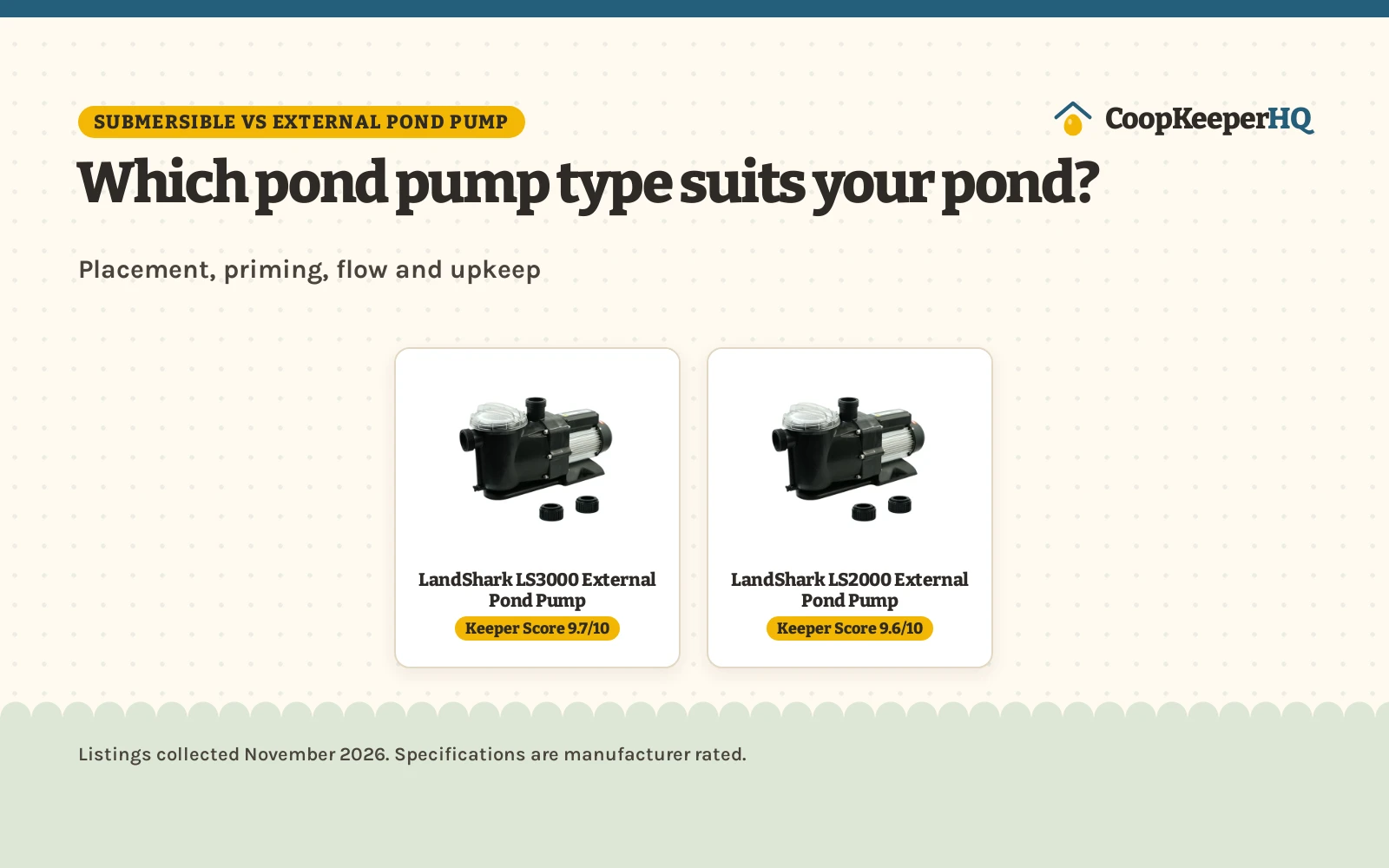
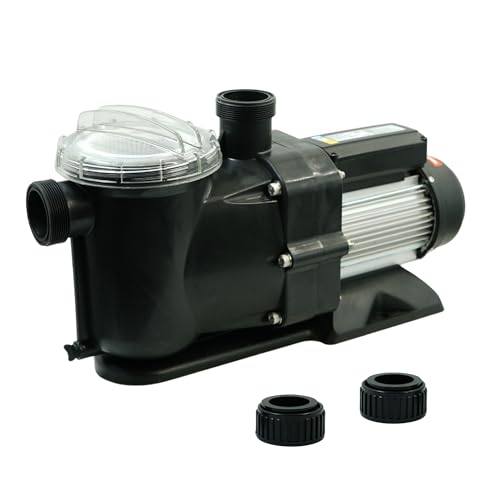 LandShark LS3000 External Pond Pump, 3300 GPH9.7/10View on Amazon
- 2LandShark LS2000 External Pond Pump, 2000 GPH9.6/10View on Amazon
Submersible vs external pond pump verdict: Choose an external pump if you have a dry spot beside the pond for the pump and you want the debris basket within easy reach for cleaning. Choose a submersible pump if you want the pump hidden under the water and you are happy to lift it out whenever it needs cleaning.
A pond that waters a duck run or a garden bed needs steady circulation, and the pump that moves the water either sits in the pond or beside it. This submersible vs external pond pump comparison covers the two types, then two external examples from the listings reviewed.
CoopKeeperHQ earns a commission if you buy through our links, at no added cost to you. Affiliate disclosure.
Two examples
LandShark LS3000 External Pond Pump, 3300 GPH
A 3300 GPH external pond pump with a 24 ft max head, 400 W draw and a removable debris basket, backed by a 2 year warranty.
Who it's for: a pond with a long lift to a filter or waterfall that needs the higher flow and head.
Who should skip it: anyone who wants the lower power draw, since this model lists 400 W against the LS2000 at 250 W.
The LandShark LS3000 lists 3300 GPH, a 24 ft max head and a 1/2 HP self-priming direct drive motor, drawing 400 W at 120 V and 5 Amps. The listing states a removable oversized debris basket with a clear, quick-release cover, a hydraulically self-balancing impeller, a self-lubricating direct drive motor, a thermal sensor and a 2 year manufacturer warranty. The title names the pump LS3000 while the spec table lists the model as LS3300.
Pros
- 3300 GPH flow with a 24 ft max head, the higher of the two examples
- Self-priming direct drive motor, stated in the listing
- Removable debris basket with a clear quick-release cover
- Thermal sensor stated to keep the pump from overheating
Cons
- No safety listing such as UL or ETL stated
- Cord is 4.5 ft, so the outlet must sit close to the pond
- Draws 400 W, more than the smaller LS2000 example
LandShark LS2000 External Pond Pump, 2000 GPH
A 2000 GPH external pond pump with a 20 ft max head, 250 W draw and a removable debris basket, backed by a 2 year warranty.
Who it's for: a smaller pond or a short lift where the lower flow and draw suit the setup.
Who should skip it: anyone who needs the higher flow and head of the LS3000 example.
The LandShark LS2000 lists 2000 GPH, a 20 ft max head and a 1/3 HP self-priming direct drive motor, drawing 250 W at 120 V and 3 Amps. The listing states a removable oversized debris basket with a clear, quick-release cover, a hydraulically self-balancing impeller, a self-lubricating direct drive motor, a thermal sensor and a 2 year manufacturer warranty.
Pros
- 2000 GPH flow with a 20 ft max head
- Self-priming direct drive motor, stated in the listing
- Removable debris basket with a clear quick-release cover
- Draws 250 W, the lower draw of the two examples
Cons
- No safety listing such as UL or ETL stated
- Cord is 4.5 ft, so the outlet must sit close to the pond
- Lower flow and head than the LS3000 example
- Weighs 17.0 pounds, more than the larger LS3000 example
Other options for the coop
 GROWNEER 550GPH Submersible Pump 30W Fountain Aquarium WaterCheck price on Amazon
 VIVOSUN 4500GPH Sub Water Pump for Pond WaterfallCheck price on Amazon
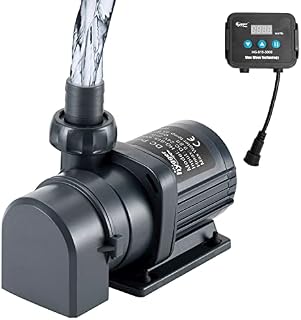 hygger 800GPH Quiet Submersible and External 24V Water PumpCheck price on Amazon
 Alpine Corporation PAL3100Check price on Amazon
 WaterRebirth Submersible Pond PumpCheck price on Amazon
 HIBLOW HP-80 Pond Aerator/Septic Linear Air PumpCheck price on Amazon
Submersible vs external pond pump: side by side
| Factor | Submersible | External | Example |
|---|---|---|---|
| Placement | Sits in the pond, under the water | Sits beside the pond, out of the water | Both examples are external pumps |
| Priming | No priming needed, it sits under water | Self-priming direct drive motor | Both listings state self-priming |
| Flow | Varies by model | 2000 GPH to 3300 GPH across the examples | LS2000: 2000 GPH; LS3000: 3300 GPH |
| Max head | Varies by model | 20 ft to 24 ft across the examples | LS2000: 20 ft; LS3000: 24 ft |
| Power | Varies by model | 250 W to 400 W across the examples | LS2000: 250 W; LS3000: 400 W |
| Debris basket | Sits in the pond with the pump | Removable basket with a clear quick-release cover | Both listings state it |
| Cleaning access | Lift the pump out of the pond | Reach the basket from beside the pond | Clear cover on both models |
| Warranty | Varies by model | 2 year manufacturer warranty | Both listings state it |
Capacities and sizes are manufacturer ratings, quoted as the listing words them, collected 13 November 2026.
Placement and priming
Placement is the first difference a keeper notices. A submersible pump sits in the pond, under the water, so it stays out of sight and needs no priming. An external pump sits beside the pond, out of the water, on a dry pad or in a pump house, and the water reaches it through piping. Both LandShark examples state a self-priming direct drive motor.
An external pump also needs a dry spot and an outlet within reach. Both examples list a 4.5 ft cord, so the outlet must sit close to the pond. A submersible pump needs no dry pad, but every cleaning means lifting the pump out of the water.
Flow and head
The two examples give flow and head figures for the external side only. The LandShark LS2000 lists 2000 GPH with a 20 ft max head, and the LandShark LS3000 lists 3300 GPH with a 24 ft max head. No submersible example is included here, so this comparison gives no flow or head figure for that side, and neither side can be called better on those specs.
Match the figures to the pond, not to each other. A pond with a long lift to a filter or a waterfall needs head, and a wide pond with ducks stirring up debris needs flow and a basket that is easy to reach. The listings state the figures as manufacturer rated, so treat them as the maker’s ratings for each model.
Power and cord
Both examples run on 120 V. The LS2000 lists 250 W and 3 Amps with a 1/3 HP motor, and the LS3000 lists 400 W and 5 Amps with a 1/2 HP motor. Both list a G2 x 2 in slip output and a 4.5 ft cord. The LS3000 lists the higher draw alongside its higher flow and head ratings, and the cord length is the same on both models, so plan the outlet position before choosing a spot for the pump.
Debris and upkeep
Pond water carries leaves, twigs and duck mess, so the debris basket matters as much as the motor. Both examples list a built-in removable oversized debris basket with a clear, quick-release cover, so the basket can be checked and cleaned easily. Both also list a hydraulically self-balancing impeller and a self-lubricating direct drive motor, and a thermal sensor that keeps the pump from overheating.
Upkeep on an external pump happens beside the pond, with the basket in reach and the pump out of the water. Upkeep on a submersible pump means lifting the whole pump out first. Both examples carry a 2 year manufacturer warranty.
Flock fit
LandShark LS3000 External Pond Pump
LandShark LS2000 External Pond Pump
Fitting It to Your Flock
- Match flow to the pond: the LS2000 lists 2000 GPH and the LS3000 lists 3300 GPH, so pick the flow that suits the pond and the lift to the filter.
- Check the lift: the LS2000 lists a 20 ft max head and the LS3000 lists a 24 ft max head, so measure the lift before choosing.
- Plan the outlet: both examples list a 4.5 ft cord, so the outlet must sit close to where the pump will stand.
- Keep the basket clear: both examples list a removable debris basket with a clear quick-release cover, so check it often when ducks use the pond.
FAQ for the flock
Can an external pond pump run dry?
The listings do not state that either example can run dry. Self-priming describes how the pump starts, not running without water, and a pump moves water only when water reaches it. Keep the basket clear.
How much flow does a pond pump need?
It depends on the pond and the lift to the filter or waterfall. The examples here list 2000 GPH with a 20 ft max head and 3300 GPH with a 24 ft max head.
Where should an external pond pump sit?
Beside the pond, on a dry pad or in a pump house, out of the water. Both examples list a 4.5 ft cord, so the outlet must sit close to the pump.
How do I clean the debris basket?
Both examples list a removable debris basket with a clear, quick-release cover. Lift the cover, take the basket out, clear the twigs and leaves, and put it back.
Do these pumps come with a warranty?
Yes. Both listings state a 2 year manufacturer warranty.
How the Coop Score came out
Each example is scored on performance, build, value, safety and warranty, using only what the listing publishes. Both listings state a 2 year warranty and a thermal sensor. The weights are on the How We Pick page.
| Product | Keeper Score | Perf. /35 | Build /25 | Value /25 | Safety /10 | Warranty /5 |
|---|---|---|---|---|---|---|
| LandShark LS3000 External Pond Pump | 9.7 | 32 | 21 | 21 | 4 | 4 |
| LandShark LS2000 External Pond Pump | 9.6 | 28 | 20 | 20 | 4 | 4 |
Keeper Scores run between 9.2 and 9.8. We spread weighted point totals across that window proportionally, so a product with more points always lands higher.
Which should you choose?
Choose an external pump if you have a dry spot beside the pond, you want the debris basket within easy reach, and you like doing upkeep without lifting a pump out of the water.
Choose a submersible pump if you want the pump out of sight under the water, you have no dry spot beside the pond, and you are happy to lift the pump out for cleaning.
Wash your hands after handling birds, eggs or equipment, supervise children around the flock, and check local rules on flock size and roosters before you buy. For sick birds, call a poultry veterinarian or your state extension office. See CDC backyard poultry guidance. Read our Safety Disclaimer.
More coop guides
Compare aeration as well in our pond aerator vs pond pump guide, and see how scores work on the How We Pick page.