Trough vs Tube Chicken Feeder: Which One Should You Buy?
Trough feeders lay feed out for many birds at once with stated capacities up to 50 pounds; tube feeders keep feed covered in a hopper for small flocks. Which suits your coop?

On this page
Top picks at a glance
As an Amazon Associate I earn from qualifying purchases.
- 1
 Sprigrown Metal Chicken Feeder9.5/10View on Amazon
- 2
 No Waste Chicken Feeders and Waterers9.6/10View on Amazon
- 3
 Goat Feeders Hanging Poultry Feeder Trough for LivestockView on Amazon
- 4
 Hanging Chicken FeedersView on Amazon
- 5
 4 Pack Chicken Feeder Plastic Feed Trough Bucket for ChickenView on Amazon
- 6
 Double-Tuf® Metal Poultry Trough FeederView on Amazon
- 7
 47" Chicken Trough FeederView on Amazon
- 8
 Hanging Chicken Feeder Trough Goat Feeder Chicken FenceView on Amazon
Trough vs tube chicken feeder comes down to how your flock eats. A trough feeder lays feed out in an open row so many birds eat side by side, with listings like the RentACoop 50 lb galvanized trough stating a 22 x 14 x 10 in body and a side view window for checking levels. A tube feeder holds feed in a vertical hopper that gravity-feeds into a small pan, keeping the feed covered and dry. Choose a trough for large flocks and shared feeding, and a tube for small flocks where you want the feed protected between visits.
Other options for the coop
 Goat Feeders Hanging Poultry Feeder Trough for LivestockCheck price on Amazon
 Hanging Chicken FeedersCheck price on Amazon
 4 Pack Chicken Feeder Plastic Feed Trough Bucket for ChickenCheck price on Amazon
 Double-Tuf® Metal Poultry Trough FeederCheck price on Amazon
 47" Chicken Trough FeederCheck price on Amazon
 Hanging Chicken Feeder Trough Goat Feeder Chicken FenceCheck price on Amazon
CoopKeeperHQ earns a commission if you buy through our links, at no added cost to you. Affiliate disclosure.
Trough vs Tube Chicken Feeder: The Quick Answer
Trough feeders win on capacity and access: the listings here range from the DallerSoode 1.3-quart 2-pack up to the RentACoop 50 lb trough, with the Little Giant reel-top listing 40 lb capacity for up to 75 adult birds. Tube feeders are not in the listings for this guide, so treat the tube side as general keeper practice: a covered hopper keeps rain and droppings out of the feed and rations it through a small pan, which suits small flocks better than a crowd. The trade is simple: troughs feed many birds at once but expose the feed, while tubes protect the feed but serve fewer birds at a time.
What trough feeders bring to the coop
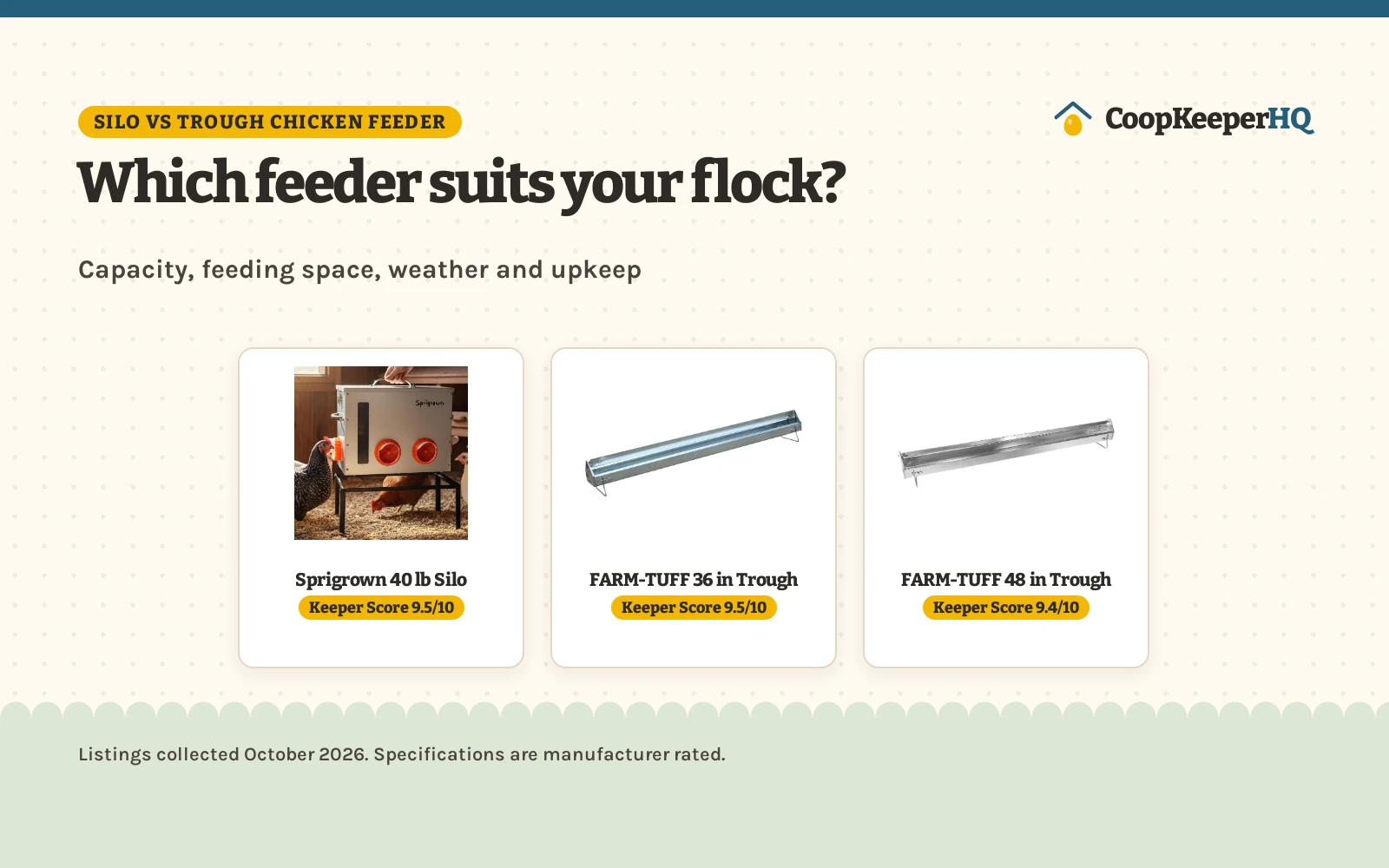
Trough feeders are the open-table option. The RentACoop 50 lb listing states a galvanized steel body at 22 x 14 x 10 inches with a removable rain cover, a magnetic lid, a side view window and an adjustable interior grate that clips up for ducks and waterfowl, and it comes in 10 lb and 25 lb sizes as well. The Little Giant reel-top states a 36-inch length, 40 lb capacity and a free-spinning reel that discourages roosting, rated for up to 75 adult birds. The FARM-TUFF reel tops come in 36-inch (36 x 5 x 4.5 in, 2.2 lb) and 48-inch (48 x 5 x 7 in, 3.4 lb) sizes with a 3/8-inch anti-waste lip. For a large flock, a long trough means less queuing and less bullying at mealtime.
Troughs also scale down: the Cedilis 4-pack lists 2.5-quart hanging troughs at 11.7 x 4.7 x 5.2 inches each, the Tiflev lists a 3.5-quart feeder, and the DallerSoode lists a 1.3-quart 2-pack. One listing gap to note: the Double-Tuf 18-inch trough states up to 3 lbs of feed in the bullets but 1.5 lbs in the spec table, so treat the capacity as somewhere in that range rather than a fixed figure. See our chicken feeder for small flock picks for more small-scale options.
What tube feeders bring to the coop
Tube feeders are the pantry option: feed sits in a covered vertical hopper and gravity-feeds into a small pan at the bottom as the birds eat. No tube listing is in the data for this guide, so everything here is general practice rather than a stated figure: the covered hopper keeps rain, droppings and bedding out of the feed, which is why tube feeders suit damp climates and coops where the feeder lives outside. The small pan means fewer birds eat at once, so a tube feeder suits a handful of hens rather than a crowd, and the hopper size sets how often you refill.
Tube feeders also waste less in one specific way: birds cannot scratch through a whole trough of feed the way they can an open row. The trade is access and cleaning: a narrow pan is harder to scrub than an open trough, and a timid bird at the bottom of the pecking order may wait longer for the pan.
Head-to-head: capacity, waste and weather
On capacity the listings give troughs a clear range: 1.3 quarts up to 50 pounds, with the Little Giant stating 40 pounds for up to 75 birds. Tube feeders have no stated figure here, and in practice their hoppers hold less than the big troughs. On waste, troughs fight spillage with design: curved lips on the Little Giant, a 3/8-inch lip on the FARM-TUFF, wavy edges on the DallerSoode, and an adjustable grate on the RentACoop. Tubes fight waste by limiting access to a small pan. On weather, the RentACoop’s removable rain cover is the only stated weather protection in the listings; tube hoppers cover their feed by design. If your feeder sits in the open, that difference matters. Our outdoor chicken feeder guide covers weather-ready options.
Cleaning and daily chores
Open troughs are easy to scrub and inspect: the RentACoop’s smooth galvanized interior and removable grate, and the Little Giant’s snap-in reel, are the stated examples. Tube feeders hide their insides, so damp feed can cake in the hopper unnoticed, and the narrow pan needs a brush rather than a quick wipe. Whichever you choose, check the feed daily for dampness and droppings, and keep the area under the feeder raked. For low-waste setups see our no-waste chicken feeder picks.
Wash your hands after handling birds, eggs or equipment, supervise children around the flock, and check local rules on flock size and roosters before you buy. For sick birds, call a poultry veterinarian or your state extension office. See CDC backyard poultry guidance. Read our Safety Disclaimer.
FAQ for the flock
Is a trough or tube feeder better for chickens?
For a large flock, a trough: listings state capacities up to 50 pounds and lengths up to 48 inches, so many birds eat at once. For a small flock where you want the feed covered and dry, a tube feeder’s hopper is the better fit.
Do trough feeders waste more feed?
They can, since birds scratch through an open row. The listings fight this with curved lips, 3/8-inch anti-waste lips, wavy edges and adjustable grates. A tube feeder limits waste by serving through a small pan instead.
Can I use a trough feeder outside?
Yes, with weather protection. The RentACoop listing includes a removable rain cover and states weatherproof galvanized construction. Tube feeders cover their feed by design, which is their advantage in the rain.
How many birds can one trough feed?
The Little Giant reel-top listing states its 36-inch, 40 lb trough is best for up to 75 adult birds. The FARM-TUFF 48-inch trough suits large flocks too. Small troughs in the listings suit a handful of birds.
Which is easier to clean?
A trough: open rows like the RentACoop and Little Giant are stated as easy to scrub, with removable grates and snap-in reels. A tube’s narrow hopper and pan need more effort to clean.
Do chickens prefer troughs or tubes?
Chickens eat readily from both. The choice is about your routine: troughs for shared feeding and easy cleaning, tubes for covered feed in a small flock. See our chicken feeder types guide for the full range.
More coop guides
- Best Chicken Feeder for Small Flock (2026): Top Picks Compared
- Best Outdoor Chicken Feeder (2026): 5 Weatherproof Picks
- Best Chicken Feeder No Waste: Picks That Save Feed
- Best Type of Chicken Feeder: 5 Backyard Picks (2026)
- Best Hanging Chicken Feeder (2026): 5 Top Picks Compared
- Best Large Chicken Feeder: 5 High-Capacity Picks (2026)
See the chicken feeder for mash picks and the feeders and waterers guides.