Open Waterer vs Nipple Waterer: Which Suits Your Flock?
Open waterer vs nipple waterer: drinking surfaces against peck valves for chickens and ducks, with capacity, winter and training trade-offs from the listings.

On this page
Top picks at a glance
As an Amazon Associate I earn from qualifying purchases.
- 1
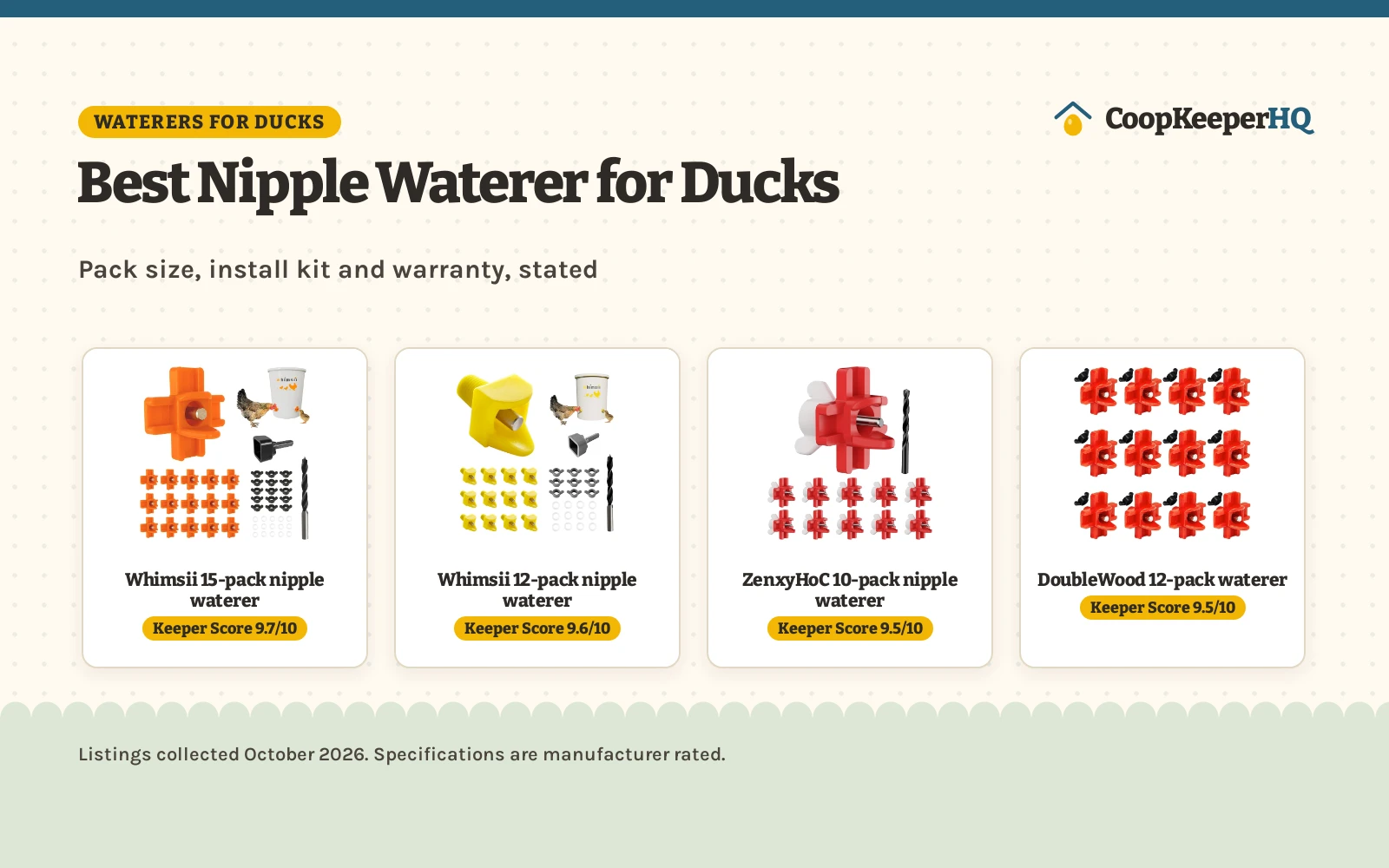
 Whimsii 15-pack nipple waterer9.7/10View on Amazon
- 2
 Farm Innovators C-50P Chicken Waterer De-IcerView on Amazon
- 3
 KISEER 30 Pack Automatic Chicken Waterer Poultry Water NippleView on Amazon
- 4
 Complete Set Pipeline Automatic Chicken Nipple Waterer CupsView on Amazon
- 5
 15 Pack Horizontal Chicken Waterer NipplesView on Amazon
- 6
 ZenxyHoC Baby Chick Waterer with Nipple Drinker 0.26 GalView on Amazon
- 7
 Lil'Clucker Horizontal Chicken Waterer NipplesView on Amazon
Open waterer vs nipple waterer comes down to how the bird gets the water. An open waterer exposes a drinking surface the bird dips into naturally, like the FARM-TUFF 8-gallon fountain with its 2-inch drinking lip or the FarmTek bell drinker that waters up to 20 birds. A nipple waterer releases water only when the bird pecks the nipple, like the ZINZINULER 4-gallon unit that offers both nipple and cup modes. Choose open waterers for ducks, young chicks and natural drinking behavior; choose nipple waterers for cleaner water and less waste, once the flock learns them.
Other options for the coop
 Farm Innovators C-50P Chicken Waterer De-IcerCheck price on Amazon
 KISEER 30 Pack Automatic Chicken Waterer Poultry Water NippleCheck price on Amazon
 Complete Set Pipeline Automatic Chicken Nipple Waterer CupsCheck price on Amazon
 15 Pack Horizontal Chicken Waterer NipplesCheck price on Amazon
 ZenxyHoC Baby Chick Waterer with Nipple Drinker 0.26 GalCheck price on Amazon
 Lil'Clucker Horizontal Chicken Waterer NipplesCheck price on Amazon
CoopKeeperHQ earns a commission if you buy through our links, at no added cost to you. Affiliate disclosure.
What an open waterer is
Open waterers hold water in a trough, cup, bell or fountain the bird drinks from directly. The FARM-TUFF example is the classic: an 8-gallon galvanized double-wall fountain, 24 inches tall by 15 inches wide with a 2-inch drinking lip, weighing 9.3 lb, whose vacuum-sealed design holds a constant level and whose cone top stops birds roosting on it. The FarmTek Bell-Matic is the automatic version: a hanging bell drinker for up to 20 full-grown birds, fed by gravity from an elevated 5-gallon pail through a quarter-inch line, or by a pressurized line at 4 to 5 PSI with 5 PSI stated as optimal, with a 10-foot PVC hose kit included. The Premier 1 Optimus splits the difference at 6 gallons: a top-fill, gravity-fed, free-standing tank, 17.5 by 17.5 by 28 inches, with a brass valve and silicone seals and a two-piece tank for cleaning.
What a nipple waterer is
Nipple waterers keep the reservoir closed and release water through small valves the bird pecks. The ZINZINULER example is a 4-gallon unit, 9.2 by 6.4 by 15 inches at 1.53 kg, with a float valve fed by a 60-inch supply pipe and 3/4-inch and 5/8-inch threaded connections for a garden hose. Unusually, it offers two drinking modes on one unit, nipple type and cup type, so the keeper can match the flock’s preference. The LZWUNYXE example is the smaller stainless version: 1.6 gallons, 15.7 by 5.3 by 17 inches, with a float valve, a dustproof roof, a drainage hole in the bottom bracket and 3/4-inch quick-connect fittings, claiming over 60 percent water saving against leaking waterers, the maker’s figure.
Open waterer vs nipple waterer: cleanliness and waste
This is where nipples win on paper. Open water collects whatever the flock brings: bedding, dust and droppings, which is why the FARM-TUFF uses a cone top to stop roosting and the Bell-Matic hangs its drinking area above the bedding. Nipple and cup systems enclose the supply, so the water the bird drinks is the water you put in. The ZINZINULER listing makes the same point from the other side, describing its automatic distribution as keeping the flock hydrated with fewer refills. Against that, an open fountain like the 8-gallon FARM-TUFF needs no training at all: day-old chicks find water by instinct, while nipples must be learned, which is why the ZINZINULER listing specifies chicks 1 month and older among its suitable birds.
Ducks, chicks and the learning curve
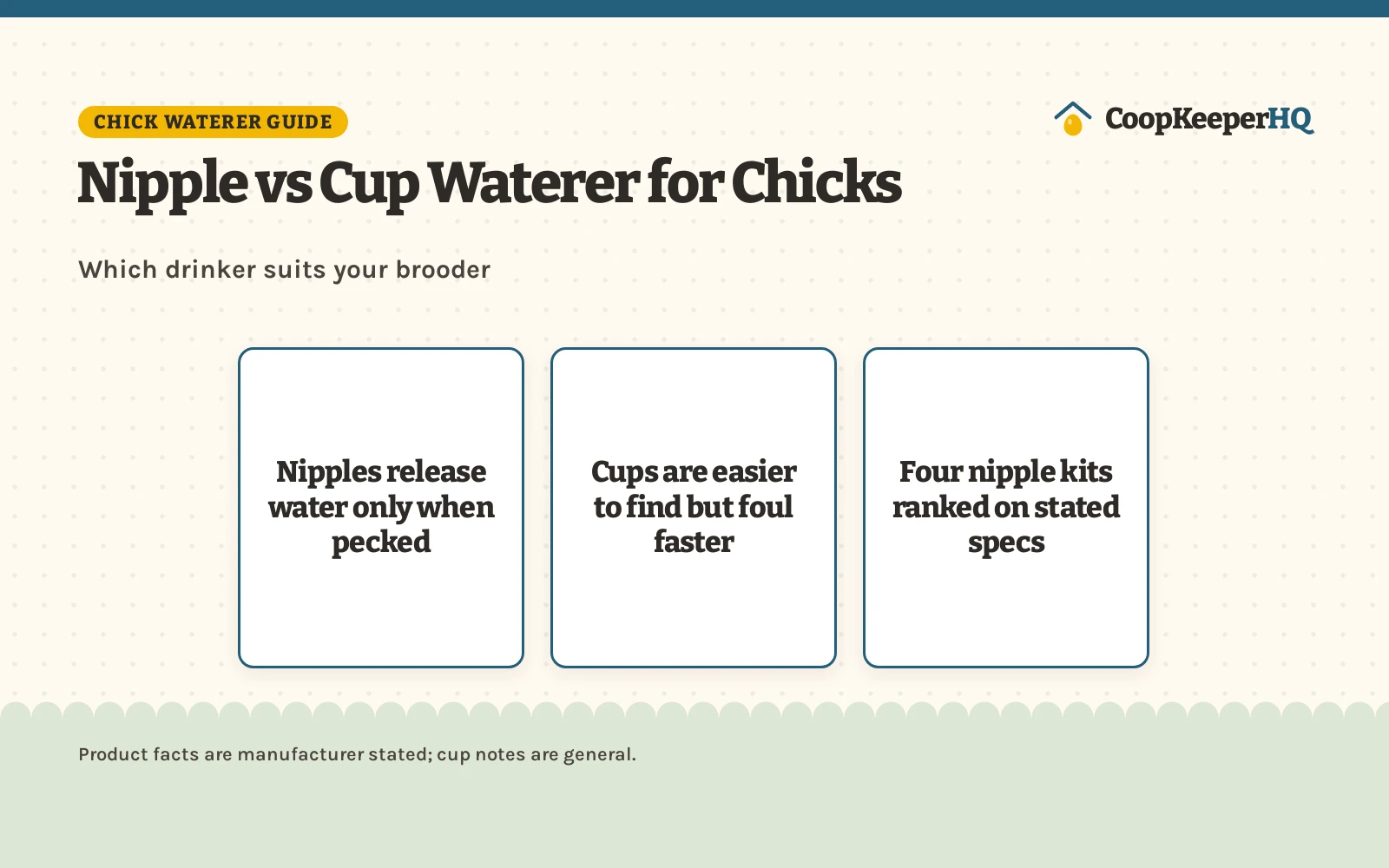
Ducks complicate the choice because they drink by dipping and dabbling, which nipples do not allow. The listings reflect this: the ZINZINULER names chickens, ducks, geese, quail, turkeys, pigeons and chicks, and offers its cup mode for birds that will not take to nipples, while the FARM-TUFF names chickens, ducks and game birds for its open fountain and the Premier 1 names chickens, ducks and geese. If your flock includes ducks, plan on an open or cup option regardless of what the chickens use. For chicks under a month, an open waterer they cannot drown in, or the cup mode, beats nipples they have not learned.
Winter: the great equalizer
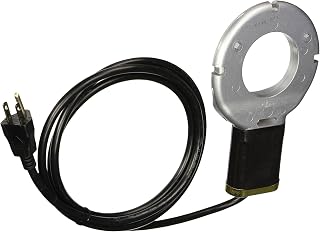
Both systems freeze, and the listings are honest about needing heat. The API deicer is made for exactly this: a thermostatically controlled unit with over-temperature protection, stated safe for plastic water tanks, with a 6-foot anti-rub cord and UL and CSA listings. Note the listing contradicts itself on power: the title says 500 watts while the spec table says 1000 watts, so confirm before sizing a circuit. An open 8-gallon fountain without heat becomes an 8-gallon ice block, and nipple valves freeze shut too. Whichever side you choose, winter means either a deicer, a heated base, or hauling fresh water through the day.
Capacity, refills and the float valve middle ground
Capacity decides your refill rhythm: 8 gallons in the FARM-TUFF, 6 in the Premier 1, 4 in the ZINZINULER, 1.6 in the LZWUNYXE. The float-valve units blur the open-versus-nipple line because they auto-refill: the ZINZINULER shuts its float valve when the 4-gallon tank is full, and the LZWUNYXE controls supply by water level, both removing the daily fill-up where a hose reaches the coop. The Bell-Matic does the same for open drinking with its leak-proof float valve and a valve that shuts off automatically when the drinker is disconnected for cleaning. If a hose reaches your coop, a float-valve unit of either type is the lowest-maintenance answer; if it does not, capacity is everything.
FAQ for the flock
Which is better for ducks?
Open or cup waterers. Ducks drink by dipping, which nipples do not allow, and the listings that name ducks, the FARM-TUFF fountain, the Premier 1 and the ZINZINULER, all offer an open or cup drinking surface.
Do chickens learn nipple waterers?
They can, with time, which is why the ZINZINULER listing specifies chicks 1 month and older. Its dual nipple-and-cup modes let a flock transition, and open waterers need no training at all.
How do I keep either type from freezing?
Add heat. The API deicer listing describes a thermostatically controlled unit with over-temperature protection, UL and CSA listed, safe for plastic tanks, though its title and spec table disagree on wattage, 500 versus 1000. Without heat, both open and nipple systems freeze.
What size waterer does my flock need?
The listings span 1.6 gallons for a small group to 8 gallons for a large flock, with the Bell-Matic rated for up to 20 birds. Bigger capacity means fewer refills; a float-valve unit on a hose removes refills entirely.
Are nipple waterers really cleaner?
The enclosed supply stays cleaner than an open surface that collects bedding and droppings, which is the nipple’s main advantage. Open designs fight back with cone tops, hanging bells and elevated tanks, as the FARM-TUFF, Bell-Matic and Premier 1 listings show.
More coop guides
Related: our best automatic chicken waterer and heated vs unheated chicken waterer guides.