Quail Cage vs Quail Hutch: Which One Should You Buy?
Wire breeding cages stack quail indoors with roll-out egg trays, while wooden hutches give backyard flocks ground-level room; here is how to choose.

On this page
Top picks at a glance
As an Amazon Associate I earn from qualifying purchases.
- 1
 Hatching Time Quail Breeding Cage Indoor9.6/10View on Amazon
- 2
 Phonjoroo A-Frame Quail Hutch: quail-named9.4/10View on Amazon
- 3
 Hatching Time Quail Breeding Cage IndoorView on Amazon
- 4
 1 Additional Layer for Quail Breeding CageView on Amazon
- 5
 2-in-1 Quail Feeder and Waterer for CageView on Amazon
- 6
 Hatching Time Quail Cage Grow Out PenView on Amazon
- 7
 2 Additional Layers for Quail Breeding CageView on Amazon
- 8
 My Favorite Chicken 27oz Chicken Cage CupView on Amazon
The morning egg round tells you which housing fits your quail. A plastic breeding cage stacks birds in a small indoor footprint with roll-out egg trays you can reach without opening the cage, while a hutch gives a larger ground-level home that usually lives outdoors. So quail cage vs quail hutch comes down to space, flock size and where you keep them: cages suit indoor or sheltered breeding setups, hutches suit backyard flocks that need room to move.
Other options for the coop
 Hatching Time Quail Breeding Cage IndoorCheck price on Amazon
 1 Additional Layer for Quail Breeding CageCheck price on Amazon
 2-in-1 Quail Feeder and Waterer for CageCheck price on Amazon
 Hatching Time Quail Cage Grow Out PenCheck price on Amazon
 2 Additional Layers for Quail Breeding CageCheck price on Amazon
 My Favorite Chicken 27oz Chicken Cage CupCheck price on Amazon
CoopKeeperHQ earns a commission if you buy through our links, at no added cost to you. Affiliate disclosure.
Quail cage vs quail hutch: the short answer
A quail cage is a plastic indoor unit, often stackable, built for breeding and laying with features like dividers, roll-out egg collection and waste trays. A quail hutch is the traditional wooden house, solid walls and a roof, usually set outdoors or in a run, giving birds more floor space per bird and a ground-level feel. Pick the cage when you breed or collect eggs daily in a sheltered space; pick the hutch when you keep a backyard flock outdoors.
What a quail cage gives you
The listings describe stacked indoor breeding cages. Hatching Time lists a 2-layer cage housing up to 30 standard quail across 3 sections per layer, with 5 smaller quail per section or 3 per section for larger birds. The assembled size is 38.6 x 24 x 35.8 in at 40 lb, with removable middle walls so sections open into larger spaces, sloped flooring that rolls eggs to a front collection area, and waste trays that extend 3 inches farther beneath the cage for easier cleanup. A 1-layer jumbo-flooring version houses up to 15 standard-size birds at 38.6 x 24 x 23 in and 28 lb, and a smaller 2-section cage houses up to 10 standard quail at 23.8 x 24 x 18.1 in and 13 lb.
The shared theme is chore efficiency: gravity-fed watering, front feeding troughs, polypropylene parts that will not rust and can be power-washed, and a 1 year manufacturer warranty on each listing. The 2-section model includes a 1-gallon water tank and 2 drinker cups. All 3 listings say the same thing about placement: use indoors or inside an enclosed shelter, because the cage is not predator-proof.
What a quail hutch gives you
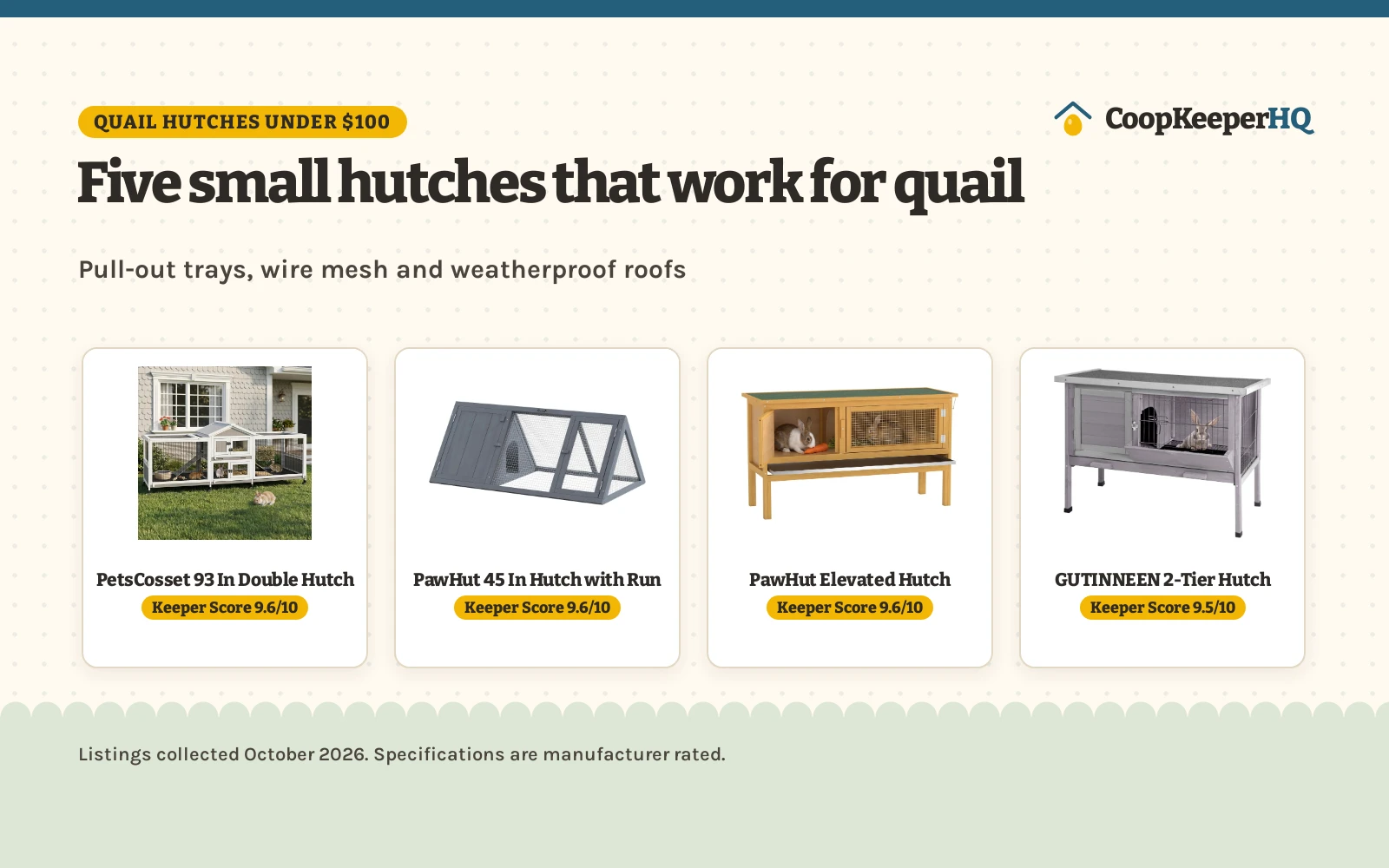
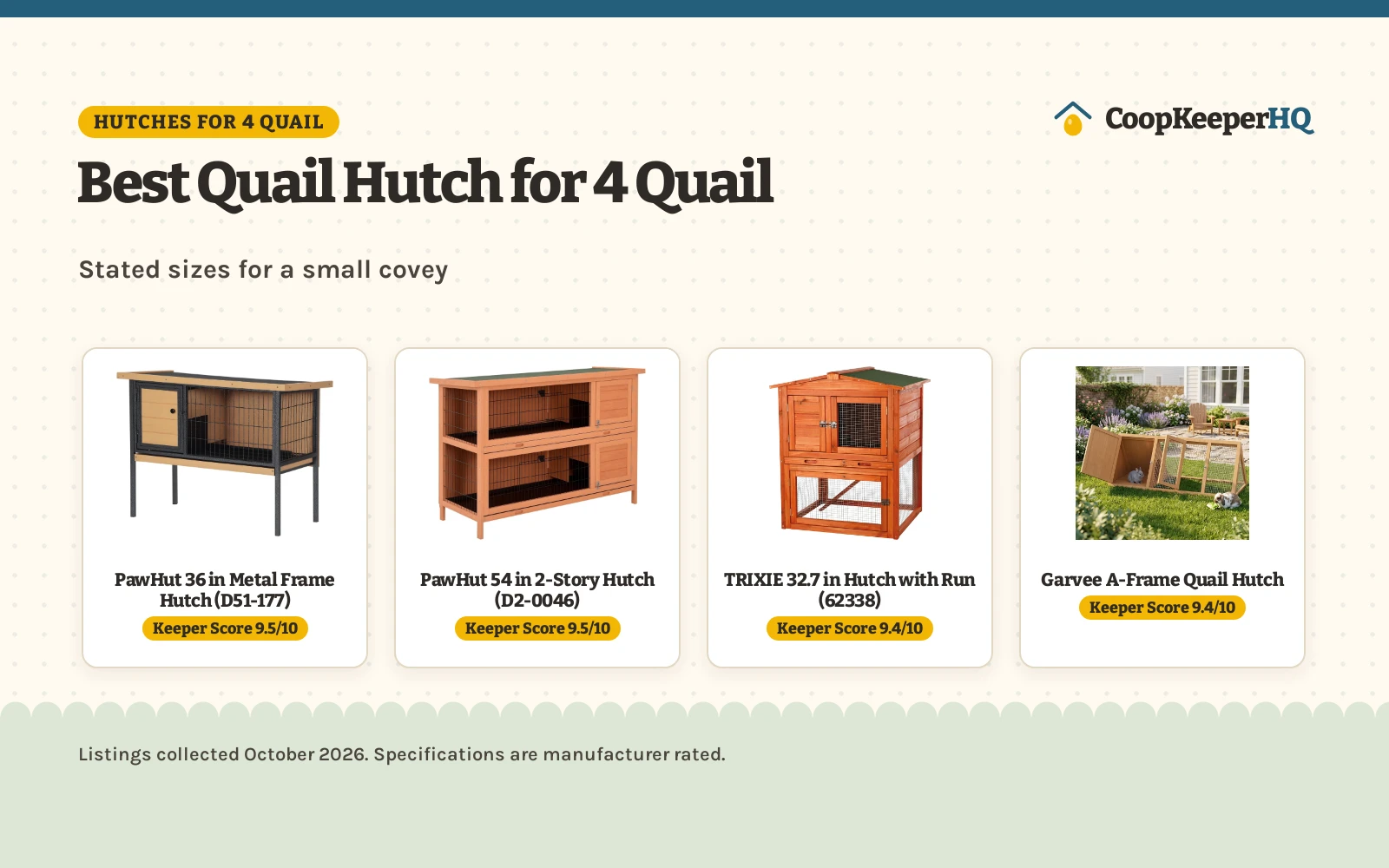
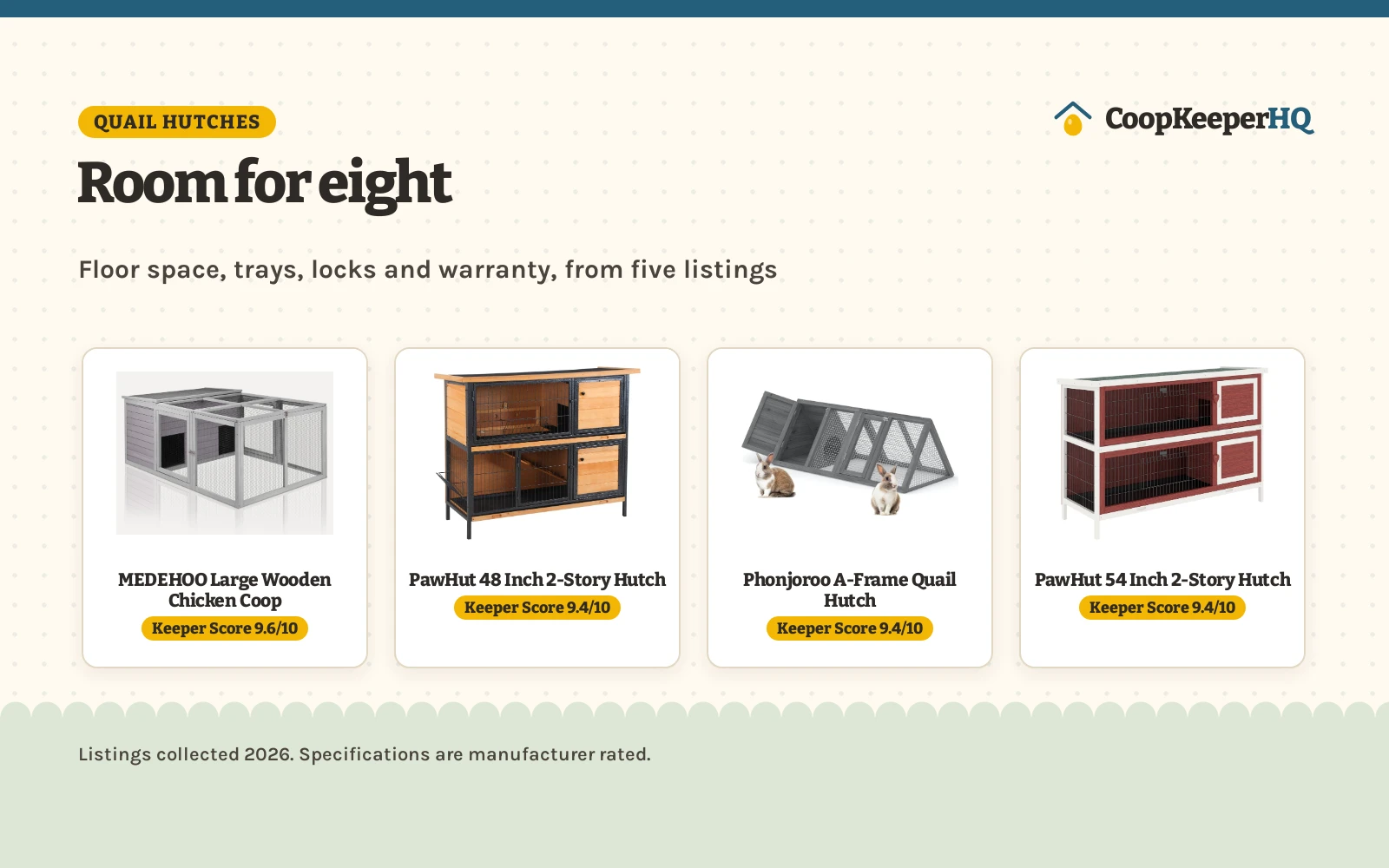
A hutch is the wooden alternative: solid walls, a roof and usually a wire-fronted section, set at ground level outdoors. Birds get bedding to scratch in rather than wire or plastic flooring, and the larger footprint suits a mixed backyard flock. The tradeoff is chores: no roll-out egg tray, so you collect by hand, and cleaning means reaching into the hutch rather than pulling a tray. Hutches also need weatherproofing and predator-proofing done right, since they sit where raccoons and rats patrol. Our plastic vs wood coop comparison covers the material tradeoffs in more detail.
Sizing and capacity compared
| Housing | Stated capacity | Stated size | Placement |
|---|---|---|---|
| 2-layer breeding cage | Up to 30 standard quail | 38.6 x 24 x 35.8 in | Indoors or enclosed shelter |
| 1-layer jumbo cage | Up to 15 standard-size birds | 38.6 x 24 x 23 in | Indoors or enclosed shelter |
| 2-section breeding cage | Up to 10 standard quail | 23.8 x 24 x 18.1 in | Indoors or enclosed shelter |
| Wooden hutch | Varies by build | Not stated in these listings | Outdoors or in a run |
The cage figures come from the Hatching Time listings; hutch sizes vary too much between builds for a single figure, so size any hutch to your flock and give birds room to move. If you are sizing housing to a flock, the run size calculator is a useful starting point.
Cleaning and daily chores
Cages win on cleanup. Sloped floors move eggs to a collection area, and removable waste trays slide out for dumping without reaching into the cage. The polypropylene parts rinse down with a power washer. Hutches need bedding changes and hand collection, which takes longer but suits keepers who enjoy the routine. Either way, match the feeder and waterer to the setup: our best quail feeder and nipple vs cup waterer for quail guides cover the options, and quail keeping supplies rounds out the kit.
Predators and placement
This is the deciding factor for many keepers. The cage listings state plainly that the cages are not predator-proof, so they belong indoors or inside an enclosed shelter. A hutch outdoors must do the predator work itself: solid latches, wire the right size, and no gaps. If you have a secure shed or garage corner, cages make excellent use of it; if your birds live in the yard, a well-built hutch with a run is the honest choice.
Which should you buy
Buy the cage if you breed, collect eggs daily and have an indoor or sheltered spot. The 2-layer Hatching Time cage suits a flock of up to 30 standard quail in a 38.6 x 24 in footprint, the 1-layer jumbo version suits larger birds, and the 2-section cage suits a starter flock of up to 10. Buy the hutch if your quail live outdoors in the yard and you want ground-level housing with bedding. Many keepers end up with both: cages for breeding groups and layers, a hutch for grow-outs or a retirement flock.
Birds, breed size, run time and climate in; coop floor, run space, roost length and nesting boxes out.
Chicken wire keeps chickens in but does not keep raccoons, dogs or foxes out. Use 1/2 inch hardware cloth on openings, bury or apron it at the base, close the coop at dusk and use two-step latches that raccoons cannot open. Read our Safety Disclaimer.
FAQ for the flock
Can quail live in a wire cage full time?
Yes, in a breeding cage designed for them and kept indoors or in an enclosed shelter. The listings describe sloped flooring, roll-out egg collection and waste trays for exactly this setup. What they do not offer is predator protection, so the shelter around the cage does that job.
How many quail fit in a breeding cage?
Follow the listing. Hatching Time rates its cages at up to 30 standard quail for the 2-layer model, up to 15 for the 1-layer jumbo model and up to 10 for the 2-section model, with fewer birds per section for larger jumbo birds. Overcrowding makes every chore harder, so stay within the stated numbers.
Are quail hutches predator-proof?
Only if built that way. A hutch outdoors needs solid latches, predator-rated wire and no gaps at the base. The cage listings state their cages are not predator-proof, which is why cages stay indoors or in a shelter.
Which is better for egg layers, a cage or a hutch?
For daily collection, the cage has the edge: sloped floors roll eggs to a front collection area. In a hutch you collect by hand. Either works for the birds; the cage saves the keeper time. Quail eggs also need the right carton, see our quail egg cartons guide.
Do quail need a run with a hutch?
They do not require a run, but extra space is always welcome. A hutch with an attached run gives ground-level birds room to scratch and dust bathe. Cages trade that space for a compact indoor footprint, which is the point of the stacked design.
More coop guides
- Nipple vs Cup Waterer for Quail: Which One Should You Buy?
- Best Quail Feeder: Low-Waste Picks for Cages
- Quail Keeping Supplies: A Beginner Checklist (2026)
- Best Egg Cartons for Quail Eggs (2026): 5 Protective Packs
See the quail keeping supplies and our plastic vs wood coop comparison for the material side of the decision.