Solar vs Battery Chicken Coop Door: Which One Should You Buy?
Comparing solar and battery chicken coop doors on winter reliability, shady coop placement, battery upkeep and backup power for backyard flocks.

On this page
Top picks at a glance
As an Amazon Associate I earn from qualifying purchases.
- 1
 Large Automatic Chicken Coop Door Solar Powered 4000mAh High9.7/10View on Amazon
- 2
 Large Automatic Chicken Coop Door Solar Powered with Timer &View on Amazon
- 3
 Chicken Coop DoorView on Amazon
- 4
 Asfrost Automatic Chicken Coop Door Solar Powered AutomaticView on Amazon
- 5
 AsFrost Automatic Chicken Coop DoorView on Amazon
- 6
 Automatic Chicken Coop DoorView on Amazon
- 7
 Automatic Chicken Coop Door: 3500mAh Solar PoweredView on Amazon
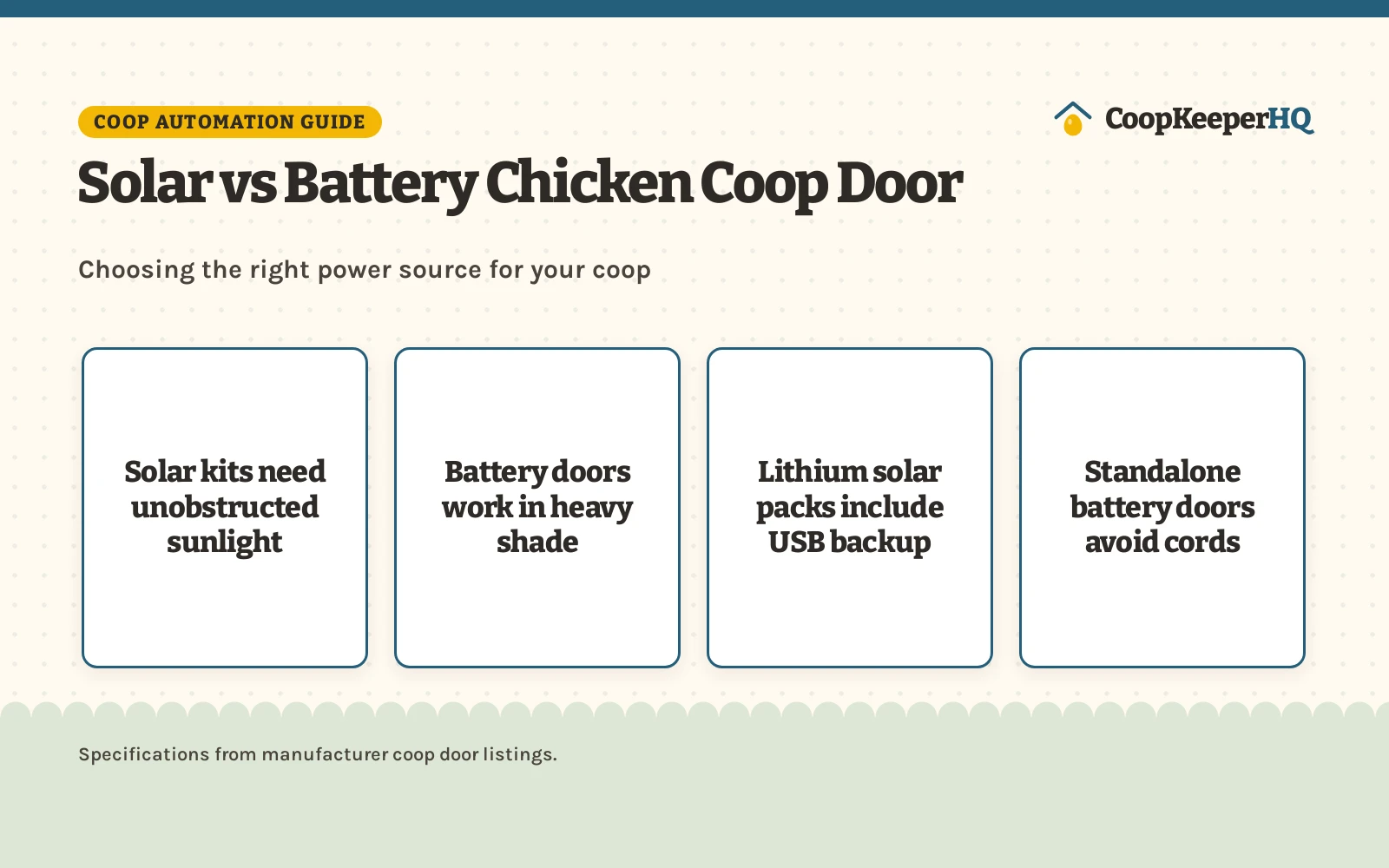
Choosing between a solar vs battery chicken coop door comes down to coop location and maintenance preference. A solar chicken coop door is the better choice for coops positioned in open sunlight where an external panel can charge an internal rechargeable battery without manual battery replacements. A battery chicken coop door powered by standalone batteries is the better pick for shaded coops, heavily wooded runs, or coops where mounting an exterior solar panel is impractical.
Other options for the coop
 Large Automatic Chicken Coop Door Solar Powered with Timer &Check price on Amazon
 Chicken Coop DoorCheck price on Amazon
 Asfrost Automatic Chicken Coop Door Solar Powered AutomaticCheck price on Amazon
 AsFrost Automatic Chicken Coop DoorCheck price on Amazon
 Automatic Chicken Coop DoorCheck price on Amazon
 Automatic Chicken Coop Door: 3500mAh Solar PoweredCheck price on Amazon
CoopKeeperHQ earns a commission if you buy through our links, at no added cost to you. Affiliate disclosure.
Solar vs battery chicken coop door: how the power sources compare
Automatic coop doors rely on different electrical configurations to open at dawn and close at dusk. A solar setup connects an external photovoltaic panel to an internal rechargeable lithium battery pack, replenishing power from daylight each day. A standalone battery unit houses its batteries directly inside the door casing, operating without external collectors or power cables. Each system eliminates the need to run household wiring out to the coop, but they handle daily operation and energy storage differently.
Standalone battery doors keep all hardware contained in a single unit. For example, the RUN-CHICKEN listing states its door operates on 2 AA batteries and mounts with six screws, delivering power for up to 1 year in cold weather and 2 years in warm climates without external cables. In contrast, solar-powered doors rely on daily sunlight to recharge internal lithium packs. Listings for NyPots and Pet Deluxe specify a 4000mAh internal battery, Tephrotrak lists a 3500mAh battery, and AsFrost, OKKÖBI, and IBKINXX cite a 2000mAh battery. If you want a complete survey of motorized designs, our automatic chicken coop door guide covers the primary mechanisms across all seasons.
Sunlight requirements and panel placement
Solar units depend on consistent exposure to daylight. The photovoltaic collector must face toward open sky where direct sun reaches the surface for multiple hours each day. If your coop sits beneath a dense tree canopy, behind a tall privacy fence, or inside a covered barn where routing a cable outside is difficult, a solar collector cannot harvest enough energy to maintain a steady charge. In heavily shaded locations, a standalone battery unit remains reliable because tree cover does not impact the power stored inside its batteries.
Panel wattage affects how quickly the internal battery recovers after overcast periods. Listings for AsFrost and Pet Deluxe specify a 7W solar panel, which gathers energy faster than lower-wattage collectors during cloudy conditions. When installing a solar model, position the collector away from the roof drip edge to prevent splashing mud and falling debris from coating the photovoltaic cells. For flocks housed in sunny pasture runs, our solar powered chicken coop door reviews compare models built for direct exposure.
Cold weather performance and battery drain
Freezing temperatures reduce chemical activity inside batteries, which can cause voltage to drop under load. Both solar lithium packs and standalone batteries face increased demand when sub-freezing weather arrives. Along with temperature effects on battery output, frost, snow, or ice buildup along the door frame can add mechanical resistance, increasing motor power draw when the unit is already cold.
Check the manufacturer operating temperature range before selecting a door for severe winters. The RUN-CHICKEN listing states its door operates from -15°F to 140°F on 2 AA batteries, with stated performance up to 1 year in cold weather. Among solar units, Tephrotrak lists an operating range from -15°F to 140°F, OKKÖBI states -14°F to 140°F, IBKINXX specifies -10F to 140F, and listings for AsFrost and Pet Deluxe state operation from -26°C to 60°C. Clearing snow from solar panels and ice from guide tracks ensures smooth travel throughout winter.
Installation, wiring, and cord routing
Physical installation differs between power systems. A standalone battery door mounts directly over the coop opening without separate components. Because all wiring stays enclosed within the housing, installation is straightforward and leaves no exposed cords for curious birds to peck. For wooden coops, the RUN-CHICKEN listing states mounting requires six screws, creating a compact setup without external brackets.
Solar designs require mounting both the door frame and an external collector, joined by a power cord. Chickens peck at dangling wires, so cords must be secured tightly against siding using staples or protective conduit. Connector placement also matters. The NyPots listing highlights a side charging port design specifically arranged to prevent birds from bumping the plug and cable as they move through the entrance. Before cutting coop siding for any installation, consult our chicken coop door opening size guide to verify height and clearance.
Backup power, USB charging, and manual control
Modern solar coop models include alternative charging ports to handle prolonged stormy weather. A solar chicken coop door with battery backup combines its photovoltaic panel with an internal reserve that can be recharged from a household outlet or portable power bank. Listings for AsFrost, OKKÖBI, Pet Deluxe, and IBKINXX all include a USB-C charging cable, allowing keepers to recharge the internal pack manually if heavy overcast or deep snow cover the solar surface.
Emergency controls provide extra peace of mind when weather or mechanical jams interrupt automatic cycles. The Pet Deluxe listing highlights an emergency button that allows keepers to open the door manually during power disruptions. Warranty coverage also reflects long-term component support across brands. The OKKÖBI listing provides a 5-year warranty, NyPots states a 2 Years warranty, AsFrost, IBKINXX, and RUN-CHICKEN state a 1 year warranty, and Pet Deluxe lists a 90-day warranty.
Timer controls, light sensors, and remote access
Solar and battery doors offer automated opening and closing routines. A light sensor operates based on ambient daylight, opening at sunrise and closing at dusk. In regions with dense tree canopy or sudden storms, light sensors can occasionally trigger earlier than expected. A programmable timer operates on fixed clock schedules, ensuring the door stays open until your flock finishes roosting regardless of passing cloud cover.
Control methods vary across models. Some keepers prefer a solar chicken coop door with app control for programming schedules directly from a smartphone. For example, the RUN-CHICKEN listing states its door supports smart app and timer control to adjust daylight settings and schedules. Other designs rely on dedicated hardware remotes and onboard displays. The Tephrotrak listing includes a 656ft remote control and color LCD screen, the IBKINXX listing provides a 66ft remote range, and the NyPots listing includes a remote with a range of 20 meters. For wireless app options, read our solar chicken coop door with app overview.
Predator resistance and safety sensors
Nighttime predator protection is the primary reason to automate coop security. Raccoons, foxes, and neighborhood dogs inspect coop openings after dark, searching for loose edges or weak latches. Rigid aluminum construction provides a sturdy physical barrier to keep predators out. Listings for RUN-CHICKEN, NyPots, OKKÖBI, AsFrost, Pet Deluxe, Tephrotrak, and IBKINXX all feature aluminum or aluminum alloy door panels designed to block nighttime intruders.
Closing doors must also protect lingering chickens from injury. Anti-pinch sensors reverse door travel if an obstruction touches the lower edge as the panel descends. Entrance dimensions must accommodate your specific flock size without crowding. The NyPots listing provides an entrance measuring 9.5″ x 10.9″ and notes it is not suitable for turkeys, while the Pet Deluxe listing states an opening of 11.4 high * 9 width inches with IP45 weather protection. Listings for OKKÖBI, AsFrost, and IBKINXX state compatibility with poultry under 10 lbs, with IBKINXX specifying an entrance clearance of 9.6 inches in height and 8.2 inches in width. Our predator proof chicken coop door guide analyzes locking styles in detail.
Daily routines and seasonal upkeep
Automation handles regular opening and closing, but routine checks keep your flock secure. Take a quick evening look into the run to confirm every hen made it inside before the door closed. Dust, chicken dander, and dried mud accumulate on solar collectors over time, reducing solar conversion efficiency. Wipe the glass surface with a damp cloth every few weeks to keep power generation steady.
For standalone battery doors, check battery condition ahead of winter so the door continues operating smoothly through freezing weather. Keep the slide tracks clear of dried manure, bedding shavings, and frozen slush so the motor does not bind during travel. To see how automated entry fits into overall housing layout, explore our chicken coop with auto door setup guide.
A simple power choice checklist
- Coop receives direct, unobstructed sunlight for multiple hours daily: choose solar
- Coop sits under dense shade trees, covered roofs, or inside barns where running a cord outside is impractical: choose battery
- Desire an all-in-one unit with zero external wiring or separate panel mounting: choose battery
- Prefer a rechargeable system with USB-C backup charging for overcast periods: choose solar
- Expect prolonged winter cloud cover or heavy snow: choose a standalone battery door or a solar model with USB backup charging
- Seek verified cold-weather ratings down to -15°F: both solar models and battery units offer compatible options
For overall housing hardware and entry planning, visit our complete coop doors and automation hub.
Birds, breed size, run time and climate in; coop floor, run space, roost length and nesting boxes out.
Wash your hands after handling birds, eggs or equipment, supervise children around the flock, and check local rules on flock size and roosters before you buy. For sick birds, call a poultry veterinarian or your state extension office. See CDC backyard poultry guidance. Read our Safety Disclaimer.
FAQ for the flock
Can a solar chicken coop door work on cloudy days?
Yes. Solar coop doors store energy in internal rechargeable batteries that keep the door operational during overcast weather. Models with larger battery capacity, such as 3500mAh or 4000mAh packs, hold reserve power to run through dark days, and many kits include USB cables for manual top-offs if needed.
How often do batteries need replacement in a standalone coop door?
Replacement frequency depends on local temperatures and daily usage. The RUN-CHICKEN listing states its door runs on 2 AA batteries for up to 1 year in cold weather and 2 years in warm climates. Checking battery levels before winter ensures continuous operation.
Do solar chicken coop doors work in freezing winter conditions?
Solar coop doors operate in freezing weather when rated for low temperatures. Manufacturer listings cite operating limits down to -10F, -14°F, -15°F, and -26°C. Keepers should clear snow from the solar panel and remove ice from the door tracks to prevent mechanical resistance.
What happens to an automatic coop door if power fails?
If a door loses power, automatic cycling stops. Models like the Pet Deluxe feature an emergency override button for manual operation during power failures, while units with USB-C ports can be recharged from a portable power bank. For standalone battery doors, inserting fresh batteries restores operation immediately.
Can a solar panel be mounted inside a covered chicken run?
A solar panel cannot generate sufficient electricity under a solid roof or inside a covered shed. The panel must be mounted on the exterior roof or an outside wall facing open sky to capture direct daylight.
More coop guides
- RUN-CHICKEN T50 Review: Specs, Pros, Cons and Who It Suits
- Best Solar Powered Chicken Coop Door (2026)
- Best Automatic Chicken Coop Door: Picks for Every Season
- Solar Chicken Coop Door with App: 5 Top Picks (2026)
See the coop doors and automation guide and the predator protection picks.