Chicken Coop Door Opening Size: Dimensions, Height and Placement Guide
Standard door dimensions, framing cutouts, sill clearance and predator safety tips for planning a comfortable backyard flock entrance.

On this page
Top picks at a glance
As an Amazon Associate I earn from qualifying purchases.
- 1
 AsFrost Large Solar Automatic Chicken Coop Door with 4000mAh9.8/10View on Amazon
- 2
 Large Size Automatic Chicken Coop Door Solar Powered9.7/10View on Amazon
- 3
 Automatic Chicken Coop Door Solar Powered with Timer & Light9.7/10View on Amazon
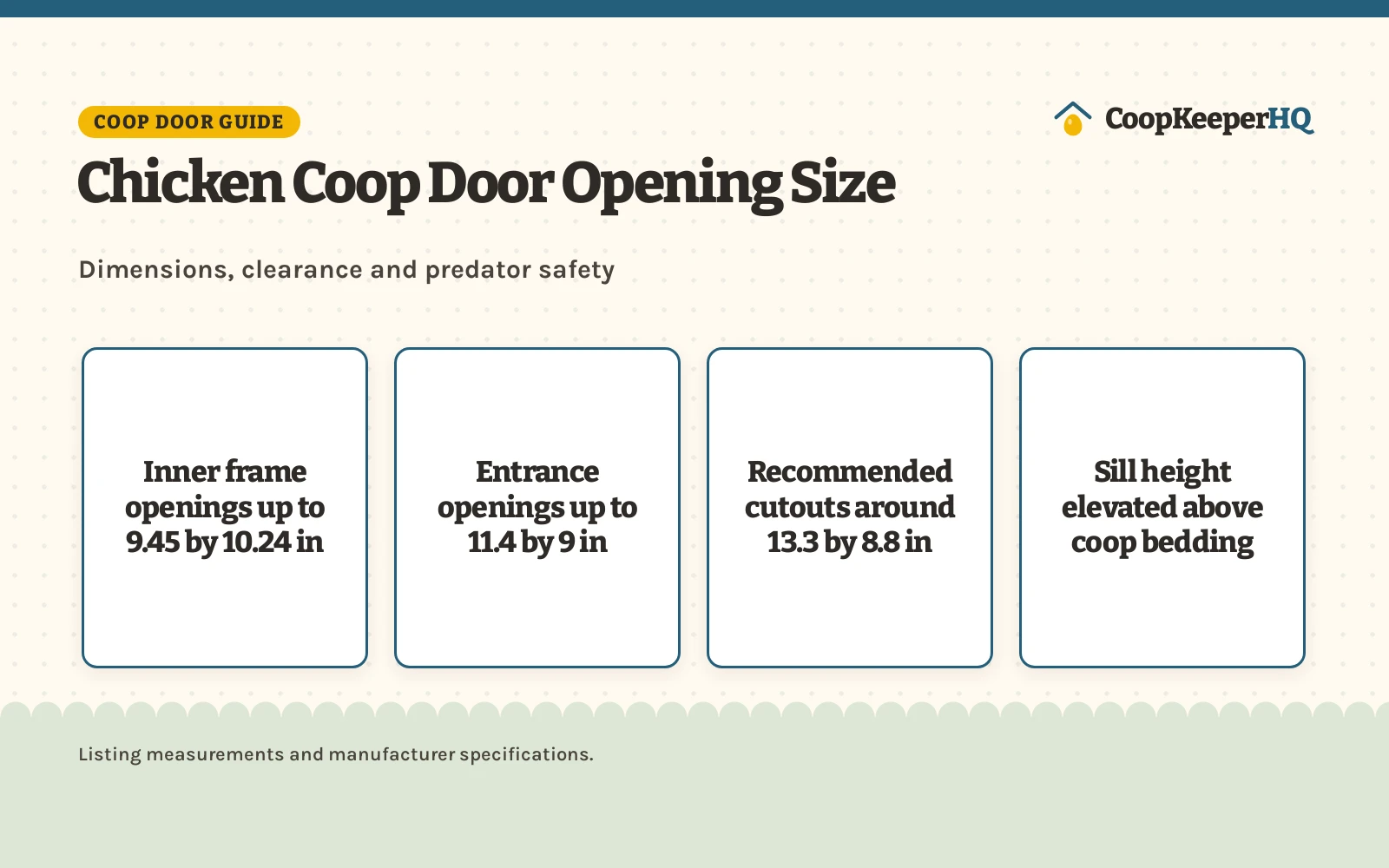
For backyard flocks, chicken coop door opening size depends on bird breed and framing style, with published commercial doors offering openings such as 9.45 by 10.24 inches or 11.4 by 9 inches. Published listings illustrate this variety: Ckin pet provides a 9.45 by 10.24 inch inner frame opening (contrasting it with standard 8-inch models), Pet Deluxe lists an entrance opening of 11.4 inches high by 9 inches wide, and Aiwaylar recommends a cut entrance size of 13.3 by 8.8 inches for poultry up to 10 pounds. Sizing the doorway to your largest bird provides clean clearance while keeping the opening compact enough to help deter predators.
CoopKeeperHQ earns a commission if you buy through our links, at no added cost to you. Affiliate disclosure.
Chicken coop door opening size: standard dimensions and clearance
The chicken coop door opening size you choose sets daily traffic flow between coop and run. If the doorway is too small, birds damage feathers against the jambs or hesitate at the threshold. If it is too large, it lets in cold drafts and creates an oversized target for predators. Most flock keepers choose an opening that lets their largest bird pass without ducking while keeping the wall cutout compact.
Commercial specifications illustrate this balance. In its listing, Ckin pet notes standard 8-inch models when presenting its larger 9.45 by 10.24 inch inner passage. For taller clearance, Pet Deluxe publishes an entrance opening of 11.4 inches high by 9 inches wide, with a 9-inch gap size. These dimensions accommodate standard dual-purpose hens easily and give heavier birds comfortable clearance.
Account for breed sizes and bird weight
Flock composition determines how much door space you need. Smaller bantams pass through compact openings easily, but standard dual-purpose hens and heavy heritage breeds require wider clearance and greater height. If you keep a mixed flock, always size the doorway for your largest bird.
Manufacturer weight ratings provide helpful guidelines. CHICKAURA rates its automatic coop door setup for poultry up to about 10 pounds (about 4.5 kg). Similarly, Aiwaylar recommends its cut entrance size for poultry under 10 pounds, including ducks and geese. Choosing an opening rated for birds in this weight range ensures standard breeds move through without rubbing backs or wings.
Door framing cutouts compared to inner passage dimensions
When framing a coop wall, keep in mind that the rough wall cutout is rarely identical to usable passage space. Automatic door assemblies feature outer flanges, tracks, or motor housings that require extra wall room. Confusing overall exterior dimensions with the actual doorway opening is a common framing mistake.
Manufacturer listings highlight this difference. Aiwaylar recommends a cut entrance size of 13.3 by 8.8 inches in its listing text for poultry under 10 pounds, even though its spec table lists overall dimensions of 9.4 by 6.2 by 13 inches, showing how listing details can conflict and why verifying physical parts before cutting is necessary. The RUN-CHICKEN T50 (on Amazon) lists exterior dimensions of 13.8 by 9.4 by 1.3 inches. For Budsom, the listing notes mounting dimensions of 10.98 by 14.33 inches alongside product dimensions of 10.8 by 1.97 by 14.17 inches. Meanwhile, Chickcozy lists unit dimensions of 12 by 2.4 by 15.5 inches, and Tephrotrak lists 10 by 1.7 by 14 inches. Always confirm required cutout measurements before cutting into coop framing.
Elevate the door sill above coop bedding
A chicken coop pop door should not sit flush with the coop floor. Bedding like wood shavings and chopped straw shifts continuously as chickens scratch. If the door threshold sits directly flush with the floor, litter packs against the doorway, wedging beneath vertical sliding panels and preventing a full closure.
Raising the rough door sill above the coop floor keeps bedding inside where it belongs. This raised threshold acts as a natural litter dam, preventing shavings from spilling out into the run each morning when birds leave. It also keeps exterior rainwater, snow, and runoff from washing into the coop bedding. If standard laying hens or heavier birds find a raised step steep, an interior stepping block or a shallow wood ramp gives them easy footing without disturbing the bedding barrier.
Ramp slope and approach space
The approach outside the door matters just as much as the cutout itself. When a coop is raised on posts, chickens depend on an exterior ramp to reach the doorway. If the ramp is steep or slick, hens will hesitate, causing congestion at dusk.
Maintain a gentle ramp slope and attach wooden cleats along the surface for secure footing in wet weather. Ensure the landing outside the door provides enough level footing for a bird to pause before entering. For broader coop layout and run planning advice, browse our coop space guide to organize movement throughout the pen.
Should you choose a hinged, sliding or roll-up door?
Coop doors generally follow distinct mechanical styles: vertical sliders, space-saving roll-up panels, side-opening split doors, and hinged pivot doors. Each style affects how you frame the opening and how much wall clearance you need.
Vertical sliding doors move upward along twin tracks and require vertical wall clearance above the opening equal to the door slab. Roll-up doors, such as models from MASTERFUN, SARELLIT, Ckin pet, and Aiwaylar, roll into an overhead housing to save interior wall room. Ckin pet notes that its roll-up track avoids the jamming issues caused by bedding and mud that can plague traditional vertical channels. Horizontal side-opening designs, such as Chickcozy, use independent dual motors and a track-free bottom design to help prevent mud and snow buildup. Side-hinged pivot designs, such as Pet Deluxe, swing outward between 90°-180° without requiring overhead vertical tracks, though they need an unobstructed exterior swing path.
Protect against predators and forced entry
The coop doorway is the most vulnerable entry point on the coop. Raccoons, foxes, and rodents inspect door edges at night, attempting to lift, pry, or chew through the panel. A secure door must withstand persistent prying.
Solid metal construction provides effective protection. Tephrotrak features an aluminum alloy frame and panel designed to resist prying by raccoons. Chickcozy uses a dual-motor locking structure with two independent motors holding panels securely shut against forced entry. Reinforce the surrounding area with welded wire mesh from our hardware cloth guide, and review defensive coop design in our safest chicken coop for backyard overview. For manual doors, choose a secure latch from our door latch guide.
Anti-pinch sensors and automatic closing safety
Automating your coop door saves time, but closing panels create a pinch risk if a bird lingers in the doorway. Reliable automatic doors include anti-pinch mechanisms that reverse when meeting resistance.
Manufacturer listings outline various safety routines. Budsom specifies an anti-pinch feature where the door reverses upon detecting resistance and stays open for 10 seconds. Ckin pet also programs a 10-second retraction. Aiwaylar uses a routine that bounces back during the first 3 attempts, pauses for 10 seconds, and halts on the 4th attempt with an alert. SARELLIT reverses within 5 seconds. Chickcozy uses dual anti-pinch bumpers and sensors for multiple gentle re-closing attempts, rated through 28,000+ cycles. For automated model comparisons, see our automatic chicken coop door guide and our solar powered chicken coop door reviews.
Daily routine and opening checks
Even with an automated door, daily checks ensure flock safety. Observe your chickens at dusk to confirm every bird is inside before the door shuts. A bird locked out on the ramp is exposed to nocturnal predators.
Establish a regular morning and evening inspection. Clear away any bedding, feathers, or mud from the sill. Checking battery levels or solar charge indicators prevents unexpected lockouts: Pet Deluxe, MASTERFUN, and Aiwaylar publish 7W solar panels, while Tephrotrak uses a 3500mAh battery charged by solar. Outdoor temperature tolerance is also critical across changing seasons: Pet Deluxe lists an IP45 rating operating from -26°C to 60°C, Chickcozy lists -22°F to 131°F, and RUN-CHICKEN, Tephrotrak, and Ckin pet list -15°F to 140°F. Budsom states an operating range from -4°F to 140°F (-20°C to 60°C), and SARELLIT states -10°C to 60°C. If a bird appears injured or unwell, contact a poultry vet or your state extension office.
A simple door installation checklist
- Measure your largest bird to verify back and comb clearance
- Select an entrance opening sized for your largest bird, reviewing dimensions like 9.45 by 10.24 inches or 11.4 by 9 inches
- Check rough cutout specifications before cutting coop wall studs
- Fasten the frame securely using supplied screws, such as 6 screws or 8 screws
- Raise the door sill above coop bedding to keep tracks clear
- Provide a gentle ramp approach with wooden cleats
- Verify anti-pinch safety reversal operates smoothly
- Inspect the threshold regularly for dirt and litter accumulation
Birds, breed size, run time and climate in; coop floor, run space, roost length and nesting boxes out.
Chicken wire keeps chickens in but does not keep raccoons, dogs or foxes out. Use 1/2 inch hardware cloth on openings, bury or apron it at the base, close the coop at dusk and use two-step latches that raccoons cannot open. Read our Safety Disclaimer.
FAQ for the flock
What is the standard chicken coop door opening size?
There is no single universal standard size, as opening dimensions vary across makers and flock needs. Commercial listings illustrate typical sizing: Ckin pet provides a 9.45 by 10.24 inch inner frame opening (contrasting it with standard 8-inch models), Pet Deluxe lists an entrance opening of 11.4 inches high by 9 inches wide, and Aiwaylar recommends a cut entrance size of 13.3 by 8.8 inches. These dimensions accommodate standard laying breeds while keeping the entry defensible against predators.
How high off the floor should a chicken coop door be installed?
Install the door sill several inches above the coop floor so bedding shavings do not spill into the doorway or block the opening. On elevated coops, connect the doorway to an exterior ramp with a gentle incline and climbing cleats.
Can a chicken coop door opening be too big?
Yes. An oversized opening lets in cold winter drafts and rain. It also makes the coop harder to defend against predators like coyotes or foxes. Sizing the doorway to fit your largest hen keeps the coop comfortable and secure.
Do large chicken breeds need a larger door opening?
Heavy breeds like Brahmas, Jersey Giants, and Orpingtons benefit from roomy passages such as the 9.45 by 10.24 inch opening on Ckin pet or the 11.4 by 9 inch entrance on Pet Deluxe. For bird capacity, Aiwaylar recommends its 13.3 by 8.8 inch entrance cutout for poultry under 10 pounds, and CHICKAURA rates its door setup for poultry up to about 10 pounds (about 4.5 kg), giving standard and larger birds ample room to pass.
How does anti-pinch safety protect chickens in automatic doors?
Anti-pinch mechanisms detect resistance if a chicken stands in the doorway while the panel closes. When triggered, the door reverses and stays open for a set pause, such as 10 seconds on Budsom and Ckin pet models or 5 seconds on SARELLIT, before closing again.
More coop guides
- Best Automatic Chicken Coop Door: Picks for Every Season
- Best Solar Powered Chicken Coop Door (2026)
- Safest Chicken Coop for Backyard: 4 Essential Picks Compared (2026)
See the coop doors and automation guides and the chicken coop picks.