Solar vs Plug-in Chicken Coop Camera: Which One Should You Buy?
Solar door cameras watch the flock and work the door from a battery and panel, while a plug-in camera draws mains power, so the right pick depends on how power reaches the coop.

On this page
Top picks at a glance
As an Amazon Associate I earn from qualifying purchases.
- 1
 Large Automatic Chicken Coop Door Solar Powered 4000mAh High9.7/10View on Amazon
- 2
 INNOLAND Solar Fan9.6/10View on Amazon
- 3
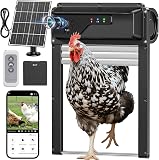 WiFi Automatic Chicken Coop Door with CameraView on Amazon
- 4
 DC HOUSE 20W Solar Powered Exhaust Fan for Chicken CoopsView on Amazon
- 5DC HOUSE 20W Solar Fan Powered Exhaust Fan for Chicken CoopsView on Amazon
- 6
 Automatic Chicken Coop Door Solar Powered with Timer & LightView on Amazon
- 7
 Chicken Coop DoorView on Amazon
- 8
 Coyote Deterrent Solar Predator Control LightView on Amazon
A morning check at the coop usually starts with the same question: is everyone inside, is the door shut, and did anything prowl around overnight? A camera on the coop answers that question without a walk out in the dark, and the solar vs plug-in chicken coop camera choice comes down to power. If no outlet sits near the coop, solar is the practical side, since the panel and battery live at the coop. If an outlet already sits close by, plug-in is the simpler side, since mains power runs the camera without a panel-and-charge routine. Pick the side that matches where the coop sits and how power gets there.
Other options for the coop
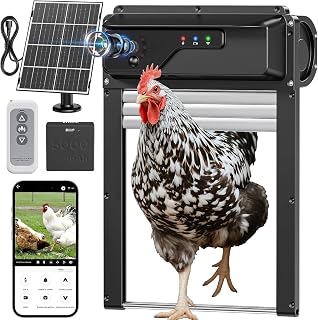 WiFi Automatic Chicken Coop Door with CameraCheck price on Amazon
 DC HOUSE 20W Solar Powered Exhaust Fan for Chicken CoopsCheck price on Amazon
- DC HOUSE 20W Solar Fan Powered Exhaust Fan for Chicken CoopsCheck price on Amazon
 Automatic Chicken Coop Door Solar Powered with Timer & LightCheck price on Amazon
 Chicken Coop DoorCheck price on Amazon
 Coyote Deterrent Solar Predator Control LightCheck price on Amazon
CoopKeeperHQ earns a commission if you buy through our links, at no added cost to you. Affiliate disclosure.
Solar vs plug-in chicken coop camera: how the two power choices differ
Solar power means the camera and door run from a panel and a battery mounted at the coop, with a cable charge as a backup on the listings in this guide. Plug-in power means the camera runs from a mains outlet, so the coop needs a cord route and an outlet that stays dry and protected. The job stays the same on either side: watch the coop and, where a door is fitted, let a timer or sensor decide when it moves. What changes is where power comes from, what happens when that source falters, and how much daily attention the power side asks for.
Solar power at the coop
Solar suits a coop that sits away from the house, where running a cord would cross a yard, a path or a run. The listings in this guide pair the camera with an automatic door, so the same battery feeds the camera and drives the door motor, and an app shows the picture and sets the door timer. That pairing matters for keepers who want the door shut at dusk without a walk out, and a picture to confirm it shut. On cloudy stretches, the backup matters as much as the panel: the listings here allow cable charging for a low battery.
Solar also asks for a little routine: panels need a clear view of the sky, batteries need charging attention through dark seasons, and app control needs a connection at the coop. The Azureblom listings answer weak Wi-Fi with a hotspot option. A solar camera is a poor fit where the coop sits in deep shade all day, or where the keeper cannot reach the coop to plug in a cable on a dull stretch.
Plug-in power at the coop
Plug-in suits a coop with an outlet close by, such as a coop wired into a garage, a barn or a garden circuit. Mains power removes the panel-and-charge routine: no panel to site, and no dull-season worry about keeping a door battery charged.
The trade is the cord. An outdoor outlet at a coop should have GFCI protection, with cords kept off the ground and out of reach of beaks, and the cord route needs protection from rain, ice and chewing. A plug-in camera without battery backup stops when its circuit stops. Where no outlet sits near the coop, plug-in means new wiring work before the camera can switch on.
The solar gear in this guide
Every camera listing in this guide pairs the camera with a solar automatic door, so the gear below compares door cameras, not standalone cameras. The order runs from the strongest stated package to the weakest, judged on the specs the listings state. No plug-in listing sits in this gear set, so the plug-in side is judged above on how mains power works.
PawHut 2K HD AI Camera Automatic Chicken Coop Door
The PawHut listing states the strongest camera package here: 2K HD with 4MP clarity and 23ft night vision, watching around the clock, with AI that detects people, cars and animals and sends classified alerts to a phone. The door runs from a built-in 5200mAh battery that runs for 28 days, or up to 6 months with the solar panel, and Type-C fast charging powers it in just 2 hours. Control runs through an app over 2.4G Wi-Fi, with timer, light sensor and manual modes. PIR heat sensing plus resistance detection stops the door when a live animal is detected, and the listing states a heavy-duty aluminum frame with IP65 protection stated for 14 to 113 ℉. A 2-way audio channel and a siren help deter predators from afar. The listing states a 90 Day Warranty Against Manufacturer Defects, and the stated size is 16″ L x 10.4″ W x 1.8″ H at 3.0 pounds.
Azureblom 1080P HD Camera Solar Automatic Chicken Coop Door, Silver listing
The Azureblom Silver listing states a 1080P HD night vision camera viewed through an app or memory card, a 5000mAh battery charged by a solar panel or the included USB-C data cable, and Wi-Fi app control with a mobile hotspot option when Wi-Fi signal is weak or absent. The door offers timer, app control, remote control and manual operation, and an anti-pinch infrared sensor makes the door rise and wait for 3 seconds before closing again when an obstacle is detected. A temperature sensing device sends out an alarm when it detects beasts or people trying to steal poultry outside the door. The listing states aluminum and ABS material, operation from -26C to 60C, and installation in less than 10 minutes. Note a contradiction: the listing promises five setting switch modes yet names timer, application control, remote control and manual, and the spec table lists Size as 16inch beside dimensions of 6.5 inches x 9.64 inches x 14.57 inches. Trust the title and bullets over the spec table. No warranty term is stated for this listing.
Azureblom 1080P HD Camera Solar Automatic Chicken Coop Door, Silver6 listing
The Azureblom Silver6 listing is, on its bullets, the same door as the Silver listing: the same 1080P HD night vision camera, the same 5000mAh battery with solar panel and USB-C cable charging, the same Wi-Fi app control with a hotspot option, the same anti-pinch sensor with a 3 seconds pause, the same aluminum and ABS build, and the same -26C to 60C range. It shares model J102 and the same five setting switch modes promise. What differs sits in the spec table: Color reads Silver6, and Size reads 6.5″L x 9.6″W x 14.6″H. Since it adds nothing the Silver listing lacks, it ranks last. No warranty term is stated for this listing either.
Choosing between solar and plug-in for your coop
Start with the outlet question, since it settles most of this choice. If a GFCI outlet already sits near the coop and the cord route can stay protected, plug-in power is the simpler daily routine. If the coop sits far from any outlet, solar power avoids the wiring work.
- Coop far from the house with no nearby outlet: solar, with cable backup for dull stretches
- Coop with a protected outlet close by: plug-in, with the cord kept off the ground and out of reach of beaks
- Weak Wi-Fi at the coop: a listing with a hotspot option, such as the Azureblom listings here
- Night watching matters most: the PawHut 23ft night vision package
- Door plus camera in one purchase: the solar door cameras in this guide
For the door side of this choice, the automatic coop door guide compares doors on their own, and the solar vs battery chicken coop camera comparison covers the battery angle.
Birds, breed size, run time and climate in; coop floor, run space, roost length and nesting boxes out.
Wash your hands after handling birds, eggs or equipment, supervise children around the flock, and check local rules on flock size and roosters before you buy. For sick birds, call a poultry veterinarian or your state extension office. See CDC backyard poultry guidance. Read our Safety Disclaimer.
FAQ for the flock
Do solar coop cameras work on cloudy days?
The listings here keep working from the battery when sun is scarce, and the Azureblom listings allow charging by USB-C cable while the PawHut listing states Type-C fast charging in just 2 hours.
What happens when a solar camera battery runs out?
A flat battery stops the camera and the powered door movement until it is charged again, since the same battery feeds the door and the picture. The Azureblom listings charge by solar panel or USB-C cable, and the PawHut listing charges by solar panel or Type-C cable. A plug-in camera draws mains power rather than running down a door battery, but a unit without battery backup stops when its circuit stops.
Is a solar door camera enough to watch the flock at night?
The Azureblom listings state 1080P HD night vision, and the PawHut listing states 4MP clarity with 23ft night vision. The PawHut AI alerts sort people, cars and animals from other motion.
Do solar coop cameras need Wi-Fi at the coop?
App control needs a connection at the coop. The PawHut listing connects over 2.4G Wi-Fi, and the Azureblom listings connect over Wi-Fi with a mobile hotspot option when Wi-Fi signal is weak or absent. A coop with no Wi-Fi and no hotspot signal cannot use app control.
Solar or plug-in: which fits a coop far from the house?
Solar fits a far coop better, since the panel and battery live at the coop and no cord needs to cross the yard. Plug-in fits a coop with a protected outlet close by, since mains power removes the battery routine. Check local, HOA and state rules before adding outdoor wiring at the coop.
More coop guides
- Solar vs Battery Chicken Coop Camera: Which One Should You Buy?
- Wifi vs Cellular Coop Camera: Which One Should You Buy?
- Best Chicken Coop Camera for Backyard Flock (2026)
- Best Automatic Chicken Coop Door: Picks for Every Season
- Best Anti Pinch Solar Chicken Coop Door (2026): 5 Compared
- How to Predator Proof a Chicken Coop and Run
See the WiFi vs cellular coop camera comparison and the backyard flock camera picks.