Wood vs Metal Egg Skelter: Which One Should You Buy?
A metal spiral skelter and a wooden egg tray compared by capacity, design and daily use for the backyard egg pile.

On this page
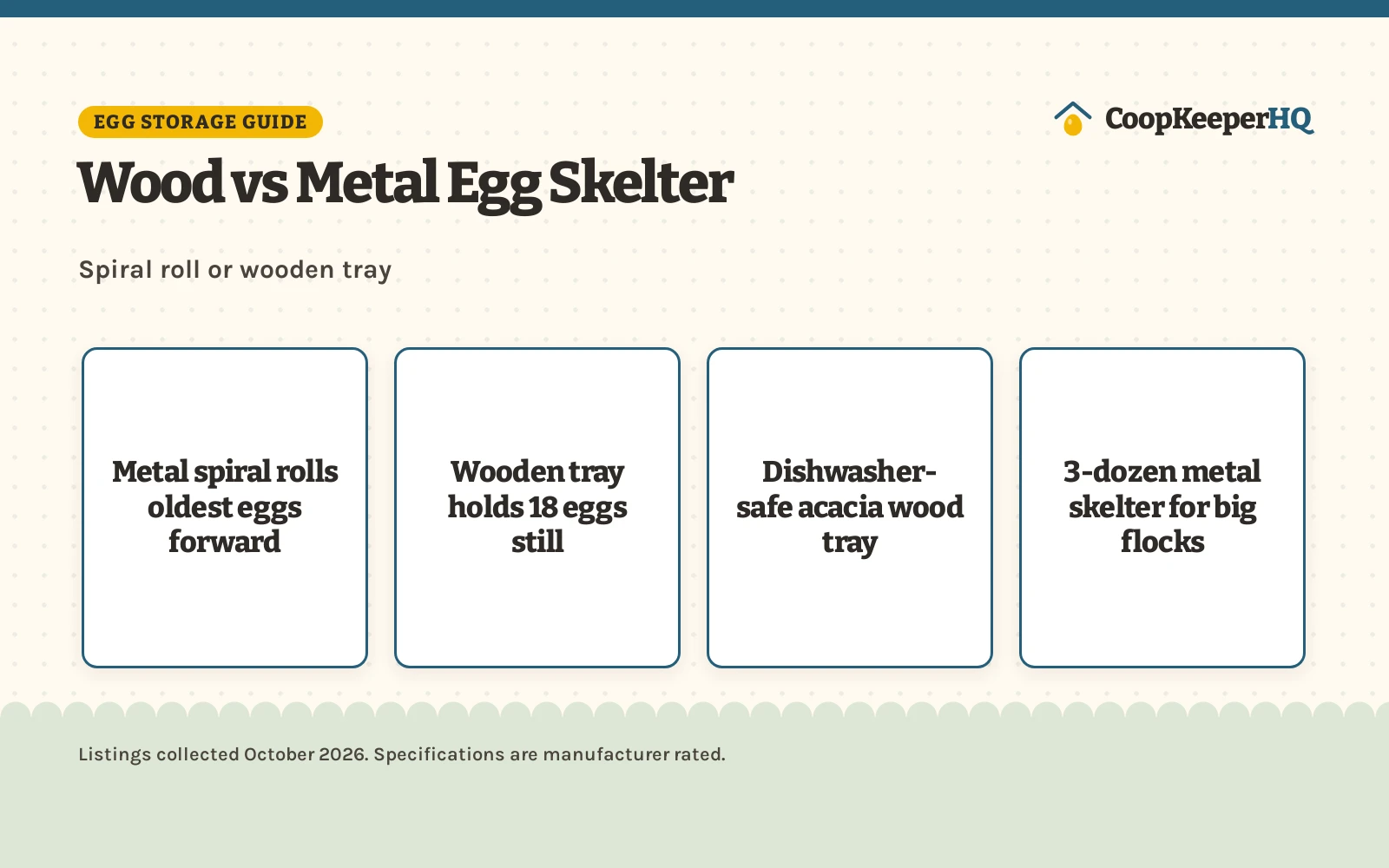
You gather the eggs each morning and line them up on the counter, and by the weekend you are shuffling cartons to find the oldest ones. A skelter fixes that with a simple roll: new eggs go in at the top, the oldest roll down to the front. The wood vs metal egg skelter question comes down to how you collect: a metal skelter rolls eggs forward oldest-first, while a wooden tray holds eggs still for display and easy grabbing.
As an Amazon Associate I earn from qualifying purchases. CoopKeeperHQ earns a commission if you buy through our links, at no added cost to you. Affiliate disclosure.
Wood vs metal egg skelter: the short answer
Pick metal if you collect daily and want the oldest eggs used first without thinking about it. The metal skelter here holds a spiral of eggs that roll forward as you take from the front, and the maker lists a coated wire frame it calls rust proof. Pick wood if you gather a few eggs at a time and like a tray you can carry, wash and set in the fridge. The wooden tray here holds eggs in place rather than rolling them.
What a metal skelter does on the counter
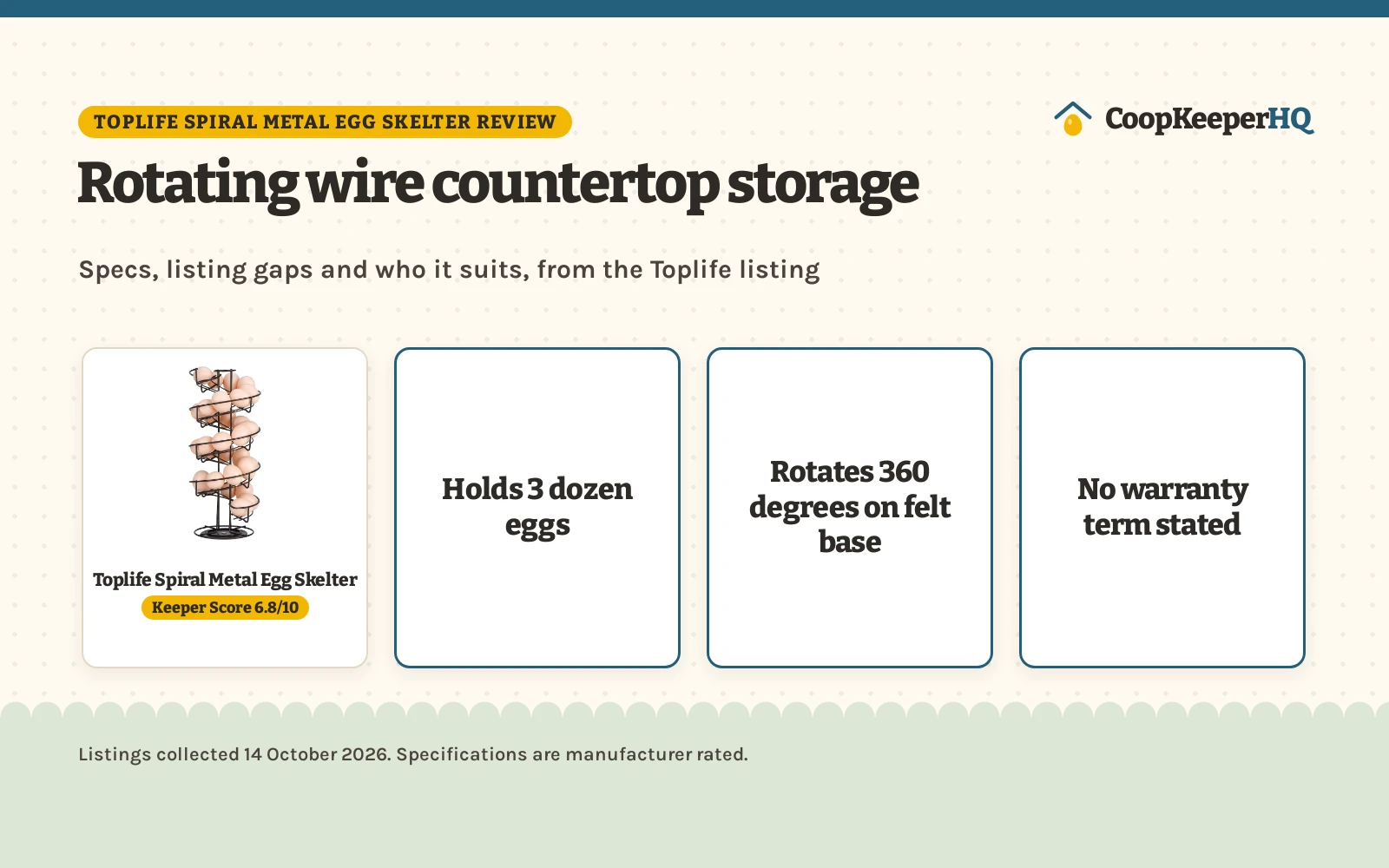
The Shop Square skelter is a spiral: you add new eggs at the top and take the oldest from the bottom, so the order takes care of itself. The listing states room for 3 dozen eggs, a storage basket underneath and a carrying ring on top for moving it around the kitchen. The frame is metal wire with a black coating the maker calls rust proof, and the maker says it works as a holder for other small kitchen items too.
What a wooden tray does
The GUI’S CHICKEN COOP tray is a flat wooden holder: eggs sit in their spots until you lift them out. The listing states room for 18 eggs in acacia wood, measuring 11.5 by 5.75 by 0.75 inches, and says it washes in the sink or dishwasher. It doubles as a fridge tray, and the maker also lists it as a portable travel or camping accessory; the maker says it suits display as well as storage.
Two egg holders, ranked
First, the Shop Square metal skelter. The listing states a spiral first-in-first-out design, room for 3 dozen eggs, a storage basket and a carrying ring, in coated metal wire the maker calls rust proof. It ranks first here on stated capacity and the self-ordering design.
Second, the GUI’S CHICKEN COOP wooden tray. The listing states an 18-egg acacia tray, 11.5 by 5.75 by 0.75 inches, washable in the sink or dishwasher. Note it is a tray, not a spiral skelter: eggs stay put rather than rolling forward. It ranks second on the smaller stated capacity and the simpler design.
Choosing for your kitchen routine
A household that gathers plenty of eggs each day will fill the wooden tray fast; the metal skelter’s 3-dozen capacity suits a bigger laying flock. If you wash eggs and refrigerate them, the wooden tray goes in the fridge while the metal skelter is a countertop piece. Match the holder to where the eggs actually live in your kitchen, not to where they look nicest in a photo.
Think about refilling too. A spiral skelter wants new eggs added at the top as you collect them; a tray wants a quick straighten when you set eggs in. For carrying eggs in from the coop, see our best egg collecting basket guide.
Living with a skelter
The first week with a skelter changes the egg routine. You stop writing dates on shells and start trusting the roll: whatever sits at the front is next. That only works if everyone in the house takes from the bottom front and adds to the top, so it is worth one short lesson for the family.
Cleaning is simple either way. Wipe the metal wire down when it looks dusty and let it dry; the wooden tray goes in the sink or the dishwasher per the listing. Keep either one away from the stove, where heat and steam do eggs no favors.
Wash your hands after handling birds, eggs or equipment, supervise children around the flock, and check local rules on flock size and roosters before you buy. For sick birds, call a poultry veterinarian or your state extension office. See CDC backyard poultry guidance. Read our Safety Disclaimer.
FAQ for the flock
How many eggs does a skelter hold?
The metal skelter here states room for 3 dozen eggs; the wooden tray states 18 eggs.
Does a skelter really keep eggs in order?
The metal spiral does: new eggs go in the top and the oldest roll to the bottom, first-in-first-out. The wooden tray does not roll; eggs stay where you set them.
Can the wooden tray go in the dishwasher?
The listing says yes: it washes in the sink or dishwasher.
Will the metal skelter rust?
The maker calls the coated wire frame rust proof. The listing states no warranty or safety listing, so wipe it dry after washing.
Which suits a small flock?
A flock that lays a few eggs a day fits the 18-egg wooden tray; a heavy-laying flock fills it fast, so the 3-dozen metal skelter fits better.
Is an egg skelter only for chicken eggs?
The wooden tray listing says any egg-shaped egg works, from chicken eggs to ceramic display eggs. The metal skelter listing calls it a chicken egg holder with room for 3 dozen eggs and does not name other egg sizes.
More coop guides
- Best Egg Skelter: Countertop Egg Holders for Fresh Eggs
- Best Egg Skelter Under 25: Countertop Storage for Fresh Eggs
- Best Egg Collecting Basket: Wire, Wood and Apron Picks
- Best Egg Cartons for 18 Eggs (2026)
See the best egg skelter picks and the egg collecting basket guides.