8×8 vs 10×10 Chicken Coop: Which One Should You Buy?
An 8x8 fits a small flock that stays small; a 10x10 fits a growing flock and winter crowding. Compare the four picks by stated size and bird count.

On this page
Top picks at a glance
As an Amazon Associate I earn from qualifying purchases.
- 1
 PawHut 137" Chicken Coop with Extra Large Run9.7/10View on Amazon
- 2
 9.8 x 6.5 x 6.5 ft Metal Chicken Coop9.7/10View on Amazon
- 3
 Quictent 12x9x6.6ft Large Metal Chicken Coop Run With Perch &9.7/10View on Amazon
- 4
 Aivituvin Extra Large Chicken Coop for 8-10 ChickensView on Amazon
- 5
 Large Metal Chicken Coop Walk in Chickens Run with ChickenView on Amazon
- 6
 Automatic Chicken Coop Door Solar Powered with Timer & LightView on Amazon
- 7
 Chicken Coop Heater for Winter with Smart APP ControlView on Amazon
- 8
 PETNF Chicken Coop Heater 140 Watts Radiant Heat ChickenView on Amazon
- 9
 Chicken Coop Heater for Winter with Remote APP ControlView on Amazon
A Saturday morning head count tells you more than any chart. Hens at the feeder look comfortable; the same run packed past its rating starts arguments you can hear from the porch. That is the real shape of the 8×8 vs 10×10 chicken coop question: not which footprint looks better on paper, but which one keeps your actual flock calm, dry and easy to clean.
Other options for the coop
 Aivituvin Extra Large Chicken Coop for 8-10 ChickensCheck price on Amazon
 Large Metal Chicken Coop Walk in Chickens Run with ChickenCheck price on Amazon
 Automatic Chicken Coop Door Solar Powered with Timer & LightCheck price on Amazon
 Chicken Coop Heater for Winter with Smart APP ControlCheck price on Amazon
 PETNF Chicken Coop Heater 140 Watts Radiant Heat ChickenCheck price on Amazon
 Chicken Coop Heater for Winter with Remote APP ControlCheck price on Amazon
CoopKeeperHQ earns a commission if you buy through our links, at no added cost to you. Affiliate disclosure.
8×8 vs 10×10 chicken coop: the short answer
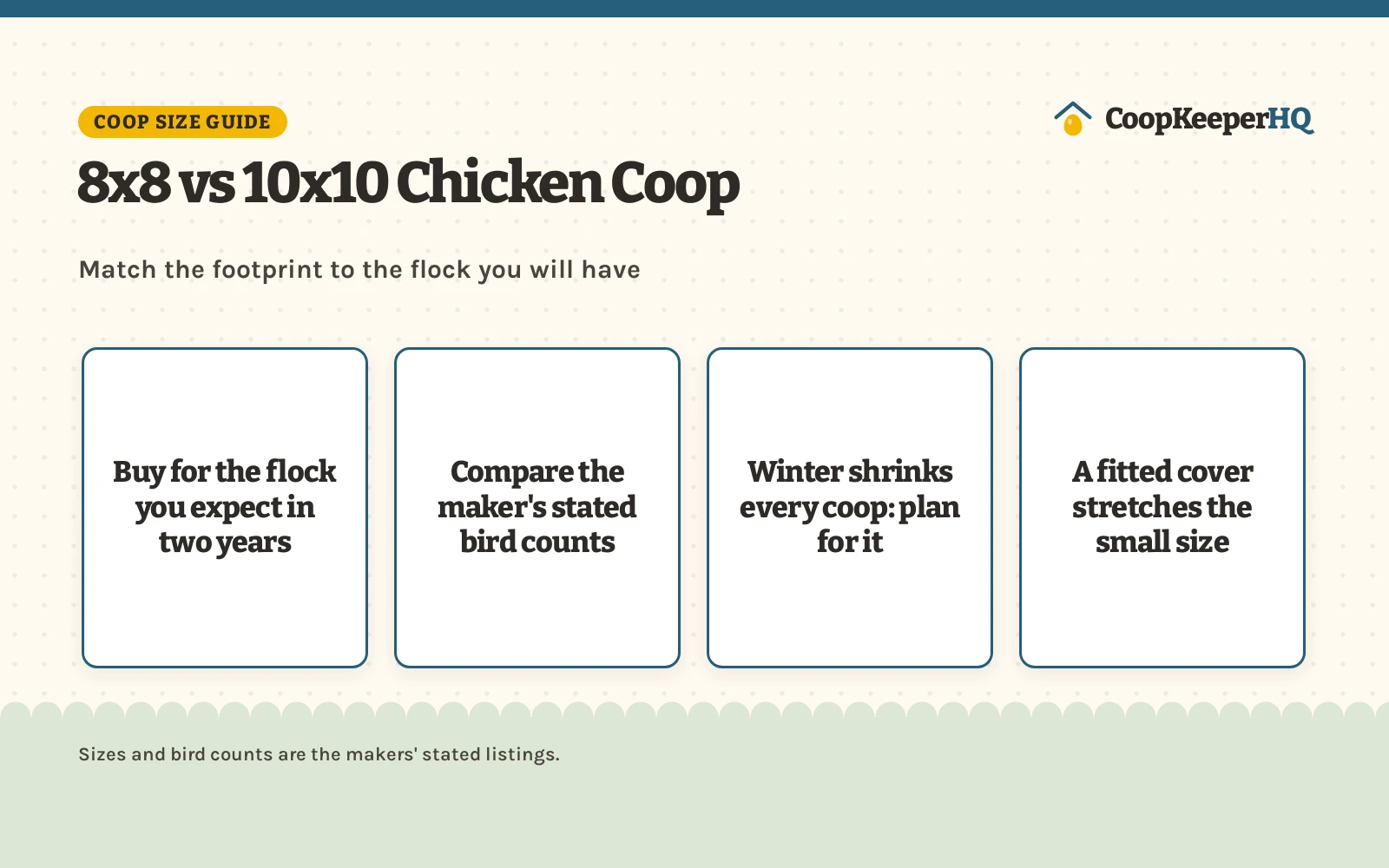
An 8×8 suits a small backyard flock you plan to keep small. A 10×10 suits a growing flock, or a keeper who wants room for a feeder, a waterer and a human to stand up inside. The bigger mistake is buying for the flock you have today instead of the flock you will have next spring, because coops are not easy to resize. Start with the bird count you expect in two years, then work backward to the footprint.
How flock size points at a size
The listings on this page state their own numbers, and those numbers are the honest way to compare. The Quictent walk-in run is built for 20+ poultry at 12x9x6.6FT with 108 square feet of floor. The Guiferland walk-in is listed for 8 chickens with 44 square feet. Both are walk-in runs, not enclosed hen houses, and both show how a maker’s stated bird count maps to a footprint. If your plan is 8 chickens or fewer and the flock will stay there, a run in the Guiferland’s class covers the stated need. If the plan drifts toward a dozen or more, you want the Quictent class of space, not wishes.
The gear that fits each size
Ranked from the most space to the least, here is how the four picks line up against the size question.
Quictent 12x9x6.6FT walk-in run. The biggest footprint here: 142.4 x 107.3 x 78 inches, 108 square feet, rated for 20+ poultry. Its case is hardware, not hype: 1″ diameter poles, 8 support bars, 1″ x 1″ welded hardware cloth in 20 gauge, a dual-latch door with a narrow gap, and a ground skirt against digging. Assembly uses a push-button frame plus bolts, and the box includes 550 zip ties, real 0.2″ breadth cable ties. Parts support runs 365-day on frame parts and 180-day on covers and cloth. This is the pick when the answer to the size question is the larger one.
Betterhood 6.6’L x 9’W x 6.5’H metal coop. The middle footprint: 79.2 x 108 x 78 inches, listed at 198 square feet of unit count, 80 lb. A steel frame with triangular supports and galvanizing, 240D Oxford cloth cover that repels water, and hexagonal wire mesh (0.6 inches). The listing suits it to chickens, ducks, rabbits and other small animals, and promises installation help plus customer service. A solid middle choice for a flock that fits the smaller side of the question.
Guiferland walk-in for 8 chickens. The compact pick: 78.7 x 78.7 x 74.8 inches, 44 square feet. Tightly woven 1-inch PVC-coated hexagonal wire, 25mm steel pipes with wall support bars, a snap-on PE cover for rain and snow, and 14 ground stakes in the box. A reinforced widened door lock with narrow door gaps keeps the flock in and predators out, and the listing carries a 1‑year warranty. Right for a fixed small flock with a small yard.
NNG 8 x 10 ft winter cover. Not a coop at all: a translucent PE tarp, 120″ x 96″, with 6 rows of stitching, grommets every 19.7 inches, a 16.4ft rope and 30 cable ties. It ranks last as a coop because it is not one, but it belongs on the list as the accessory that makes either size work through winter, letting sunlight in while blocking rain, snow and wind. If you buy the smaller footprint, this is how you stretch its season.
Birds, breed size, run time and climate in; coop floor, run space, roost length and nesting boxes out.
Winter and weather change the answer
Cold weather shrinks a coop. Birds crowd the sheltered end, waterers freeze, and the run sits empty on the worst days. A 10×10 that felt generous in June feels merely adequate in January. The NNG winter cover above is the practical response: a fitted 8 x 10 ft cover turns either footprint into a windproof shelter without rebuilding anything. The Quictent’s waterproof UV-resistant PE roof cover and the Guiferland’s snap-on PE cover do the same job at the roof line, and the Betterhood’s 240D Oxford cloth is cut for the same weather. If your winters are hard, weight the decision toward the larger footprint and budget for the cover. A run that breathes in summer and buttons up in winter is worth more than a few extra square feet of open mesh in January.
Measuring before you buy
Tape the footprint on the lawn before you order. The Quictent’s 142.4 x 107.3 x 78 inches and the Guiferland’s 78.7 x 78.7 x 74.8 inches are both walk-in height, so you can stand inside to feed and clean; a run you can walk into gets cleaned more often than one you reach into on your knees. Leave a service path around the outside for the wheelbarrow, and check that the door swings clear of the fence.
Wash your hands after handling birds, eggs or equipment, supervise children around the flock, and check local rules on flock size and roosters before you buy. For sick birds, call a poultry veterinarian or your state extension office. See CDC backyard poultry guidance. Read our Safety Disclaimer.
FAQ for the flock
Is an 8×8 big enough for 8 chickens?
The Guiferland pick is listed for 8 chickens at 44 square feet, so a run in that class matches the maker’s own rating. Watch behavior: crowding, feather pulling and constant squabbling mean the flock wants more room than the label promised.
When does a 10×10 make more sense?
When the flock is growing, when you want a feeder and waterer inside the run, or when winter keeps birds indoors for long stretches. The Quictent class of space, rated for 20+ poultry, is the example here.
Can I use a winter cover instead of a bigger coop?
Partly. A 8 x 10 ft chicken coop cover keeps rain, snow and wind out of an existing run, which stretches a small footprint through winter. It does not add floor space, so it cannot fix genuine overcrowding.
Do these coops need a fenced yard too?
The three run picks are enclosed runs with mesh walls and doors, so they stand alone as daytime housing. The fourth pick is a winter cover, not a run. The Quictent adds a ground skirt against digging, and the Guiferland includes 14 ground stakes. Nighttime locking is still on you.
What should I check before buying?
Measure the actual spot in your yard, check the maker’s stated dimensions (the Quictent is 142.4 x 107.3 x 78 inches; the Guiferland is 78.7 x 78.7 x 74.8 inches), and confirm the stated bird count covers the flock you expect in two years.
More coop guides
- Chicken Coop Fan vs Heater: Which One Should You Buy?
- Insulated vs Uninsulated Chicken Coop: Which One Should You Buy?
- Side vs Top Door Chicken Coop: Which One Should You Buy?
- Mobile vs Stationary Chicken Coop: Which One Should You Get?
- How to Winterize a Chicken Coop: A Fall Checklist
- Best Chicken Coop Heater: Safer Panels for Winter
- Best Chicken Coop Bedding: Shavings, Hemp and Sand
See the chicken coop picks and the coop supply guides.