Chicken Coop Fan vs Heater: Which One Should You Buy?
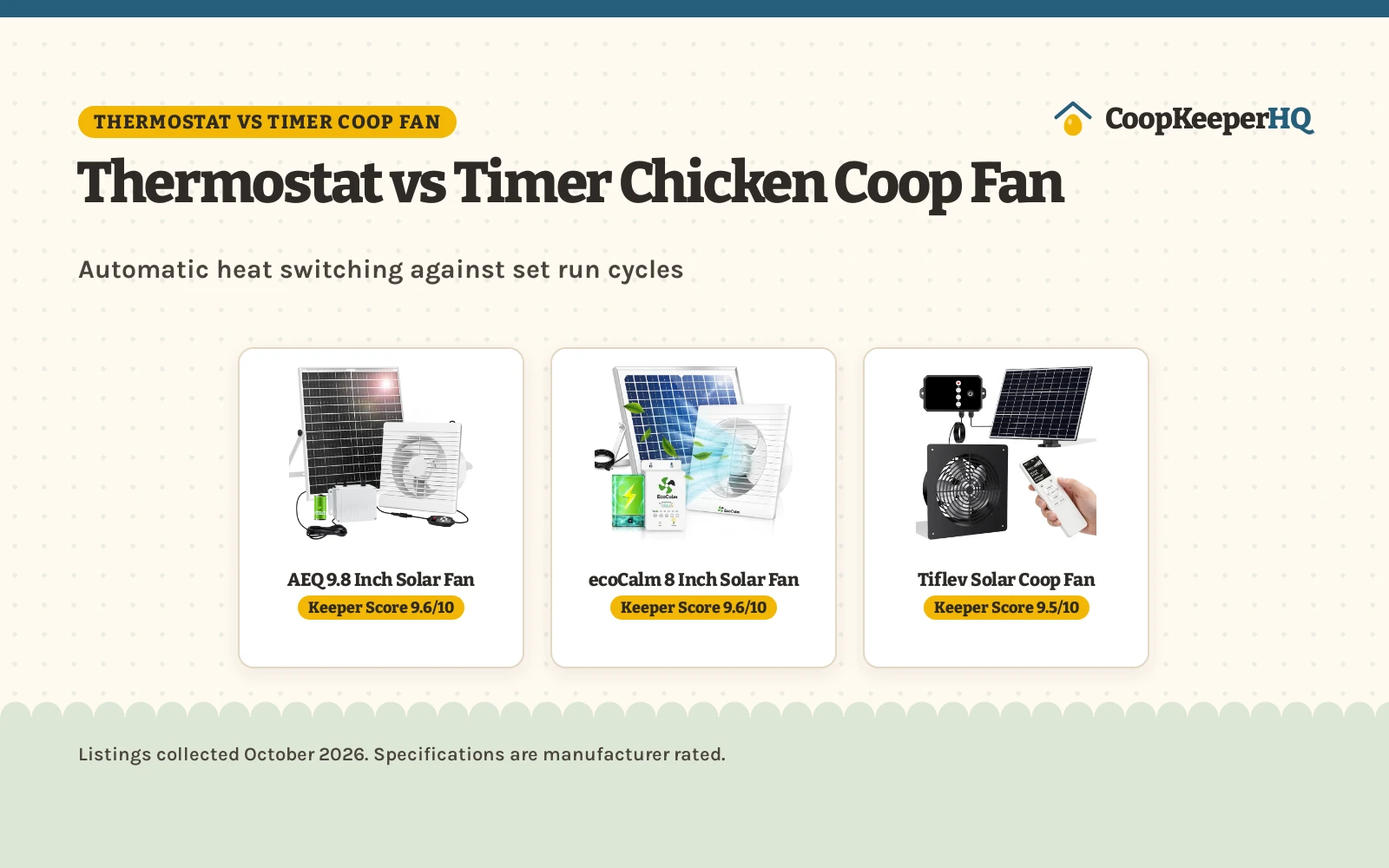
Chicken coop fan vs heater: why ventilation usually matters more than added heat for backyard flocks, featuring two VEVOR fans for coops.

On this page
Top picks at a glance
As an Amazon Associate I earn from qualifying purchases.
- 1
 8'' Upgraded Shutter Exhaust Fan with Thermostat & RemoteView on Amazon
- 2
 Solar Powered Fan 15WView on Amazon
- 3
 Solar Fan 30W Solar Powered FanView on Amazon
- 4
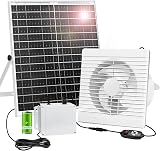 Solar Fan for Chicken Coop with 2 Fan Speed/1-8 Cycle TimerView on Amazon
- 5
 iLiving 24" Shutter Exhaust Fan with Wireless Smart RemoteView on Amazon
- 6
 18" Solar FanView on Amazon
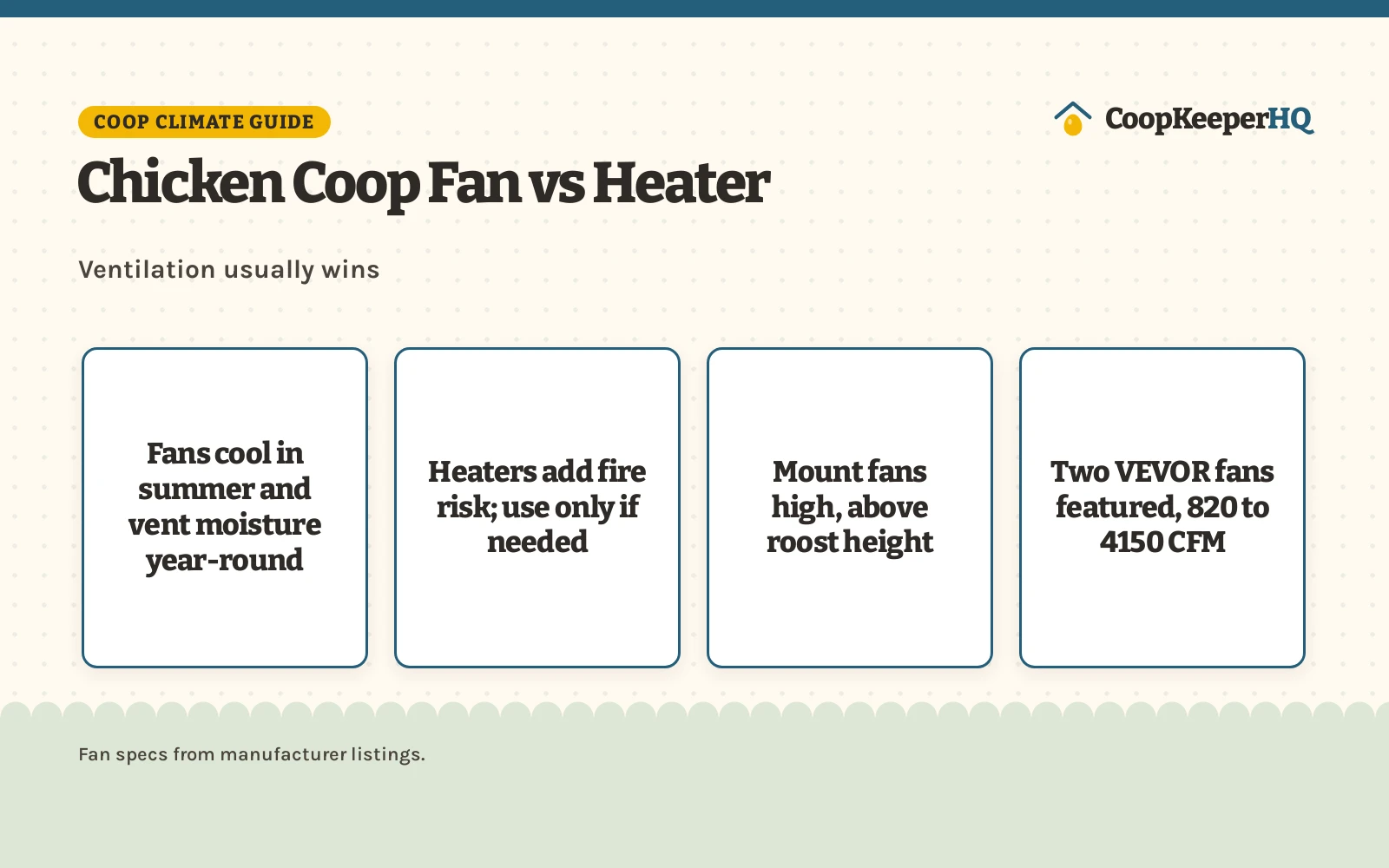
Chicken coop fan vs heater? For most flocks, a fan for summer ventilation matters more than a heater for winter. Chickens handle cold with feathers and huddling, but they suffer in heat and damp. A fan moves air and carries moisture out; a heater adds warmth but also fire risk. This guide compares the two approaches and features two VEVOR fans from the listings.
Other options for the coop
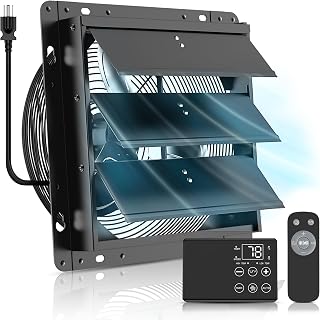 8'' Upgraded Shutter Exhaust Fan with Thermostat & RemoteCheck price on Amazon
 Solar Powered Fan 15WCheck price on Amazon
 Solar Fan 30W Solar Powered FanCheck price on Amazon
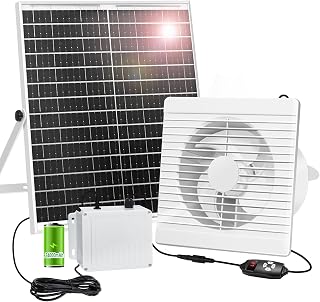 Solar Fan for Chicken Coop with 2 Fan Speed/1-8 Cycle TimerCheck price on Amazon
 iLiving 24" Shutter Exhaust Fan with Wireless Smart RemoteCheck price on Amazon
 18" Solar FanCheck price on Amazon
CoopKeeperHQ earns a commission if you buy through our links, at no added cost to you. Affiliate disclosure.
Why ventilation beats heat
A dry coop with moving air keeps birds comfortable. In summer, a fan prevents heat stress. In winter, ventilation high on the wall carries moisture out without drafts at roost height. Heaters can help in extreme cold, but they introduce fire risk and dependency. Most keepers prioritize airflow first.
Chicken coop fan vs heater: the gear
The VEVOR 18-inch wall mount fan moves 4150 CFM on 3 speeds at 90 watts and 50 dB. The listing states pull chain control and wall mount. For a large coop or run, the 4150 CFM moves substantial air.
The VEVOR 10-inch shutter exhaust fan moves 820 CFM at 45 watts per the bullets (the spec table says 27 watts) and 50 dB. The listing states button control and wall mount. For a small coop, the 820 CFM provides steady exhaust without excessive power draw.
Sizing a fan to your coop
The two VEVOR fans sit at opposite ends of the airflow scale. The 18-inch wall mount fan moves a maximum of 4150 CFM with a reach of around 30 ft, which suits a large coop or an open run where air has to travel. The 10-inch shutter exhaust fan moves 820 CFM, which suits a small enclosed coop where a 4150 CFM blast would be too much. The 18-inch has 3 speeds on a pull chain, so you can turn it down; the 10-inch is single speed and runs steady. Size the fan to the space: too little airflow does nothing, and too much in a small coop creates drafts at roost height.
Power draw: 90 watts vs 45 watts
The 18-inch fan has a 90W copper motor in an all-metal casing. The 10-inch fan’s bullets state 120V/60Hz and 45W, while its spec table says 27 watts; the bullets win on this site’s rules, so plan for 45W. Both run on standard household voltage, 115 volts for the 18-inch and 120 volts for the 10-inch. The 10-inch also notes a fully enclosed motor with thermal protection and permanent lubrication, which suits a dusty coop environment where the motor runs for hours.
Mounting: where and how
Both fans are wall mount. The 18-inch listing says to hang it on concrete or metal structures and does not recommend wooden walls, and it weighs 13.5 pounds at 20.9 by 22.4 by 21.7 inches. It tilts vertically for optimum airflow and comes with a 6 ft power cord. The 10-inch is 12.8 by 12.8 inches and fits window openings or openings along walls. One catch on the 10-inch: the listing states it does not include a speed control switch or plug, and a separate plug must be purchased and wired for use. Budget for that before installation day.
Noise: both state 50 dB
Both listings state 50 dB. The 18-inch lists 1500 RPM and the 10-inch 1650 RPM, and both claim lower noise at their airflow. For a coop near the house, 50 dB at the fan is moderate; mount the fan on the far wall and keep it above roost height so the sound and the airflow stay away from sleeping birds.
Weather ratings: IP44 vs galvanized
The 18-inch fan is IP44 rated for water resistance with aluminum blades and a powder coated finish, and it is ETL listed. The listing still says not to use it in rain or exposed outdoor areas, so a covered mounting spot matters. The 10-inch has a galvanized steel frame with an aluminum alloy fan and shutter, stated as highly resistant to weather, liquid and dust, and it is FCC listed. For a humid coop, either build holds up; for a fan that catches rain, neither is rated for it.
Fan or heater: running costs through the year
A fan runs in summer for cooling and in winter for moisture control, so it earns its keep in both seasons. The 90W 18-inch fan and the 45W 10-inch fan both draw modest power for the airflow they give. A heater, by contrast, runs only in winter and draws far more watts for the heat it adds, while introducing fire risk near bedding. For most flocks, the fan-first approach costs less to run and covers more months of the year. If you do add a heater later, the fan stays useful for ventilation, so the fan purchase is never wasted.
What the listings do not state
Neither fan listing states a warranty term, so there is no warranty to compare here. Neither states a thermostat or temperature trigger, so both run when you switch them on; the 18-inch uses its pull chain and 3 speeds, and the 10-inch runs at one speed once wired. Neither listing gives a duty cycle or a maximum run time. Plan on manual control, and check the listing for the plug the 10-inch needs before you mount it.
When to use a fan
Use a fan in summer for cooling and year-round for moisture control. Mount high on the wall, above roost height, so air moves without blowing directly on birds. The 3-speed VEVOR allows adjusting airflow; the single-speed shutter fan runs steady.
When to consider a heater
Consider a heater only in extreme cold with vulnerable birds. Use a flat radiant panel with a stated safety listing, never a heat lamp with an exposed bulb. Keep heaters away from bedding and on a GFCI outlet. For most flocks, dry bedding and draft-free roosts suffice.
Wash your hands after handling birds, eggs or equipment, supervise children around the flock, and check local rules on flock size and roosters before you buy. For sick birds, call a poultry veterinarian or your state extension office. See CDC backyard poultry guidance. Read our Safety Disclaimer.
Fitting It to Your Flock
For larger flocks, either fan works; size to your coop volume. The 4150 CFM suits larger coops or runs.
FAQ for the flock
Do chickens need a heater in winter?
Most healthy adult chickens do not. Dry bedding, no drafts at roost height and ventilation higher up matter more.
Do chickens need a fan in summer?
Yes, for cooling and air movement. Heat stress is a real risk; a fan helps.
Which fan is better for a small coop?
The VEVOR 10-inch shutter exhaust fan at 820 CFM. It provides steady ventilation without excessive airflow.
Is a heat lamp safe in a coop?
Heat lamps are a known fire risk. Use a flat radiant panel instead if you must add heat.
More coop guides
- Best Chicken Coop Fan: Solar and Plug-In Ventilation
- Best Chicken Coop Heater: Safer Panels for Winter
- How to Keep Chickens Cool in Summer: Shade, Water and Airflow
- How to Winterize a Chicken Coop: A Fall Checklist
See the chicken coop picks and the coop supply guides.