Brooder Heater vs Heat Lamp: Which One Should You Buy?
Brooder heaters and heat lamps compared on fire risk, energy use, chick capacity, height adjustments and safety, with three models evaluated from published listings.

On this page
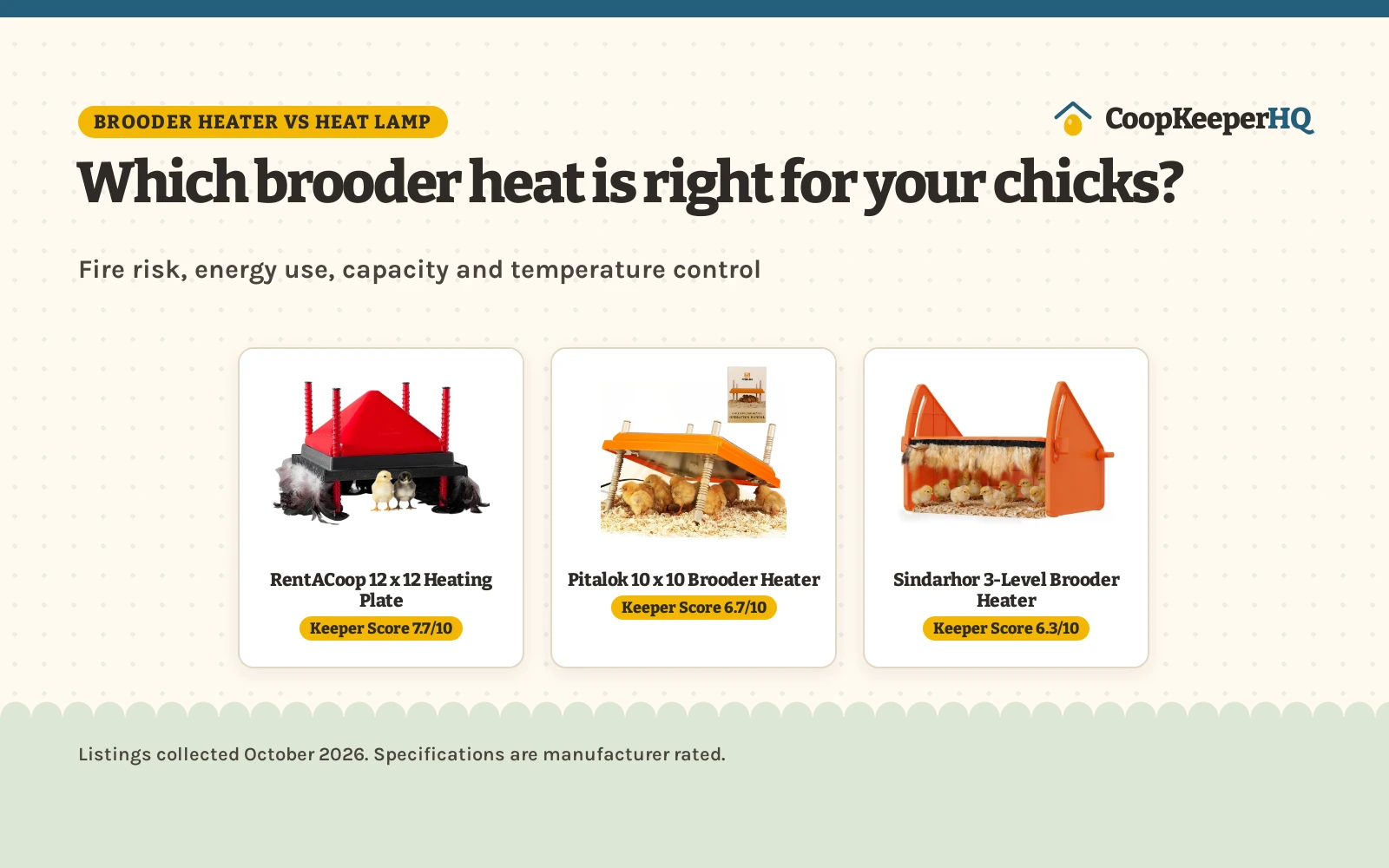
Top picks at a glance
As an Amazon Associate I earn from qualifying purchases.
- 1
 RentACoop 12x12 Adjustable Heating Plate9.6/10View on Amazon
- 2
 Pitalok 10x10 Brooder Heater Plate9.4/10View on Amazon
- 3
 Sindarhor 3-Level Adjustable Temperature Brooder9.3/10View on Amazon
Brooder heater vs heat lamp verdict: Choose a brooder heater for brooding chicks indoors in a draft-free space: radiant heating plates eliminate exposed bulb hazards and let chicks rest in natural darkness, with the RentACoop example drawing 22 W. Choose a heat lamp only if you must brood in an uninsulated, cold space where radiant plates cannot warm surrounding air, drafts are blocked, and you use a securely mounted, guarded fixture with a GFCI outlet.
Both brooder heaters and heat lamps provide supplemental warmth for young poultry, but they transfer heat through distinct mechanisms. A radiant brooder plate warms chicks from above through direct contact and radiant heat, mimicking a brooding hen, while a traditional heat lamp warms surrounding air and bedding from an overhead bulb. This brooder heater vs heat lamp comparison evaluates how the two heat sources compare on fire safety, energy draw, and flock management using published listing specifications.
CoopKeeperHQ earns a commission if you buy through our links, at no added cost to you. Affiliate disclosure.
Featured models
| # | Product | Keeper Score | Buy |
|---|---|---|---|
| 1 | RentACoop 12x12 Adjustable Heating Plate | 9.6/10 | Buy on Amazon |
| 2 | Pitalok 10x10 Brooder Heater Plate | 9.4/10 | Buy on Amazon |
| 3 | Sindarhor 3-Level Adjustable Temperature Brooder | 9.3/10 | Buy on Amazon |

RentACoop 12x12 Adjustable Heating Plate
A 22 W radiant heating plate measuring 12 x 12 inches, rated by the maker for up to 20 chicks, with 25 height settings from 1 to 9 inches, an anti-roost cone and removable comfort feathers.
Who it's for: backyard keepers brooding up to 20 chicks indoors in a draft-free space who want low power consumption and minimal fire risk.
Who should skip it: anyone brooding in an unheated outbuilding during freezing weather where radiant contact heat alone cannot warm chilled air.
The RentACoop heating plate measures 12 x 12 inches, draws 22 W at 110 V (0.2 A), and is rated by the manufacturer for up to 20 chicks. The listing specifies 25 height settings from 1 to 9 inches, an underside center temperature of about 107 F, a 6 ft cord, an anti-roost cone, and removable comfort feathers. The maker notes no thermostat is needed because the temperature remains steady, though no formal safety listing like UL or ETL is stated.
Pros
- Only 22 W power draw, compared to 250 W for a traditional heat lamp
- 25 height settings from 1 to 9 inches with tilt capability
- Includes hard anti-roost cone and removable comfort feathers
- Manufacturer rated to warm up to 20 chicks, ducklings, quail or turkey poults
Cons
- No warranty term is stated in the listing
- No safety certification such as UL or ETL is stated
- Fixed underside temperature of about 107 F with no thermostat adjustment
- Listing specifies indoor use only

Pitalok 10x10 Brooder Heater Plate
A 10 x 10 inch chick heating plate rated for 15 chicks, featuring 25 height settings from 1 to 7 inches, a detachable top cleaning plate, and a 1-year manufacturer warranty.
Who it's for: keepers raising a small flock of up to 15 chicks who value an included 1-year warranty and a removable top cover for quick cleaning.
Who should skip it: buyers who require verified wattage specifications or third-party electrical safety certifications.
The Pitalok brooder plate measures 10 x 10 inches and is rated by the maker for around 15 chicks, with a stated operating temperature of 113 F to 131 F and 25 height positions from 1 to 7 inches. The listing contains a material contradiction: the spec table lists aluminum, whereas the bullet points state it is made of ABS plastic with aluminum foil along the bottom and top insulation. Power wattage is not stated anywhere in the listing. It includes a 1-year manufacturer warranty and a detachable top plate for cleaning.
Pros
- 1-year manufacturer warranty stated in the listing
- 25 height settings from 1 to 7 inches with adjustable angle options
- Detachable top plate designed for easier cleaning of droppings
- Rated by the manufacturer to keep around 15 chicks warm
Cons
- Power wattage is not stated in the listing
- No third-party safety listing such as UL or ETL is stated
- Fixed temperature range of 113 F to 131 F with no variable thermostat dial

Sindarhor 3-Level Adjustable Temperature Brooder
An enclosed brooder heater featuring 3 temperature settings (131 F, 149 F, 167 F), an 8.67 x 10.63 inch top plate, comfort feathers, and a 180-day quality promise.
Who it's for: poultry keepers who want multiple temperature settings and an enclosed side-panel design for ducklings, quail, or small clutches.
Who should skip it: anyone needing explicit wattage figures to calculate power draw or a verified chick count capacity.
The Sindarhor brooder heater features an enclosed house style with side panels and 3 temperature settings of 131 F, 149 F, and 167 F. The listing shows a dimension contradiction: the bullet points state a top panel of 8.67 x 10.63 inches, while the spec table lists overall dimensions of 8.7 x 9.8 x 13 inches. Neither electrical wattage nor chick capacity is stated anywhere in the listing. The unit is made of ABS plastic, includes comfort feathers, and lists a 180-day quality promise.
Pros
- Three selectable temperature settings of 131 F, 149 F, and 167 F
- Enclosed house structure with dual side panels to minimize heat loss
- Includes removable comfort feathers and wipe-clean ABS plastic
- 180-day quality promise stated by the manufacturer
Cons
- Wattage is not stated in the listing
- Bird capacity count is not stated in the listing
- Dimensions conflict between 8.67 x 10.63 inches in bullets and 8.7 x 9.8 x 13 inches in specs
- No third-party safety listing such as UL or ETL is stated
Other options for the coop
 Chick Brooder Heater Plate with Digital Temperature ControlCheck price on Amazon
 16"x22" Chick Brooder Heater Plate for Up to 50 Baby ChicksCheck price on Amazon
 Chick Brooder Heater with Adjustable TempCheck price on Amazon
 Smart Chicks Coop HeaterCheck price on Amazon
 180W Radiant Chicken Coop Heater Energy-Efficient WinterCheck price on Amazon
 Brooder Heater for ChicksCheck price on Amazon
Brooder heater vs heat lamp: side by side
| Factor | RentACoop 12 x 12 | Pitalok 10 x 10 | Sindarhor 3-Level |
|---|---|---|---|
| Tagged side in data | Heat lamp (contrasted) | Brooder heater | Brooder heater |
| Power draw | 22 W, 110 V (vs 250 W lamp) | Electric, wattage not stated | Electric, wattage not stated |
| Chick capacity | Up to 20 chicks | Around 15 chicks | Not stated |
| Dimensions | 12 x 12 x 9 in | 10 x 10 x 9 in | 8.67 x 10.63 in (specs 8.7 x 9.8 x 13 in) |
| Height range | 1 to 9 in, 25 settings | 1 to 7 in, 25 settings | Adjustable levels |
| Stated temperature | About 107 F underside | 113 F to 131 F | 3 levels (131 F, 149 F, 167 F) |
| Weight | Not stated | 1.7 lb | 3.06 lb (1.39 kg) |
| Safety features | Anti-roost cone, no exposed bulb | Insulated top, foil bottom | Enclosed structure to prevent burns |
| Stated warranty | Not stated | 1 year | 180-day quality promise |
Ranges reflect manufacturer-rated specifications from listings collected 9 October 2026.
Fire risk
Fire risk is the primary safety distinction separating brooder heaters from heat lamps. A traditional heat lamp uses a high-wattage bulb that reaches extreme surface temperatures, creating a fire hazard if bedding dust accumulates, if clamps slip, or if birds knock the fixture into flammable litter. In contrast, radiant brooder heating plates operate without exposed bulbs. The RentACoop model lists an underside temperature of about 107 F, and the Pitalok listing notes top insulation to protect hands. While eliminating an exposed glass bulb reduces a primary coop fire hazard, any electric brooder heater still requires sound wiring and a GFCI outlet.
Energy use
| Heat source | Stated power |
|---|---|
| RentACoop 12 x 12 plate | 22 W |
| Heat lamp comparison in listing | 250 W |
| Pitalok 10 x 10 plate | Not stated |
| Sindarhor 3-level plate | Not stated |
Power draw is only partly documented across the listings. The RentACoop listing specifies a 22 W draw for its plate and contrasts that with 250 W for a traditional heat lamp. For that specific model, running at 22 W requires less power than a 250 W lamp. However, neither the Pitalok nor the Sindarhor listing publishes a wattage figure, leaving power consumption for those brooder heaters unstated rather than measurably lower.
Behavior and light
Lighting conditions influence young poultry rest and activity patterns. Standard heat lamp bulbs produce continuous light around the clock, which can interfere with natural resting cycles unless specialized infrared elements are used. Radiant brooder heaters emit warmth without producing light, allowing chicks to experience a natural day-night cycle. Under an elevated plate, chicks move underneath to warm up and step out into the brooder box to eat and drink. Observing chick behavior provides clear feedback: tightly packed, loud chicks indicate chilling, while chicks crowding the far edges of the box indicate excessive heat.
Capacity and cold rooms
Capacity and room temperature determine which heat source fits a setup. A brooder plate warms birds directly underneath its surface. Among the reviewed models, the RentACoop listing rates capacity at up to 20 chicks, the Pitalok listing rates capacity at around 15 chicks, and the Sindarhor listing leaves bird capacity unstated. In an unheated space during cold weather, a radiant plate does not warm ambient air and may leave chicks chilled unless the brooder is well insulated and protected from drafts. A heat lamp warms the surrounding air and bedding within its footprint, though drafts must still be blocked. For indoor setups, our best brooder heat plate guide reviews models by size, and keepers planning for growing groups can check our chicken brooder for 15 chicks guide.
Cost and upkeep
Maintenance and ongoing operating demands differ between the two approaches. Radiant plates require routine wiping of droppings; the Pitalok model includes a detachable top plate for cleaning, while the RentACoop model supplies an anti-roost cone to discourage perching. Heat lamps require periodic bulb replacement when filaments fail. When comparing documented power ratings, the 22 W draw of the RentACoop example requires less power over time than the 250 W lamp figure cited in its listing, though unstated wattages on other plates leave broad cost comparisons incomplete.
Flock fit
RentACoop 12 x 12 Heating Plate
Pitalok 10 x 10 Brooder Heater
Sindarhor 3-Level Brooder Heater
FAQ for the flock
What is a brooder heater?
A brooder heater is a radiant heating device designed to warm young poultry without relying on an open high-temperature bulb. Most brooder heaters use an elevated plate that chicks nestle under to absorb warmth from above, simulating the contact warmth of a mother hen.
Are brooder heaters safe?
Brooder heating plates avoid the exposed hot glass bulb of a traditional heat lamp, which lowers fire risk in dry bedding. The RentACoop listing specifies a 22 W draw with moderate underside warmth (about 107 F), and the Pitalok listing describes top thermal insulation. However, because neither model publishes a third-party electrical listing like UL or ETL, keepers must still inspect cords and use a GFCI outlet.
How many chicks can a brooder heater warm?
Capacity depends on plate size and bird growth. Among the reviewed listings, the RentACoop 12 x 12 inch plate is maker-rated for up to 20 chicks, and the Pitalok 10 x 10 inch plate is maker-rated for around 15 chicks, while the Sindarhor listing does not state a bird count. As birds grow, space underneath decreases, requiring additional plates for larger broods.
Can a brooder heater keep chicks warm in a cold room?
A radiant brooder plate warms the space directly underneath it rather than heating ambient room air. In an unheated room exposed to cold drafts, a radiant plate may not keep chicks warm enough on its own. Using an insulated brooder enclosure in a draft-free indoor location allows the plate to work as intended.
How long do chicks need heat in a brooder?
Chicks require supplemental heat until they grow their juvenile feathers and can regulate their own body temperature. Keepers adjust the height of an adjustable plate upward as chicks grow, watching bird behavior to ensure they remain comfortable without crowding or chilling.
How the Coop Score came out
Each model is evaluated on performance, build, value, safety and warranty, using only what the listing publishes. The Pitalok model states a 1-year warranty, the Sindarhor lists a 180-day quality promise, and the RentACoop listing states no warranty. The scoring criteria and weights are explained on our How We Pick page.
| Product | Keeper Score | Perf. /35 | Build /25 | Value /25 | Safety /10 | Warranty /5 |
|---|---|---|---|---|---|---|
| RentACoop 12 x 12 Heating Plate | 9.6 | 32 | 21 | 21 | 3 | 0 |
| Pitalok 10 x 10 Brooder Heater | 9.4 | 27 | 18 | 18 | 3 | 3 |
| Sindarhor 3-Level Brooder Heater | 9.3 | 24 | 18 | 16 | 3 | 2 |
A product’s weighted total becomes its score on a scale capped at 9.8 and floored at 9.2, in a straight line.
Which should you choose?
Choose a brooder heater if you brood chicks in a draft-free indoor space or insulated room, you want to eliminate exposed hot bulb hazards, you want chicks to experience natural nighttime darkness, and you want the lower power draw shown by documented models like the 22 W RentACoop.
Choose a heat lamp if you must brood in an uninsulated, cold space where radiant plates cannot overcome low ambient temperatures, provided drafts are blocked and you use a heavy-duty guarded fixture secured by chain to a structural support and plugged into a GFCI outlet.
Pick a species and a set date for candling days, lockdown and hatch day, with a calendar file to save.
Heat lamps are a common cause of coop and barn fires. If you use one, secure it with more than the clamp (a chain or wire to a fixed point), keep it well away from bedding, walls and cardboard, and plug it into an outlet or a cord rated for the load. Radiant heat plates run cooler and remove most of that risk. Check chicks often in the first days: huddling under the heat means too cold, spreading to the edges means too warm. Read our Safety Disclaimer.
More coop guides
- Best Waterer for Baby Chicks (2026): 5 Top Picks Compared
- Chicken Brooder for 15 Chicks (2026): 5 Top Picks Compared
- Cheap Chick Brooder: 5 Budget Picks for Chicks (2026)
- Chick Brooders for Backyard: 5 Starter Kits Compared (2026)
- Best Brooder Heat Plate: Safer Heat for Chicks
- Best Incubator for Chicken Eggs: Hatch Picks by Size
- Best Chicken Coop Heater: Safer Panels for Winter
See every brooder guide for more backyard flock equipment.