How Big Should a Chicken Coop Be? Space per Bird Explained
About 4 sq ft of coop floor and 10 sq ft of run per standard hen, adjusted for breed size, outdoor time and winter weather, with a table from 3 to 25 hens.

On this page
Top picks at a glance
As an Amazon Associate I earn from qualifying purchases.
- 1
 Automatic Chicken Coop Door Solar Powered with Timer & LightView on Amazon
- 2
 PETNF Chicken Coop Heater 140 Watts Radiant Heat ChickenView on Amazon
- 3
 Chicken Coop Heater for Winter with Remote APP ControlView on Amazon
- 4
 Chicken Coop Heater for Winter with Smart APP ControlView on Amazon
- 5
 Chicken Coop DoorView on Amazon
- 6
 JVR Automatic Chicken Coop DoorView on Amazon
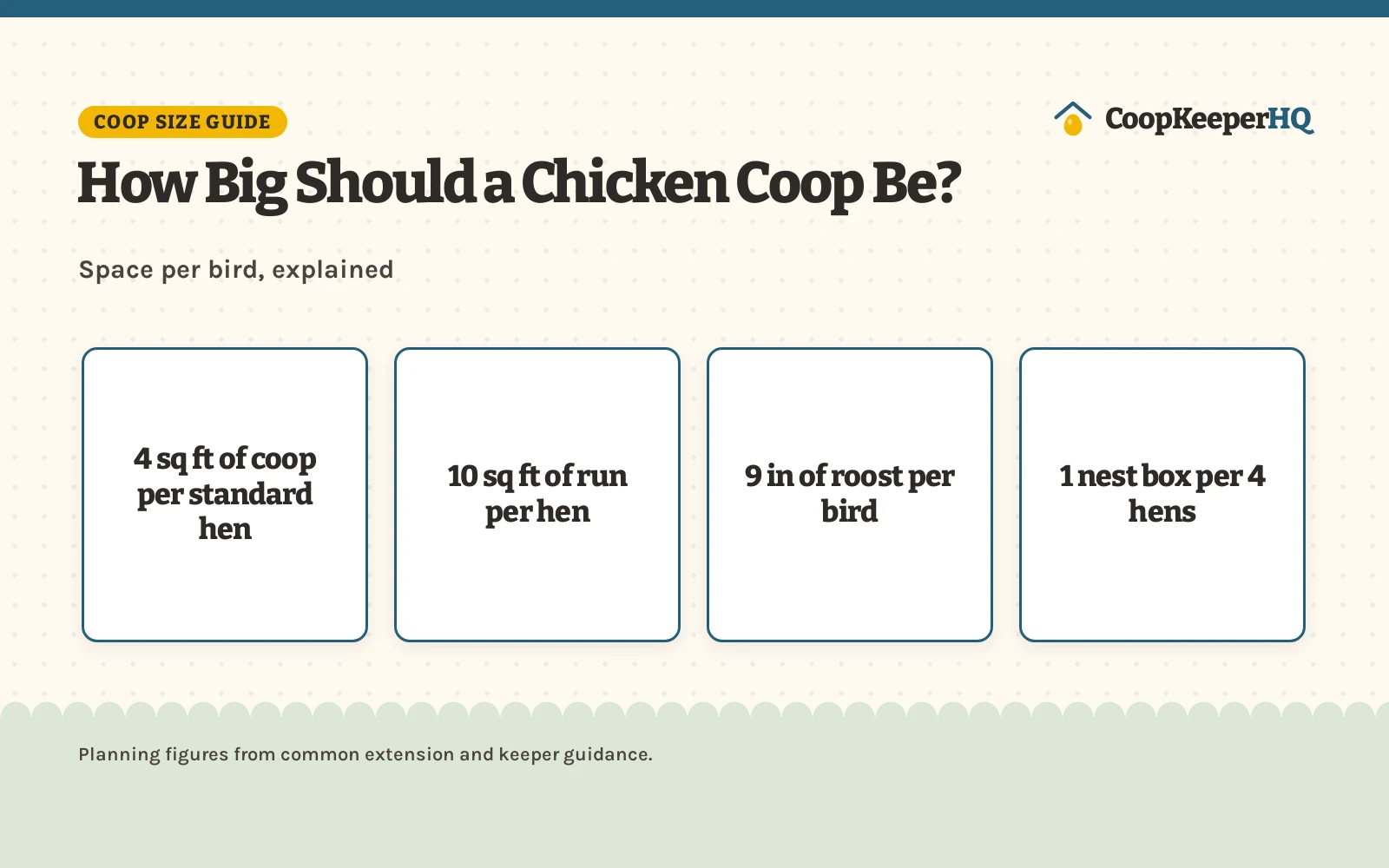
How big should a chicken coop be? The short answer most keepers use is about 4 square feet of coop floor per standard hen, plus about 10 square feet of run per hen. The longer answer depends on breed size, how much time your birds spend outside and what your winters are like, and it explains why so many coops sold “for 6 hens” are really comfortable for three or four.
Other options for the coop
 Automatic Chicken Coop Door Solar Powered with Timer & LightCheck price on Amazon
 PETNF Chicken Coop Heater 140 Watts Radiant Heat ChickenCheck price on Amazon
 Chicken Coop Heater for Winter with Remote APP ControlCheck price on Amazon
 Chicken Coop Heater for Winter with Smart APP ControlCheck price on Amazon
 Chicken Coop DoorCheck price on Amazon
 JVR Automatic Chicken Coop DoorCheck price on Amazon
CoopKeeperHQ earns a commission when you buy through links on this site, at no extra cost to you. Affiliate disclosure.
How big should a chicken coop be per bird?
These are the planning figures we use across CoopKeeperHQ, drawn from common extension and keeper guidance. They are rules of thumb, not legal minimums, and they assume birds that sleep in the coop and spend their days in a run or yard.
| Bird size | Coop floor per bird | Run per bird | Roost bar per bird |
|---|---|---|---|
| Bantam (Silkie, Sebright, Japanese) | 2 sq ft | 5 sq ft | 6 in |
| Standard (Rhode Island Red, Barred Rock, Australorp) | 4 sq ft | 10 sq ft | 9 in |
| Large (Brahma, Cochin, Jersey Giant, Orpington) | 5 sq ft or more | 15 sq ft | 12 in |
Add one nesting box for every four hens, rounded up. Hens share boxes happily, and most flocks pick one favorite anyway.
Six standard hens: 6 x 4 = 24 sq ft of coop floor, 6 x 10 = 60 sq ft of run, 6 x 9 in = 54 in of roost bar, and 2 nesting boxes. The coop size calculator does this for any flock.
Why the number on the box is often too high
Prefab coop listings usually quote how many birds can fit on the roost at night, not how many can live in the coop through a rainy week. A coop with a 3 ft by 4 ft interior has 12 sq ft of floor. At 4 sq ft per standard hen that is a coop for three, even if the box says six.
Floor space is also smaller than the outside dimensions. Walls, a ramp, a nesting box that sits on the floor and a pull-out tray frame all take room. When a listing gives only overall dimensions, measure the inside before you count birds. Our coop guides show the maker’s hen count next to a realistic count for exactly this reason, starting with our picks for six chickens.
Breed size changes the answer
A flock of Silkies and a flock of Brahmas are very different buildings. Bantams can live comfortably on about half the floor of a standard hen, while large breeds need more floor, wider doors, bigger nesting boxes and lower, sturdier roosts. If you keep a mixed flock, size the coop for the largest birds. Our chicken breed table lists a suggested coop floor per bird for 30 breeds, and pages such as Brahma and Silkie show the space for three, six and ten birds.
Run space and time outside
The coop is where birds sleep, lay and shelter. The run is where they spend their day. How much run you need depends on how often they get out beyond it:
- Free-ranging most days: the coop floor stays the same, and a smaller run (about half) covers bad-weather days and days you are away.
- A daily run with some free-range time: about 10 sq ft per standard hen.
- Coop and run only: birds that never leave need more room to stay calm, so plan about 1.5 times the usual run.
A cramped run is where boredom, feather pecking and mud start. If space is tight, a covered run that stays dry is worth more than a few extra square feet of mud.
Climate: winter and summer
In cold, snowy places birds may stay inside for days at a time, so we add about 25 percent to the coop floor. Good ventilation matters even more in winter: moisture from breath and droppings, not cold alone, is what frosts combs, so keep vents open high on the walls and keep drafts away from the roost. Our guide to coops for cold climates covers what to look for.
In hot climates, ventilation and shade matter more than extra floor. Large screened vents on two sides, a light-colored roof and a shaded run do more for comfort than a bigger footprint.
Roosts, nesting boxes and headroom
- Roosts: about 8 to 10 inches of bar per standard bird, set higher than the nesting boxes so hens do not sleep in them. Large breeds want lower, wider bars.
- Nesting boxes: one per four hens, roughly 12 by 12 inches for standard hens and larger for big breeds, placed in a darker corner.
- Headroom: enough height for roosts above the floor and for you to reach every corner when cleaning. For flocks of ten or more, a walk-in coop makes cleaning far easier; see walk-in coops.
Coop size by flock size
| Standard hens | Coop floor | Run | Roost bar | Nest boxes |
|---|---|---|---|---|
| 3 | 12 sq ft | 30 sq ft | 27 in | 1 |
| 4 | 16 sq ft | 40 sq ft | 36 in | 1 |
| 6 | 24 sq ft | 60 sq ft | 54 in | 2 |
| 10 | 40 sq ft | 100 sq ft | 90 in | 3 |
| 15 | 60 sq ft | 150 sq ft | 135 in | 4 |
| 25 | 100 sq ft | 250 sq ft | 225 in | 7 |
Figures assume a daily run in a mild climate. Most keepers add birds within a year or two, so if you sit between two sizes, buy for the larger one. Check your local ordinance and HOA rules first, because many towns cap backyard flocks at four to six hens. Browse every guide by flock size on our flock size page.
Birds, breed size, run time and climate in; coop floor, run space, roost length and nesting boxes out.
Many towns limit flock size, ban roosters or set how far a coop must sit from property lines, and HOAs often add their own rules. Check your local ordinance and HOA covenants before you buy a coop or order chicks. Read our Safety Disclaimer.
FAQ for the flock
How big should a chicken coop be for 6 chickens?
About 24 sq ft of coop floor for six standard hens, with roughly 60 sq ft of run, 54 inches of roost bar and two nesting boxes. In a snowy climate, plan on about 30 sq ft.
Is 2 square feet per chicken enough?
For bantams, yes. For standard hens it is tight, and birds kept that close tend to peck at each other, especially in winter when they stay inside. Aim for about 4 sq ft per standard hen.
How tall should a chicken coop be?
Tall enough for roosts above the nesting boxes and for good ventilation high on the walls. Small coops often have about 3 to 4 feet of interior height; walk-in coops let you stand up to clean.
Does a bigger run mean a smaller coop?
No. Birds still sleep, lay and shelter in the coop, so the coop floor stays the same. A big run or free-ranging reduces the run you need, not the coop.
How many chickens can I fit in a 4×8 coop?
A 4 by 8 foot interior is 32 sq ft, enough for about eight standard hens, sixteen bantams or six large-breed birds, if the nesting boxes sit outside the floor area.
More coop guides
- How to Use Compost Bin for Coop Waste
- Chicken Coop Fan vs Heater: Which One Should You Buy?
- Insulated vs Uninsulated Chicken Coop: Which One Should You Buy?
- Side vs Top Door Chicken Coop: Which One Should You Buy?
- Mobile vs Stationary Chicken Coop: Which One Should You Get?
- Digital vs Analog Incubator Thermometer: Which Hatches Better?
- How to Keep Chickens Cool in Summer: Shade, Water and Airflow
- Are Backyard Chickens Worth It? Costs, Time and Eggs
- Chicken Keeping Supplies List: What You Need and What Can Wait
- Best Chicken Coop for 6 Chickens: Picks Checked for Real Floor Space
- Best Chicken Coop for 10 Chickens: Roomy Picks for a Growing Flock
- Best Chicken Tractor: Mobile Coops Compared by Real Space
See every chicken coop guide, the first-flock checklist and the chicken breed table.