Chicken Egg Incubator Temperature and Humidity Settings
Two readings run the hatch: this guide explains chicken egg incubator temperature and humidity, how to measure each, and what to do when they drift.

On this page
Top picks at a glance
As an Amazon Associate I earn from qualifying purchases.
- 1
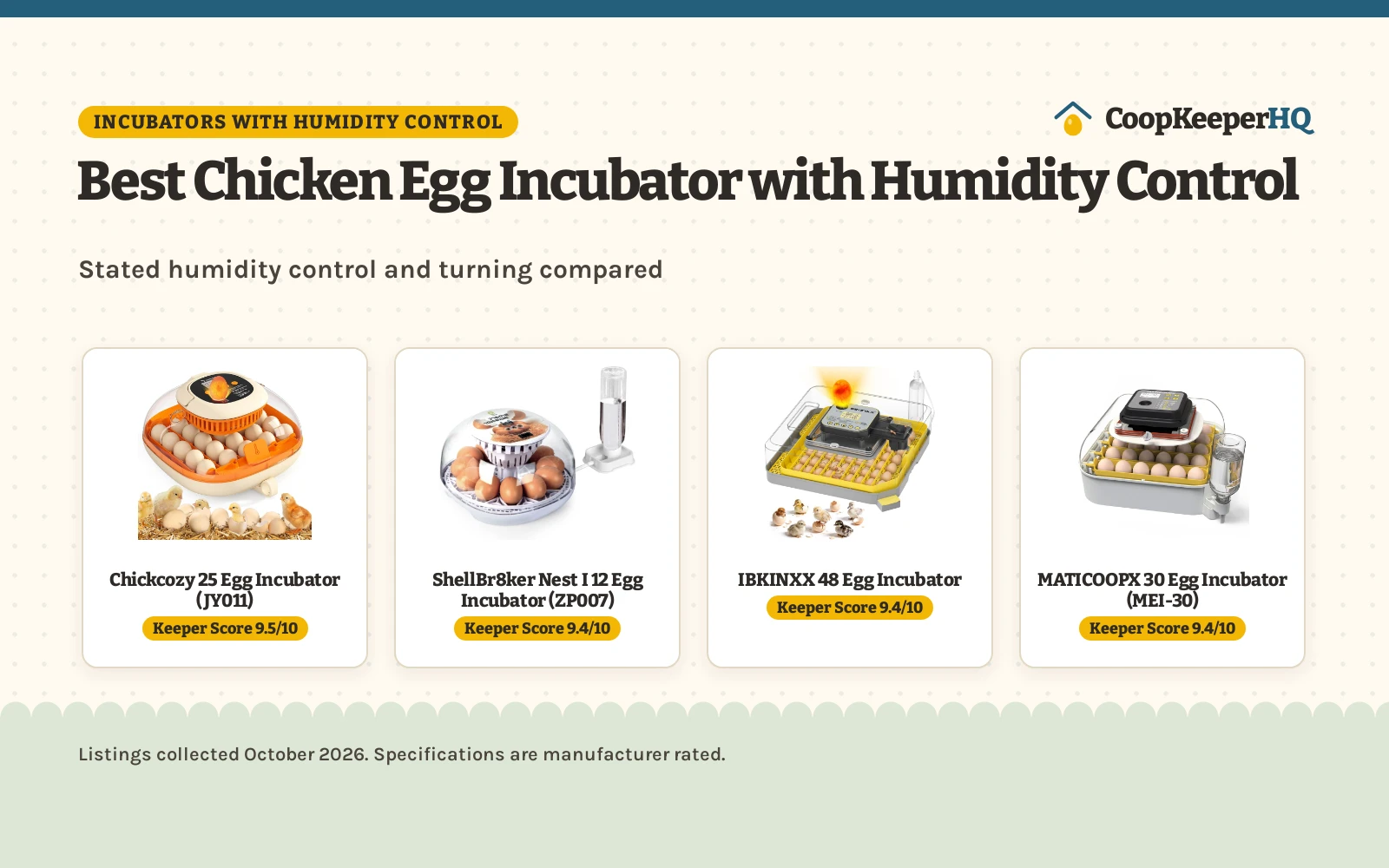
 Chickcozy 25 Egg Incubator with Humidity Control and Egg9.5/10View on Amazon
- 2
 IBKINXX 48 Egg Incubator with Auto Humidity Control System9.4/10View on Amazon
- 3
 MATICOOPX 30 Egg Incubator with Humidity Display and Egg9.4/10View on Amazon
- 4
 Weewooday 6 Pcs Digital Humidity Meter with Probe LCDView on Amazon
- 5
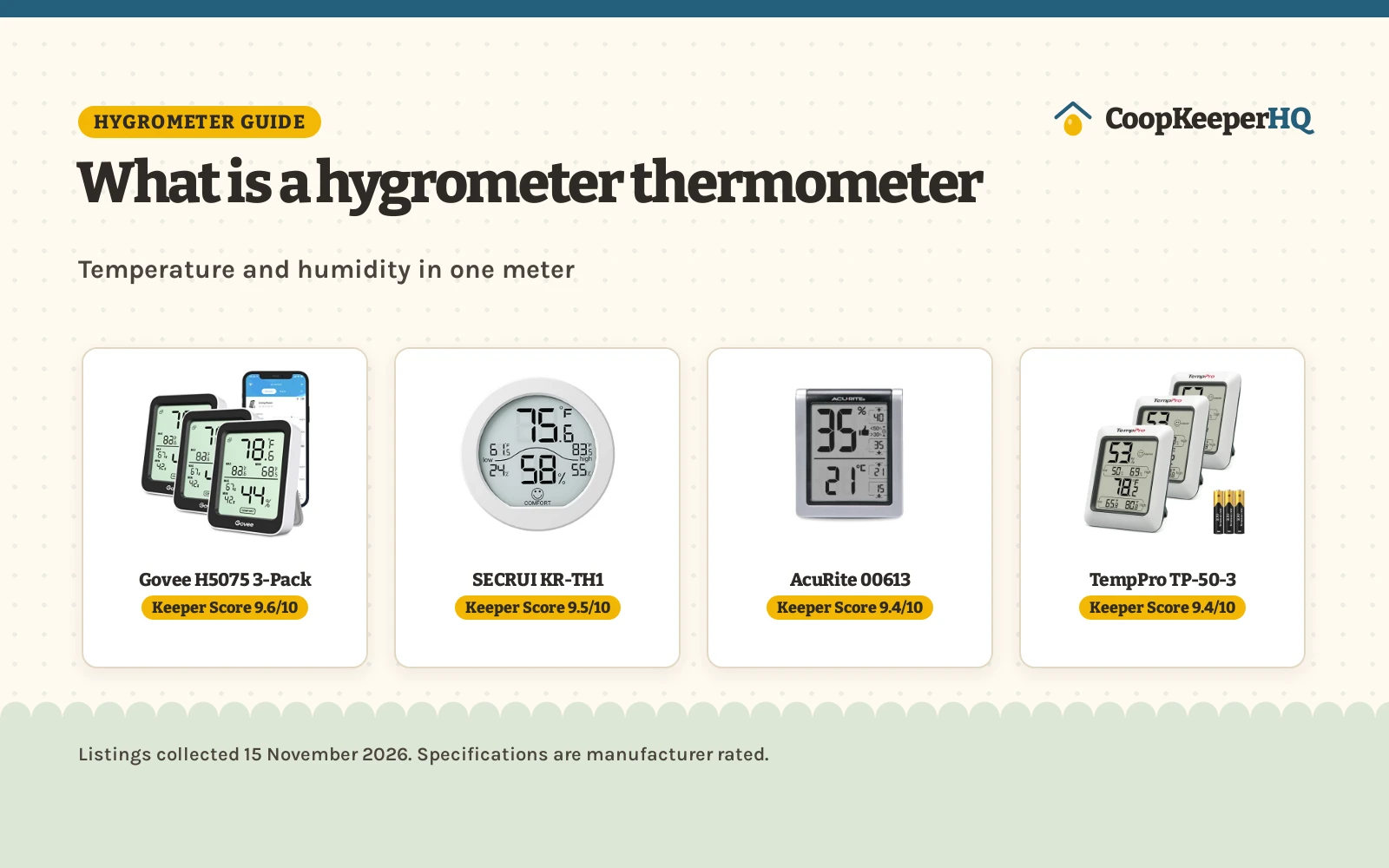
 Inkbird ITH-10 Digital Thermometer and Hygrometer TemperatureView on Amazon
- 6
 Egg Incubators for Hatching EggsView on Amazon
- 7
 Incubator for Hatching EggsView on Amazon
- 8
 18 Egg Incubator for Hatching Eggs with Humidity &View on Amazon
- 9
 KEBONNIXS 12 Egg Incubator with Humidity DisplayView on Amazon
The eggs are in and the lid is shut, so chicken egg incubator temperature and humidity are the readings that shape the hatch from here on. The keeper’s job is to watch both and hold them steady. This guide explains what each reading does, how to measure it, and what to check when a reading drifts.
Other options for the coop
 Weewooday 6 Pcs Digital Humidity Meter with Probe LCDCheck price on Amazon
 Inkbird ITH-10 Digital Thermometer and Hygrometer TemperatureCheck price on Amazon
 Egg Incubators for Hatching EggsCheck price on Amazon
 Incubator for Hatching EggsCheck price on Amazon
 18 Egg Incubator for Hatching Eggs with Humidity &Check price on Amazon
 KEBONNIXS 12 Egg Incubator with Humidity DisplayCheck price on Amazon
CoopKeeperHQ earns a commission if you buy through our links, at no added cost to you. Affiliate disclosure.
Chicken Egg Incubator Temperature and Humidity: What the Two Readings Do
Temperature drives development inside the egg, and humidity governs how much moisture the egg loses while it develops. When temperature runs cool, development slows; when it runs warm, the embryo is under strain. When the air inside the incubator is too dry, the egg loses moisture faster than it should; when it is too damp, the hatch can struggle. Neither reading works alone: a steady temperature with swinging humidity, or steady humidity with a drifting temperature, still leaves the hatch at risk. That is why most of the listings combine the two measurements in a single meter, and why keepers watch both on the same display.
Measure temperature at egg height
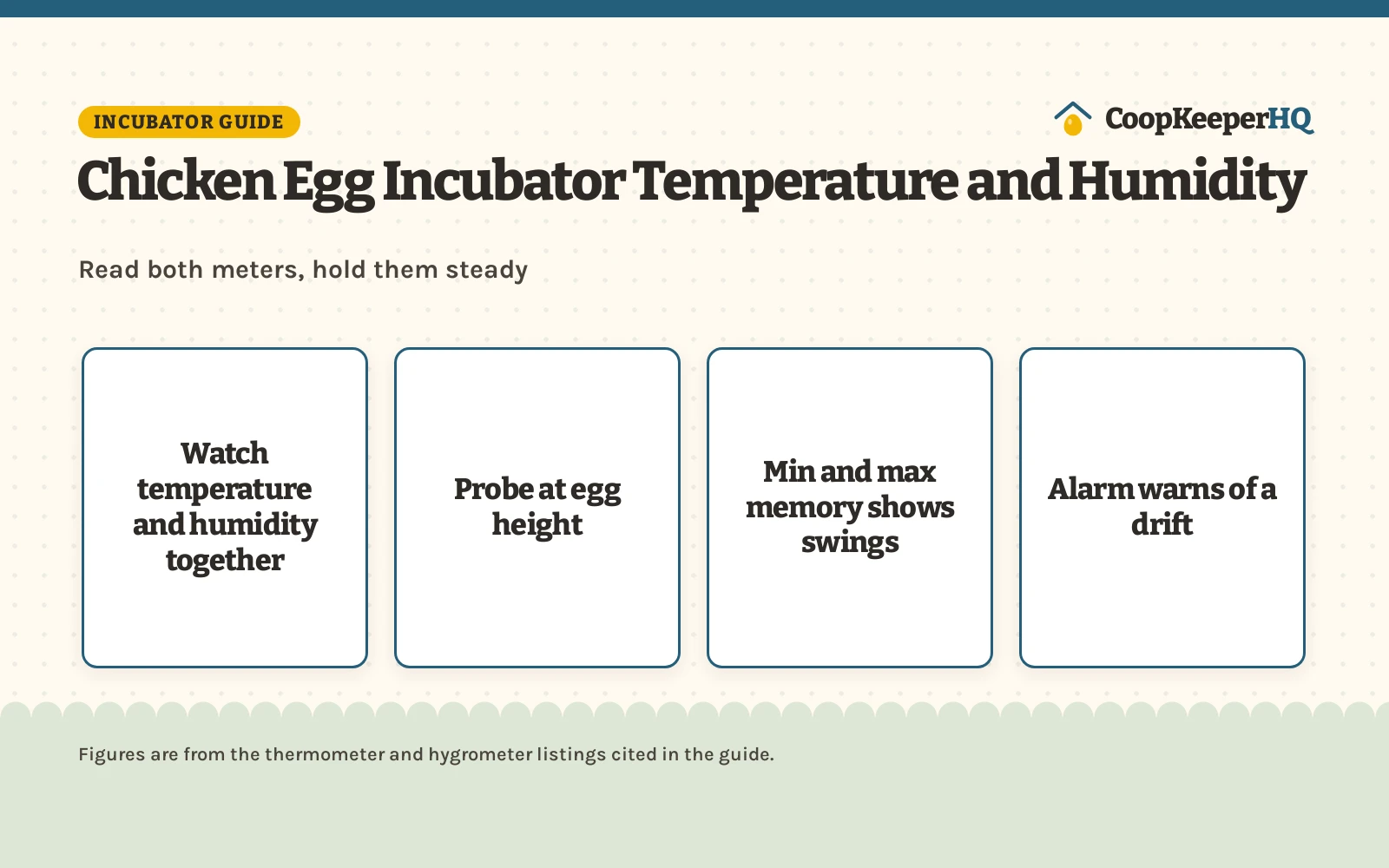
Air near the lid can run warmer than air at the eggs, so the probe belongs where the eggs sit. The Little Giant thermometer (on Amazon) mounts on a clear backing that measures 4.5 inches wide by 5.5 inches high, made to sit on top of the eggs and keep the thermometer at egg height. The Egg-O-Meter takes a different route: its sensor sits inside a synthetic egg, so it reads the temperature of the egg itself rather than the air around it, and a 36-inch cord lets the display sit outside the incubator. The IncuTherm Plus uses a remote probe the same way: the probe goes inside with the eggs while the display stays outside for easy viewing. Whichever meter you use, keep the sensor or thermometer at egg height and leave it there, since moving it makes the numbers jump.
Humidity needs its own reading
Humidity is the reading keepers guess at most. Several of the hygrometers in the listings measure humidity from 10% to 99%RH, and the reading moves whenever water is added to the incubator, the lid opens, or the room air changes. A meter that reads in Fahrenheit only, like the Veanic, still shows humidity on the same display, so both readings sit side by side. Watch the humidity reading after the lid has been shut for a while rather than right after opening it, since opening the lid lets the damp air out. For the full hatching routine, see how to incubate chicken eggs at home.
Pick a meter that fits the incubator
Several of the listings are digital thermometer hygrometers with a probe, and the differences that matter are accuracy, memory, and how the display is read. Several listings state a temperature accuracy of ±2℉ and a humidity accuracy of ±5%RH, while the Inkbird states ±1.8℉ and ±3%RH and the IncuTherm Plus states ±1°. A tighter accuracy figure means the reading sits closer to the true temperature. Min and max memory, on the IncuTherm models, the Egg-O-Meter and the Inkbird, records the highest and lowest readings since the memory was last cleared, so a swing that happened overnight still shows in the morning. The Egg-O-Meter adds a programmable alarm that can be set in one-degree increments to warn when the temperature moves past a chosen point. Meters come in packs as well: the EWPJDK and Weewooday listings are 6 packs, the Veanic is a 4-pack, and the JEDEW and DWEII listings are 2 packs, so a spare meter is on hand to check a reading that looks wrong. The DWEII meter (on Amazon) takes 2 LR44 button batteries, and the IncuTherm models come with a battery included. See the thermometer guide for the brooder box for a meter that also works past hatch day.
Set the meter up before the eggs go in
Set the incubator running with the meter in place before the eggs go in, and let the readings settle. Several of the meters in the listings respond every 10 seconds, so the display catches up quickly after the lid closes, but a settled incubator still reads steadier. The EWPJDK meter (on Amazon) fits an embedded opening of 1.81 x 1.06 inches, and double-sided tape holds it where the opening does not fit. The IncuTherm models read in Celsius and Fahrenheit, so pick the unit you read most easily and leave it there. Keep the probe dry: the Weewooday and Veanic listings warn that the probe is not made to sit in water, so never rest it in the water channel. Place the probe at egg height, keep the cord clear of the lid seal, and write down the readings at the same time each day.
Watch for swings with min and max memory
A single reading tells you where the incubator sits right now; min and max memory tells you where it has been. The IncuTherm Plus, the IncuTherm and the Inkbird all record the highest and lowest temperature and humidity readings, and the Egg-O-Meter records the highest and lowest temperature readings, so a dip overnight or a spike while the room warmed up still shows on the display in the morning. Check the memory at the same time each day and clear it after noting the figures. A wide gap between the minimum and the maximum means the incubator is swinging rather than holding steady, and the cause is usually the room or the lid rather than the meter: a cold room at night, a lid that does not sit flat, or a probe that has slipped away from the eggs. If the memory shows no swing and the live reading still looks wrong, check it against a spare meter before changing anything.
When the readings drift
When a reading moves off where it was, work through the simple causes first. Look at the probe: it may have slipped off the eggs, fallen against the incubator wall, or ended up in water. Look at the lid: a lid that is not fully shut lets warm, damp air escape and the readings slide. Look at the room: a cold night or a sunny window can move the room air, and the incubator follows it. Look at the water: a dry reservoir lets the humidity reading fall, and topping it up brings it back. Look at the meter itself: a low battery can make the display fade or the readings wander, and the DWEII meter runs on 2 LR44 button batteries. If the meter still reads oddly after all that, swap in a spare meter and compare the two. For a step-by-step hatching routine, see the manual egg incubator guide.
A simple daily check
- Read the temperature and humidity on the display
- Check the min and max memory for swings
- Look at the water level in the reservoir
- Check that the probe sits at egg height
- Check that the lid is fully shut
- Note the readings each day
Pick a species and a set date for candling days, lockdown and hatch day, with a calendar file to save.
Run the incubator for a day before you set eggs to confirm temperature and humidity, keep it away from direct sun and drafts, and plug it into a protected outlet. Plan the brooder before hatch day. Wash your hands after handling eggs and chicks. See CDC backyard poultry guidance. Read our Safety Disclaimer.
FAQ for the flock
What temperature should a chicken egg incubator be?
The thermometer listings state measuring ranges, not a target setting: several cover -58℉ to 158℉, which is far wider than any incubator setting. Follow the incubator maker’s instructions for the setting, and use the meter to hold it steady.
What humidity should a chicken egg incubator be?
Several of the hygrometer listings state a measuring range of 10% to 99%RH, not a target. Follow the incubator maker’s instructions for the humidity setting, and watch the meter to hold it steady through the hatch.
Where does the thermometer probe go in an incubator?
At egg height, with the eggs. The Little Giant thermometer sits on top of the eggs on a backing that measures 4.5 inches wide by 5.5 inches high, and the IncuTherm Plus probe goes inside while the display stays outside.
How accurate are incubator thermometer hygrometers?
It varies by listing. Several state ±2℉ and ±5%RH, the Inkbird states ±1.8℉ and ±3%RH, and the IncuTherm Plus states ±1°. A tighter figure means the reading sits closer to the true temperature and humidity.
Can a regular room thermometer be used in an incubator?
The listings include indoor meters used in incubators, but a meter with a remote probe is easier to live with: the probe sits with the eggs while the display stays outside, so the lid stays shut while you read it.
Why does my incubator humidity keep changing?
The reading moves when the lid opens, when water is added, or when the room air changes. Check the min and max memory to see how far it swings, then check the lid, the water level, and the probe position.
More coop guides
- How to Incubate Chicken Eggs at Home
- Manual Egg Incubator: Hatching at Home, Step by Step
- Cool Top vs Still Air Incubator: Which One Should You Buy?
- Foam vs Plastic Egg Incubator: Which One Should You Buy?
- Turkey Egg Incubator vs Chicken Egg Incubator: Which One Should You Buy?
See the incubators and hatching guides and the egg handling guides.