Chicken Wire Sizes: Mesh Openings, Gauges and Roll Dimensions
A practical guide to standard chicken wire sizes, comparing hexagonal mesh openings, wire gauges, and roll dimensions for poultry runs and garden barriers.

On this page
Top picks at a glance
As an Amazon Associate I earn from qualifying purchases.
- 1
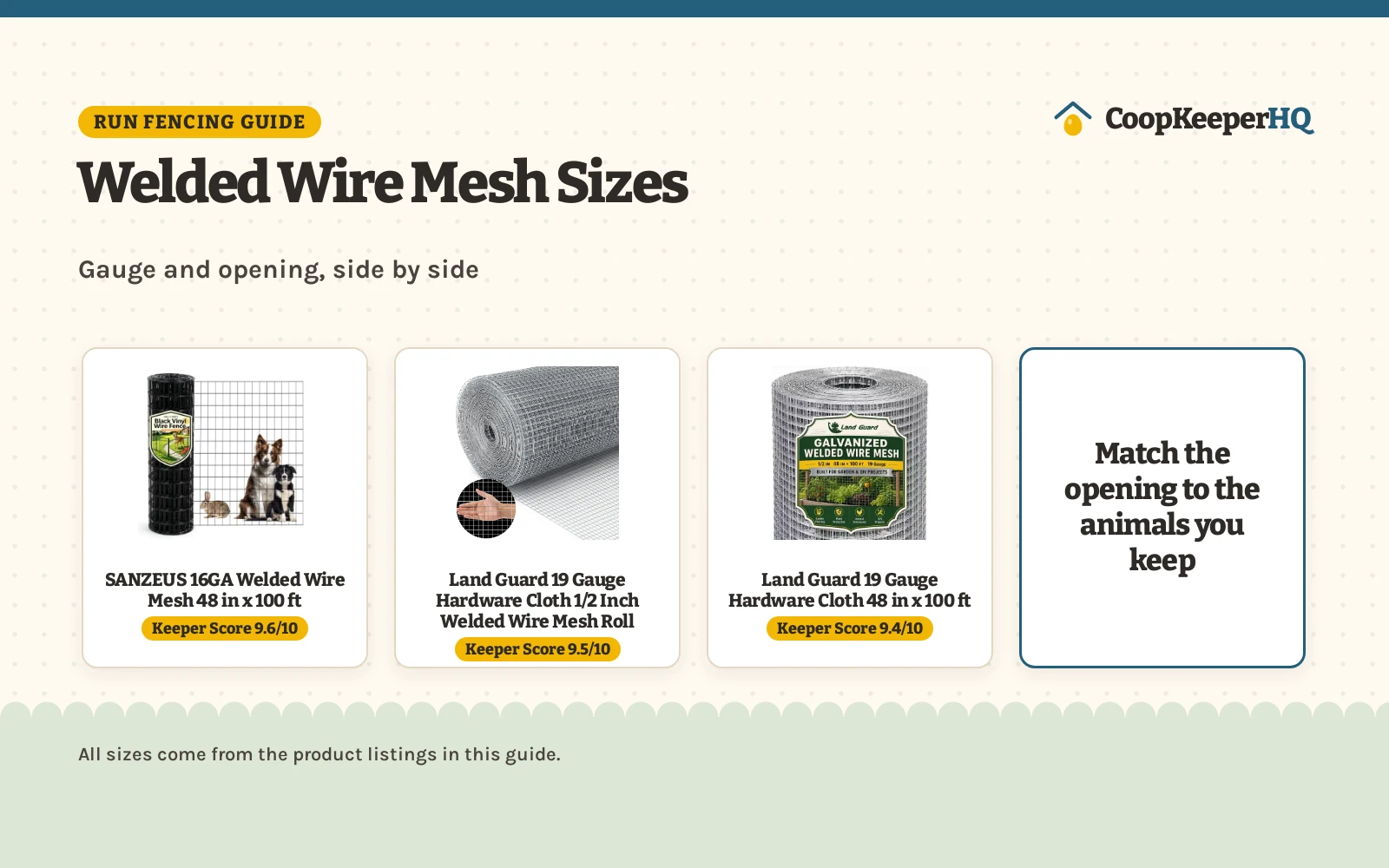
 Land guard 19 Gauge Hardware Cloth9.4/10View on Amazon
- 2
 SANZEUS PVC Coated Welded Wire Mesh 16GA 48 in x 100 ft9.6/10View on Amazon
- 3
 Land Guard 19 Gauge Hardware Cloth9.5/10View on Amazon
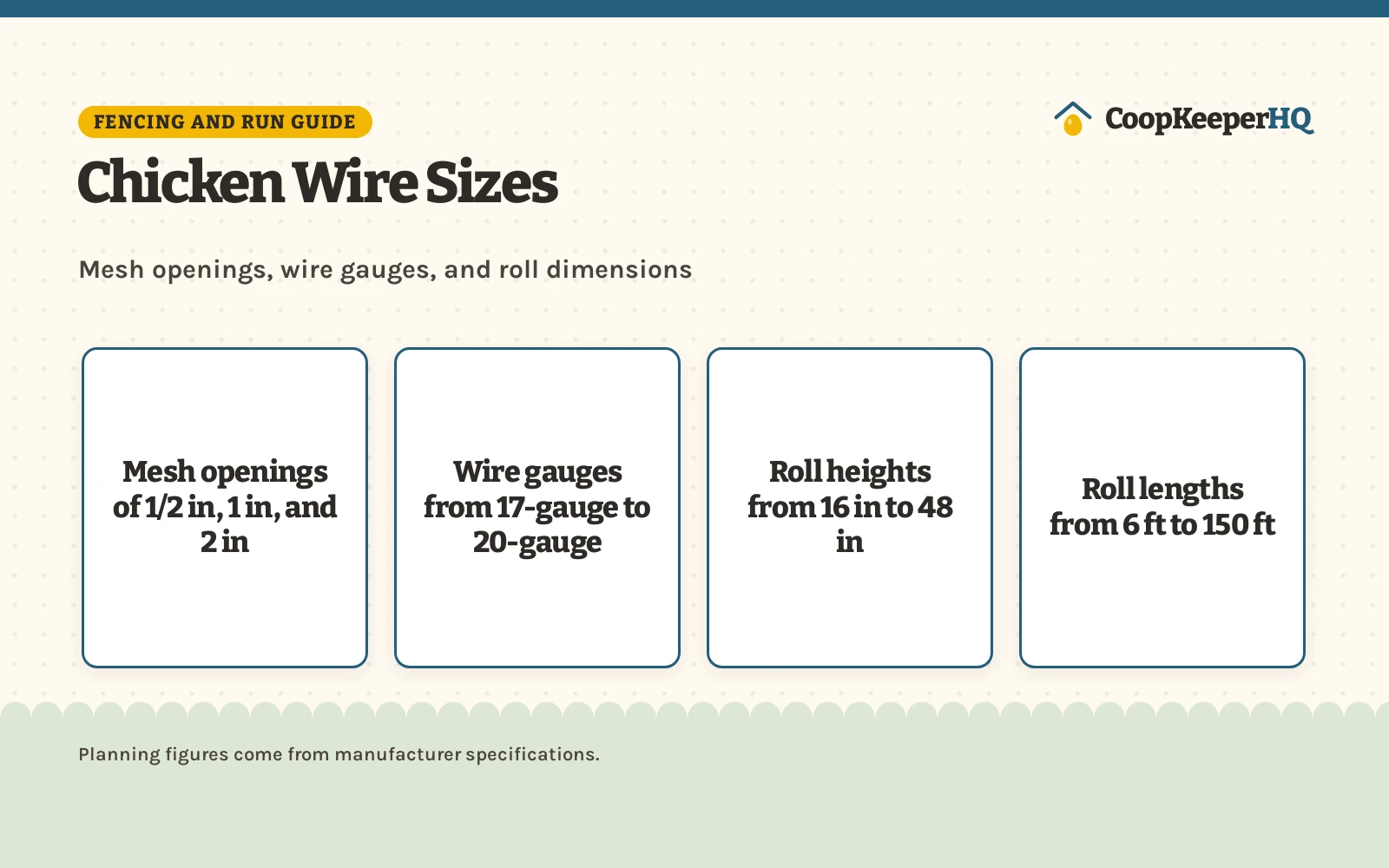
Standard chicken wire sizes center on 1-inch and 2-inch hexagonal mesh openings, alongside 1/2 inch welded wire options, paired with wire diameters from 20-gauge (0.9mm) down to 0.6mm and 0.5mm strands. Roll heights typically measure 16 inches, 36 inches, or 48 inches (4ft), while roll lengths range from 6ft rolls to full 50ft, 100ft, and 150ft fencing rolls. Choosing the right size depends on whether you are confining adult birds, excluding small garden pests, or covering run roofs.
CoopKeeperHQ earns a commission if you buy through our links, at no added cost to you. Affiliate disclosure.
Chicken wire sizes: choose the right mesh opening first
Mesh opening refers to the gap between wire strands. Traditional chicken wire features twisted hexagonal openings, most commonly 1-inch or 2-inch across. In comparison, HANWRAPS lists a 1/2 inch opening and HORCH lists a 1/2 inch aperture on welded wire. This tight 1/2 inch welded spacing stops mice and small rodents from squeezing through and keeps young chicks safely contained. For adult chickens, 1-inch hexagonal wire is the standard choice: vensovo lists a 1-inch mesh, 24 Rifny lists a 1 inch mesh, Moyios lists a 1 inch opening, and Yardbliss lists a 1 inch opening. If you only need to define a large boundary perimeter for mature hens, HOSTIC lists a 2-inch mesh opening with two inches between knots. If keeping small critters out is your main goal, our guide to chicken wire with small holes compares fine-mesh rolls.
Understanding wire gauge and wire diameter
Wire gauge measures strand thickness inversely: a lower gauge number means a thicker wire. Yardbliss lists a 17-gauge wire, which provides thick strands that hold their shape along fence lines. HORCH lists a 19-gauge wire strand, offering rigid structure for garden and run boundaries. HOSTIC lists a 20-gauge wire with 0.9mm diameter, which provides greater strength than lighter wire netting. Standard hexagonal poultry netting uses thinner, more flexible strands: TOYPOPOR, 24 Rifny, and Moyios list 0.6mm diameter wire, while vensovo lists 0.5mm wire diameter. These 0.5mm and 0.6mm strands are pliable and easy to shape by hand along curves, but they offer less physical resistance than heavier gauges.
Standard roll heights and widths
Selecting the right roll height keeps installation simple by minimizing seams. TOYPOPOR and Moyios list 16 inch widths, HANWRAPS and Mklsit list 15.7 inches, and 24 Rifny lists 16.5 inches. These narrow rolls suit low garden borders, raised planter beds, and temporary garden partitions. For general run fences and garden boundaries, vensovo and Yardbliss list 36 in roll heights. When enclosing full-height runs, HOSTIC lists a 4ft (48 inches) width, and HORCH lists a 48 inches height. A 48 inches roll provides full vertical coverage to keep adult hens from fluttering over low barriers.
Selecting roll lengths for backyard projects
Roll length determines how much area you can fence in a single continuous run. HANWRAPS lists a 6ft roll for small patches and planter boxes, while Mklsit lists 13.1 feet and 26.24ft rolls for craft and garden projects. For medium backyard enclosures, Moyios lists a 50ft roll, 24 Rifny lists a 60ft roll, and TOYPOPOR lists an 82ft roll. Large backyard enclosures and long run perimeters require bulk rolls: HORCH and Yardbliss list 100ft rolls, while vensovo and HOSTIC list 150ft rolls. Using a 100ft or 150ft roll avoids frequent splicing and weak joints along extended fence lines. For budget options, see our cheap chicken wire picks.
Galvanized steel versus PVC coatings
Outdoor wire fencing faces damp soil and rain, making corrosion protection essential. TOYPOPOR lists galvanized steel wire, while HOSTIC, vensovo, and Moyios list hot-dip galvanized steel wire where a thick zinc layer bonds to the metal core to resist rust. Mklsit and Yardbliss list PVC coated and vinyl coated wire over a galvanized steel core. The outer plastic coating seals the wire against moisture, prevents corrosion in wet soil, and provides smooth edges that reduce skin scratches during handling.
Chicken wire versus hardware cloth for predator protection
A common mistake among new keepers is using chicken wire for nighttime predator security. Hexagonal chicken wire is designed to keep chickens inside a perimeter, not to keep determined predators out. Raccoons can reach through 1-inch and 2-inch hexagonal openings, while larger animals can tear lightweight 0.6mm wire netting. For secure nighttime coop ventilation windows, run skirtings, and predator aprons, keepers switch to heavy welded mesh. Read our hardware cloth guide to understand how welded wire differs, and see our hardware cloth for chicken coops guide for protective setups.
Where chicken wire works best around the coop and run
While chicken wire should not secure nighttime sleeping quarters, it performs reliably in daytime and overhead applications. It serves as an economical roof cover across chicken runs to block hawks and owls. See our guide on poultry netting for run roofs for aerial barrier ideas. Chicken wire also works well for dividing internal run space, separating breeding pens, or keeping foraging hens out of vegetable patches and flower beds.
Cutting, shaping, and fastening wire mesh
Hexagonal chicken wire is flexible and unrolls smoothly along fence posts. To simplify setup, 24 Rifny packages 100 zip ties with its wire roll for quick attachment to T-posts and stakes. Lightweight 0.5mm and 0.6mm wire cuts easily with standard wire snips. Our chicken wire cutters guide highlights reliable cutting tools. Moyios includes a pair of nitrile gloves and wire pliers with its roll to protect hands from sharp wire ends during cutting. Fasten the wire firmly using fencing staples on wood framing or UV-stabilized zip ties on metal posts, keeping tension even along the roll.
Routine inspection and maintenance
Keep your fencing sound with regular seasonal inspections. Walk your fence line to check for sagging sections, broken wire strands, or loose fasteners. Clear damp leaves and heavy organic matter away from the bottom edge to reduce moisture buildup and extend the life of galvanized coatings. Replace damaged ties promptly and restaple loose sections to ensure hens cannot squeeze through perimeter gaps.
A simple chicken wire sizing checklist
- Choose 1/2 inch welded mesh when blocking rodents or containing young chicks
- Choose 1-inch hexagonal mesh for general adult chicken containment and garden barriers
- Choose 2-inch hexagonal mesh for lightweight overhead run netting or daytime boundary runs
- Select 17-gauge or 19-gauge welded wire when you need rigid barrier strength
- Use 48 inches (4ft) roll height for full run enclosures, or 16 inches for low garden borders
- Switch to welded hardware cloth on coop ventilation windows and nighttime sleeping quarters
Birds, breed size, run time and climate in; coop floor, run space, roost length and nesting boxes out.
Use a charger rated for the length of netting you run, ground it as the manual describes and post warning signs where neighbors or children can reach the fence. Keep grass and weeds off the bottom strands, and never leave netting unpowered, because birds and wildlife can tangle in it. Read our Safety Disclaimer.
FAQ for the flock
What is the most common chicken wire size?
The most common chicken wire opening for adult chickens is 1-inch hexagonal mesh. Keepers frequently pair this opening with 36 in or 48 inches (4ft) roll heights to build boundary fencing that keeps mature hens contained while remaining lightweight to install.
Can predators chew through 1-inch chicken wire?
Yes. Raccoons, foxes, and dogs can chew or pull through lightweight 1-inch hexagonal chicken wire. For predator-resistant night protection, replace chicken wire with 1/2 inch welded hardware cloth around the coop and lower run.
What chicken wire size is needed to contain baby chicks?
Young chicks can slip through 2-inch mesh openings. While makers like vensovo and 24 Rifny list 1-inch fine mesh designed to contain chicks, small chicks are safest behind 1/2 inch mesh, such as HANWRAPS lists, to prevent squeezing through fence gaps.
What is the difference between 20-gauge and 17-gauge chicken wire?
Wire gauge measures strand thickness inversely. Yardbliss lists a 17-gauge wire, which is thicker and more rigid than the 20-gauge wire listed by HOSTIC. Thicker 17-gauge wire resists bending, while 20-gauge wire is lighter and more flexible.
Is chicken wire tall enough to keep chickens from flying out?
A 48 inches (4ft) roll height provides adequate boundary containment for calm, heavy breeds. For lighter breeds that fly over fencing, keepers either clip wing feathers or install overhead netting across the run roof.
More coop guides
- Chicken Wire with Small Holes (2026): 5 Top Mesh Rolls Compared
- Cheap Chicken Wire: 5 Budget Picks for Runs and Coops (2026)
- Best Hardware Cloth for Chicken Coop Runs and Aprons
See the chicken runs and fencing picks and the predator protection guides.