What Is Hardware Cloth? Wire Mesh Guide for Chicken Coops
A complete guide to hardware cloth, explaining welded steel wire mesh, gauge thickness, grid opening sizes and installation methods for predator-proof chicken coops.

On this page
Top picks at a glance
As an Amazon Associate I earn from qualifying purchases.
- 1
 TUOKS Black PVC Coated Hardware Cloth9.8/10View on Amazon
- 2
 TUOKS Hot-Dip Galvanized Hardware Cloth9.8/10View on Amazon
- 3
 Hardware Cloth 1/2 inch Mesh 72" x 50' 19 Gauge Chicken Wire9.7/10View on Amazon
- 4
 AggFencer 16in x 10ft Black Hardware Cloth 1/2 inch 19Ga PVCView on Amazon
- 5
 Black Hardware Cloth 1/2 in 48 x 50 ft 19 Ga Welded MeshView on Amazon
- 6Black Hardware Cloth 1/2 in 36 x 100 ft 19 Gauge Wire MeshView on Amazon
- 7
 16" x 50' Hardware ClothView on Amazon
- 8
 Black Hardware Cloth 1/2inx48inx100ftView on Amazon
- 9
 1/4 inch Hardware Cloth Wire Mesh 24’’x100’ 23-Gauge Hot-dipView on Amazon
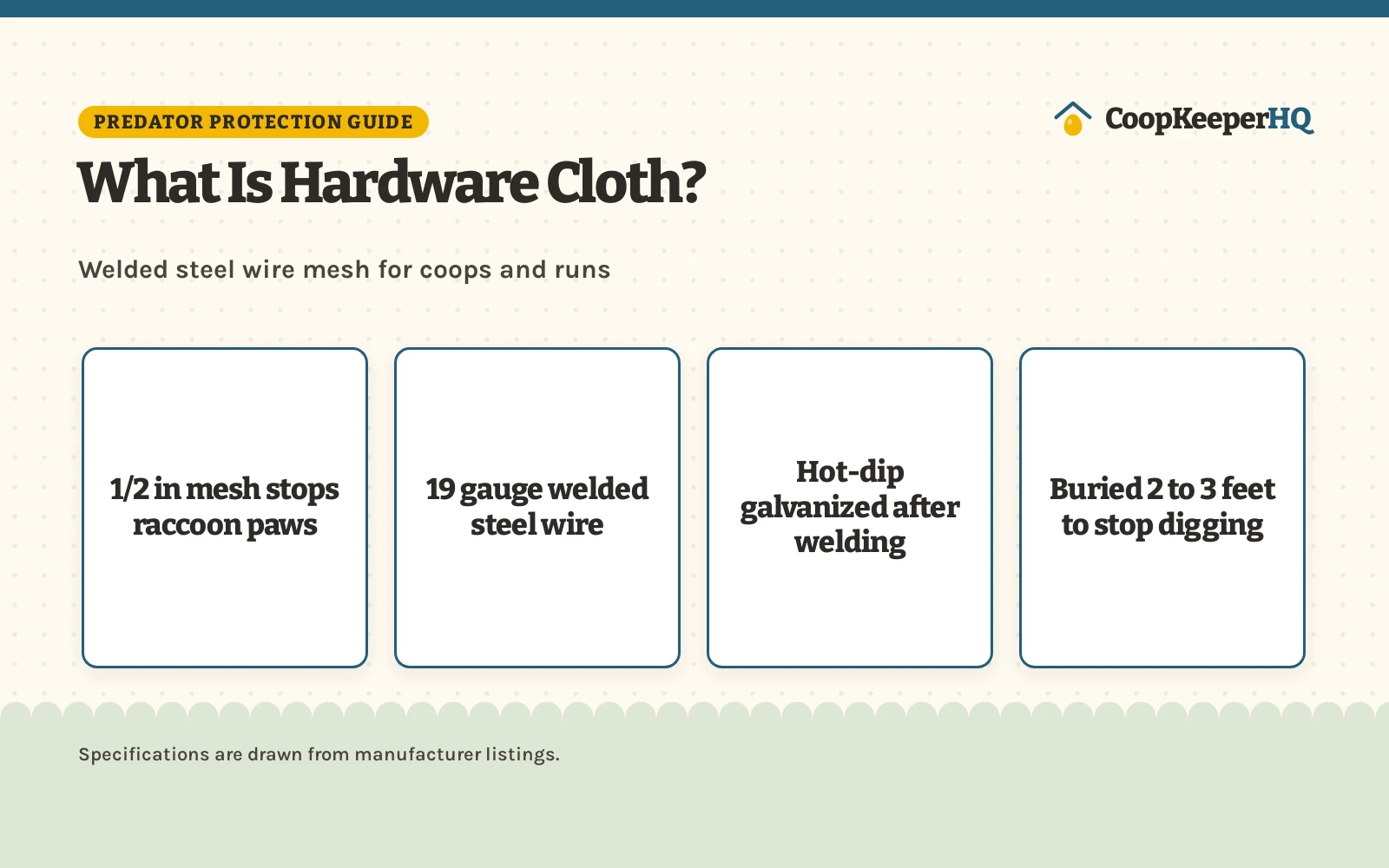
Hardware cloth is a heavy-duty welded steel wire mesh formed into a rigid grid of square openings, used by backyard poultry keepers to protect chicken coops and runs from predators. Unlike flexible woven chicken wire, hardware cloth cannot be easily pulled apart, chewed through, or stretched open by raccoons, dogs, and foxes. Installing this welded mesh across coop windows, ventilation openings, and run fencing creates a secure physical barrier that keeps chickens safe.
Other options for the coop
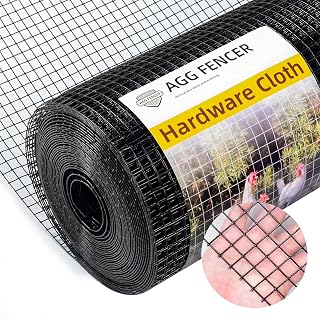 AggFencer 16in x 10ft Black Hardware Cloth 1/2 inch 19Ga PVCCheck price on Amazon
 Black Hardware Cloth 1/2 in 48 x 50 ft 19 Ga Welded MeshCheck price on Amazon
- Black Hardware Cloth 1/2 in 36 x 100 ft 19 Gauge Wire MeshCheck price on Amazon
 16" x 50' Hardware ClothCheck price on Amazon
 Black Hardware Cloth 1/2inx48inx100ftCheck price on Amazon
 1/4 inch Hardware Cloth Wire Mesh 24’’x100’ 23-Gauge Hot-dipCheck price on Amazon
CoopKeeperHQ earns a commission if you buy through our links, at no added cost to you. Affiliate disclosure.
What is hardware cloth: welded wire mesh explained
Despite the word cloth in its name, hardware cloth is not fabric. It is a stiff wire mesh made by arranging horizontal and vertical steel wire strands into a square grid and welding them together at every junction point. When planning a predator-resistant coop, many new keepers ask what is a hardware cloth and why it differs from common fencing. Understanding what does hardware cloth do to keep predators out helps you choose the right roll for your setup. This welding process locks each joint in place, creating a rigid sheet that resists impact, tearing, and pushing forces. Backyard chicken keepers rely on hardware cloth as the primary defense in predator protection because clever, strong predators cannot pull the welded joints apart.
Hardware cloth vs chicken wire
Many new flock keepers assume traditional chicken wire is adequate for coop security, but chicken wire and hardware cloth serve completely different purposes. Chicken wire is a thin, flexible mesh made by twisting wires into hexagonal openings. It is designed to keep chickens inside a pen, not to keep hungry predators out. Raccoons, foxes, coyotes, and neighborhood dogs can easily rip through twisted hexagonal wire, bite through the thin strands, or stretch the openings wide enough to squeeze into the coop. Raccoons can also reach their paws through wide hexagonal gaps to grab roosting birds. Welded wire mesh stops this because the steel strands cannot slide or expand under pressure. To explore fencing options, see our chicken wire alternative guide and our hardware cloth vs welded wire comparison.
Choosing the right mesh opening size
Hardware cloth is defined primarily by its mesh opening size, which refers to the measurement of the square holes in the grid. Common opening sizes used for poultry housing are 1/2 inch and 1/4 inch.
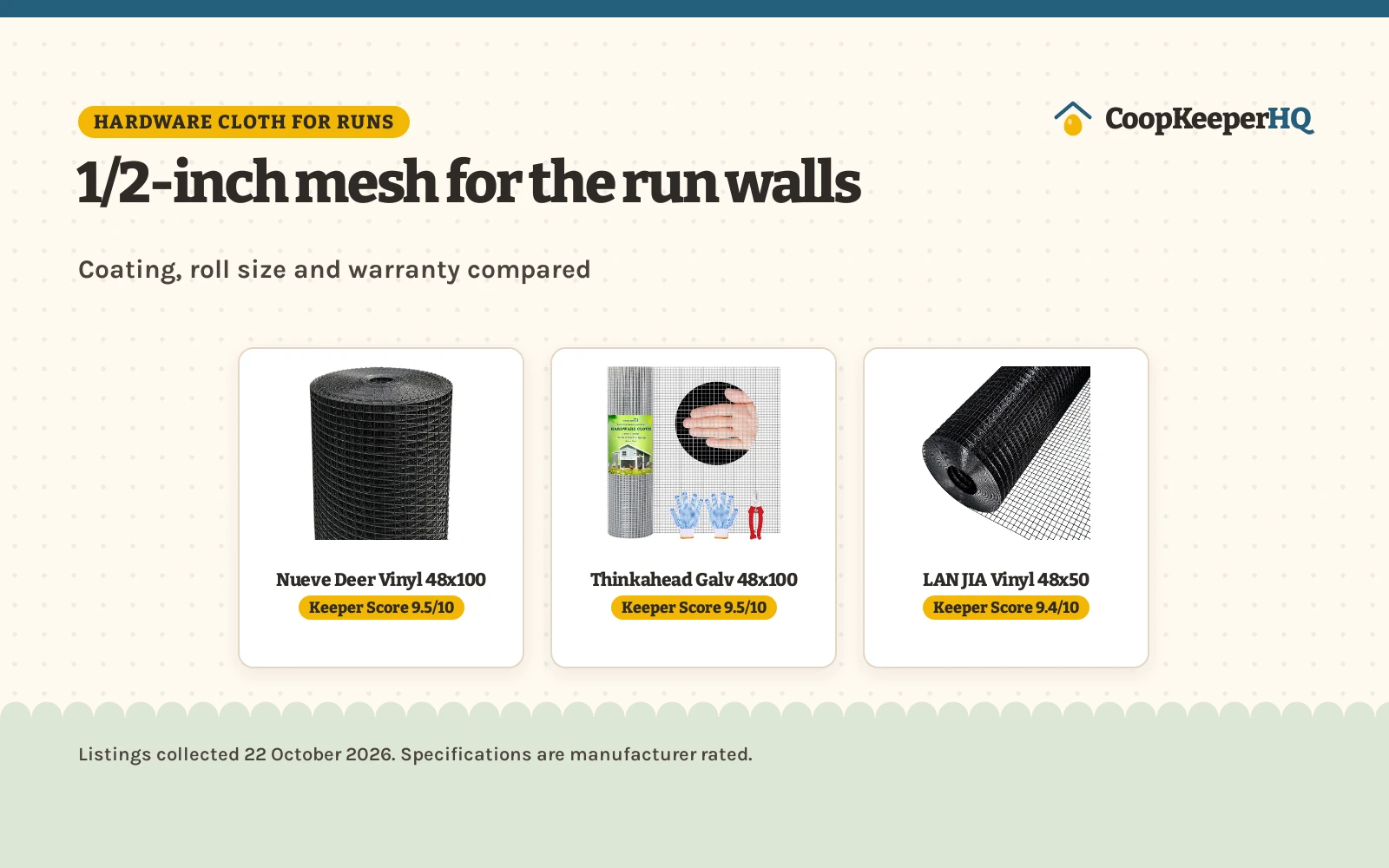
A 1/2 inch mesh is the standard selection for backyard coops, run walls, and high ventilation openings. The 1/2 inch spacing blocks raccoon paws, opossums, hawks, and large rodents while still allowing plenty of fresh air and light to circulate through the coop. Makers such as Land Guard, SANZEUS, and Yardbliss publish 1/2 inch mesh rolls as dedicated poultry protection barriers. LAN JIA notes in its listing that 1/2 inch mesh openings protect chickens from raccoons, foxes, and hawks.
A 1/4 inch mesh features significantly narrower square openings. This tighter weave is particularly useful in regions with heavy populations of small weasels, rats, mice, or juvenile snakes that could squeeze through larger openings. Makers such as VEVOR and UULID publish 1/4 inch mesh rolls, with LAN JIA noting that 1/4 inch mesh openings are small enough to block snakes. The trade-off is that narrower 1/4 inch openings gather dust and debris more quickly and slightly reduce airflow compared to 1/2 inch mesh. For product comparisons across different wire styles, read our hardware cloth for chicken coop guide.
Understanding wire gauge thickness
The strength of hardware cloth depends on the thickness of the steel wire, measured by wire gauge. In wire gauge standards, a lower number indicates a thicker, heavier wire, while a higher number indicates a thinner wire strand.
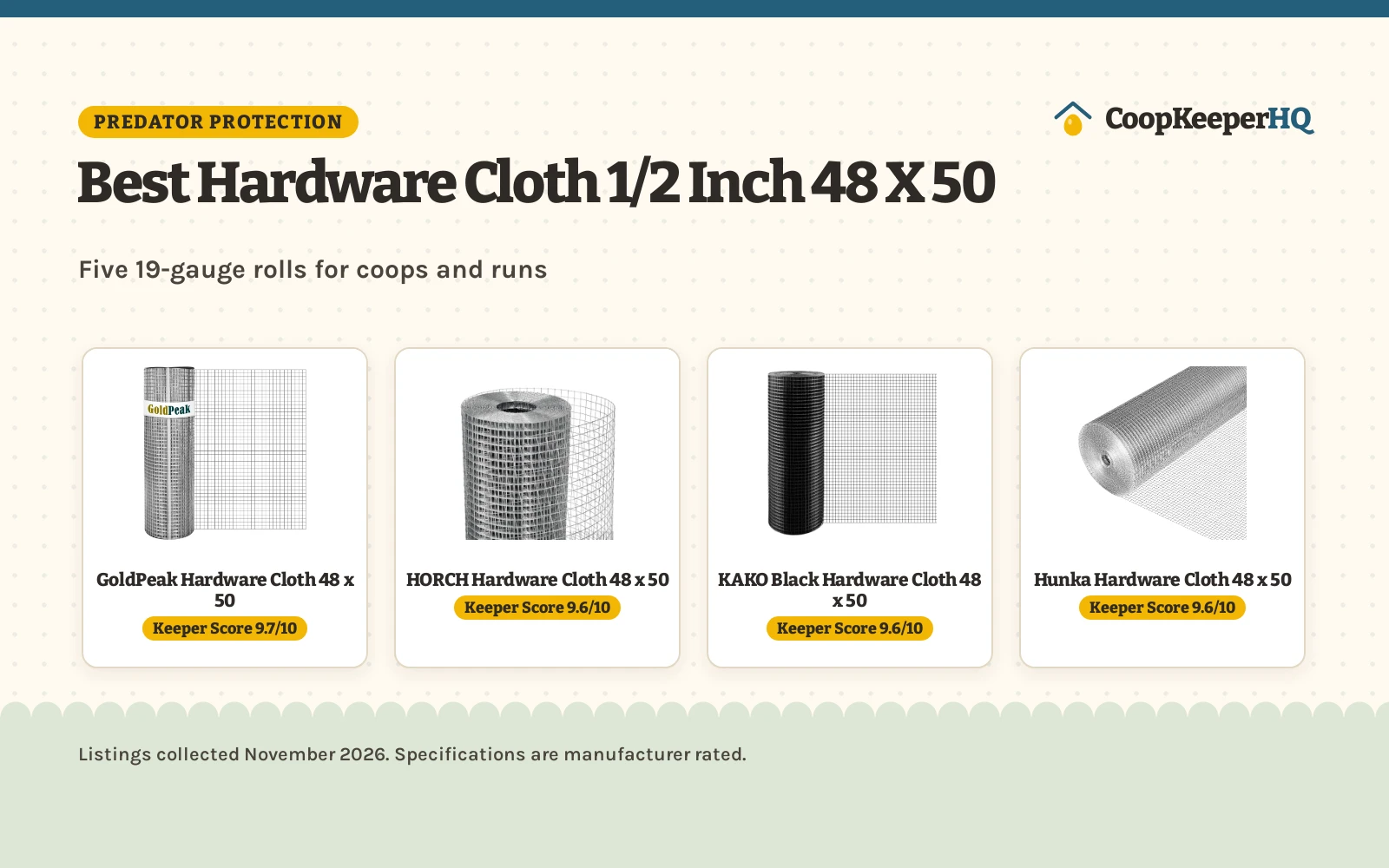
Most 1/2 inch hardware cloth uses 19 gauge steel wire. Land Guard, SANZEUS, TUOKS, and Yardbliss all publish 19 gauge wire for their 1/2 inch mesh products. At 19 gauge, the steel provides enough stiffness to withstand clawing and pushing from dogs and raccoons while remaining pliable enough to cut and shape around wooden coop frames. For 1/4 inch mesh, manufacturers like VEVOR and UULID publish 23 gauge wire. Because 1/4 inch openings are much closer together, the lighter 23 gauge wire maintains structural stability across the tighter welded pattern.
Galvanized steel and vinyl protective coatings
Because hardware cloth remains outdoors in rain, snow, and damp soil, rust protection is essential for long-term flock security. Manufacturers protect steel wire from rust using hot-dip galvanization or vinyl coatings.
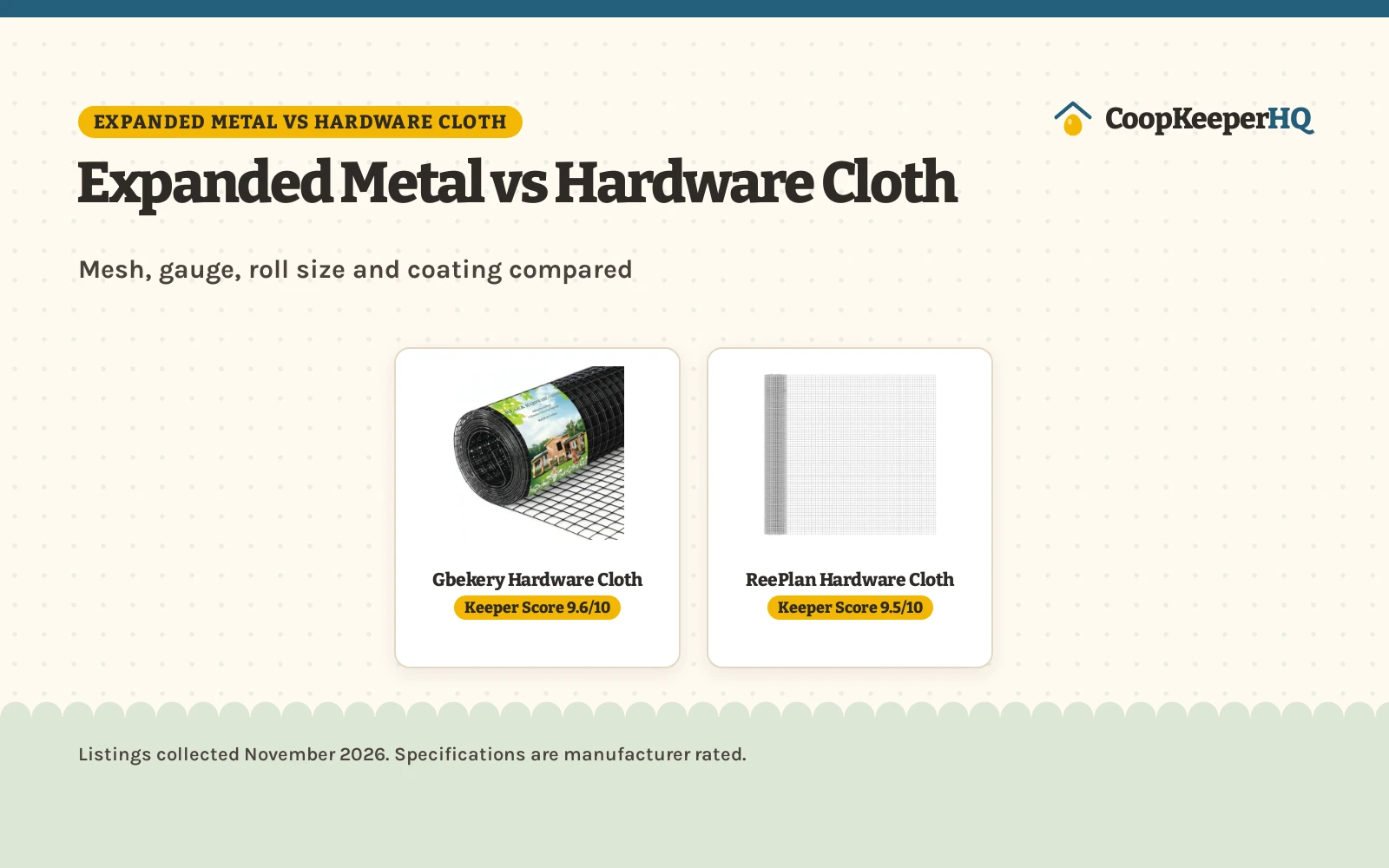
Hot-dip galvanization involves submerging the welded steel mesh into molten zinc. The most durable form is hot-dip galvanized after welding, where the zinc coats both the wire strands and the welded connection points. SANZEUS and HORCH highlight double galvanizing and post-weld galvanization so every weld joint is protected from moisture. Land Guard, HANWRAPS, and UULID also specify hot-dip galvanization for outdoor weather resistance.
Double-coated wire adds a thick exterior layer of vinyl or PVC over a galvanized steel core. LAN JIA, AggFencer, TUOKS, and Yardbliss list black vinyl coated hardware cloth featuring galvanized steel inside with a vinyl exterior. Beyond providing extra resistance against moisture, black coated wire reduces sunlight glare and appears almost transparent from a distance, giving keepers a clearer view into the run while enhancing the look of the backyard setup.
Roll widths and project coverage
Hardware cloth is sold in rolls of varying widths and lengths. Planning your measurements before purchasing minimizes wasted wire and reduces the number of seams you need to secure.
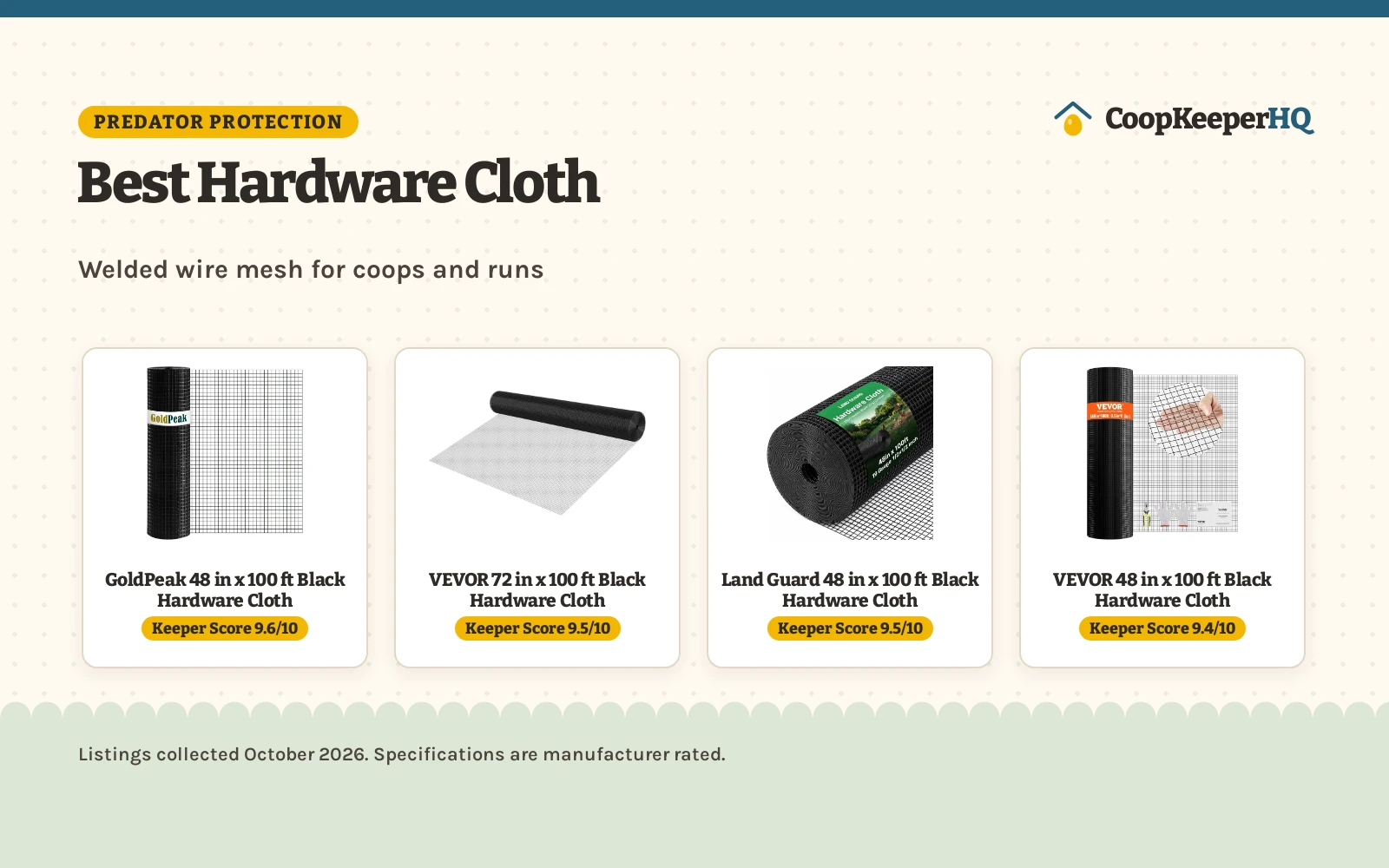
Common roll widths include 16 inch, 36 inch, and 48 inch dimensions. Land Guard and AggFencer list 16 inch widths, which work well for narrow runs, predator aprons, and eave ventilation strips. HANWRAPS publishes a 15.7 inch width for modular installations. Yardbliss lists 36 inch wide rolls, while SANZEUS, VEVOR, UULID, HORCH, and TUOKS publish 48 inch wide rolls, which allow keepers to cover large run panels with fewer horizontal joints.
Roll lengths range from small project rolls to bulk spools. AggFencer and HANWRAPS publish 10 ft rolls, with AggFencer listing coverage of 13 square feet, suitable for patching windows or small vents. Land Guard and LAN JIA offer 50 ft rolls. SANZEUS, VEVOR, UULID, HORCH, TUOKS, and Yardbliss publish 100 ft rolls for enclosing entire runs. Roll weights reflect wire density: SANZEUS publishes a 48 pound weight for its 48 inch by 100 ft roll in 19 gauge, HORCH lists 47 pounds, TUOKS lists 41.7 pounds, and UULID lists 38.2 pounds for 23 gauge. Shorter rolls are lighter, with LAN JIA listing 23.9 pounds for a 50 ft roll, Yardbliss listing 26 pounds for a 36 inch by 100 ft roll, and HANWRAPS listing 1.08 pounds for a 10 ft roll. Cutting through these heavy rolls requires dedicated tools; see our chicken wire cutters guide for recommendations.
Securing mesh to coop frames and vents
A barrier is only as strong as its attachment method. A common mistake is attaching hardware cloth with light craft staples or thin wire ties, which a determined predator can pull loose with body weight and claws.
The most secure installation method uses heavy-duty wood screws paired with wide metal fender washers. The washer clamps a broad section of the wire mesh directly against the wooden coop studs, preventing the wire from pulling over screw heads. Another effective technique is sandwiching the wire edge between the main coop stud and a wooden batten strip screwed tightly on top. Apply hardware cloth over all windows, eave openings, and pop doors. For entrance security, explore our locks for chicken coops guide, or install an automatic chicken coop door to ensure the coop closes reliably each night.
Trenching and predator apron installation
Predators like foxes, coyotes, dogs, and rats frequently attempt to dig beneath run walls rather than climb over them. Securing the perimeter below ground level is just as important as covering the walls.
A reliable ground defense method is trenching. Land Guard recommends digging a shallow trench and installing the fence 2 to 3 feet deep in the ground to block burrowing animals. In rocky or root-filled soil where digging a trench is difficult, keepers install a predator apron instead. An apron consists of hardware cloth attached to the bottom of the run wall and laid flat along the ground surface extending outward. Digging predators naturally approach the fence base and attempt to dig straight down; when their claws strike the flat wire apron, they cannot penetrate the barrier. Secure the apron with ground staples and cover it with dirt, gravel, or sod. Our predator proof chicken run guide covers additional layout strategies.
Routine wire inspection and maintenance
Weather, soil moisture, and physical pressure from wildlife can cause wire fences and framing to shift over time. Establishing a routine inspection schedule keeps your flock protected throughout the year.
Walk around the coop and run perimeter regularly to inspect the wire. Look for loose screws, rusty fasteners, or areas where shifting soil has exposed the bottom edge of the mesh. Check all seams where overlapping wire rolls meet to confirm the joint remains tight without gaps. If you spot damage or loose sections, patch them promptly with spare mesh and heavy fasteners. For broader advice on building secure pens, review our chicken runs and fencing section and our chicken coops guides.
A simple hardware cloth installation checklist
- Select welded wire mesh rather than flexible hexagonal chicken wire
- Choose 1/2 inch mesh for general predator defense or 1/4 inch mesh for small rodents and snakes
- Confirm 19 gauge or 23 gauge wire thickness on the product listing
- Pick hot-dip galvanized after welding or vinyl-coated wire for moisture resistance
- Fasten wire to framing using heavy screws and wide fender washers or wood sandwich battens
- Cover all windows, ventilation gaps, eaves, and pop door openings
- Trench the mesh 2 to 3 feet into the soil or install an outward-facing ground apron
Birds, breed size, run time and climate in; coop floor, run space, roost length and nesting boxes out.
Wash your hands after handling birds, eggs or equipment, supervise children around the flock, and check local rules on flock size and roosters before you buy. For sick birds, call a poultry veterinarian or your state extension office. See CDC backyard poultry guidance. Read our Safety Disclaimer.
FAQ for the flock
What is hardware cloth used for on a chicken coop?
Hardware cloth is used to cover windows, ventilation openings, run walls, and underground perimeters. It creates a rigid physical barrier that prevents raccoons, foxes, dogs, hawks, snakes, and rodents from entering the flock enclosure.
Why is chicken wire not enough for predator protection?
Chicken wire is made of thin, twisted hexagonal wire designed only to contain chickens. It lacks welded joints, allowing predators like raccoons, foxes, and dogs to bend the wire, tear the seams apart, or reach paws through the openings.
What mesh size of hardware cloth is best for chickens?
A 1/2 inch square mesh is the most popular size for chicken coops and runs because it blocks raccoon paws while maintaining airflow. In areas with high rodent or snake pressure, 1/4 inch mesh provides a tighter barrier.
What gauge hardware cloth should you use?
A 19 gauge steel wire is the standard choice for 1/2 inch mesh rolls, providing strong resistance against clawing and chewing predators. For tighter 1/4 inch mesh, manufacturers commonly use 23 gauge wire.
How deep should hardware cloth be buried around a run?
Digging a trench and installing hardware cloth 2 to 3 feet deep in the ground, as Land Guard suggests in its product listing, provides strong defense against burrowing predators. Keepers can also lay an outward wire apron flat along the ground surface if digging a deep trench is not feasible.
More coop guides
- Best Hardware Cloth for Chicken Coop Runs and Aprons
- Hardware Cloth vs Welded Wire: Which One Should You Buy?
- Chicken Wire Alternative: Which One Should You Buy?
See the predator protection picks and the chicken runs and fencing guides.