Hinged vs Sliding Chicken Coop Door: Which Should You Build?
Hinged vs sliding chicken coop door: manual simplicity against automatic slide-up openers, with predator protection, weather ratings and power compared.

On this page
Top picks at a glance
As an Amazon Associate I earn from qualifying purchases.
- 1
 AutoCoop Chicken Coop Door and 24 Inch Rails Set9.3/10View on Amazon
- 2
 Automatic Chicken Coop Door9.7/10View on Amazon
- 3
 Automatic Chicken Coop Door9.6/10View on Amazon
- 4
 Omlet Automatic Chicken Coop Door Opener Operated by LightView on Amazon
- 5
 Automatic Chicken Coop Door: 3500mAh Solar PoweredView on Amazon
- 6
 Automatic Chicken Coop Door Solar Timer/Light Sensor PoweredView on Amazon
- 7
 Solar Chicken Coop DoorView on Amazon
- 8
 Automatic Chicken Coop Door Solar PoweredView on Amazon
- 9
 Automatic Chicken Coop Door with LCD Visual Screen RemoteView on Amazon
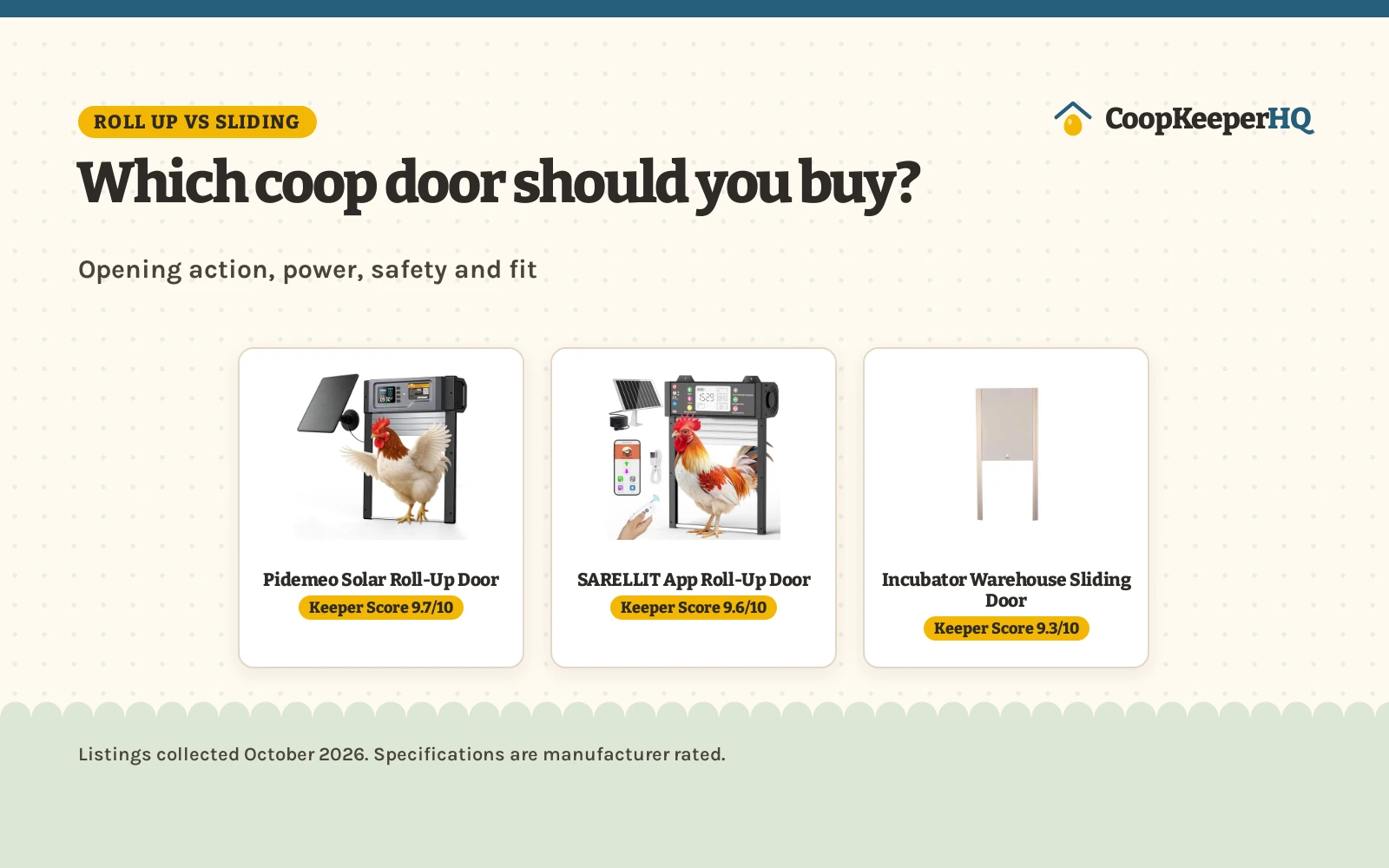
Hinged vs sliding chicken coop door is a choice between simplicity and automation. A hinged door swings open on hinges, costs little, and you open and close it yourself every day. A sliding door, usually a vertical slide-up panel, is the design behind nearly every automatic coop door opener in the listings: it opens at sunrise and locks at dusk on a light sensor or timer, with no daily chore. Pick hinged for the simplest, cheapest door that you will operate by hand; pick sliding for automatic, predator-proof operation that works while you are away.
Other options for the coop
 Omlet Automatic Chicken Coop Door Opener Operated by LightCheck price on Amazon
 Automatic Chicken Coop Door: 3500mAh Solar PoweredCheck price on Amazon
 Automatic Chicken Coop Door Solar Timer/Light Sensor PoweredCheck price on Amazon
 Solar Chicken Coop DoorCheck price on Amazon
 Automatic Chicken Coop Door Solar PoweredCheck price on Amazon
 Automatic Chicken Coop Door with LCD Visual Screen RemoteCheck price on Amazon
CoopKeeperHQ earns a commission if you buy through our links, at no added cost to you. Read our affiliate disclosure.
Hinged vs sliding chicken coop door: the short answer
Hinged doors are manual and need swing clearance: the door arc must be free of feeders, bedding and snow. Sliding doors move straight up inside a frame, need no swing space, and are the form every automatic opener uses. The listings tell the story: RUN-CHICKEN, Omlet, Budsom, Tephrotrak, JUJOJB, BREDASINX and Chickcozy all sell slide-up automatic doors, while the only hinge listing is a 6-inch T-strap hardware pack. If you want automation, you are buying a sliding door.
How a hinged coop door works
A hinged door is a wooden or metal panel on two or more hinges, opened by hand and held shut by a latch. The hardware listing shows what that takes: TDCHINGES 6-inch T-strap hinges with 270° rotation, 2.5mm thick iron, rated at 176 pounds or more per pack. That is far more than a coop door weighs, which is the point: oversized hinges do not sag or drag over time. The weak link is the latch, not the hinge. A hinged door is only predator-proof when it is latched, and latching is a human habit. Hinged doors also need their swing arc kept clear: deep bedding, a feeder or a snowdrift can block the door, and a door that swings outward can hit the run fence.
How a sliding coop door works
A sliding coop door is a panel that travels vertically in a frame, driven up and down by a small motor. Every automatic opener in the listings uses this design. The RUN-CHICKEN T50 measures 13.8 by 9.4 by 1.3 inches at 2 pounds; the Omlet Autodoor frame is 19.25 by 16.5 by 2.25 inches; the Budsom H74 is 10.8 by 1.97 by 14.17 inches at 2.36 pounds. Opening sizes run from 10 inches wide by 8 inches high on the BREDASINX XK-3 to 9.5 by 10 inches on the JUJOJB. Because the panel slides straight up, it needs no swing clearance, which suits tight coops and runs. The motor closes the door against a locked position, so a latched sliding door resists raccoons better than a hand-latched hinged door that someone forgot.
Automation: the real difference
The sliding door’s advantage is the opener, not the slide. The listings describe light-sensor modes that open at dawn and close at dusk, timer modes for fixed schedules, and manual overrides. The Tephrotrak CK2 adds a 656ft long-range remote and 5 modes; the Omlet Smart adds WiFi with Alexa and Google Home; the Budsom runs on 3 AA batteries with an LCD display. Anti-pinch sensors are standard: RUN-CHICKEN, Omlet, Budsom, Tephrotrak, JUJOJB and Chickcozy all describe sensors that stop or reverse the door on obstruction. A hinged door has no automation story: you are the sensor, the timer and the latch, every morning and every night, in every weather.
Weather and power
Sliding automatic doors are rated for serious cold. RUN-CHICKEN and Tephrotrak state -15°F to 140°F; JUJOJB matches that; Chickcozy states -22°F to 131°F; Omlet lists -4°F with an IPX6 waterproof casing. Power varies: the RUN-CHICKEN T50 runs on 2 AA batteries with up to 1 year in cold weather and 2 years in warm climates; Omlet uses 4 AA for 6 months; Budsom uses 3 AA; the Tephrotrak carries a 3500mAh battery with solar; the Chickcozy carries a 3200mAh battery with solar and lists 28,000-plus cycles. A hinged door has no power needs and no electronics to freeze, which is its one reliability edge in deep cold: nothing to fail but the latch.
Which should you choose?
Choose a sliding automatic door if you travel, keep odd hours, or want the flock locked at dusk without fail: the light sensor handles it, the anti-pinch sensor protects stragglers, and the locked panel keeps out raccoons and foxes. The RUN-CHICKEN T50’s 1-year warranty, the Chickcozy’s 2-year warranty and the JUJOJB’s lifetime warranty show how far the category has come. Choose a hinged door if the coop is small, the budget is tight, and someone is home every morning and night to work the latch. And note the Giant exception: the RUN-CHICKEN Giant at 15.7 by 1.34 by 23.6 inches is made for ducks and turkeys, not chickens, so size the door to the birds: standard chickens fit the 8 to 10 inch openings listed here.
FAQ for the flock
Can I automate a hinged coop door?
Not with the openers in the listings: every automatic opener here drives a sliding panel. Automating a hinge would need a different mechanism entirely, so hinged doors stay manual.
Do sliding coop doors work in winter?
The listings are rated for it: -15°F to 140°F on RUN-CHICKEN, Tephrotrak and JUJOJB, -22°F to 131°F on Chickcozy, and -4°F on Omlet. The Chickcozy’s track-free bottom design is meant to prevent mud and snow buildup.
What size opening do chickens need?
The listings show 10 inches wide by 8 inches high on the BREDASINX and 9.5 by 10 inches on the JUJOJB for standard chickens. The RUN-CHICKEN Giant is the exception: it is sized for ducks and turkeys, not chickens.
How do automatic doors keep predators out?
They close on schedule and lock the panel in place. The listings describe aluminum panels, dual-motor locks on the Chickcozy, and reinforced frames, all of which resist prying better than a hand latch that was never engaged.
What powers an automatic coop door?
Batteries or solar. The listings show 2 AA, 3 AA and 4 AA battery designs, 3500mAh and 3200mAh rechargeable packs with solar panels, and plug-in options. The RUN-CHICKEN T50 claims up to 2 years on batteries in warm climates.
More coop guides
Related: our best automatic chicken coop door and chicken coop door opening size guides.