Sliding vs Guillotine Chicken Coop Door: Which Should You Buy?
Sliding vs guillotine chicken coop doors explained: how each works, which suits your coop, and four automatic doors worth a look.

On this page
Top picks at a glance
As an Amazon Associate I earn from qualifying purchases.
- 1
 AutoCoop Chicken Coop Door and 24 Inch Rails Set9.3/10View on Amazon
- 2
 AsFrost Large Solar Automatic Chicken Coop Door with 4000mAh9.8/10View on Amazon
- 3
 Automatic Chicken Coop Door9.7/10View on Amazon
- 4
 Omlet Automatic Chicken Coop Door Opener Operated by LightView on Amazon
- 5
 Extra Large Chicken Coop DoorView on Amazon
- 6
 Automatic Chicken Coop Door with Solar Panel Upgrade DoorView on Amazon
- 7
 Automatic Chicken Coop Door Solar Timer/Light Sensor PoweredView on Amazon
- 8
 Solar Chicken Coop DoorView on Amazon
- 9
 Automatic Chicken Coop Door Solar PoweredView on Amazon
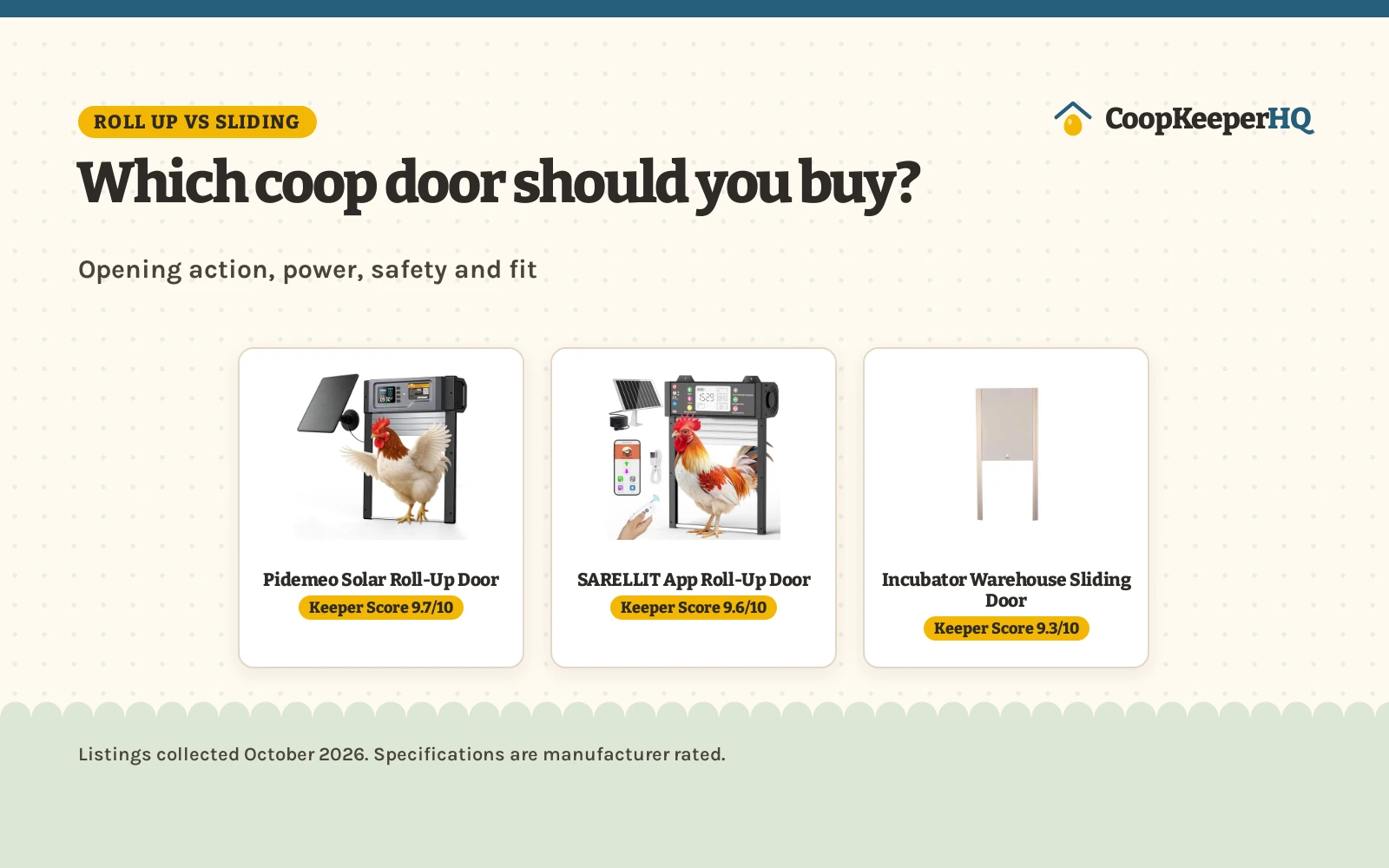
A sliding chicken coop door runs sideways on a track, while a guillotine door lifts straight up and drops down to close. For most backyard chicken coops, the sliding door is the better pick: it needs no clearance above the opening, the sliding Omlet is the best-documented automatic door here, and the sideways motion tolerates bedding piled against the opening better than a drop panel. This sliding vs guillotine chicken coop door guide explains how each works, which suits your coop, and what the listings state about power, safety and sizing.
Other options for the coop
 Omlet Automatic Chicken Coop Door Opener Operated by LightCheck price on Amazon
 Extra Large Chicken Coop DoorCheck price on Amazon
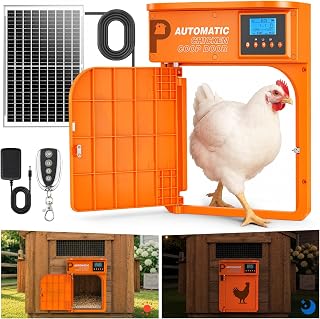 Automatic Chicken Coop Door with Solar Panel Upgrade DoorCheck price on Amazon
 Automatic Chicken Coop Door Solar Timer/Light Sensor PoweredCheck price on Amazon
 Solar Chicken Coop DoorCheck price on Amazon
 Automatic Chicken Coop Door Solar PoweredCheck price on Amazon
CoopKeeperHQ earns a commission if you buy through our links, at no added cost to you. Affiliate disclosure.
How a sliding coop door works
A sliding door hangs on a horizontal track and moves left or right to open. The Omlet Autodoor is the clearest example here: its design lets it open to the left or right, so it fits the coop either way. Because the panel never swings out or drops down, a sliding door works with bedding piled against the opening and needs no headroom above it. The trade is the track itself, which wants an occasional wipe so grit does not slow the panel. On an automatic door, the motor drives the panel along that track on a light sensor or timer schedule.
How a guillotine coop door works
A guillotine door rides in vertical channels and lifts straight up to open, then drops straight down to close. It needs clear space above the opening equal to the door height, which suits tall, narrow coop fronts. Gravity does the closing, so the design is simple, but the channels must stay clear of bedding and ice for the panel to drop fully. A guillotine panel can be motorized to lift and lower on a schedule; a powered design should include obstruction sensing rather than relying on a gravity drop.
What about swinging doors
A third style appears in the listings: double-sided swinging doors. The OKKOBI XL describes doors that swing open like a supermarket door, which needs clear space on both sides of the opening to move. Swinging doors suit wide openings where neither a track nor a tall channel fits well. The trade is that a swinging panel can catch the wind, so the closing mechanism must latch it firmly. The OKKOBI pairs its swinging doors with an anti-pinch system that reverses on resistance.
Sliding vs guillotine chicken coop door: which should you buy
Buy a sliding door for a standard coop front: it fits anywhere a horizontal track fits, it tolerates bedding buildup, and the automatic options are proven. The Omlet opens either direction, which solves more coop layouts than a fixed-side slider, and its 19.25 by 16.5 in frame suits a standard pop door cutout. Buy a guillotine style only when the opening is tall and narrow with solid wall above it and no room for a sideways track. Consider a swinging door like the OKKOBI when the opening is wide and you want the largest clear passage for big birds. In cold climates, all styles need their tracks, channels or hinges kept clear; the Omlet is rated to minus 4 degrees Fahrenheit, and the OKKOBI from minus 4 to 140 degrees. The VEVOR lists aluminum alloy and ABS construction as corrosion and UV resistant for long outdoor use. Whichever style you pick, an anti-pinch or safety sensor matters: the Omlet has built-in safety sensors, and the OKKOBI and VEVOR reverse when obstructed. The Proshine adds a rain shelter over its mechanism, which is worth noting for exposed coop walls.
Four automatic doors worth a look
Four automatic doors cover both styles, ranked by what their listings state. The Omlet Autodoor is the sliding pick: it opens to the left or right, runs on a light sensor or timer, carries an IPX6 waterproof rating, and is backed by a 180-day money-back guarantee. Its control panel cable runs 6 ft 6 in, which gives flexibility on where the panel mounts. The OKKOBI XL suits bigger birds with an 11.3 by 8.7 in opening and double-sided swinging doors, plus solar power, anti-pinch reversing, and a 5-year protection plan. The VEVOR M6 is the value pick: solar and battery power, four modes covering light sensor, timer, remote and manual, and anti-pinch that lifts back within 3 seconds. The Proshine fits tight spots with an innovative opening that sets anywhere from 30 to 180 degrees, a remote that works to 130 ft, dry-battery power for up to 3 months, and a 1-year manufacturer warranty.
Wash your hands after handling birds, eggs or equipment, supervise children around the flock, and check local rules on flock size and roosters before you buy. For sick birds, call a poultry veterinarian or your state extension office. See CDC backyard poultry guidance. Read our Safety Disclaimer.
FAQ for the flock
Do automatic coop doors work in winter?
The Omlet is rated to minus 4 degrees Fahrenheit and the OKKOBI from minus 4 to 140 degrees. Keep tracks and channels clear of ice so the panel closes fully.
What powers these doors?
The Omlet runs on 4 AA batteries with a 6-month life stated. The OKKOBI uses solar with a 2000mAh battery and USB-C backup; the VEVOR lists solar and a 2000mAh battery. The Proshine runs on 4 dry batteries for up to 3 months stated.
How big an opening do chickens need?
The OKKOBI XL lists an 11.3 by 8.7 in opening for birds under 10 lbs. Match the opening to your largest bird.
Can I open the door remotely?
The OKKOBI remote works to 50 ft and the Proshine remote to 130 ft, per the listings. The VEVOR also lists a remote control.
What if a chicken is in the doorway?
The Omlet lists built-in safety sensors, the OKKOBI lists anti-pinch reversing, and the VEVOR lifts back within 3 seconds of hitting an obstruction.
How do I set the open and close times?
The Omlet and OKKOBI run on a light sensor or timer; the OKKOBI adds an LCD display and remote. The VEVOR offers light sensor, timer, remote and manual modes. The Proshine uses a timer and light sensor with remote override.
More coop guides
- Best Automatic Chicken Coop Door: Picks for Every Season
- Hinged vs Sliding Chicken Coop Door: Which Should You Build?
- Best Solar Powered Chicken Coop Door (2026)
- Chicken Coop Door Opening Size: Dimensions, Height and Placement Guide
See the coop doors and automation guides for more on automatic doors, latches and predator-proofing the coop entrance.