PVC Chicken Feeder Problems and Fixes
PVC chicken feeder problems such as caked feed, waste, rats and wrong height mostly come from damp feed and poor placement, and each one has a plain fix.

On this page
Top picks at a glance
As an Amazon Associate I earn from qualifying purchases.
- 1
 Chewoof PVC pipe feeder9.4/10View on Amazon
- 2
 MUDUOBAN stainless treadle feeder9.6/10View on Amazon
- 3
 RentACoop treadle feeder extension9.5/10View on Amazon
The morning round starts with the feeder, and PVC chicken feeder problems show up the same way week after week: feed caked in the tube, grain scattered under the ports, and a tube that empties too fast or not at all. Most of them come down to a short list of causes, damp feed, the wrong height, too few ports, too small a tube and a lid that does not stay shut, and each one has a plain fix. This guide walks through each problem in turn, with the figures the listings state.
CoopKeeperHQ earns a commission if you buy through our links, at no added cost to you. Affiliate disclosure.
PVC chicken feeder problems at a glance
Start with the troubles that cover most complaints: feed that cakes and clogs, feed that scatters, a tube that empties too fast, and rats that find the open lid. Damp feed causes the first, the wrong height causes the second, too small a tube causes the third, and a loose lid causes the last. Read the sections below in order, and check the figures against the feeder on the wall: the fixes are small, and most of them take one visit to the coop.
Feed cakes and clogs in the tube
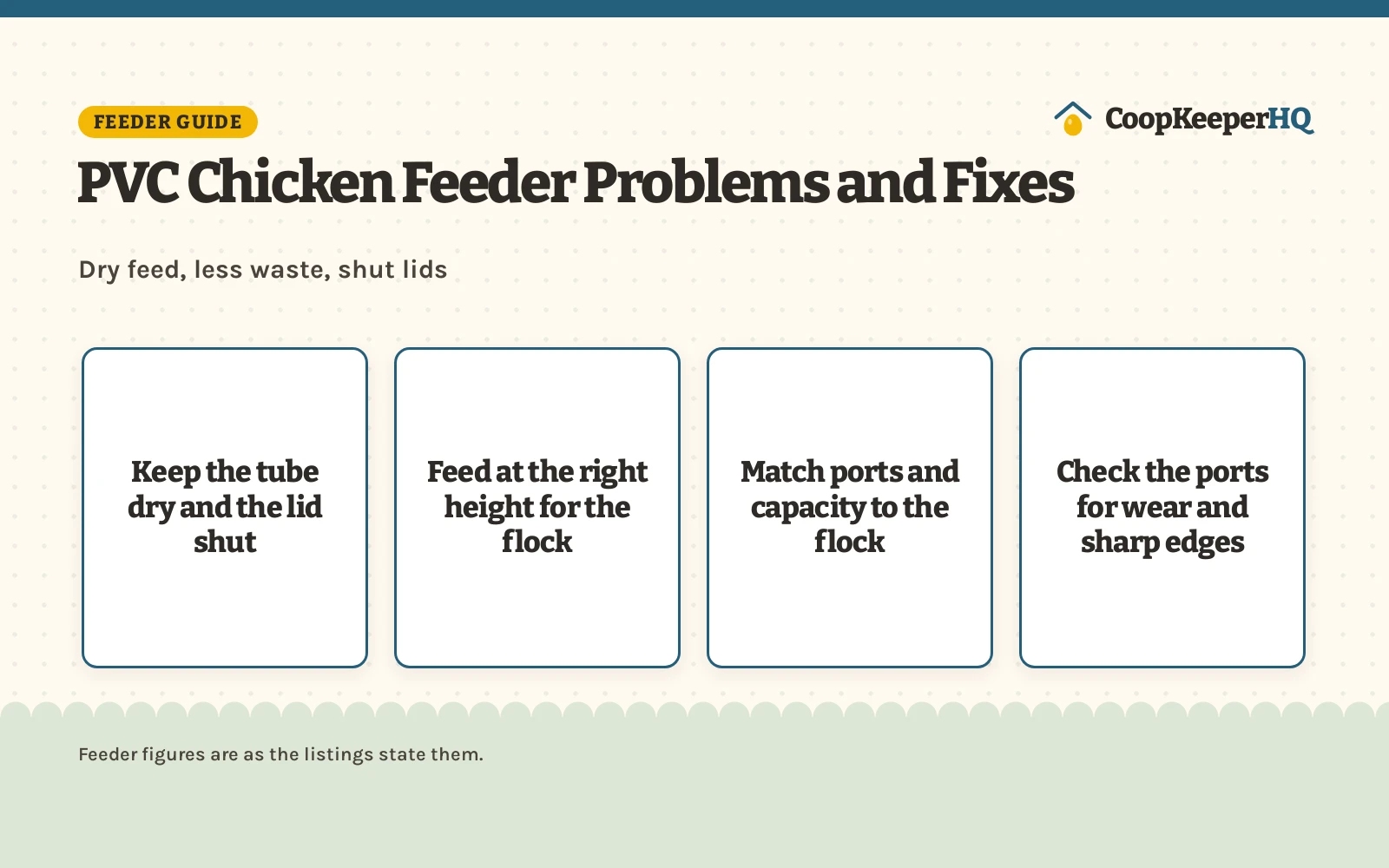
Damp feed is the usual cause of a clog. The listings say the same thing in plain terms: keep the feeder away from rain, water pipes and other water sources, as the Rexwnadu and Chewoof listings state. A tube that stands in the rain wets the feed at the ports, and wet feed packs into a plug that gravity cannot move. The IMJEGEM.Q feeder (on Amazon), 19 inches high with a 4.3 inch diameter, carries a rain cover on the top and a rain cover on the discharge port to keep the feed dry, and the Rexwnadu tube, with a wall about 0.2 inches thick, wipes clean once the damp feed is out. Fix it by moving the feeder under cover, shutting the lid after every fill, and clearing out any damp feed before it sets: dry feed flows, damp feed does not.
Feed scatters under the ports
Chickens scratch, and an open trough lets them scatter feed across the floor. A PVC tube feeder fixes this by letting the birds eat with their heads inside the port, so the feed stays in the tube: the Rexwnadu listing describes exactly that, with birds inserting their heads and no scratching at the feed. Angled ports help too, as the HJYTFARM feeder (on Amazon) states, and a soft protective edge around the opening, as the Tocsho feeder (on Amazon) states, gives the birds a cushioned rim instead of a hard PVC edge. The no waste feeder guide compares enclosed designs. If the scatter continues, check the height: a port set too low lets birds rake feed out with their feet, while a port set too high makes them stretch and spill. The Rexwnadu tube, 19.7 inches long with a 2.95 inch diameter, feeds up to 6 chickens at once, so a single tube can serve a small flock without a crowd at the ports.
The tube empties too fast
A tube that needs filling every morning is usually too small for the flock, not broken. The listings state the spread plainly: the Rexwnadu, HOMAR and Tocsho tubes hold 6 lb of feed, while the KHEARPSL feeder (on Amazon) holds 13 lb with 6 feeding ports, and the HJYTFARM feeder holds 2 gal with 2 feeding ports. A single refill lasts about 2 days, as the HOMAR and Chewoof listings state, so a flock that empties it sooner needs a bigger tube or another station. A 3-pack, as the Tocsho, Rexwnadu, Generic and Chewoof listings state, gives the flock three stations and stretches the time between refills. The automatic versus gravity feeder comparison explains the gravity feed that keeps these tubes flowing.
Rats and wild birds get in
An open tube is an invitation, and rats learn the way to it fast. The fix starts with the lid: the MHLLGN kit (on Amazon) states that its covering lid deters rats and other pests, and that closing the lid when the birds are full keeps the feed safe from unwanted visitors. The Chewoof listing calls its feeder rat proof, and the Generic listing states that its fully enclosed structure protects feed from moisture and unwanted intruders. Keep the tube on the wall and off the floor, shut the lid after every fill, and clear spilled grain from under the ports, since spilled feed is what brings rats back. The predator proofing guide covers the coop itself.
Sharp edges and sore heads
A rough port rim can rub a bird’s head raw over a season of feeding, and it shows up as birds that peck once and walk away. The Tocsho feeder answers this with a soft protective edge around the feeding opening, a cushioned rim that keeps hard PVC away from the birds. The Generic listing states a smooth-designed port for easy pecking, and the MHLLGN kit states no sharp edges at all. Run a finger around the rim before hanging the tube: any rough spot can be smoothed, and a rim that stays rough is a reason to pick a different feeder.
The feeder hangs wrong
Height is the quiet problem: too low and the birds rake feed out, too high and the small birds cannot reach. Wall mounting fixes the height in place, and the listings give the hardware: the Rexwnadu kit includes 6 metal fixing rings and 12 screws, and the HJYTFARM feeder comes with 2 mounting kits for wall-mounted or hanging setup. The wall mounted versus hanging feeder comparison covers both ways to hang a tube. Mount the tube where the birds can reach the ports without stretching, keep it away from rain and water pipes as the Rexwnadu and Chewoof listings state, and check the rings and screws when the tube is refilled, since a loose tube swings and spills.
A quick check before you buy
- Feed stays dry: the tube has a lid that shuts, and a rain cover over the top or the discharge port where the listing states one
- Ports suit the flock: enough ports for the birds, with a smooth or soft edge
- Capacity suits the flock: a 6 lb tube lasts about 2 days for a small flock, a 13 lb tube longer
- Mounting is in the box: rings, screws or a hanging kit, so the tube goes up straight
- The lid deters rats: a covering lid that shuts tight after every fill
- Dimensions are stated: length, diameter and port count, so the tube fits the wall and the birds
For the full list of feeders that suit a small flock, see the best chicken feeders for a small flock and the no waste feeder guide.
How much feed your flock eats a day and a month, how long a bag lasts, and what it costs.
Wash your hands after handling birds, eggs or equipment, supervise children around the flock, and check local rules on flock size and roosters before you buy. For sick birds, call a poultry veterinarian or your state extension office. See CDC backyard poultry guidance. Read our Safety Disclaimer.
FAQ for the flock
Why does feed cake up in a PVC feeder?
Damp feed is the usual cause. Rain, a leak or a lid left open wets the feed, and wet feed packs into a plug that gravity cannot move. Move the feeder under cover, shut the lid after every fill, and clear out damp feed before it sets.
What stops chickens wasting feed from a PVC feeder?
An enclosed tube with head-in ports, as the Rexwnadu listing describes, and a height where the birds reach the ports without raking feed out. A soft protective edge, as the Tocsho feeder states, gives the birds a cushioned rim instead of a hard PVC edge, and clearing spilled grain keeps the floor clean.
How many chickens can one PVC feeder serve?
It depends on the tube: the Rexwnadu tube feeds up to 6 chickens at once, while the HOMAR, Generic and Chewoof tubes feed 3 chickens at once, and the KHEARPSL feeder has 6 feeding ports. For a bigger flock, a 3-pack gives three stations instead of one.
Can a PVC feeder stay outside in the rain?
The listings say to keep the feeder away from rain and water sources, as the Rexwnadu and Chewoof listings state. The IMJEGEM.Q feeder carries rain covers on the top and the discharge port, but even so, a spot under cover lasts longer and keeps the feed dry.
How often does a PVC feeder need refilling?
A single refill lasts about 2 days, as the HOMAR and Chewoof listings state. A 6 lb tube suits a small flock, a 13 lb tube with 6 ports suits a bigger flock, and a 3-pack spreads the feeding across three stations.
More coop guides
- Best Chicken Feeder No Waste: Picks That Save Feed
- Best Wall Mounted Chicken Feeder: 5 Space-Saving Picks (2026)
- Hanging vs Ground Chicken Feeder: Which One Should You Buy?
- Automatic vs Gravity Chicken Feeder: Which One Should You Buy?
- Treadle Feeder vs Pvc Pipe Feeder: Which One Should You Buy?
See the feeders and waterers guides and the feeder ports guide.