What Is an Egg Skelter?
A guide to how spiral egg skelters use first-in, first-out rotation to keep fresh unwashed backyard eggs organized and accessible on your kitchen counter.

On this page
Top picks at a glance
As an Amazon Associate I earn from qualifying purchases.
- 1
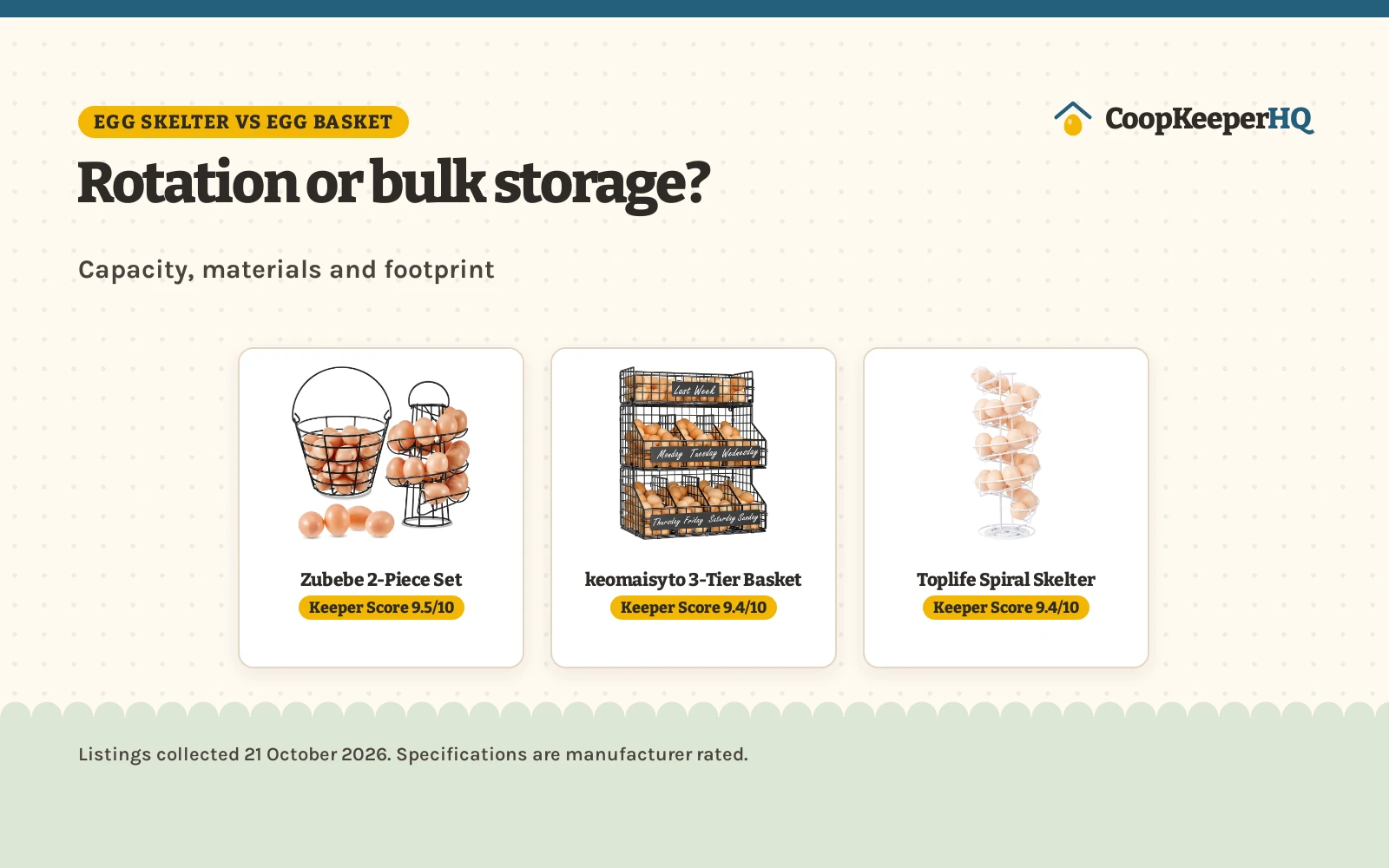
 Toplife Spiral Metal Egg Skelter Dispenser Rack9.6/10View on Amazon
- 2
 Toplife Spiral Design Stainless Steel Egg Skelter Dispenser9.5/10View on Amazon
- 3
 Black Metal Egg Holder Countertop9.5/10View on Amazon
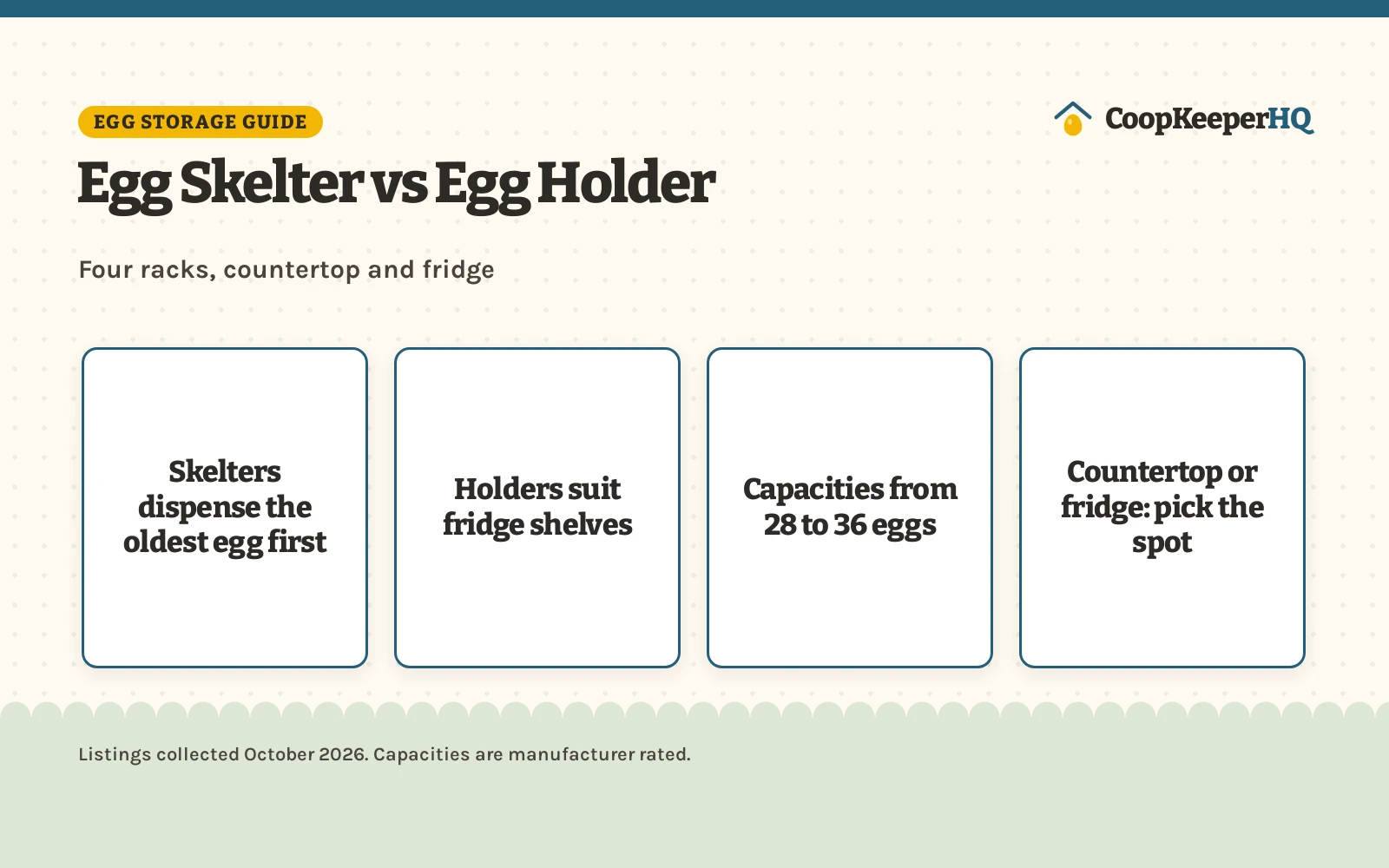
An egg skelter is a downward-sloping spiral wire rack that stores fresh backyard eggs on a kitchen counter in date order using first-in, first-out rotation. Fresh eggs go into the top, and as older eggs are taken from the bottom dispenser, the line advances so the earliest eggs get used first. This vertical wire organizer keeps eggs visible and accessible on a small counter footprint.
CoopKeeperHQ earns a commission if you buy through our links, at no added cost to you. Affiliate disclosure.
What is an egg skelter: how the spiral design works
A standard egg skelter uses a spiraling metal track winding downward around a central frame. Parallel wire rails cradle each egg along its sides. When you place an egg at the top entrance, gravity lets it move down the incline until it settles behind eggs already on the track.
An open dispensing cradle or stop lip holds the lead egg at the bottom. Lifting that bottom egg allows eggs behind it to advance along the rails into the front spot. This gravity-fed slide operates without electricity, cords or moving gears, using vertical height to hold eggs on a compact counter footprint.
How first-in, first-out rotation prevents waste
Backyard flocks produce eggs daily, often leaving keepers with a bowl of mixed eggs collected across different days. In an open bowl, new eggs pile on top, and keepers grab from the top while older eggs sit forgotten at the bottom.
An egg skelter enforces a first-in, first-out routine. The oldest egg on the track rests at the bottom exit, ready to use next. As you add newly collected eggs to the top, the line advances in collection sequence, eliminating the need to mark shells with pencil dates or sort through cartons.
Why unwashed eggs belong on a counter rack
Keepers primarily use an egg skelter to store fresh, unwashed eggs at room temperature. When a hen lays an egg, a natural protective bloom coats the shell and helps seal its microscopic pores, slowing moisture loss and blocking bacteria.
Washing an egg strips away this bloom, allowing bacteria to penetrate porous shells. Washed eggs must be refrigerated. US guidance from the USDA and extension programs is to refrigerate eggs. Keeping unwashed eggs on the counter is a keeper practice, suited to short periods only. If you use a skelter, keep only clean, intact eggs with undisturbed blooms on it, and refrigerate any washed eggs right away.
Countertop capacities and footprint sizes
Skelters are sold in different capacities and heights. Here is what each maker lists, so you can match a model to your daily egg count and counter space:
- Flexzion: 20 eggs, depending on egg size, with a lower storage basket.
- OBVIS: 22 eggs, 12.5 inches high and 8.25 inches in diameter.
- Toplife: 3 dozen eggs, 16.1 inches high.
- QUTREY: 2-3 dozens of large eggs on the black model, or about 3 dozens on the silver model, 13 inches high and 6.9 inches in diameter, with a storage basket.
- Shop Square: 3 dozen eggs, with a storage basket.
- Abiglifty: about 3 dozens of eggs, needing 7.3 inches by 12.8 inches of counter space.
Capacity claims that include a bottom basket count eggs in the basket as well as on the spiral, so the track alone holds fewer.
Key features to look for on an egg skelter
Wire construction is standard across brands, using coated iron, alloy steel and powder-coated steel frames to support egg weight without flexing.
Specific features add convenience. Toplife lists a 360 degree rotating design with a non-slip felt base, letting you turn the rack to load eggs or inspect shells. OBVIS and Shop Square include a metal carrying handle or ring atop the central stem for easy moving. Flexzion, QUTREY and Shop Square build a wire storage basket into the bottom frame beneath the spiral slide, offering space for odd-shaped eggs or eggs set aside for morning cooking.
How to load and dispense eggs without cracks
Because eggshells are fragile, loading and dispensing require gentle handling to prevent hairline cracks. When adding eggs to the top, place each egg sideways across the parallel rails so it rests evenly between the supports.
Never let an egg roll unchecked down an empty spiral track, where gaining speed can crack the shell against the bottom stop. When filling an empty rack, support the first few eggs down the incline until a cushioned line forms. Once loaded, new eggs roll only a short distance to touch the line. When retrieving an egg, lift the bottom egg straight out so the remaining line slides forward smoothly.
When an egg skelter is not the right choice
An egg skelter works well for small backyard flocks, but large flocks collecting dozens of eggs daily quickly overwhelm countertop capacity, requiring cartons anyway.
Fixed rail spacing also limits bird species. Skelters are sized for chicken eggs. Small quail eggs can slip through wire gaps and fall, while large duck or goose eggs can wedge between rails or jam against the central post. Keepers with large flocks or mixed waterfowl generally find stacking cartons or flats more practical than a decorative spiral rack.
Cleaning and maintaining a metal wire skelter
Because a skelter holds farm eggs, rails collect dust and bits of nesting material over time. Regular cleaning keeps resting surfaces hygienic.
Wipe coated or painted wire rails with a damp cloth and mild dish soap. Avoid abrasive scouring pads that could scratch finishes and invite rust. Always dry the metal thoroughly with a towel after wiping. If an egg leaks on the track, remove all eggs, wash the rails with warm soapy water, and allow the frame to dry completely before reloading.
Daily egg collection routine
Daily routine is simple. Gather eggs from clean nest boxes using an egg collection basket. Keeping clean bedding in boxes reduces dirty shells, and our nesting box guide details bedding management.
Indoors, inspect each egg. Discard cracked shells, and set aside soiled eggs for washing and immediate refrigeration. Place clean, unwashed eggs into the top of the skelter to settle against the line. At mealtimes, dispense older eggs from the bottom exit. When you are ready to compare specific models, see our egg skelter guide.
A simple egg skelter checklist
- Store clean, unwashed eggs with natural blooms intact
- Support the first eggs down an empty track to avoid cracks
- Load fresh eggs at the top and dispense older eggs from the bottom
- Check cabinet clearance before choosing tall spiral racks
- Wash and refrigerate soiled eggs, and discard cracked eggs
- Wipe rails with mild soap and dry thoroughly to prevent rust
For more storage advice, explore our egg handling resources and our review of egg baskets for fresh eggs.
What a dozen of your own eggs really costs, with and without startup costs, against the store price.
Wash your hands after handling birds, eggs or equipment, supervise children around the flock, and check local rules on flock size and roosters before you buy. For sick birds, call a poultry veterinarian or your state extension office. See CDC backyard poultry guidance. Read our Safety Disclaimer.
FAQ for the flock
What is an egg skelter used for?
An egg skelter stores and organizes fresh unwashed eggs on a counter. Its downward wire spiral uses first-in, first-out rotation so keepers use the oldest eggs first while loading fresh eggs at the top.
Can you put washed eggs on an egg skelter?
Washed eggs should not sit on a counter skelter. Washing removes the protective bloom, leaving pores open to bacteria. Washed eggs must be stored in the refrigerator.
Do eggs crack when rolling down an egg skelter?
Eggs can crack if dropped down an empty spiral track. Supporting initial eggs down the incline until a continuous line forms cushions movement and prevents shell damage.
How many eggs does an egg skelter hold?
Capacities vary by listing. Compact models list 20 eggs (Flexzion) or 22 eggs (OBVIS), while larger spiral designs list 2-3 dozens of large eggs or 3 dozen eggs (Toplife, QUTREY, Shop Square).
Do duck eggs fit on a standard chicken egg skelter?
Standard rails are sized for chicken eggs. Larger duck eggs often bind between the rails or hit the central support, making flat trays or baskets a better fit for waterfowl eggs.
More coop guides
- Best Egg Skelter: Countertop Egg Holders for Fresh Eggs
- Egg Baskets for Fresh Eggs: 5 Top Picks for Backyard Flocks (2026)
- Best Chicken Nesting Box: Roll-Away and Open Picks
See the egg handling picks and the coop supply guides.