Wood vs Wire Quail Cage (2026): Which Should You Buy?
Wire wins for most quail keepers on cleaning and airflow; wood wins on draft protection. This guide compares both, with the wire mesh and clips to build the wire side.

On this page
Top picks at a glance
As an Amazon Associate I earn from qualifying purchases.
- 1
 Amcortn Wood Duck House9.5/10View on Amazon
- 2
 Hatching Time Quail Breeding Cage Indoor9.6/10View on Amazon
- 3
 Aivituvin Chicken Coop Double Folding Fir Wood Chicken HouseView on Amazon
- 4
 25-Pack Electric Fence Wood Post Poly Tape InsulatorsView on Amazon
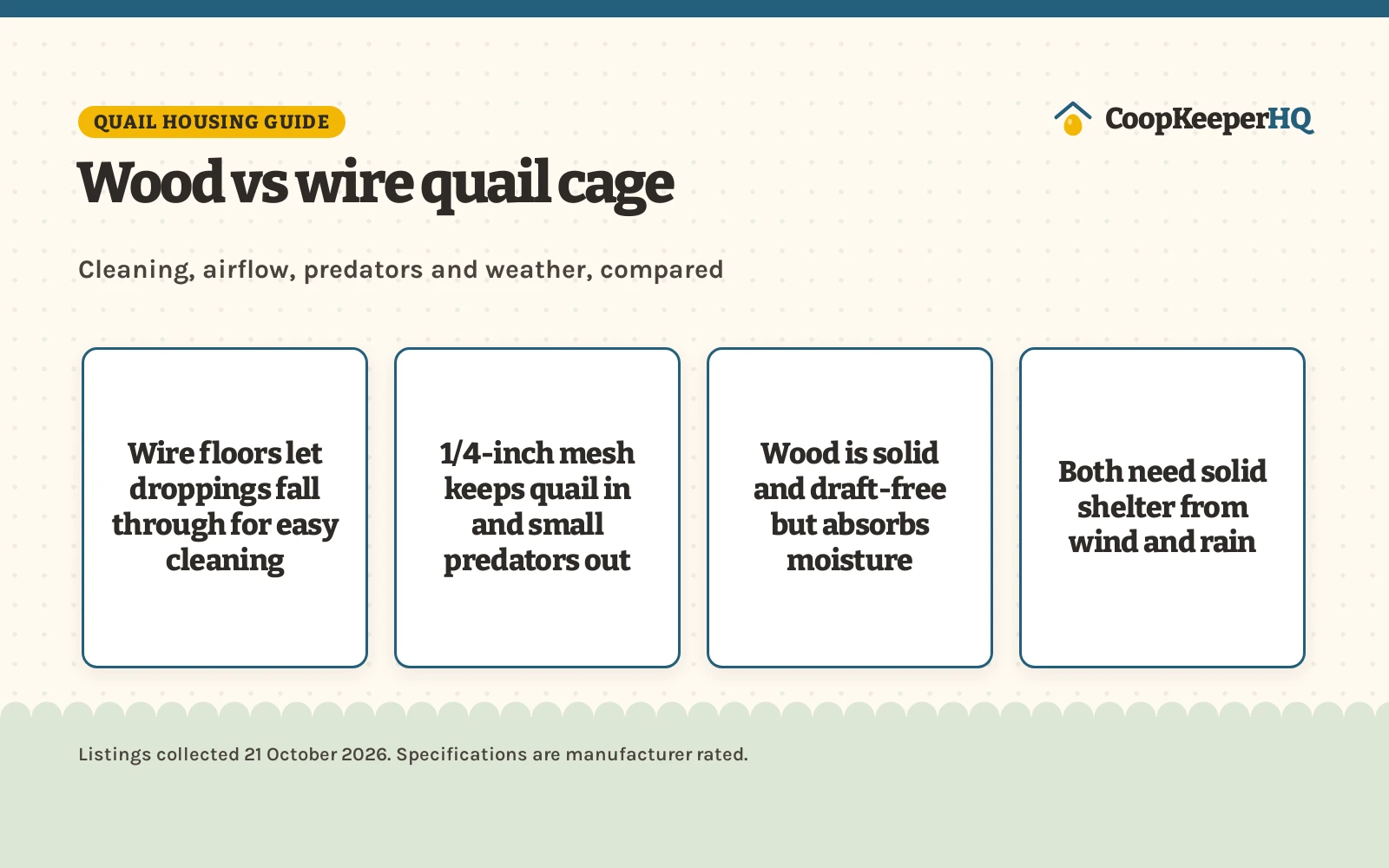
For quail, wire is the practical winner for most keepers: a 1/4-inch hardware-cloth cage lets droppings fall through, moves air freely and keeps small predators out. Wood cages are solid and draft-free, but wood soaks up moisture and is harder to sanitize. This guide compares wood vs wire quail cage housing on cleaning, airflow, predators and weather, then shows the wire-side gear from the listings.
Other options for the coop
 Aivituvin Chicken Coop Double Folding Fir Wood Chicken HouseCheck price on Amazon
 25-Pack Electric Fence Wood Post Poly Tape InsulatorsCheck price on Amazon
CoopKeeperHQ earns a commission if you buy through our links, at no added cost to you. Affiliate disclosure.
Wood vs wire quail cage: the quick answer
Wire wins on cleaning and airflow; wood wins on draft protection and looks. Most quail keepers land on wire cages because droppings fall through the mesh instead of piling up under the birds, and a wire cage dries fast after rain. Wood works if you commit to frequent bedding changes and weatherproofing, and it suits cold, windy spots where a solid wall matters.
Why wire suits quail
A wire cage built from 1/4-inch hardware cloth does three jobs at once: it holds the birds, it lets droppings and spilled feed fall through for easy cleaning, and it ventilates in summer heat. The dense mesh also blocks the small animals the listing names, snakes, rats and squirrels, which matters because quail are small enough to be at risk. Give the birds a solid resting board or a shelter box inside so they are not on wire all day, and the setup stays simple.
When a wood cage makes sense
Wood is solid, quiet and draft-free, which helps in cold, windy weather. A wooden hutch with a sound roof shrugs off rain and gives the birds a dark corner to rest in. The tradeoff is maintenance: wood absorbs moisture and odor, joints are harder to scrub clean than wire, and a wood cage is heavier to move. If you go wood, raise it off the ground, keep the roof watertight and plan on regular bedding changes.
The wire-side gear: mesh and clips
To build the wire side, the listings give you the two essentials. The Amagabeli hardware cloth is 1/4-inch mesh in a 36 inch by 50 ft roll, 23 gauge, hot-dipped galvanized for rust resistance; the listing states it blocks rabbits, cats, snakes, squirrels and rats, and it suits quail cages among other uses. See also our guide to the best hardware cloth for quail cages. To join the panels, the NAOEDEAH kit pairs 900 wire cage clips with pliers for assembling or repairing wire cages for quail, chickens and other birds; the pliers run 6.69 inches and each clip measures 0.43 by 0.39 inch, and squeezing the pliers curls the clip into a circle around the wires.
Reading the mesh specs
The Amagabeli listing gives the three numbers that matter: 1/4-inch mesh, 23 gauge wire and a roll 36 inches wide by 50 feet long. The spec table states a wire diameter of 0.02 inches and a unit count of 150 square feet, so one roll covers a lot of cage: panels, a lid and a droppings tray surround come out of a single roll with room to spare. The mesh is woven from high-strength low-carbon steel with a hot-dipped galvanized coating, and the listing states reinforced protection on seams for weather resistance in wet conditions. If your cage plan is bigger than one roll, the listing states that multiple rolls can be spliced for seamless coverage, and the roll arrives in a 6.3 by 6.3 by 36 inch package.
Cutting and shaping the roll
The listing states the mesh cuts easily with scissors or wire cutters, and that you can cut it to any size you need. That matters for quail cages because the panels are small: cut the floor, walls and top from the 36-inch-wide roll with little waste, since the listing frames the modular design as avoiding material waste. Wear gloves when cutting and folding, since cut wire ends are sharp; the NAOEDEAH kit ships a pair of gloves, which doubles as cutting protection. Fold the cut edges or clip them tight so no sharp ends face the birds.
Joining panels with clips
The NAOEDEAH kit is the joining system for the wire side: 900 wire cage clips plus pliers, stated for assembling or repairing wire cages for quail, chickens and other birds. The pliers are 6.69 inches long with an ergonomic plastic handle, and each clip measures 0.43 by 0.39 inch. The listing’s technique is specific: insert the clip with the curved part down, close the jaws a little to hold the clip while you position it around the two wires, then squeeze, and the clip curls into a circle that locks the joint. The pliers have no spring, which the listing notes plainly. The kit weighs 0.76 kg all in, so it lives in the coop toolbox.
Predator protection in the mesh choice
The Amagabeli listing names what its 1/4-inch mesh blocks: rabbits, cats, snakes, squirrels and rats. That is the wire side’s predator argument in one line, and it is why the mesh runs this dense rather than a wider weave that quail could squeeze through. The listing also states the mesh can be buried underground and last for many years, which is the standard way to stop diggers at the cage base: run a skirt of the same hardware cloth out from the cage walls and pin it under soil. For the top, the same 1/4-inch mesh keeps out climbing and aerial threats while the solid shelter box inside gives the birds their draft-free corner.
Birds, breed size, run time and climate in; coop floor, run space, roost length and nesting boxes out.
Use a charger rated for the length of netting you run, ground it as the manual describes and post warning signs where neighbors or children can reach the fence. Keep grass and weeds off the bottom strands, and never leave netting unpowered, because birds and wildlife can tangle in it. Read our Safety Disclaimer.
FAQ for the flock
Is 1/4-inch mesh small enough for quail?
Yes. The hardware cloth here is 1/4-inch mesh, which holds quail while blocking the small animals the listing names. Wider mesh risks escapes and lets small predators reach through.
Do quail need a solid floor area?
It is common practice to give them one. A resting board or a small shelter box inside a wire cage gives the birds a break from the mesh and a draft-free corner.
Can a wood quail cage sit outside?
Yes, with a watertight roof and the cage raised off the ground. Wood needs weatherproofing and regular cleaning, since it absorbs moisture that wire simply sheds.
How do I join hardware cloth panels?
With J-clips or hog rings and pliers, like the clip kit above: position the clip around the two wires and squeeze, and the clip curls into a circle that holds the joint.
Wire or wood for winter?
Wood is naturally more draft-free. A wire cage works in winter too, but site it out of the wind and give the birds a solid shelter box; keep both types dry.