Quail Cage Size: Space, Dimensions and Setup Guide
Floor space baselines, cage dimensions, wire mesh sizing and housing setups for keeping healthy coturnix quail in backyard coops and aviaries.

On this page
Top picks at a glance
As an Amazon Associate I earn from qualifying purchases.
- 1
 Hatching Time Quail Breeding Cage Indoor9.6/10View on Amazon
- 2
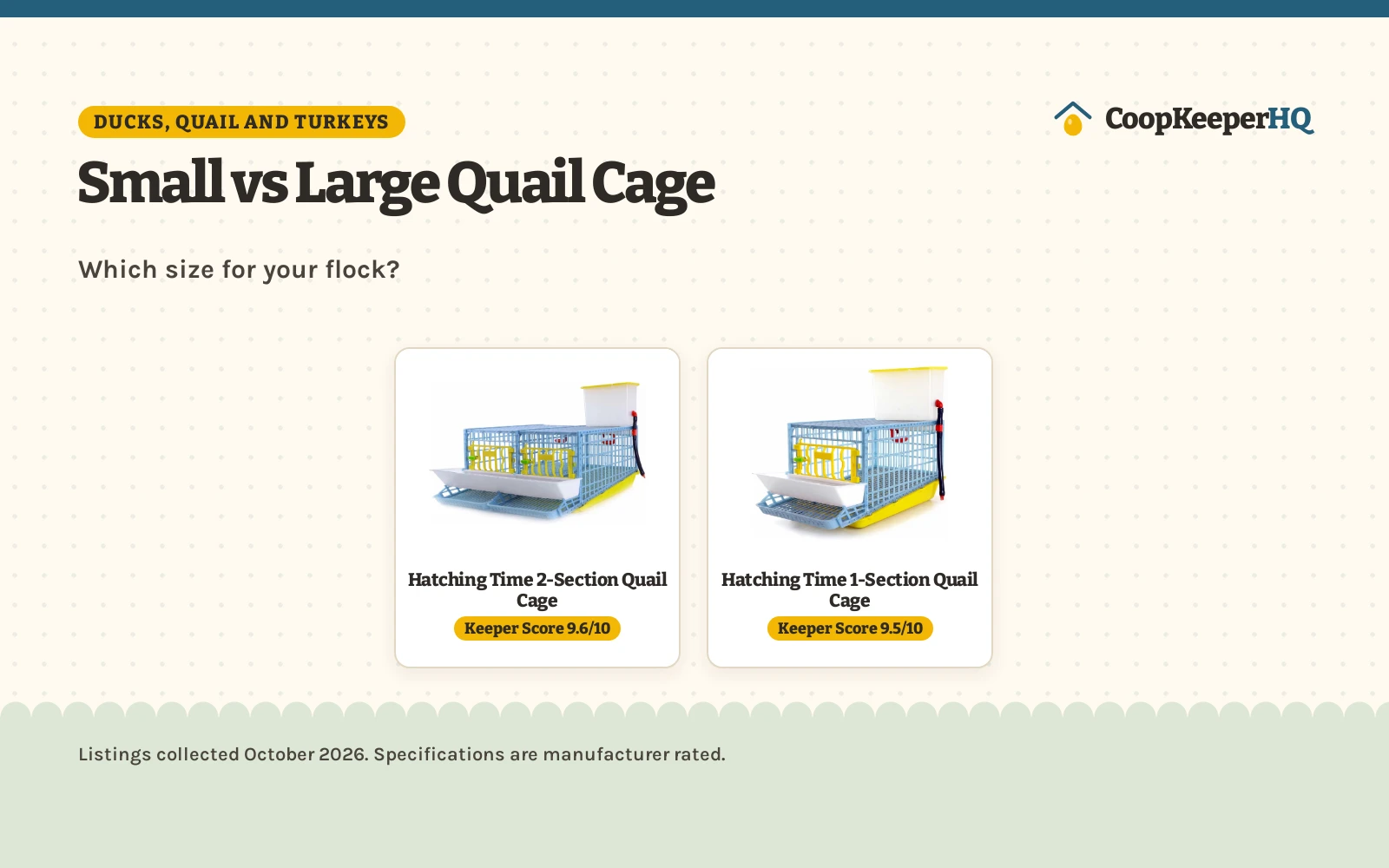
 Large example: 2 sections9.6/10View on Amazon
- 3Small example: 1 section9.5/10View on Amazon
- 4
 Hatching Time Quail Breeding Cage IndoorView on Amazon
- 5
 Hatching Time Quail Cage Grow Out PenView on Amazon
- 6
 1 Additional Layer for Quail Breeding CageView on Amazon
- 7
 2 Additional Layers for Quail Breeding CageView on Amazon
- 8
 My Favorite Chicken 27oz Chicken Cage CupView on Amazon
- 9
 2-in-1 Quail Feeder and Waterer for CageView on Amazon
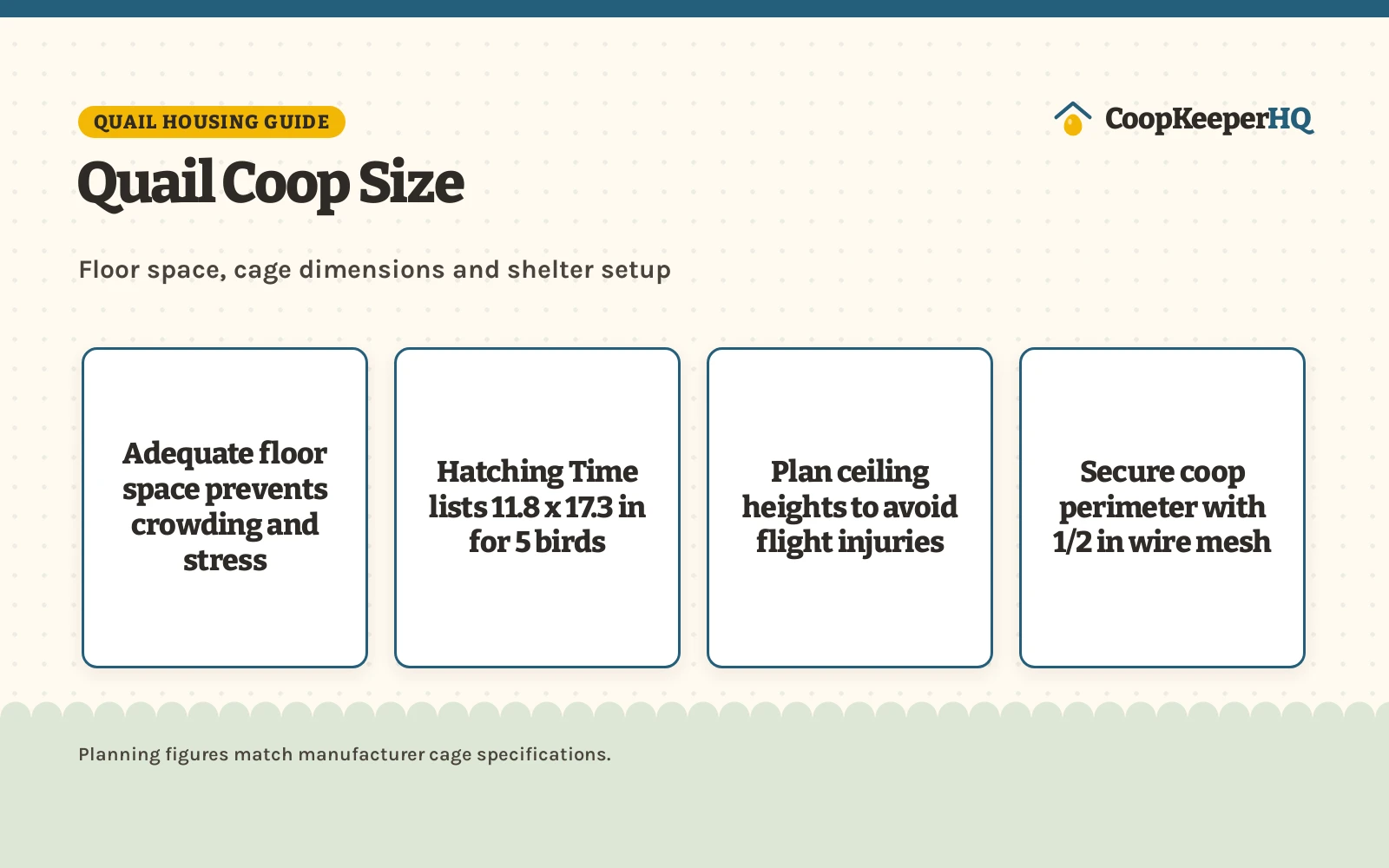
Selecting the proper quail cage size depends on bird breed, flock headcount and whether birds live in commercial breeding batteries, outdoor hutches or roomy walk-in aviaries. Coturnix quail require adequate floor area to walk and feed without crowding, alongside ceiling clearance designed to prevent head injuries when birds flush upward. Providing sufficient floor space reduces feather pecking, keeps litter cleaner and supports steady daily egg production across the flock.
Other options for the coop
 Hatching Time Quail Breeding Cage IndoorCheck price on Amazon
 Hatching Time Quail Cage Grow Out PenCheck price on Amazon
 1 Additional Layer for Quail Breeding CageCheck price on Amazon
 2 Additional Layers for Quail Breeding CageCheck price on Amazon
 My Favorite Chicken 27oz Chicken Cage CupCheck price on Amazon
 2-in-1 Quail Feeder and Waterer for CageCheck price on Amazon
CoopKeeperHQ earns a commission if you buy through our links, at no added cost to you. Affiliate disclosure.
Quail cage size: how much floor space do birds need?
When planning housing, floor footprint matters more than vertical height because quail spend their waking hours walking, scratching and resting on the ground. Unlike chickens, quail do not perch on elevated roosting bars, so available floor area determines how comfortable the birds remain. Crowded cages lead to stress, aggressive feather picking, soiled eggs and weakened birds. If you want to compare housing layouts, our quail coop size guide outlines outdoor run dimensions, while our best quail coop review covers backyard shelters.
Manufacturer ratings on commercial cages provide clear benchmarks for daily density. Hatching Time lists a single compartment measuring 11.8 x 17.3 in of floor space for up to 5 standard quail. That same maker recommends 3 larger birds for the Jumbo Coturnix configuration within that 11.8 x 17.3 in floor area. When expanding to a wider layout, Hatching Time lists a 2-section cage with 23.8 x 17.3 in of floor space for up to 10 standard quail, providing space for 5 smaller birds per section or 3 larger birds per section. For larger groups on a single level, Hatching Time lists a 3-section cage providing 35.8 x 17.3 in of layer floor space for up to 15 standard-size birds. Keepers managing heavy jumbo birds should stick to the conservative recommendation of 3 larger birds per section to ensure calm covey behavior.
Ceiling height and head injury prevention
Ceiling clearance is a critical consideration in quail housing design. When startled by shadows, noises or sudden movements, quail react by flushing straight upward with explosive force. In an enclosure with an awkward ceiling height, a flushing bird can strike its head against rigid wire, causing severe head trauma or neck injury.
Experienced keepers address this natural flushing reflex through distinct design approaches. One approach uses low ceilings, typical of stacked commercial breeding cages. Hatching Time lists cage models with an overall height of 18.1 in (and 18.01 in in spec details), which keeps the ceiling close enough to the floor that birds cannot build up vertical speed when jumping. Their multi-tier brooder unit lists 9.5 inches of internal vertical clearance per level for birds under 5 inches tall. Another approach uses tall walk-in aviary designs where ceilings sit high enough that birds lose upward momentum before reaching the top netting. EOXNYZR lists a walk-in run measuring 6.6 x 9.8 x 6.5 ft, giving ample vertical clearance for birds to flutter safely. Avoid intermediate ceiling heights where birds achieve maximum flight speed right before colliding with unpadded wire.
Stacked breeding cages and multi-tier systems
Stacked multi-tier battery cages are popular for keeping laying Coturnix indoors, in sheds, or inside garages because they maximize bird capacity while occupying minimal ground area. By stacking compartments vertically, keepers can house substantial flocks without expanding their floor footprint.
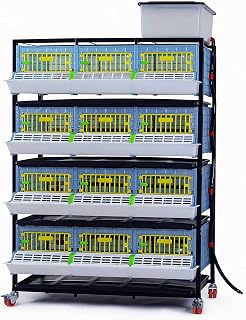
For multi-tier breeding setups, Hatching Time lists a 3-layer system with 3 sections per layer, measuring 38.6 x 24 x 52 in overall, that houses up to 45 standard quail. That setup accommodates up to 5 smaller quail per section, or 3 larger birds per section, with removable middle walls that allow keepers to maintain separate breeding groups or open compartments into larger spaces. A stacked system also centralizes care: Hatching Time includes gravity-fed watering and sloped flooring that guides laid eggs forward into an external roll-out collection tray. For smaller hobby setups, their 1-layer, 3-section cage measures 38.6 x 24 x 23 in and weighs 28 lb, offering the same 35.8 x 17.3 in layer floor area in a compact footprint. Routine maintenance is streamlined because droppings fall through the wire floor into removable droppings trays below each tier.
Wire mesh flooring and droppings clearance
Floor design is another fundamental factor when choosing quail cages. Most purpose-built quail cages feature wire mesh floors that allow droppings to fall through into collection trays below. This separation keeps the birds out of manure, prevents dirty eggshells and reduces odor. However, wire openings must match the size of your birds’ feet to prevent toe catching, leg sprains or foot injuries.
Hatching Time lists two distinct floor grid sizes: Traditional flooring with 5/8 x 5/8 inches openings for regular-size quail, and Jumbo flooring with 7/8 x 5/8 inches openings designed for larger Coturnix. The larger 7/8 x 5/8 inches grid allows larger droppings from jumbo birds to pass cleanly while supporting their broader foot pads. Hatching Time manufactures these floors from rust-free polypropylene plastic that can be power-washed between flocks. For wire enclosures, mesh density is equally critical. SNAAT lists metal wire panels with a 0.6-inch gap size. By contrast, PawHut lists a gap size of 4 inches on a rabbit hutch, which is hazardous for quail because small game birds can easily push through or get their necks trapped. If you are building or modifying an enclosure, our what is hardware cloth guide explains how tight welded wire mesh keeps birds safely contained.
Outdoor hutches, pens and predator protection
Keeping quail outdoors requires durable predator protection because quail are defenseless against raccoons, foxes, rats, snakes and domestic cats. Standard chicken wire is inadequate because predators can tear through light wire or reach through wide gaps. Outdoor cages require heavy-gauge welded wire, sturdy framing and animal-proof door latches.
For compact outdoor housing, Sailret lists a 63-inch metal cage measuring 63 x 24 x 29.92 inches with a rustproof bottom metal mesh floor, two top access panels, one feeding door and one gravity self-locking main door, weighing 44 pounds. That bottom mesh prevents digging predators from entering while keeping birds safely inside. For wooden outdoor shelters, PawHut lists a 2-story hutch measuring 53.75 x 19.75 x 36.5 inches with fir wood construction, an asphalt roof, 2 levels, two pull-out trays and 4 doors, weighing 44.8 pounds. While wooden hutches offer weather protection, any gaps wider than small hardware cloth mesh must be screened. For large outdoor pens, EOXNYZR lists a walk-in run measuring 6.6 x 9.8 x 6.5 ft built from 1-inch thick galvanized steel tubing with Oxford fabric sunshade roofing. Our best hardware cloth guide details predator aprons and perimeter mesh to prevent burrowing.
Feeding and watering space
Cage dimensions must account for feeder and drinker placement so birds do not crowd during feeding. Quail have fast metabolisms and eat frequently throughout the day. If cage space is too tight, dominant birds will guard food troughs and drive submissive birds away, leading to uneven flock growth.
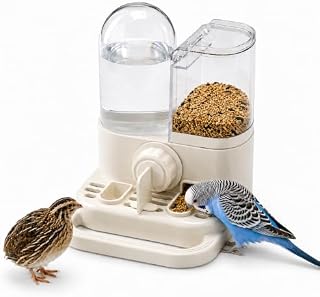
Commercial cages solve feeder spacing by mounting troughs along the exterior wall. Hatching Time integrates front feeding troughs alongside gravity-fed drinker cups, keeping interior floor space entirely open for bird movement. On their 2-section unit, Hatching Time supplies a 1-gallon water tank connected to 2 drinker cups. Their 3-section cage features an extended waste tray that extends 3 inches farther beneath the feeding area to catch spilled feed and droppings. For DIY setups or wire pens, external troughs like those in our metal J feeders for quail guide save interior space. If cold weather freezes water lines, our quail coop for winter guide discusses winter shelter strategies. Never introduce supplemental heat lamps into confined cages due to severe fire hazards; consult a poultry vet or state extension office if birds show signs of cold stress.
Indoor enclosures and brooder space
Brooding quail chicks requires specialized enclosures with controlled temperatures and draft-free walls. Young quail chicks are extremely small at hatch and can squeeze through minimal gaps or drown in open water dishes.
For brooding small game birds, Hatching Time lists a 5-layer brooder measuring 38.6 x 23.6 x 77.2 inches overall with 35.8 x 17.3 x 9.5 inches of internal space per level, designed for chicks under 5 inches tall. Each level includes a 125W brooder heater with a thermostat regulating between 68°F and 104°F for indoor rooms warmer than 65°F, alongside waste trays that sit 3 inches deeper than older models. For small indoor habitats, Vilanpaw lists a wooden and tempered glass enclosure measuring 32 x 17 inches (with product dimensions 31.5 x 15.75 x 15.75 inches and weight 24.6 pounds) featuring two distinct chambers separated by a removable divider. Modular wire pens like SNAAT’s 20-panel enclosure measuring 48 x 24 x 16 inches with 0.6-inch wire mesh provide flexible temporary housing. As chicks grow, transfer them to permanent cages once fully feathered, and store collected eggs using trays from our egg cartons for small eggs guide.
A simple quail cage checklist
- Floor space matches flock headcount, providing sufficient room for birds to walk and feed without crowding
- Ceiling height is either kept low in stacked cages or tall in walk-in aviaries to prevent head injuries
- Wire mesh floor openings support foot pads while letting droppings fall cleanly into collection trays
- Wire gaps on walls and doors measure 0.6 inches or narrower to prevent escapes and keep predators out
- External feeding troughs and gravity-fed drinkers preserve usable interior floor space
- Shelters provide protection from drafts, driving rain and direct summer sun
For broader comparisons of outdoor pens, see our hoop coop for quail guide and budget housing in our quail coop cheap review.
Birds, breed size, run time and climate in; coop floor, run space, roost length and nesting boxes out.
Wash your hands after handling birds, eggs or equipment, supervise children around the flock, and check local rules on flock size and roosters before you buy. For sick birds, call a poultry veterinarian or your state extension office. See CDC backyard poultry guidance. Read our Safety Disclaimer.
FAQ for the flock
What is the recommended quail cage size for five birds?
For standard Coturnix quail, manufacturer baselines like Hatching Time specify a single cage compartment measuring 11.8 x 17.3 in of floor space for up to 5 birds. For larger jumbo Coturnix, the recommendation decreases to 3 birds within that same floor area to prevent overcrowding.
Can quail cages be stacked in multiple layers?
Yes, quail cages are commonly stacked into multi-tier battery systems. Hatching Time lists a 3-layer, 3-section setup measuring 38.6 x 24 x 52 in that accommodates up to 45 standard quail. Stacked units feature pull-out droppings trays beneath each level to keep lower compartments clean.
What wire mesh size is safe for quail cage floors?
Purpose-built plastic flooring from Hatching Time uses 5/8 x 5/8 inches openings for standard quail and 7/8 x 5/8 inches openings for jumbo Coturnix. These dimensions allow droppings to pass through while supporting small feet without catching toes.
Do quail need high ceilings in their cages?
No, standard breeding cages use low ceilings around 18.1 in tall, or brooder heights of 9.5 inches per level, to prevent birds from building up vertical speed when flushing. Aviaries should be tall walk-in designs, avoiding mid-height ceilings that cause head collisions.
Can you keep quail in an outdoor chicken run?
Quail can live in an outdoor run if the enclosure is fully predator-proofed with small mesh. SNAAT lists wire panels with 0.6-inch gaps, which prevents escapes. Large walk-in runs like EOXNYZR’s 6.6 x 9.8 x 6.5 ft pen require fine wire mesh along the base to keep small quail from slipping through.
More coop guides
- Quail Coop Size: Space Requirements and Setup Guide
- Best Quail Coop: 5 Backyard Picks Compared (2026)
- Quail Coop Cheap: 5 Budget Picks for Backyard Flocks (2026)
See the quail and poultry guides and the runs and fencing picks.