12 vs 24 Egg Incubator: Which One Should You Buy?
12 vs 24 egg incubators compared on capacity, turning, humidity control and warranty, with two 12-egg examples and the Brinsea 24-egg example.

On this page
Top picks at a glance
As an Amazon Associate I earn from qualifying purchases.
- 1
 Brinsea Maxi 24 EX9.6/10View on Amazon
- 2
 OKKÖBI 12-Egg Incubator9.5/10View on Amazon
- 3
 KEBONNIXS 12-Egg Incubator9.4/10View on Amazon
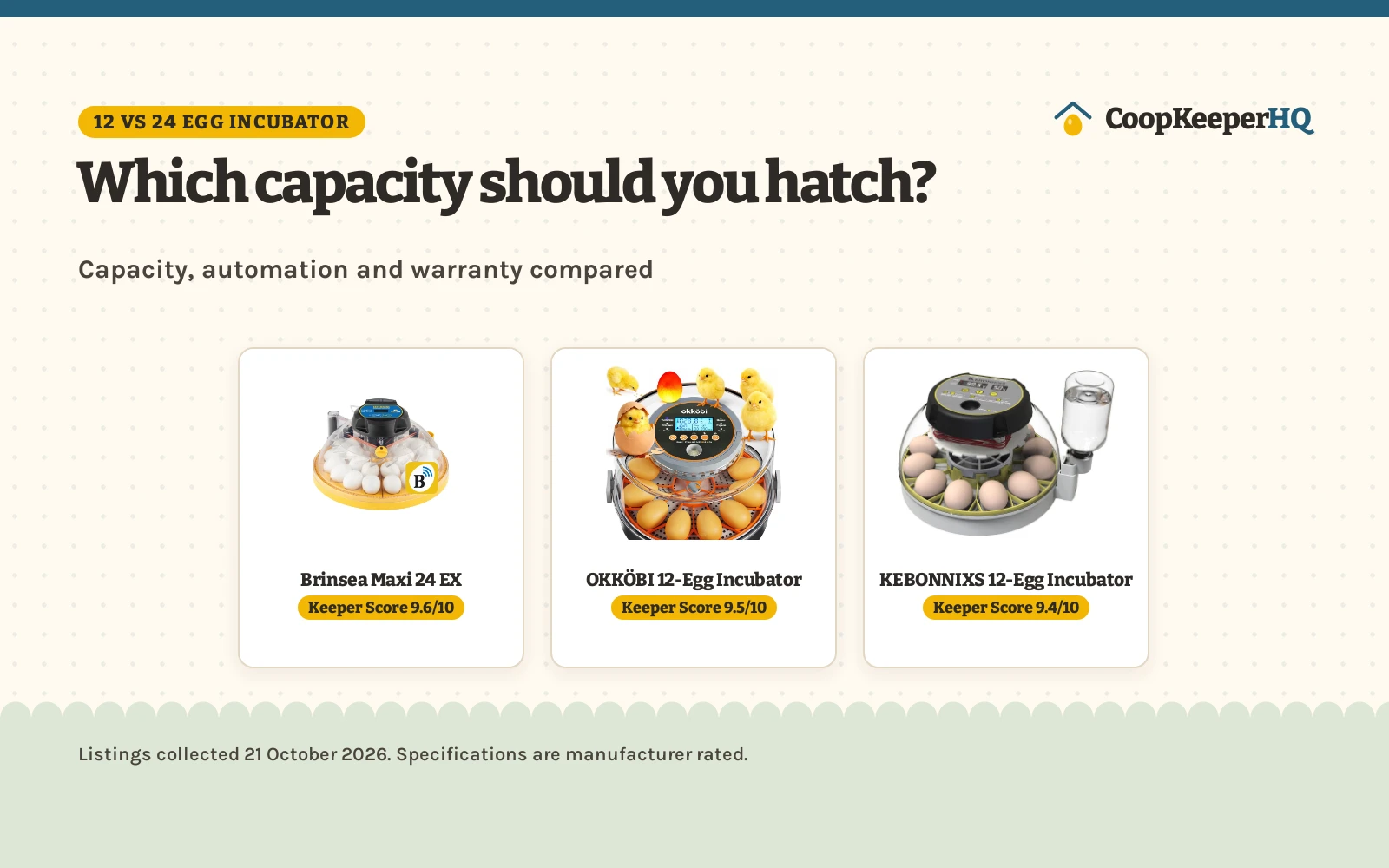
12 vs 24 egg incubator verdict: Choose a 12-egg incubator for a small backyard flock or a first hatch: both 12-egg examples here turn eggs automatically and include a built-in candler. Choose a 24-egg incubator when you want to hatch a bigger batch at once: the Brinsea example holds 24 standard eggs with app-driven controls and automatic humidity.
Both sides hatch chicks the same way, but they suit different flock plans. A 12-egg incubator fits a keeper who hatches a few dozen chicks a season; a 24-egg incubator fits one who wants more chicks per run or hatches for friends too. This 12 vs 24 egg incubator comparison covers the two capacities, then three examples from the listings we reviewed.
CoopKeeperHQ earns a commission if you buy through our links, at no added cost to you. Affiliate disclosure.
Two examples
| # | Product | Keeper Score | Buy |
|---|---|---|---|
| 1 | Brinsea Maxi 24 EX | 9.6/10 | Buy on Amazon |
| 2 | OKKÖBI 12-Egg Incubator | 9.5/10 | Buy on Amazon |
| 3 | KEBONNIXS 12-Egg Incubator | 9.4/10 | Buy on Amazon |
Brinsea Maxi 24 EX
24-egg incubator with app-driven controls, automatic humidity pump and programmable turning, 3-year warranty.
The Brinsea is the 24-egg side example: 24 standard chicken eggs with a mix-and-match quadrant insert system, app-driven controls with immediate notifications, automatic humidity from a built-in pump, and programmable automatic turning with auto-stop. The clear top gives visibility through the hatch.
Pros
- 24 standard eggs, or 12 large, 8 jumbo or 40 smaller
- App-driven controls with 24/7 alerts stated
- Automatic humidity with built-in pump
- 3-year warranty stated
Cons
- No built-in candler stated
- 6.98 lb is the heaviest of the three
- 13 by 13 by 9 in needs the most shelf space
- No safety listing stated

OKKÖBI 12-Egg Incubator
12-egg incubator with sensors, 1L tank, 90-minute turning and built-in candler, 5 years of product protection.
The OKKÖBI is the 12-egg example with the longest warranty: 5 years of product protection with 7-day support. The listing states sensors managing heat, moisture and rotation, a 1L tank, automatic turning every 90 minutes that stops 3 days before hatch, and a built-in candling lamp.
Pros
- 5 years of product protection is the longest term here
- Sensors manage heat, moisture and turning with a 1L tank
- Turning every 90 minutes, adjustable in custom mode
- Built-in candling lamp included
Cons
- 12-egg capacity suits smaller hatches only
- Trays are not dishwasher safe, per the listing
- No app control stated
- No safety listing stated
KEBONNIXS 12-Egg Incubator
12-egg incubator with circulating fan, humidity display, egg candler and auto-stop turner at 3.67 lb.
The KEBONNIXS is the simpler 12-egg example: a circulating fan for stable temperature, a humidity display, a built-in egg candler and an automatic turner that stops 3 days before hatch. Water filling needs no lid opening, which avoids temperature fluctuation per the listing.
Pros
- Circulating fan for stable temperature distribution
- Humidity display, no separate hygrometer needed
- Built-in egg candler included
- Water filling without opening the lid
Cons
- No warranty term stated
- 12-egg capacity suits smaller hatches only
- No app control stated
- No safety listing stated
Other options for the coop
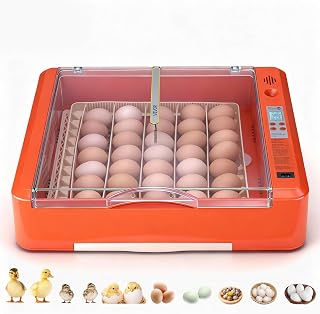 VEVOR 36 Egg IncubatorCheck price on Amazon
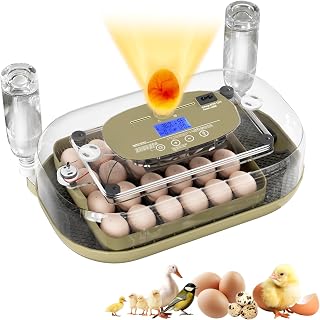 XOTTI Incubator for Hatching EggsCheck price on Amazon
 Syluris Incubators for Hatching EggsCheck price on Amazon
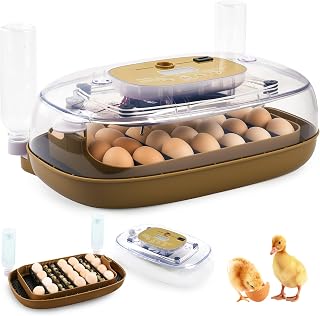 24 Eggs Incubator with Auto Water Refill & Humidity ControlCheck price on Amazon
 Harris Farms Nurture Right Egg Incubator with Auto TurnerCheck price on Amazon
 MATICOOPX 30 Egg Incubator with Humidity DisplayCheck price on Amazon
12 vs 24 egg incubator: side by side
| Factor | KEBONNIXS 12-Egg Incubator | OKKÖBI 12-Egg Incubator | Brinsea Maxi 24 EX |
|---|---|---|---|
| Capacity stated | 12 eggs | 12 eggs | 24 standard eggs |
| Egg turning | Automatic, auto-stop 3 days before hatch | Every 90 min, auto-stop 3 days before hatch | Programmable automatic with auto-stop |
| Humidity | Display | Sensors + 1L tank | Automatic pump |
| Candler | Built-in | Built-in | Not stated; clear top |
| App control | Not stated | Not stated | Connect app with alerts |
| Weight stated | 3.67 lb | 1.6 kg | 6.98 lb |
| Warranty | Not stated | 5 years | 3-year |
These are common ranges across the poultry listings we read; we quote the brand’s rated specs from the product listings (as of 20 October 2026).
Capacity
This is the whole question. The KEBONNIXS and OKKÖBI each state 12 eggs, with the OKKÖBI noting 12 large chicken eggs or more small eggs in a single layer. The Brinsea states 24 standard chicken eggs, or 12 large, 8 jumbo or 40 smaller eggs, with a mix-and-match quadrant insert system for hatching various egg sizes at once. If your flock plan needs more than a dozen chicks per hatch, the 24 side is the answer; if a dozen covers it, the 12 side costs less space on the shelf.
Egg turning
All three listings state automatic turning with an auto-stop before hatch. The KEBONNIXS states an automatic egg turner that stops 3 days before hatch, the OKKÖBI turns every 90 minutes, adjustable in custom mode, and also stops 3 days before hatch, and the Brinsea states programmable automatic turning with auto-stop. Turning is even heat for the embryos, and none of these three asks you to do it by hand.
Humidity control
The approaches differ. The KEBONNIXS shows a humidity display so you can watch the level, and its water filling needs no lid opening. The OKKÖBI uses built-in sensors with a 1L tank to manage moisture for you. The Brinsea goes furthest: an automatic humidity system with a built-in pump that the listing says eliminates opening the incubator. More automation means less fiddling during the hatch.
Candling and visibility
Both 12-egg listings include a built-in egg candler for watching embryo development without buying a separate lamp. The Brinsea states no candler, but it has a clear top for visibility throughout the hatch. If candling matters to you, the 12 side includes it; on the 24 side you watch through the lid.
Size, weight and app control
The KEBONNIXS states 11.4 by 10.2 by 6.7 in at 3.67 lb, the OKKÖBI states 1.6 kg, and the Brinsea states 13 by 13 by 9 in at 6.98 lb. The Brinsea is the biggest and heaviest of the three, which follows from holding twice the eggs. Only the Brinsea states app-driven controls with 24/7 alerts; the 12-egg listings manage themselves on the unit with no app stated.
Egg sizes and the mix-and-match tray
Egg capacity numbers assume standard chicken eggs. The OKKÖBI states 12 large chicken eggs or more small eggs, so quail eggs stretch the count. The Brinsea states 24 standard, 12 large, 8 jumbo or 40 smaller eggs, with a mix-and-match quadrant insert system for hatching various egg sizes at once. If you hatch quail or duck alongside chicken eggs, the quadrant system is the practical difference, not just the headline number.
Automation compared
The three listings automate different amounts of the hatch. The Brinsea automates the most: app-driven temperature, turning and humidity with a built-in pump, plus immediate notifications. The OKKÖBI automates on the unit: sensors manage heat, moisture and rotation with a 1L tank, and turning runs every 90 minutes, adjustable in custom mode. The KEBONNIXS automates turning and shows humidity on a display, with water filling that needs no lid opening. The KEBONNIXS and OKKÖBI both stop turning 3 days before hatch; the Brinsea states auto-stop without a stated day count. If you want to set the incubator and check your phone, the Brinsea is the only one with an app; if you prefer the unit to manage itself, the OKKÖBI’s sensors do that.
Running the hatch
Capacity decides the workload as much as the chick count. Twenty-four eggs means twice the eggs to watch and twice the chicks to brood afterward, so the 24 side suits a keeper with brooder space ready. Twelve eggs suits a first hatch or a small flock: the KEBONNIXS at 3.67 lb and the OKKÖBI at 1.6 kg sit easily on a shelf, while the Brinsea at 6.98 lb and 13 by 13 by 9 in wants a dedicated spot. The OKKÖBI notes its trays are not dishwasher safe, so plan on hand washing them; the other two listings state no dishwasher guidance.
Flock fit
Brinsea Maxi 24 EX
OKKÖBI 12-Egg Incubator
KEBONNIXS 12-Egg Incubator
FAQ for the flock
Is a 12 or 24 egg incubator better for a first hatch?
For a first hatch, 12 eggs is plenty: fewer eggs to manage and both 12-egg examples here turn automatically with a built-in candler. Move to 24 when you want more chicks per run.
Do these incubators turn the eggs automatically?
All three state automatic turning with an auto-stop before hatch. The OKKÖBI turns every 90 minutes and is adjustable in custom mode; the KEBONNIXS states auto-stop 3 days before hatch, and the Brinsea states auto-stop without a stated day count.
How do I manage humidity?
The KEBONNIXS shows a humidity display, the OKKÖBI uses sensors with a 1L tank, and the Brinsea runs an automatic humidity pump. None of the listings asks you to guess.
Can I candle eggs without opening the lid?
The KEBONNIXS and OKKÖBI include a built-in candler. The Brinsea states no candler but has a clear top for watching the hatch.
Which example has the longest warranty?
The OKKÖBI states 5 years of product protection, the Brinsea states a 3-year warranty, and the KEBONNIXS states no warranty term.
How the Coop Score came out
Each example is scored on performance, build, value, safety and warranty, using only what the listing publishes. The OKKÖBI states 5 years of product protection, the Brinsea states a 3-year warranty, and the KEBONNIXS states no warranty term. The weights are on our How We Pick page.
| Product | Keeper Score | Perf. /35 | Build /25 | Value /25 | Safety /10 | Warranty /5 |
|---|---|---|---|---|---|---|
| Brinsea Maxi 24 EX | 9.6 | 32 | 21 | 20 | 0 | 4 |
| OKKÖBI 12-Egg Incubator | 9.5 | 29 | 20 | 20 | 0 | 5 |
| KEBONNIXS 12-Egg Incubator | 9.4 | 28 | 20 | 20 | 0 | 0 |
A product’s weighted total becomes its score on a scale capped at 9.8 and floored at 9.2, in a straight line.
Which should you choose?
Choose a 12-egg incubator if you hatch for a small backyard flock, you want automatic turning and a built-in candler, and a compact unit suits your shelf.
Choose a 24-egg incubator if you want twice the eggs per hatch, you like app alerts and automatic humidity, and you have room for the bigger unit.
Pick a species and a set date for candling days, lockdown and hatch day, with a calendar file to save.
Run the incubator for a day before you set eggs to confirm temperature and humidity, keep it away from direct sun and drafts, and plug it into a protected outlet. Plan the brooder before hatch day. Wash your hands after handling eggs and chicks. See CDC backyard poultry guidance. Read our Safety Disclaimer.
More coop guides
- Best Incubator for 12 Eggs (2026): 5 Picks Compared
- Best Incubator for 24 Eggs (2026): 5 Picks
- Small vs Large Egg Incubator: Which One Should You Buy?
- Incubator vs Broody Hen: Which One Should You Buy?
- Chicken Egg Incubation Chart: Day-by-Day Stages and Guide
See the incubator and hatching guides and the egg hatch calendar.