Incubator vs Broody Hen: Which One Should You Buy?
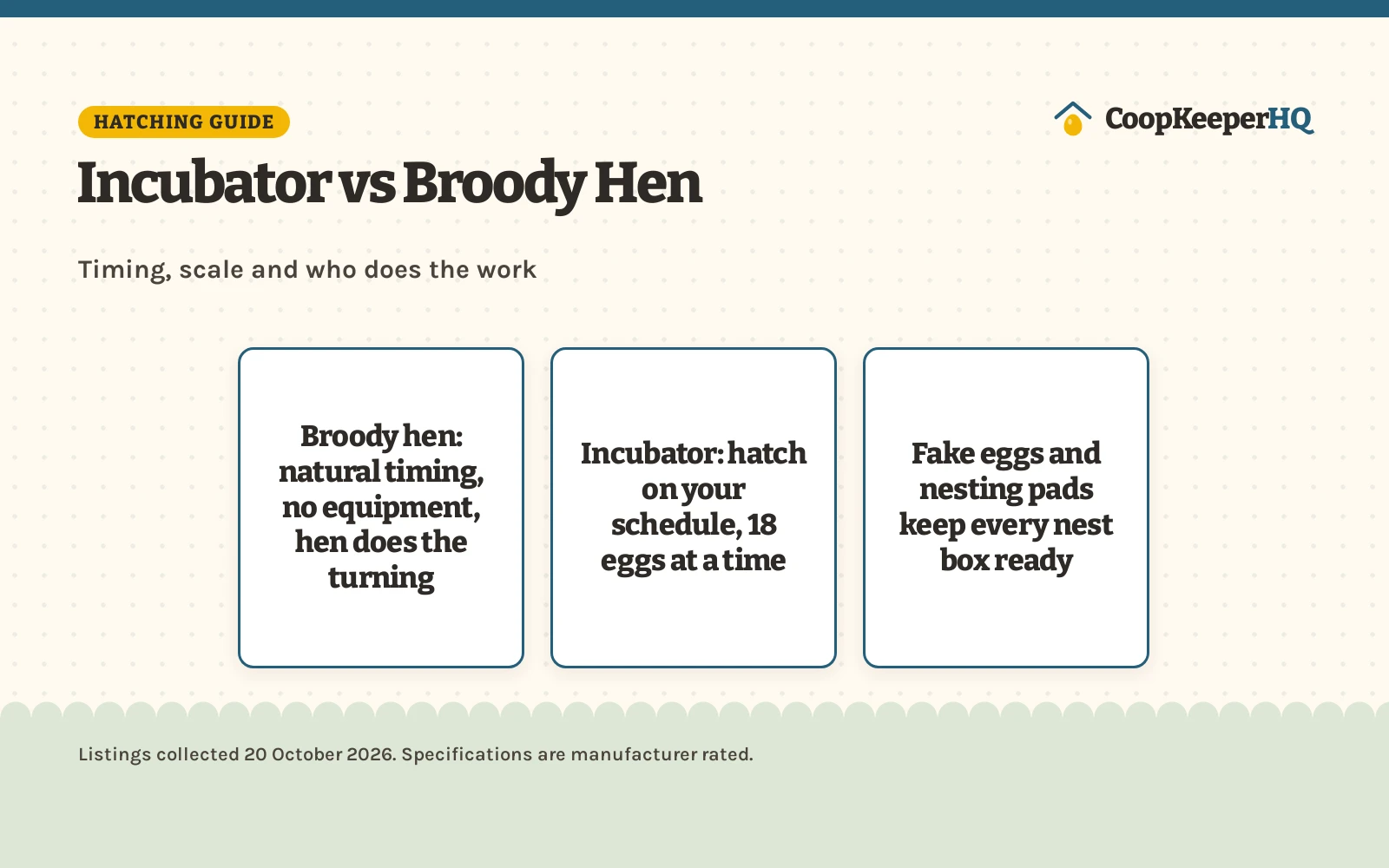
Choosing between an incubator and a broody hen comes down to timing, scale and how much of the work you want to do yourself.

On this page
Top picks at a glance
As an Amazon Associate I earn from qualifying purchases.
- 1
 Egg Incubators for Hatching Eggs9.7/10View on Amazon
- 2
 Egg Incubator with 360° ViewView on Amazon
- 3
 Series III-18 Egg Automatic Incubator with Smart Dual-BottleView on Amazon
- 4
 26-Egg Incubator for Hatching EggsView on Amazon
- 5
 iPettie Nestasy ProHatch56 Egg Incubator with Automatic EggView on Amazon
- 6
 48 Egg IncubatorView on Amazon
- 7
 48 Incubators for Hatching EggsView on Amazon
You go out to collect eggs and find a hen parked flat in the nest box, puffed up and growling when you reach under her. She has decided to hatch, and now you have a decision too. Incubator vs broody hen comes down to timing, scale and how much of the work you want to do yourself: the hen works on her own schedule for free, while an incubator hatches on yours for the cost of the equipment and the electricity.
Other options for the coop
 Egg Incubator with 360° ViewCheck price on Amazon
 Series III-18 Egg Automatic Incubator with Smart Dual-BottleCheck price on Amazon
 26-Egg Incubator for Hatching EggsCheck price on Amazon
 iPettie Nestasy ProHatch56 Egg Incubator with Automatic EggCheck price on Amazon
 48 Egg IncubatorCheck price on Amazon
 48 Incubators for Hatching EggsCheck price on Amazon
CoopKeeperHQ earns a commission if you buy through our links, at no added cost to you. Affiliate disclosure.
Incubator vs broody hen: the short answer
Choose the broody hen if you have a reliably broody bird, a small batch of eggs and no deadline pressure. She handles the turning, the humidity and the schedule, and she raises the chicks herself. Choose the incubator if you want to hatch on a date you pick, hatch more eggs than one hen can cover or hatch when no hen is broody. Many keepers use both across the season: the hen for spring clutches and the incubator for planned hatches.
When a broody hen is the better choice
A broody hen is the low-equipment option. She turns the eggs, keeps them at her own steady warmth and talks to the chicks before they hatch, and once they are out she teaches them to eat and drink. There is nothing to plug in, nothing to calibrate and no water bottles to refill. The trade is control: she decides when, she decides how many eggs fit under her and she may abandon the nest partway through, which is a risk you accept with the method. A quiet, low nest box helps; our nesting box guide for broody hens covers low, quiet picks.
When an incubator is the better choice
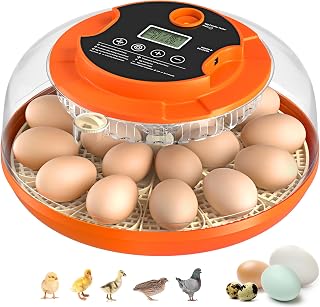
An incubator hatches on your calendar. The example here, the Onsju, holds 18 chicken or duck eggs, or about 40 quail or parrot eggs, which suits a planned hatch bigger than one hen usually covers. It turns the eggs automatically on a 1, 2 or 3 hour interval you choose, watches the temperature with a digital thermostat and built-in airflow, and sounds an alarm if the temperature leaves your set range. Two water bottles allow external refills without opening the lid, which keeps the humidity steady through the run. The 360-degree transparent dome with LED egg-checking lights lets you watch progress without lifting the lid. Our small vs large incubator comparison and the cabinet vs tabletop comparison cover the size question in more depth.
The gear that helps either way
Three kinds of gear support both methods. First, the incubator itself for planned hatches: the Onsju’s 18-egg capacity, automatic turning, external water refill and temperature alarm are all stated in its listing. Second, nesting pads for the nest boxes: the Eaton Pet and Pasture 10-pack gives 13 by 13 inch pads of sustainably harvested aspen excelsior over a kraft paper layer, which the maker says draws moisture down and keeps the nest fresher. Note the spec table lists 13.75 by 13.75 inches against the 13 by 13 in the title and bullets; trust the title and bullets. Third, dummy eggs: the Azatemgo 6-pack of solid wood eggs, 5.5 by 4 cm each, encourages hens to lay in the nest box, which matters because a hen that lays in the box is a hen you can set. The spec table’s 6.3 by 5.59 by 2.13 in dimensions read as the package, not the eggs; trust the bullets. See nesting pads vs straw if you are choosing bedding.
Buying the gear: what the listings tell you
Start with capacity. The Onsju example holds 18 chicken or duck eggs, or about 40 quail or parrot eggs, so match the model to the hatch you actually plan: a small backyard clutch fits the chicken-egg count, while a classroom or small-farm project may want the quail-egg end of the range. Automatic turning on a 1, 2 or 3 hour interval means you choose the schedule and the machine handles the rest, and the digital thermostat with built-in airflow plus a temperature alarm covers the two things that undo a hatch, uneven heat and a missed temperature swing.
Humidity control is the quiet feature to shop for. The Onsju uses two water bottles for external refills, so you top up without opening the lid and breaking the humidity the eggs sit in. The 360-degree transparent dome with LED egg-checking lights serves the same purpose from the other side: you check progress without lifting the lid at all. Every lid opening costs warmth and moisture, so features that keep the lid shut are worth more than they look.
For the nest boxes, the Eaton 10-pack gives 13 by 13 inch pads of aspen excelsior over a kraft paper layer that the maker says draws moisture down, keeping the nest fresher and minimizing egg breakage. Put fresh pads in at setting time so the hen starts clean. The Azatemgo 6-pack of solid wood dummy eggs, 5.5 by 4 cm each with a smooth, round finish and no peculiar smell, goes into the nest boxes to encourage hens to lay where you can collect and set the eggs. Six eggs cover several boxes, and the 8.4 oz listed weight reads as the package, not per egg.
Run the incubator for a day before you set eggs to confirm temperature and humidity, keep it away from direct sun and drafts, and plug it into a protected outlet. Plan the brooder before hatch day. Wash your hands after handling eggs and chicks. See CDC backyard poultry guidance. Read our Safety Disclaimer.
FAQ for the flock
Can I hatch chicks without an incubator?
Yes, with a broody hen. She turns the eggs, keeps them warm and raises the chicks, with no equipment to buy or power to supply. The trade is timing and scale: she hatches when she chooses, and only as many eggs as she can cover.
How many eggs can I set at once in an incubator?
It depends on the model. The Onsju example here holds 18 chicken or duck eggs, or about 40 quail or parrot eggs. Match the capacity to the size of the hatch you plan, and see our small vs large incubator comparison before sizing up.
Do dummy eggs really encourage hens to lay in the nest box?
That is what they are sold for. The Azatemgo listing says its 6-pack of solid wood eggs, 5.5 by 4 cm each, helps encourage hens to lay in the hen house nest boxes. A hen laying in the box is easier to set than one laying in a corner of the run.
What do nesting pads do for a broody hen?
They give her a clean, soft surface to sit on. The Eaton 10-pack uses aspen excelsior over a kraft paper layer that the maker says draws moisture down, keeping the nest fresher through the sit. Fresh pads at setting time mean she starts clean.
Can I use a broody hen and an incubator in the same season?
Many keepers do. Let the hen take the spring clutch she wants, and use the incubator for a planned hatch on your own dates or for more eggs than she can cover. Keep the two projects separate so a hen coming off the nest does not disturb the incubator batch, and vice versa.
More coop guides
- Small vs Large Egg Incubator: Which One Should You Buy?
- Cabinet vs Tabletop Egg Incubator: Which One Should You Buy?
- Digital vs Analog Incubator Thermometer: Which Hatches Better?
- Best Chicken Nesting Box for Broody Hens (2026): Low, Quiet Picks
- Nesting Pads vs Straw: Which One Should You Buy?
- Metal vs Wooden Chicken Nesting Box: Which One Should You Buy?
See the egg incubator for off grid picks and the propane vs electric brooder comparison for what comes after the hatch.