Aluminum vs Steel Hardware Cloth: Which One Should You Buy?
Aluminum vs steel hardware cloth for chicken runs, compared across 4 featured wire rolls by mesh size, gauge, coating and roll size, with install notes.

On this page
Top picks at a glance
As an Amazon Associate I earn from qualifying purchases.
- 1
 GMOTLSE 304 Stainless Steel Hardware Cloth9.6/10View on Amazon
- 2
 19-Gauge Galvanized Hardware ClothView on Amazon
- 3
 SS304 Stainless Steel 1/4 Hardware Cloth,Stainless Steel WireView on Amazon
- 4
 Hardware Cloth 1/8" Chicken Wire Mesh Fencing 36in x 10ftView on Amazon
- 5
 Hardware Cloth 1/4 inch 23 Gauge Small Size 304 StainlessView on Amazon
- 6
 304 Stainless Steel Hardware Cloth 1/4 Inch 23 Gauge ChickenView on Amazon
- 7304 Stainless Steel Hardware Cloth 1/2 Inch 20 Gauge ChickenView on Amazon
Walking the run fence on a morning round, a keeper checks the same things every time: gaps at the bottom, loose corners, and any place a small animal could push through. When that walk turns into a shopping question, the answer for aluminum vs steel hardware cloth is straightforward for the listings featured here: steel wire is the material described in the listings, in galvanized and stainless forms, while no aluminum roll is featured. This guide compares the 4 featured rolls by mesh size, gauge, coating and roll size, and explains what to check before buying.
Other options for the coop
 19-Gauge Galvanized Hardware ClothCheck price on Amazon
 SS304 Stainless Steel 1/4 Hardware Cloth,Stainless Steel WireCheck price on Amazon
 Hardware Cloth 1/8" Chicken Wire Mesh Fencing 36in x 10ftCheck price on Amazon
 Hardware Cloth 1/4 inch 23 Gauge Small Size 304 StainlessCheck price on Amazon
 304 Stainless Steel Hardware Cloth 1/4 Inch 23 Gauge ChickenCheck price on Amazon
- 304 Stainless Steel Hardware Cloth 1/2 Inch 20 Gauge ChickenCheck price on Amazon
CoopKeeperHQ earns a commission if you buy through our links, at no added cost to you. Affiliate disclosure.
Aluminum vs steel hardware cloth: the short answer
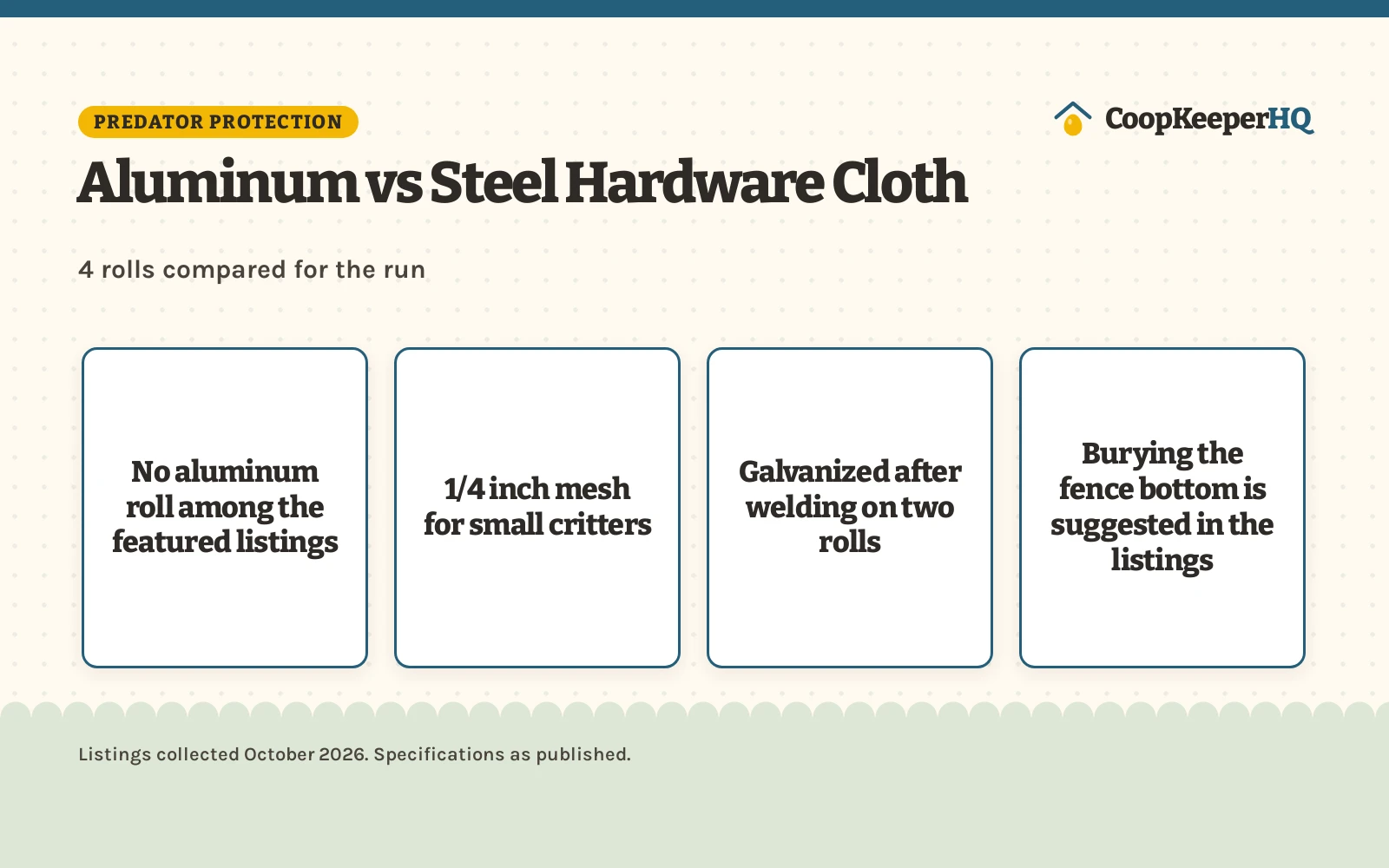
For a chicken run, the listings featured here point to steel wire, with a spec table listing Iron instead. Two rolls are galvanized after welding, one is 304 stainless steel, and one is galvanized steel with a PVC coating. No aluminum roll appears among the featured listings, so no aluminum pick is ranked in this guide, and any aluminum comparison would need listings that are not featured here. Steel is the side with stated specs to check: mesh, gauge, coating and roll size.
Mesh size is the first decision. Openings of 1/4 inch are stated to keep out small critters and snakes, while the ReePlan listing states its 1/2 inch openings keep out rodents and snakes while still allowing airflow and light. Gauge figures differ across the listings, with 19 gauge and 23 gauge wire stated, so check the gauge on the listing for the exact roll rather than assuming one figure covers the whole category. Roll width and length matter just as much: a narrow roll suits patches and small repairs, while a wide, long roll suits a full run fence.
The gear: 4 steel rolls, ranked
304 stainless steel, 1/2 inch, 24 in x 50 ft
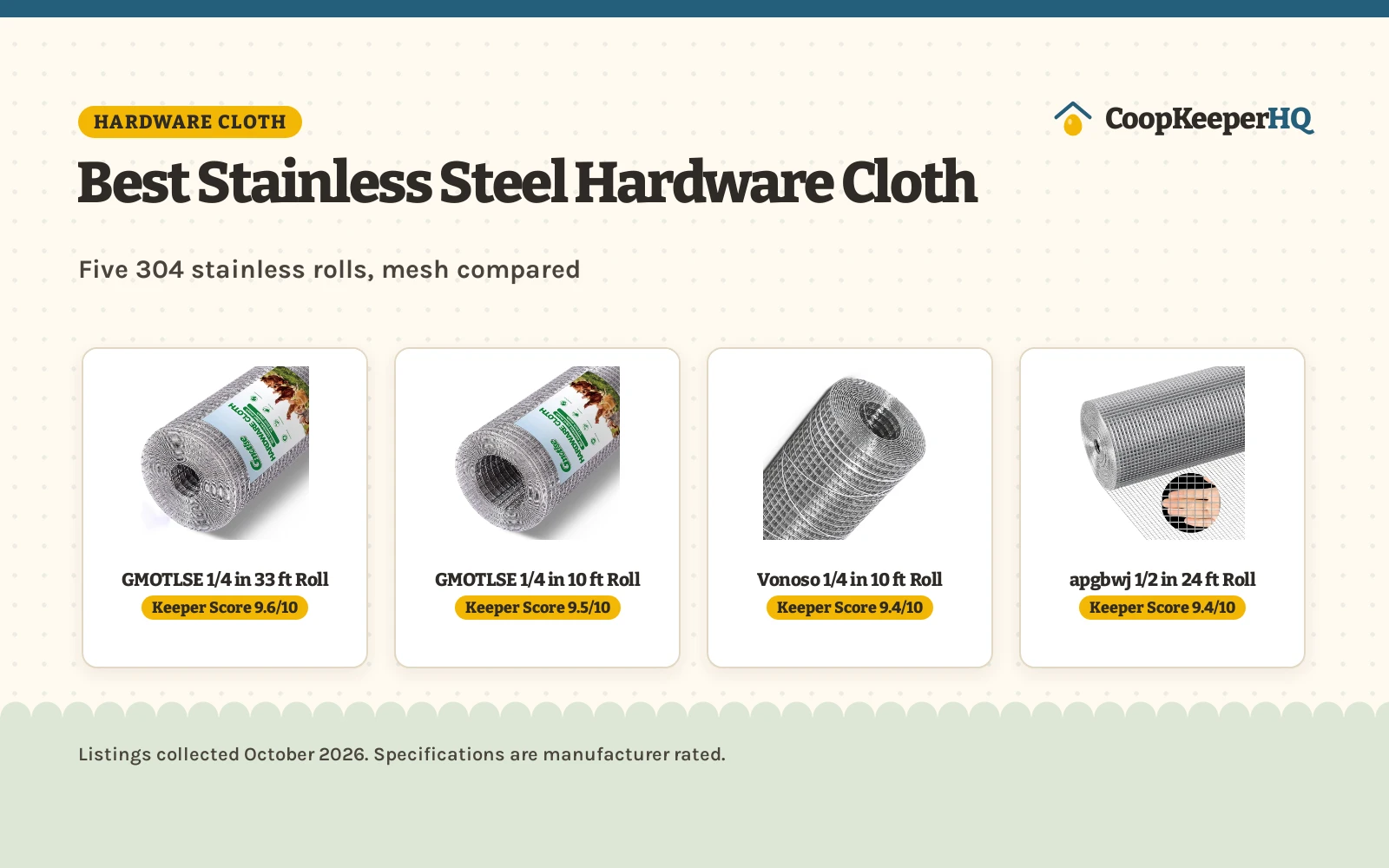
The apgbwj roll is 304 stainless steel with precision welding and reinforced weld joints, stated to resist deformation under normal use and to suit indoor and outdoor applications. Its 1/2 inch openings suit garden fencing, chicken coops, rabbit enclosures and tree guards, and the listing states excellent corrosion resistance, with regular cleaning and maintenance recommended in coastal areas or other high-salt environments. At 16.79 pounds for a 24 in x 50 ft roll, it suits a damp run, and it can be trimmed with cutting tools.
Galvanized steel with PVC coating, 1/2 inch, 48 in x 50 ft
The ReePlan roll is 19 gauge galvanized steel with a PVC coating, stated to be rust-resistant and weatherproof, in a black finish that blends with outdoor spaces. Its 1/2 inch by 1/2 inch openings are stated to keep out rodents and snakes while allowing airflow and light, and the roll measures 48 in x 50 ft at 18.11 pounds. The listing describes it as lightweight, bendable and easy to cut for tree guards, raised beds, enclosures and cage repairs. For a keeper who wants the widest roll here with a coated finish, this is the pick.
Galvanized after welding, 1/4 inch, 36 in x 100 ft
The Amagabeli roll is the longest here at 36 in x 100 ft, with 1/4 inch openings stated to keep out voles, gophers, raccoons, snakes and other small critters, and galvanizing after welding so every weld point is coated for rust resistance. The listing suggests a shallow trench so the fence sits partially underground, and notes the mesh can line raised beds, guard fruit trees, or be cut while still in the roll with a hack saw. One conflict to note: the title lists 23 gauge while the bullets mention 19 gauge wire as easy to lay down and cut, so check the listing for the gauge of the exact roll before ordering.
Galvanized after welding, 1/4 inch, 8 in x 25 ft
The ArdeFentium roll is the small repair roll of the group at 8 in x 25 ft, with 1/4 inch square openings and 23 gauge wire, hot dipped galvanized after welding so the zinc coating covers every weld point. The listing states it is corrosion resistant in rainy or humid climates, flexible enough to bend, shape and attach to posts, frames or existing fence panels, and easy to cut with tin snips or wire cutters. It suits repairing damaged areas, adding protection to coop doors and fence bottoms, and skirting decks and porches. Note a second listing conflict: the spec table lists the material as Iron while the bullets describe steel wire, so the listing itself is not consistent on material naming.
Mesh size and gauge: what to check
Start from the animals the fence must stop. For snakes and very small critters, the 1/4 inch rolls are the stated match, since the listings say those openings are small enough to stop rabbits, squirrels and other small critters from squeezing under fences. For general run fencing where airflow and light matter, the ReePlan listing states its 1/2 inch openings keep out rodents and snakes while letting air and light through. The listings differ on snakes: the snake-fence listings use 1/4 inch, while the ReePlan listing claims 1/2 inch openings keep snakes out, so check the listing for the exact roll where snakes are the main concern. Check the opening size on the listing for the exact roll.
Gauge and coating come next. The listings state 19 gauge and 23 gauge wire, and coatings of galvanized after welding, galvanized steel with PVC coating, and 304 stainless steel. Galvanizing after welding is stated to coat every weld point for maximum rust resistance, which matters on a fence that lives outdoors in rain and humidity. Stainless steel is stated to resist corrosion, with a maintenance note for coastal and high-salt environments, while the PVC-coated roll adds a black finish over galvanized steel. Where a listing contradicts itself, confirm the exact roll before buying.
Installing it around a run
Two install notes repeat across the listings. First, bury the bottom: the Amagabeli listing suggests a shallow trench so the fence sits partially underground, and the ArdeFentium listing says to bury the fence a few inches underground to create a snake fence and rodent barrier around gardens, raised beds and chicken coops. Second, cut it to fit: tin snips or wire cutters are stated for the ArdeFentium roll, and a hack saw is stated for cutting the Amagabeli roll while it is still rolled. The listings give the mesh several jobs around the coop and garden, including lining the bottom of a chain link fence, guarding fruit trees, lining raised beds, and skirting decks and porches, with different listings stating different jobs, so the featured rolls cover several jobs between them.
Check local, HOA and state rules before building or extending a run fence. For flock health or veterinary questions, a poultry vet or state extension office is the right source.
Use a charger rated for the length of netting you run, ground it as the manual describes and post warning signs where neighbors or children can reach the fence. Keep grass and weeds off the bottom strands, and never leave netting unpowered, because birds and wildlife can tangle in it. Read our Safety Disclaimer.
FAQ for the flock
Is 1/4 inch or 1/2 inch mesh better for a chicken run?
For snakes and very small critters, the listings point to 1/4 inch openings, while the ReePlan listing states its 1/2 inch openings keep out rodents and snakes while allowing airflow and light. Choose 1/4 inch where small animals are the main problem, and 1/2 inch for general run fencing.
Does galvanized hardware cloth rust?
Galvanized mesh is described in the listings as rust-resistant, with galvanizing after welding stated to coat every weld point for maximum rust resistance. That is resistance rather than a guarantee against rust. Stainless steel is also stated to resist corrosion, with regular cleaning recommended in coastal or high-salt environments.
Can hardware cloth be cut to fit?
Yes: the ArdeFentium listing states tin snips or wire cutters for cutting to fit coops, runs, rabbit cages and deck skirting, and the Amagabeli listing states a hack saw for cutting the roll while it is still rolled.
Should hardware cloth be buried?
Some listings suggest it: dig a shallow trench so the fence sits partially underground, or bury the fence a few inches underground, to create a barrier against tunneling animals and snakes around gardens, raised beds and chicken coops.
Why is there no aluminum pick in this guide?
None of the featured listings is aluminum, so aluminum has no pick here.
More coop guides
- Best Hardware Cloth for Chicken Coop Runs and Aprons
- Hardware Cloth vs Chicken Wire: Which Keeps Predators Out?
See the predator protection guides and the chicken runs and fencing guides.