How Long Do Fresh Eggs Keep? Storage Guide for Backyard Flocks
How long unwashed and washed backyard eggs stay fresh on the counter or in the refrigerator, how the bloom protects them, and how to store them safely.

On this page
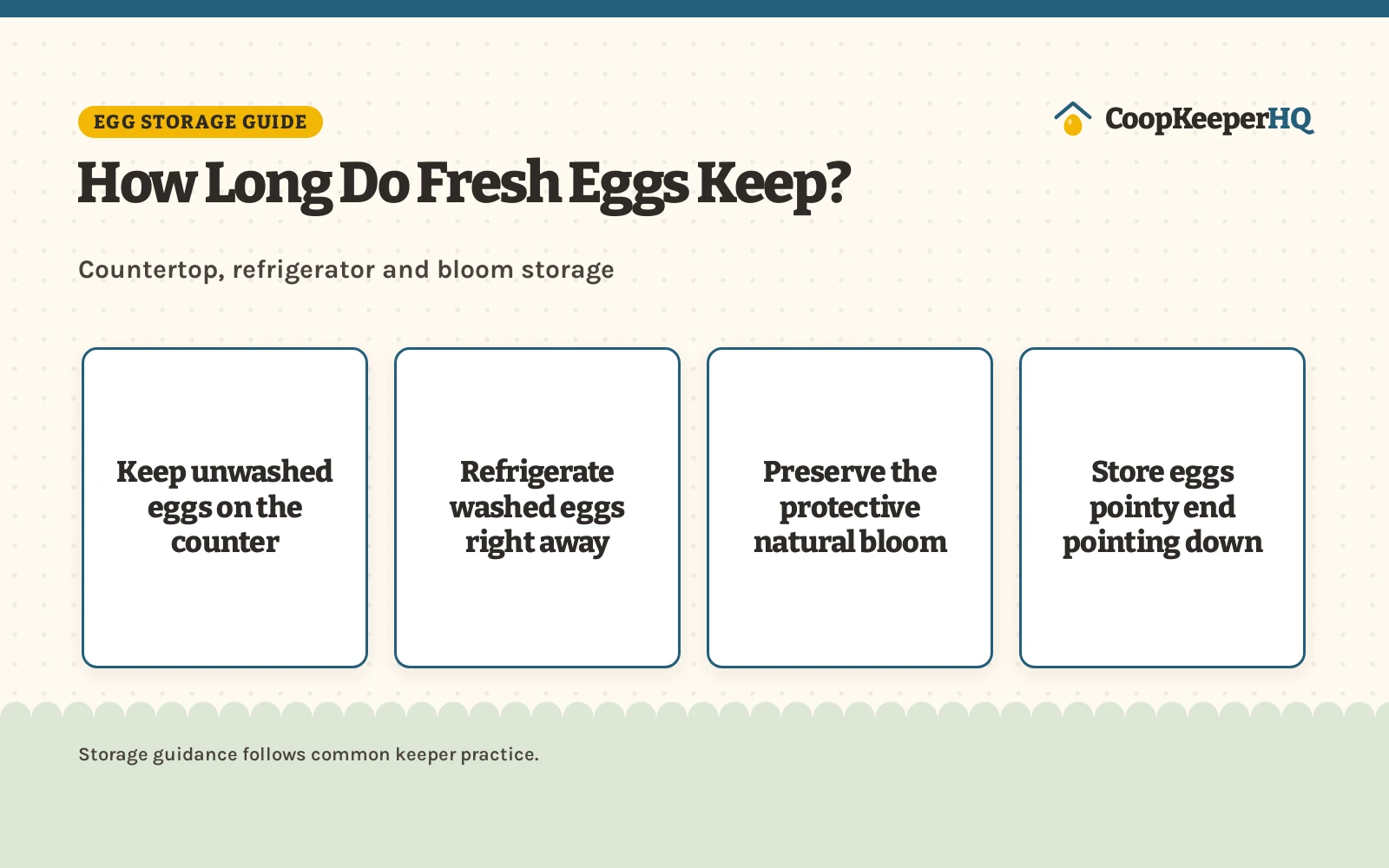
Unwashed fresh eggs keep at room temperature on a cool kitchen counter for several weeks, while eggs stored in a refrigerator remain fresh for months. The natural bloom on an unwashed shell helps block bacteria and slows moisture loss, allowing countertop storage. Once an egg is washed with water, that protective layer is removed, so any stored washed eggs must stay chilled in a refrigerator.
As an Amazon Associate I earn from qualifying purchases. CoopKeeperHQ earns a commission if you buy through our links, at no added cost to you. Affiliate disclosure.
How long do fresh eggs keep: countertop vs refrigerator
Backyard chicken keepers often wonder how long their harvest can sit on the counter before moving into cold storage. An unwashed egg left at room temperature retains its freshness for several weeks. Moisture gradually evaporates through the shell, but the interior stays wholesome and safe for cooking.
Placing fresh eggs in a refrigerator chills the eggs and slows bacterial growth, keeping them wholesome for months. Cold storage is ideal if your kitchen gets warm or if eggs were washed. Keep storage temperatures stable: moving cold eggs into a warm room causes condensation on the shell, which can draw surface bacteria inward. Our egg handling category covers collection practices for every season.
The protective role of the natural bloom
Before laying, a hen applies an invisible protein coating over the shell called the bloom or cuticle. An eggshell has thousands of tiny pores that allow gas exchange, and the bloom covers these pores to deter bacteria while slowing internal moisture loss.
Commercial eggs in the United States are washed before sale, which removes this coating and makes refrigeration mandatory. Backyard keepers can leave the bloom intact, allowing countertop storage at moderate room temperature. Our guide on how to clean fresh eggs explains gentle techniques that protect this shield.
Washing fresh eggs and when to avoid water
Washing with water strips away the bloom and leaves shell pores unprotected. Washing an egg in cool water also causes the interior to contract, creating suction that pulls surface moisture and bacteria inside. For counter storage, eggs should never touch water.
If shells have light dust or shavings, use dry cleaning methods. Rubbing gently with a dry cloth or sanding sponge cleans the surface while keeping the bloom intact. Reserve washing for heavily soiled eggs. When washing, use running water warmer than the egg so contents expand outward, dry immediately with a clean towel, and refrigerate right away.
Countertop storage using skelters and baskets
Unwashed eggs stored on the counter need good airflow and a first-in, first-out rotation so you always use the oldest eggs before the newest lay. Wire baskets and spiral racks keep countertop eggs organized.
Wire baskets provide open airflow that stops moisture from gathering beneath shells. For example, tag lists an antique white chicken wire egg basket measuring 12 inches in diameter and 8 inches in height, weighing 10.24 ounces with a wooden handle. Our guide to egg baskets for fresh eggs compares collection styles.
Spiral countertop racks keep eggs arranged by date, either along downward rolling tracks or on rotating tiers. For rolling designs, OBVIS lists a spiral egg holder holding up to 22 eggs, measuring 12.5 inches in height and 8.25 inches in diameter, weighing 15.16 ounces with a 15 Ounce unit count, designed so eggs roll forward automatically as one is removed from the bottom. Abiglifty lists a metal spiral rack holding about 3 dozen eggs within a 7.3 by 12.8 inch footprint that lets older eggs roll to the bottom. For rotating access, Toplife lists a 360-degree rotating spiral metal egg skelter with a capacity of 3 dozen eggs, measuring 16.1 inches long by 6.9 inches wide by 16.1 inches high, weighing 1.9 pounds in gold and 1.7 pounds in black. See what is an egg skelter and our best egg skelter reviews for more picks.
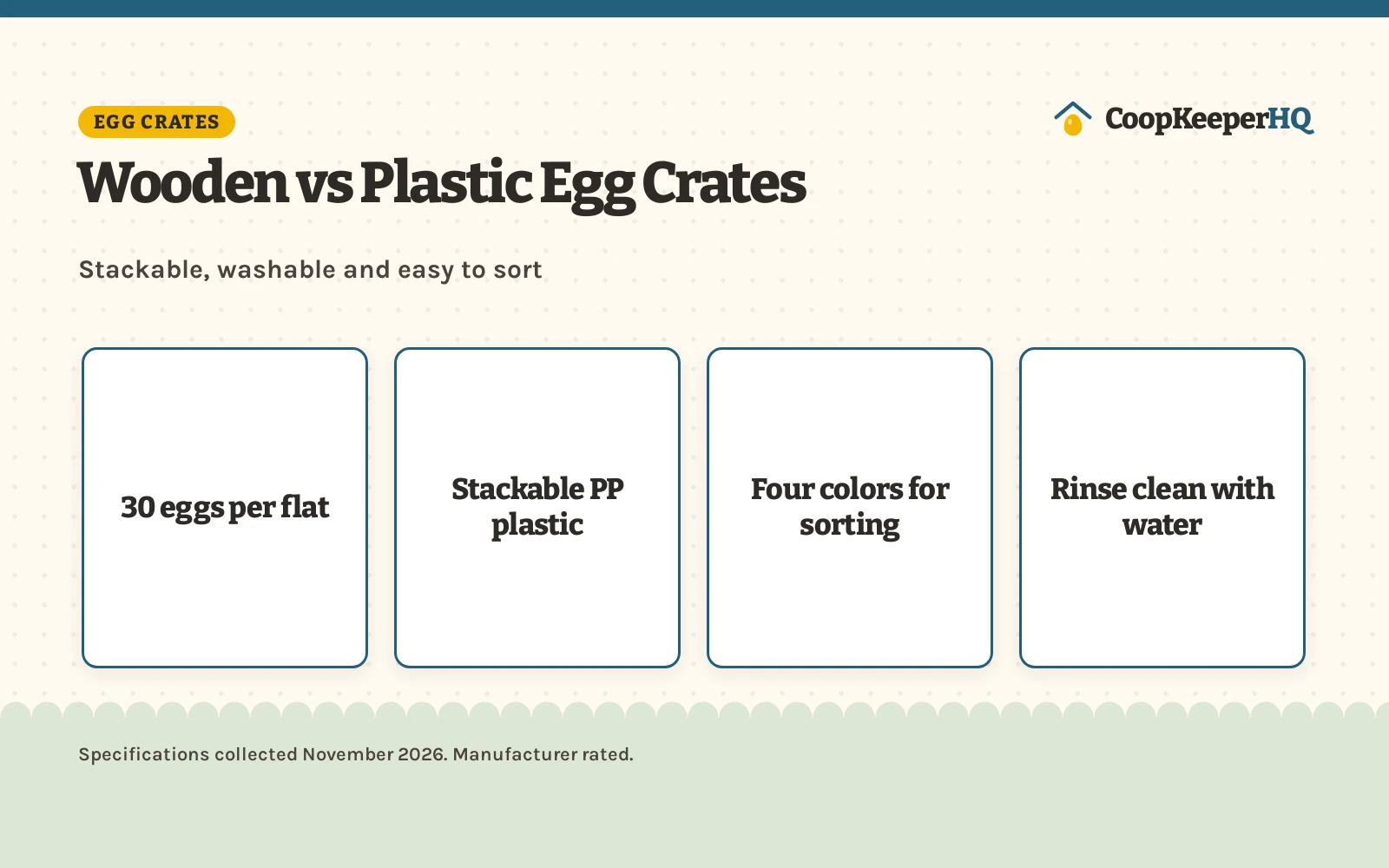
For wooden countertop storage, YOUEON lists a stackable 2-tier wooden egg holder for 24 eggs, using two wooden crates with 12 rounded egg slots each, measuring 4.7 inches deep by 12.6 inches wide by 3.5 inches high, weighing 0.94 kg.
Refrigerator storage using covered containers
When you gather more eggs than counter space permits, or after washing, the refrigerator provides safe storage for months. In a refrigerator, cold temperatures preserve internal egg quality for months. However, because modern frost-free refrigerators circulate dry air, unwashed and washed eggs stored long-term benefit from covered containers or cartons to reduce gradual moisture loss and shield porous shells from absorbing food odors.
For flat shelves, Utopia Home lists a pack of 2 clear refrigerator egg trays with 14 slots each, measuring 13.5 inches long by 4.2 inches wide by 3 inches deep, with stackable snap lids. Zoeyingt lists a pack of 2 refrigerator egg containers holding 24 eggs with snap lids, measuring 12.8 inches long by 9 inches wide by 3.2 inches high, weighing 1.6 pounds.
For tiered storage, ShuNuac lists a 2-tier refrigerator egg container holding 28 eggs, with 14 eggs per tier and 7 eggs per row on a 7-degree slope for automatic rolling, measuring 12.99 inches long by 6.3 inches wide by 5.31 inches high, weighing 1.5 pounds with a manufacturer capacity of 2 pounds. MEUPMEOP lists a 3-tier clear refrigerator container with 16 slots, measuring 12.09 inches long by 3.19 inches wide by 7.76 inches high. For carton storage, our egg cartons for large eggs and cheap egg cartons guides compare breathable boxes.
Store containers on an interior shelf rather than the refrigerator door, where frequent opening causes temperature shifts and jarring.
Storing eggs pointy end down
Store eggs with the narrow, pointy end facing down and the broad, blunt end facing up. The air cell forms at the broad end between the inner and outer shell membranes. Keeping the broad end upward keeps the air cell in place and allows the buoyant yolk to stay centered in the thick albumen.
If an egg is stored pointy end up, the yolk rises into the narrow tip and can adhere to the shell membrane, while the air cell can detach and migrate, reducing shelf life.
Clean nest boxes mean longer-lasting eggs
Long-lasting eggs start in the coop. If hens step into soiled nest boxes, bacteria stick to damp shells. Clean nest boxes ensure eggs emerge spotless and ready for counter storage without washing.
Fill nest boxes with clean, dry shavings or pads. Our nesting box bedding guide compares clean linings. Collect eggs promptly each morning and afternoon to prevent cracking and soiling. If your current boxes get dirty quickly, our nesting box guide covers roll-away models that keep eggs clean automatically.
How to check freshness in a bowl of water
As eggs age, internal moisture slowly evaporates through shell pores and the blunt-end air cell expands. You can check the size of this air cell by placing the egg in a bowl of cool water.
A fresh egg has a small air cell and rests flat on the bottom. An egg stored for several weeks tilts or stands on its pointy end at the bottom because the expanded air pocket lifts the blunt end, though it remains usable for cooking. An egg that floats to the surface has lost substantial moisture, creating a large buoyant air cell. Floating indicates age rather than definitive spoilage, but floating eggs should always be cracked individually into a separate dish to verify odor and appearance before use.
Crack older eggs into a small dish before adding them to a recipe. A fresh egg has a rounded yolk and firm white; an older egg has a flatter yolk and thinner white. If you detect any sulfur odor, discard the egg immediately. To inspect internal quality through the shell, our guide on what is an egg candler explains how backlighting works.
Safe handling and storage checklist
A simple routine keeps your flock harvest fresh and safe:
- Gather eggs from nest boxes promptly each day
- Keep nest box bedding clean and dry
- Brush light dust away with a dry cloth rather than water
- Leave clean eggs unwashed for countertop keeping
- Use a skelter or wire basket for first-in, first-out use
- Store eggs pointy end down to protect the air cell
- Wash soiled eggs with warm running water and refrigerate immediately
- Keep refrigerated eggs on an interior shelf
- Check older eggs in water and discard any that smell bad or show discoloration
What a dozen of your own eggs really costs, with and without startup costs, against the store price.
Wash your hands after handling birds, eggs or equipment, supervise children around the flock, and check local rules on flock size and roosters before you buy. For sick birds, call a poultry veterinarian or your state extension office. See CDC backyard poultry guidance. Read our Safety Disclaimer.
FAQ for the flock
Can you keep unwashed eggs on the kitchen counter?
Yes, unwashed eggs keep on the counter for several weeks because the natural bloom covers shell pores against bacteria. Store them in a cool spot out of direct sunlight.
Why do store-bought eggs require refrigeration while farm eggs do not?
Commercial eggs in the United States are washed and sanitized, which strips away the protective bloom. Without that barrier, bacteria can enter shell pores more readily at room temperature. Unwashed farm eggs retain their bloom, helping keep them protected on the counter in moderate temperatures.
How can you tell if a fresh egg has spoiled?
A spoiled egg produces an unmistakable sulfur odor when cracked open. While an egg that floats in water has a large air cell from age, odor and appearance are the true indicators of spoilage. Discard any egg with a foul smell, unusual discoloration or mold on the shell.
Should you wash backyard eggs right after gathering?
No, do not wash eggs intended for counter storage. Washing removes the bloom and cool water can pull bacteria inward. Leave shells unwashed until cooking, or wash in warm water and refrigerate immediately.
How does checking an egg in water work?
Moisture slowly evaporates through shell pores over time while air enters the blunt end, enlarging the air cell. Fresh eggs sink flat, older eggs tilt or stand upright on the bottom, and eggs with large air cells become buoyant and float.
More coop guides
- How to Clean Fresh Eggs Without Washing Away the Bloom
- Best Egg Skelter: Countertop Egg Holders for Fresh Eggs
- Egg Baskets for Fresh Eggs: 5 Top Picks for Backyard Flocks (2026)
See the egg handling guides and the coop supply picks.