How Tall Should a Chicken Run Be? A Practical Guide for Backyard Flocks
A run tall enough to walk in and work, with roof netting that keeps hawks out and room for feeders, water and daily chores.


On this page
Top picks at a glance
As an Amazon Associate I earn from qualifying purchases.
- 1
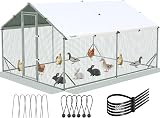 Quictent Large Metal Chicken Coop Run for 20+ Poultry w/Side9.7/10View on Amazon
- 2
 Quictent 18x9x6.6ft Large Metal Chicken Coop Run With9.7/10View on Amazon
- 3
 Sino Luban Walk-in Chicken Run9.7/10View on Amazon
- 4
 Petsfit Outdoor Chicken Coop with Run for 4-6 ChickensView on Amazon
- 5
 GOJOOASIS 40" Wooden Chicken Run Coop Outdoor Hen HouseView on Amazon
- 6
 55ft² Extra Large Chicken Coop with RunView on Amazon
- 7
 Trixie Natura Chicken Outdoor Run with Mesh-Covered TopView on Amazon
- 8
 Walk-in Metal Chicken Coop 10x6.5View on Amazon
Morning chores set the height of a run more than any plan on paper. A keeper carries feed and water out, tops up bedding, checks the nest boxes and tries to catch a hen that needs a look over, all inside the run. When the roof is low, every job means bending double or kneeling in the bedding. How tall should a chicken run be? Tall enough for a keeper to walk in and work inside, with a roof net stretched over the top to keep hawks out and the flock in.
Other options for the coop
 Petsfit Outdoor Chicken Coop with Run for 4-6 ChickensCheck price on Amazon
 GOJOOASIS 40" Wooden Chicken Run Coop Outdoor Hen HouseCheck price on Amazon
 55ft² Extra Large Chicken Coop with RunCheck price on Amazon
 Trixie Natura Chicken Outdoor Run with Mesh-Covered TopCheck price on Amazon
 Walk-in Metal Chicken Coop 10x6.5Check price on Amazon
CoopKeeperHQ earns a commission if you buy through our links, at no added cost to you. Affiliate disclosure.
How Tall Should a Chicken Run Be: Start With the Birds
The short answer is that the run should fit the keeper before the birds. Chickens spend their days at ground level, scratching, dust bathing and moving between feed, water and shade. They do not need headroom the way a keeper does, but they do need a roof that keeps hawks and owls out and a fence that keeps them in. A run a keeper can walk into makes every chore easier, and height also decides how the roof goes on: a tall run takes a frame and a net stretched across the top, while a low run takes a lid that lifts off or a panel the keeper reaches over.
Tall Enough to Walk In and Work
Daily chores are the real measure. Feed and water go in every day, bedding gets topped up, eggs get gathered from the nest boxes and a bird that looks off needs catching. In a walk-in run, a keeper carries a bucket and sets it down without ducking. In a low run, the same jobs happen through a door or over a wall, and catching a bird means reaching in while the rest of the flock scatters.
A walk-in run also makes cleaning less of a chore. Raking out damp bedding and hosing down a muddy patch need room to move a rake and a barrow, and a full height gate that swings wide lets a barrow through. When the run sits against the coop, the pop door and the run gate should line up so birds move between coop and run without a keeper herding them through a gap.
Height and the Roof Net
The roof net is what turns a tall run from a fence into a safe enclosure, and its size sets how far the frame can span. Junkogo lists a 50×50 ft net with a 1 inch mesh that the maker says supports over 100 pounds, and Threekia lists a 50×50 ft net with a 2 inch mesh made from 0.8mm HDPE, with a stated life of 8 to 12 years. A net that wide covers a run roof up to that size with no joins for a hawk to find.
Smaller runs suit smaller nets. Fvellix lists a 25×25 ft net with a 1 inch square mesh, supplied with 50 m of bird repellent ribbon and 100 cable ties, while POYEE lists a 25×50 ft net with a 1 inch mesh in HDPE weighing 30g/m². Yoojahow lists a 20 x 30 ft net with a 0.79 inch mesh, and MEANCHEN lists a 25×100 ft net with a 1 inch mesh, supplied with 50 zip ties. For sizing, MEANCHEN advises choosing a net about 1.5× larger than the estimated coverage area, since a diamond mesh changes shape as it stretches. The poultry netting for the roof guide compares cover choices, and the poultry netting for predators guide covers mesh choice.
Low Runs and When They Work
A low run is not a mistake. It suits a small flock on a small yard, a tractor that moves around the garden, and a keeper who is happy to work from outside. Feed and water can hang from the lid or sit by the door, and bedding can be raked through a hatch. The trade is access: catching a bird, cleaning a corner and fixing a fence panel all take longer when the keeper cannot get inside. A low run still needs a lid the keeper can lift or slide, since a run without a roof is open to hawks. The chicken tunnel vs chicken run comparison covers low, movable runs, and the attached run vs separate chicken run guide covers placement against the coop.
Predators and Overhead Cover
Hawks hunt from above, so the roof is the part of the run that matters most for safety. A net with a 1 inch mesh keeps hawks and owls out while letting sun and rain through, and the listings cited here describe their nets as hawk netting for chicken runs. Raccoons and foxes work the ground line instead, so the fence needs burying or an apron at the base, and the gate latch needs to resist paws. Cover works best when it is tight and checked often: a sagging net leaves a pocket where a hawk can land, and a gap at the edge lets a bird slip out. The cheap predator proof chicken run guide covers low-cost builds.
Shade, Rain and Snow on a Tall Run
A solid roof cover is what keeps the ground dry and the birds cool. Shade cloth over part of the run gives birds a cool place on hot days, while a solid cover over the feed and water keeps rain out of feed and water. Snow is the load a solid cover must carry, so the frame and cover should be checked before the cold season, and frame joints checked after a storm. The shade cloth vs bird netting for the chicken run comparison covers the choice, and the chicken run shade cloth guide lists low-cost shade picks.
Fitting the Height to the Spot
The yard sets the height as much as the flock does. A run on a slope needs posts of different lengths and a gate that swings clear of the high side, while a run on flat ground takes a simple square frame. Leave room around the run to walk the fence line, and keep the gate clear of the coop door so a keeper can carry a bucket through without turning sideways. Height also follows the coop: nest boxes sit off the ground, and the nesting box height guide covers mounting.
A Simple Height Checklist
- Keeper can walk in and stand upright to work
- Gate swings wide and lets a barrow through
- Roof net is stretched tight with no sagging gaps
- Roof mesh keeps hawks out and the flock in
- Shade covers part of the run on hot days
- Fence line and gate latch are checked after storms
For runs on a budget, see the chicken run under 100 guide and the chicken wire run guide.
Birds, breed size, run time and climate in; coop floor, run space, roost length and nesting boxes out.
Wash your hands after handling birds, eggs or equipment, supervise children around the flock, and check local rules on flock size and roosters before you buy. For sick birds, call a poultry veterinarian or your state extension office. See CDC backyard poultry guidance. Read our Safety Disclaimer.
FAQ for the flock
How tall should a chicken run be for a small flock?
Walk-in height suits a small flock as well as a large flock, since the keeper does the same chores either way. A low run can work for a small flock when the keeper is happy to work through a hatch.
Can a chicken run be too tall?
A run can be taller than it needs to be, and the cost is a bigger frame, more net and a roof that is harder to reach. MEANCHEN advises choosing a net about 1.5× larger than the estimated coverage area.
Do I need a roof on a chicken run?
Yes, in most yards. Hawks and owls hunt from above, and a roof net with a 1 inch mesh keeps them out while letting sun and rain through. A run without a roof leaves the flock open to aerial predators, even when the fence is sound.
What mesh size works for a chicken run roof?
A 1 inch mesh is the common choice for a run roof, fine enough to block most birds and keep chickens in. A 2 inch mesh is the coarser option, listed for enclosing chickens and keeping hawks out, and a 0.79 inch mesh is finer than the 1 inch mesh.
How do I keep a tall run standing in wind?
Set the posts deep, brace the corners and keep the net taut so it does not flap and pull at the frame. Ground anchors help on soft ground, and a solid cover should be tied down at the edges.
More coop guides
- Cheap Predator Proof Chicken Run: 5 Budget Backyard Picks (2026)
- Poultry Netting for Roof: 5 Aerial Predator Run Covers Compared (2026)
- Attached Run vs Separate Chicken Run: Which One Should You Buy?
- Best Poultry Netting for Predators (2026): 4 Picks Compared
- Shade Cloth vs Bird Netting for Chicken Run: Which One Should You Buy?
- Best Hawk Decoy for Chicken Run: 5 Picks to Deter Hawks (2026)
- Field Fence vs Poultry Netting: Which One Should You Buy?
- Poultry Netting vs Chicken Wire: Which One Should You Buy?
- Best Chicken Run Odor Eliminator (2026): 4 Picks for Fresher Runs
- How High Should Chicken Nesting Boxes Be Off the Ground: Mounting Guide
- Best Chicken Wire Run (2026): 5 Picks for Flocks and Gardens
See the chicken run under 100 picks and the ground anchors for the chicken run guide.