Poultry Netting vs Chicken Wire: Which One Should You Buy?
Learn the differences between poultry netting and chicken wire for flock containment, aerial hawk protection and perimeter fencing in your backyard setup.

On this page
Top picks at a glance
As an Amazon Associate I earn from qualifying purchases.
- 1
 Starkline Electric Poultry Netting Kit9.6/10View on Amazon
- 2
 Zevemomo 36 in x 50 ft 1/4 inch PVC Coated Hardware Cloth9.7/10View on Amazon
- 3
 Tenax Poultry Fence9.5/10View on Amazon
- 4
 BSTPCOO Bird Netting for Chicken CoopView on Amazon
- 5
 Bird Netting 25x50 FtView on Amazon
- 6
 PVC Hexagonal Poultry Netting Chicken Wire 12" x25' x 1" MeshView on Amazon
- 7
 PVC Hexagonal Poultry Netting Chicken Wire 36" x150' x 1"View on Amazon
- 8
 HOSTIC 4FTx150FT Chicken Wire NettingView on Amazon
- 9
 Black Plastic Chicken Wire 16in x 10ftView on Amazon
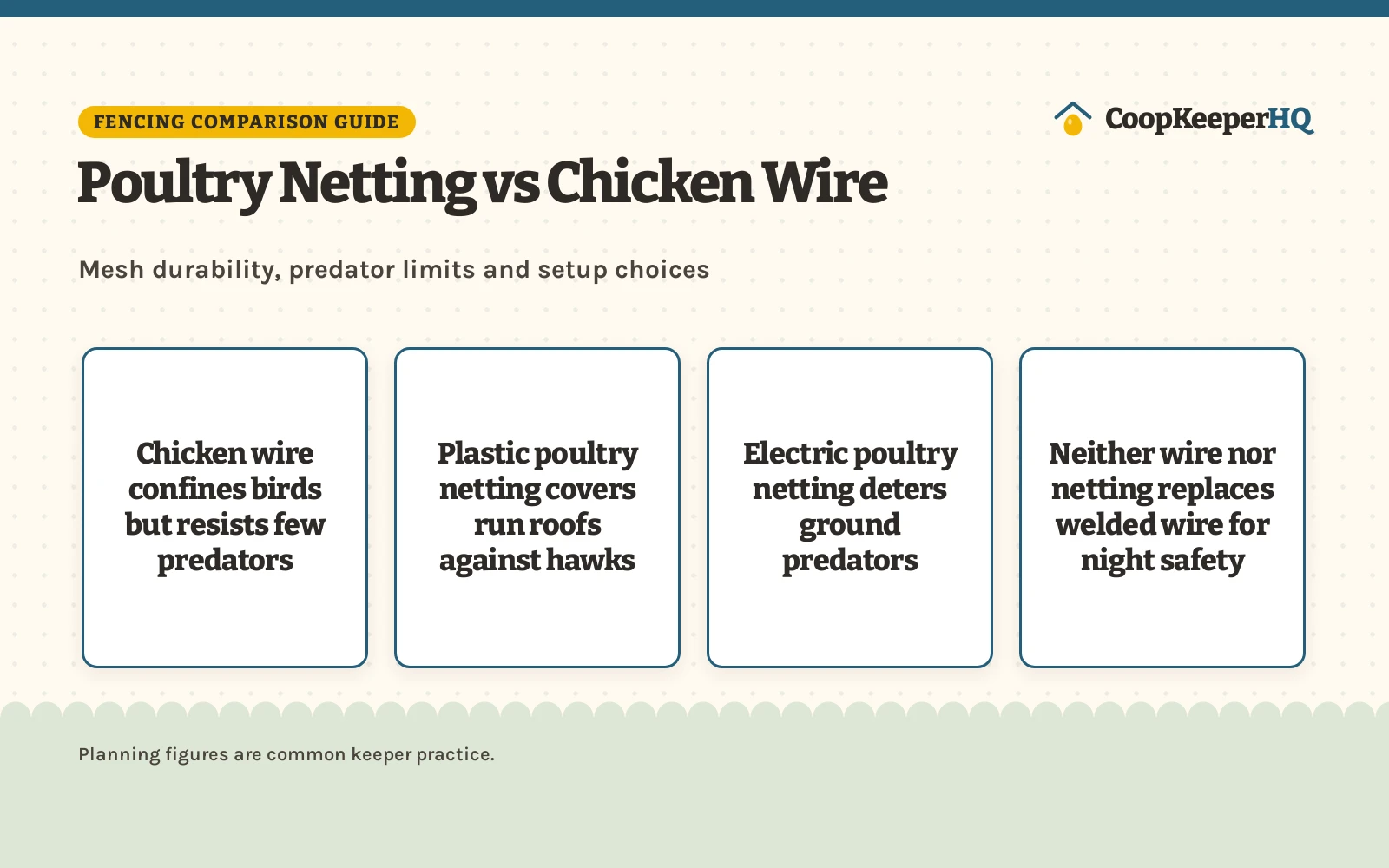
Poultry netting and chicken wire serve different roles in a backyard setup, so the right choice depends on whether you need flock containment, aerial predator defense, or perimeter boundary protection. Traditional chicken wire is a flexible wire mesh designed to keep poultry inside an enclosure, while lightweight plastic poultry netting covers run tops against hawks, and electric poultry netting repels ground predators across open ground. Neither chicken wire nor plastic netting prevents persistent digging or gnawing predators from breaching an enclosure, meaning keepers frequently combine these materials with heavy welded wire to protect their birds.
Other options for the coop
 BSTPCOO Bird Netting for Chicken CoopCheck price on Amazon
 Bird Netting 25x50 FtCheck price on Amazon
 PVC Hexagonal Poultry Netting Chicken Wire 12" x25' x 1" MeshCheck price on Amazon
 PVC Hexagonal Poultry Netting Chicken Wire 36" x150' x 1"Check price on Amazon
 HOSTIC 4FTx150FT Chicken Wire NettingCheck price on Amazon
 Black Plastic Chicken Wire 16in x 10ftCheck price on Amazon
CoopKeeperHQ earns a commission if you buy through our links, at no added cost to you. Affiliate disclosure.
Poultry netting vs chicken wire: core differences at a glance
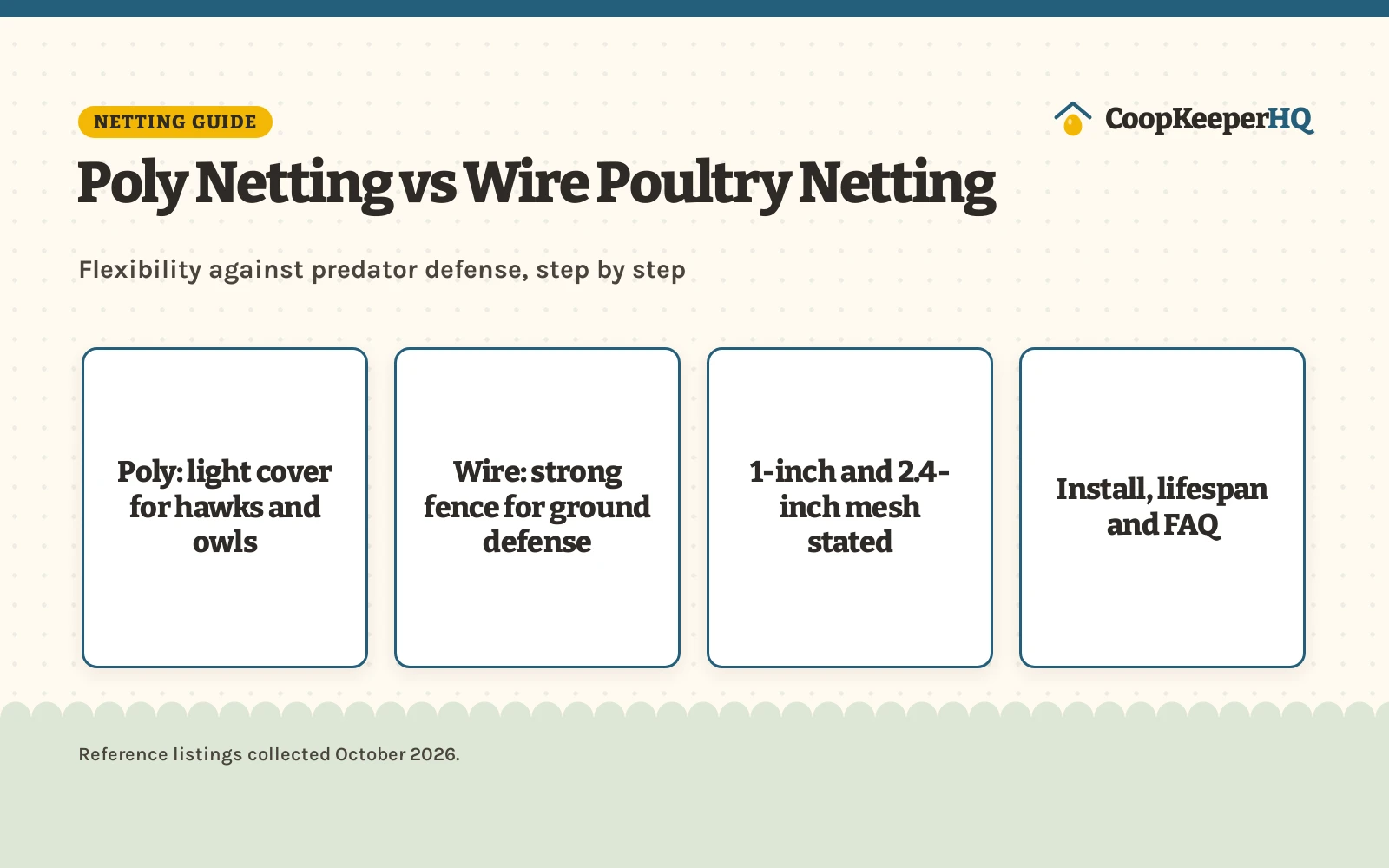
When comparing poultry netting vs chicken wire, the primary distinction lies in physical structure and purpose. Chicken wire consists of thin metal strands twisted into a distinctive hexagonal mesh pattern. Its main function has always been poultry containment, preventing adult chickens from wandering into gardens or road traffic. The metal weave bends easily around wooden posts and framing, adapting to uneven terrain and simple wooden posts.
In contrast, modern poultry netting encompasses distinct product categories. Keepers choose between lightweight woven nylon or extruded plastic netting used overhead to block aerial raptors, and electrified pasture netting that incorporates conductive filaments into a portable fence grid powered by a fence energizer. Historically, manufacturers also labeled traditional chicken wire as poultry netting on retail packaging, but modern keepers use the terms to distinguish metal wire from plastic or electric netting. While chicken wire provides a physical boundary that keeps birds enclosed, non-electric netting primarily shields runs from flying predators, and electric netting delivers an electric pulse to deter curious mammals.
Understanding traditional chicken wire mesh
Chicken wire remains a familiar sight on homesteads because it is economical and easy to shape. Manufacturers weave galvanized steel wire into hexagonal openings that allow airflow and visibility while holding birds inside a designated space. The flexibility of the twisted weave makes it simple to staple against timber framing or wrap around pasture pens.
Listing details illustrate specifications for this material. For example, YARDGARD lists 2 inch poultry netting manufactured from 20 gauge galvanized steel, with a roll measuring 24 inches by 150 feet and an item weight of 10.9 pounds. In that same listing, a contradiction appears between sections: the title states a length of 150 feet, while the specification table lists 25 feet. Another example is Mklsit, which provides a floral chicken wire roll measuring 15.7 inches by 157 inches, described also as 16 inches by 13.1 feet, featuring 0.6 inch hexagonal mesh, a wire diameter of 0.9mm, and a weight of 1.2 pounds. These examples show that traditional wire mesh ranges from narrow rolls with fine openings to wide agricultural fencing with larger gaps.
Where chicken wire fails against predators
A widespread misconception among beginner keepers is that chicken wire keeps predators out of a coop. Chicken wire was designed to keep chickens in, not to withstand hungry wildlife. The thin gauge steel wire bends under moderate force, and the twisted joints can unravel when pulled by determined animals. Large dogs, coyotes, and foxes can tear through lightweight chicken wire or break the twisted seams with their teeth and claws.
Furthermore, standard openings leave gaps that allow agile predators to reach through or enter entirely. Raccoons can reach their paws through openings to grab birds roosting near the wire, while weasels, rats, and small snakes can squeeze through open gaps without resistance. Because chicken wire lacks rigid welds, burying it as a predator apron offers limited defense against burrowing pests that chew through the underground barrier. For an overview of wire gauges and roll options, see our guide to chicken wire sizes.
Plastic and nylon poultry netting for overhead hawk protection
Unlike metal wire fencing, plastic and nylon poultry netting is predominantly deployed as an overhead roof barrier over outdoor enclosures. Hawks, owls, and crows frequently target backyard flocks from above. Stretching heavy metal wire across a wide run ceiling is difficult because metal wire sags under its own weight and requires substantial structural framing. Lightweight netting solves this problem by providing wide physical coverage without heavy downward strain on posts.
Manufacturers produce these aerial nets from synthetic polymers designed for outdoor resilience. For instance, DQS supplies nylon poultry netting measuring 50 feet by 50 feet with 2.4 inch square mesh, providing 2500 square feet of coverage, 4 corner ropes, and an item weight of 1.97 kg, packaged with 100 cable ties, 12 stakes, and 10 ground nails, accompanied by a 30 days return window. BSTPCOO offers a similar nylon net measuring 50 feet by 50 feet with 2.4 inch mesh, weighing 2.12 kg with 50 cable ties and 12 stakes, as well as a 25 feet by 50 feet version offering 1250 square feet of coverage, weighing 1.24 kg with 50 cable ties and 8 stakes. POYEE offers run cover netting measuring 25 feet by 100 feet with 1 inch mesh woven from high density polyethylene, and JUNKOGO lists a 25 feet by 50 feet woven net with 1 inch mesh claiming support for over 100 pounds. For narrower spaces, Feitore produces polypropylene netting measuring 7 feet by 100 feet with 3/4 inch mesh, weighing 1.7 pounds with 10 stakes and 50 zip ties. These lightweight covers stop diving raptors without requiring structural timber beams across the run ceiling. Learn more about overhead run enclosures in our guide on poultry netting for roof installations.
Electric poultry netting for pasture boundaries
When keepers refer to poultry netting in the context of pasture management, they usually mean electric poultry netting. This specialized fencing system consists of horizontal polywire strands interwoven with stainless steel conductive filaments, supported by built-in step-in posts. When connected to a fence energizer, the fence grid carries an electric pulse that deters ground predators upon contact.
Electric netting excels at rotational grazing and predator deterrence across large areas where permanent fencing is impractical. Foxes, coyotes, stray dogs, and bears typically learn to avoid the perimeter after encountering an unpleasant pulse on their noses. Keepers can readily relocate the entire enclosure to provide fresh forage while keeping the flock contained. To function reliably, electric netting requires proper grounding and continuous energizer output. For pasture setups, explore our guide to electric netting for chickens, and consider pairing your fence with a dedicated unit from our solar battery charger for electric fence overview or our poultry netting and charger guide.
Durability and weather performance over time
Environmental conditions affect chicken wire and synthetic netting in very different ways. Galvanized chicken wire resists rust initially, but moisture, acidic chicken manure, and soil contact gradually strip away zinc coatings, leading to rust and brittle wire strands. Coated options offer added corrosion resistance, such as the PVC coated wire from Mklsit. However, prolonged ground contact eventually compromises thin metal wire.
Synthetic poultry netting does not rust, but sunlight exposure and seasonal temperature swings present different challenges. Quality plastic and nylon netting incorporates UV stabilizers to prevent fibers from degrading under direct sunlight. Listing specifications demonstrate wide operating parameters: RIFNY lists high density polyethylene netting measuring 13 feet by 40 feet with 5/8 inch mesh and a weight of 30 g, accompanied by 6 landscape staples of 7-inch length, rated for temperatures from -58℉ to 212℉. PotatoLife lists reusable high density polyethylene mesh measuring 4 feet by 100 feet, weighing 8.73 pounds and supplied with 100 zip ties and 1 pair of gloves. While polymer netting resists rain and corrosion, materials respond differently to seasonal weather, and heavy snow loads can cause fine mesh to sag if snow accumulates on top, requiring keepers to clear run covers during winter storms.
Hardware cloth: the true standard for nighttime safety
Neither chicken wire nor non-electric poultry netting provides adequate protection for a coop overnight. A predator-proof coop perimeter requires welded wire mesh, commonly known as hardware cloth. Unlike twisted chicken wire, hardware cloth features solid welded intersections that cannot be pulled apart by raccoons or gnawed through by rodents.
Backyard keepers should reserve chicken wire for internal coop dividers or garden borders, and install welded wire over all coop windows, ventilation gaps, and lower run perimeters. Extending an apron of welded wire outward along the ground prevents digging predators from tunneling beneath the fence line. For complete coop fortification specifications, read our guide on what is hardware cloth and see recommendations in our review of hardware cloth for chicken coop setups.
How to choose between netting and wire for your run
Selecting the right material depends on your primary management goal, flock size, and predator pressure. If your primary objective is keeping chickens out of a vegetable patch or separating flock members within an already enclosed run, traditional chicken wire provides an affordable, easy-to-shape physical barrier.
If your flock spends the day in an open run vulnerable to hawks, overhead nylon or plastic poultry netting is the ideal choice because it spans broad distances without sagging under excess weight. For pastured flocks requiring mobile containment and defense against coyotes or stray dogs, portable electric poultry netting offers unmatched flexibility. Many successful homestead setups combine these materials strategically: hardware cloth on the coop and exterior run perimeter, chicken wire for internal flock partitions or garden borders, and lightweight netting across the ceiling.
A simple fencing decision checklist
- Chicken wire confines birds within garden borders or interior run partitions
- Chicken wire does not stop raccoons, dogs, coyotes, or weasels from entering
- Nylon or plastic poultry netting provides lightweight overhead protection against hawks
- Electric poultry netting deters ground predators across pastures and rotating paddocks
- Coop windows, pop doors, and exterior run perimeters require heavy welded wire hardware cloth
- Electric fencing requires regular voltage monitoring and clear ground vegetation
For more details on run design and perimeter construction, explore our comprehensive collection of chicken runs and fencing guides.
Birds, breed size, run time and climate in; coop floor, run space, roost length and nesting boxes out.
Use a charger rated for the length of netting you run, ground it as the manual describes and post warning signs where neighbors or children can reach the fence. Keep grass and weeds off the bottom strands, and never leave netting unpowered, because birds and wildlife can tangle in it. Read our Safety Disclaimer.
FAQ for the flock
Can predators break through chicken wire?
Yes. Common predators including raccoons, dogs, coyotes, and foxes can bend, chew through, or tear thin chicken wire. Chicken wire is intended for poultry containment rather than predator exclusion.
What is the difference between poultry netting and chicken wire?
Chicken wire is a twisted hexagonal metal wire mesh used for basic containment. Poultry netting refers either to flexible plastic or nylon mesh used overhead to deter hawks, or electrified polywire fencing used to protect pastured flocks from ground predators. Historically, retail packaging sometimes labeled traditional chicken wire as poultry netting, but keepers now use distinct terms for each material.
Does poultry netting keep hawks away from chickens?
Yes. Heavy-duty nylon or plastic poultry netting stretched across the top of an open chicken run creates an effective physical barrier that prevents hawks and owls from diving into the enclosure.
Can electric poultry netting replace a predator-proof coop at night?
No. While electric netting deters large ground predators during pasturing, it does not prevent aerial attacks, small rodents, or digging pests from reaching birds at night. Chickens should always be locked inside a predator-proof coop after dusk.
Is hardware cloth better than chicken wire?
Yes. Hardware cloth is made of welded wire mesh that resists chewing, tearing, and paw reaching. It is far superior to chicken wire for securing coop openings, run walls, and predator aprons.
More coop guides
- Electric Netting for Chickens: 5 Portable Fences Compared (2026)
- Chicken Wire Sizes: Mesh Openings, Gauges and Roll Dimensions
- Best Hardware Cloth for Chicken Coop Runs and Aprons
See the chicken runs and fencing picks and the predator protection guides.