How to Use Egg Incubator: Step-by-Step Guide for Backyard Flocks
Learn how to set up an egg incubator, maintain steady temperature and humidity, turn eggs, and manage lockdown for a successful hatch.

On this page
Top picks at a glance
As an Amazon Associate I earn from qualifying purchases.
- 1
 Egg Incubators for Hatching Eggs9.7/10View on Amazon
- 2
 Series III9.7/10View on Amazon
- 3
 GleeGearNex Gen III 24 Egg Automatic Incubator with9.7/10View on Amazon
- 4
 VEVOR 36 Egg IncubatorView on Amazon
- 5
 Incubator for Hatching EggsView on Amazon
- 6
 Sailnovo 70 Egg IncubatorsView on Amazon
- 7
 Incubators for Hatching Eggs with Smart Voice AssistantView on Amazon
- 8
 KEBONNIXS 12 Egg Incubator with Humidity DisplayView on Amazon
- 9
 Harris Farms Nurture Right Egg Incubator with Auto TurnerView on Amazon
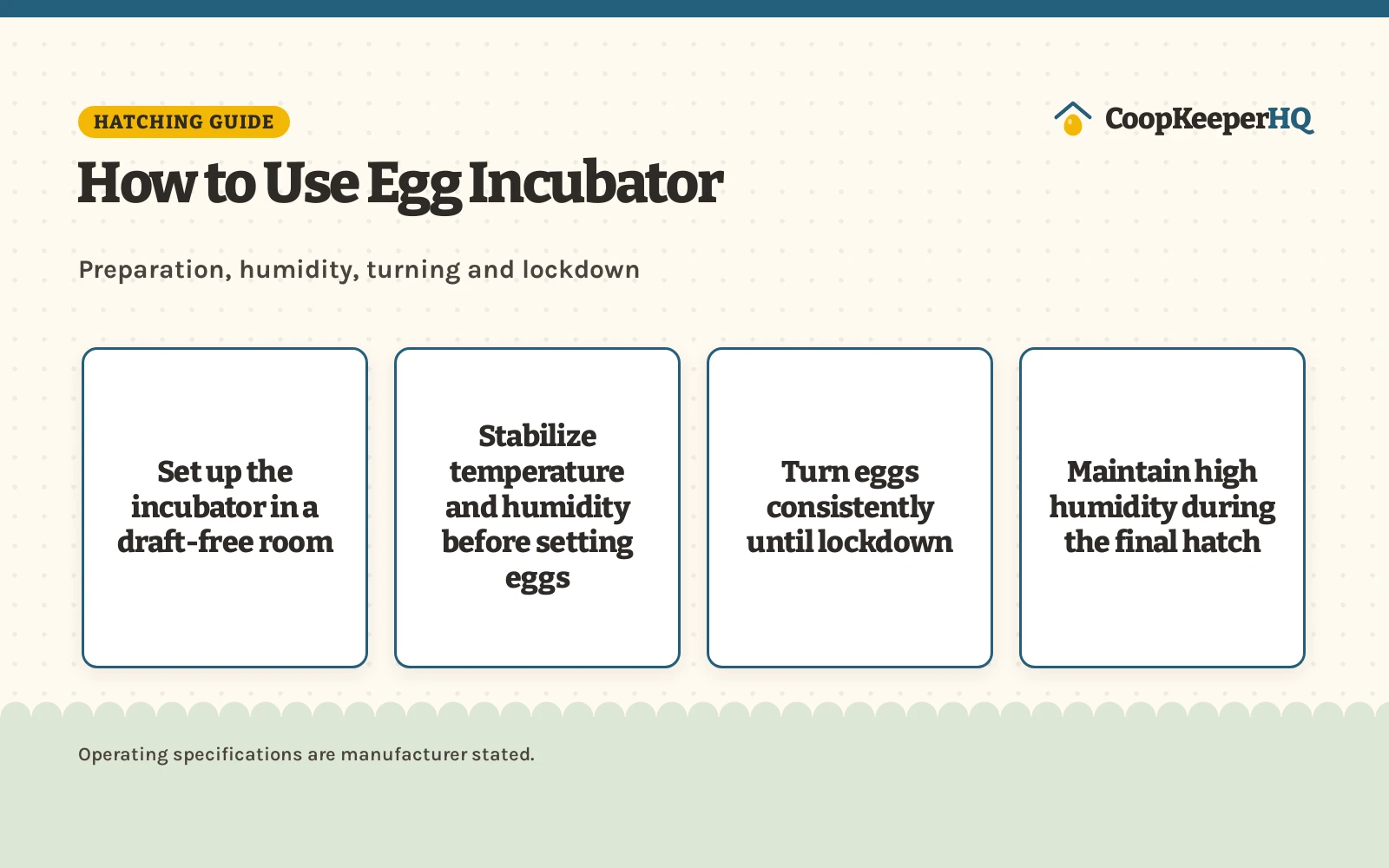
Gathering warm eggs from the nesting boxes each morning is a rewarding chore of keeping chickens, especially when you decide to hatch your own replacement birds instead of ordering chicks through the mail. Learning how to use egg incubator equipment comes down to creating a dependable environment: setting up clean gear in a draft-free room, stabilizing temperature and humidity before adding eggs, maintaining regular rotation, and locking down the unit during the final hatch.
Other options for the coop
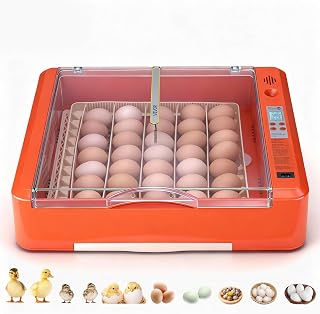 VEVOR 36 Egg IncubatorCheck price on Amazon
 Incubator for Hatching EggsCheck price on Amazon
 Sailnovo 70 Egg IncubatorsCheck price on Amazon
 Incubators for Hatching Eggs with Smart Voice AssistantCheck price on Amazon
 KEBONNIXS 12 Egg Incubator with Humidity DisplayCheck price on Amazon
 Harris Farms Nurture Right Egg Incubator with Auto TurnerCheck price on Amazon
CoopKeeperHQ earns a commission if you buy through our links, at no added cost to you. Affiliate disclosure.
How to use egg incubator: start with clean gear and a trial run
Every successful hatch begins long before eggs enter the chamber. Thoroughly clean and sanitize the incubator basin, tray and lid with warm soapy water or a mild disinfectant solution, then let everything dry completely. Avoid harsh chemicals that could leave lingering fumes inside a sealed environment. Once dry, assemble the machine and plug it in for an empty trial run to ensure that the heating element, fan and sensors function properly before trusting them with fertile eggs.
Running the incubator empty allows you to observe temperature stability. For example, ZOZOO specifies an adjustable temperature range of 68-104°F with a precision of 0.5°F, while Holdwell S provides automatic temperature control with ±0.5°C accuracy. VEVOR notes that temperature fluctuations of 0.9°F are normal during incubation and do not harm developing embryos. Place an auxiliary incubator thermometer hygrometer inside the tray to verify that internal conditions match the digital readout. While your machine stabilizes, review our guide on collecting eggs for incubation to store and select clean hatching eggs properly.
Choose the right room and a stable location
Where you place the incubator matters just as much as the machine itself. Choose an interior room with a consistent ambient climate, away from exterior doors, drafts, air vents and direct sunlight. Sunlight hitting a clear plastic dome can cause sudden spikes in warmth that an automatic thermostat cannot cool down in time. Keep the unit on a level, sturdy table away from curious pets and household commotion.
Ambient room conditions also influence how hard the heater works. Sailnovo features an 85W heating system and includes a fitted styrofoam cover to place over the unit for extra insulation when operating in low ambient room temperatures. VEVOR similarly advises keeping the factory styrofoam packaging to provide extra insulation in cooler environments, and includes a dual-power design that runs on a 110V power supply with a manual switch to a 12V battery power source during unexpected power outages.
Setting eggs and managing incubation temperature
Once internal conditions have stabilized, place your hatching eggs gently into the tray. Most incubator trays require eggs to sit with the large, blunt end pointed upward, which keeps the internal air cell positioned correctly at the top of the egg. Capacities vary widely among backyard models: ZOZOO offers a compact 12-egg incubator, Holdwell S manufactures 20-egg and 56-egg models, VEVOR provides a 36-egg design, and Sailnovo holds up to 70 eggs with adjustable dividers. WONEGG includes interchangeable trays accommodating 26 standard poultry eggs or up to 59 quail eggs.
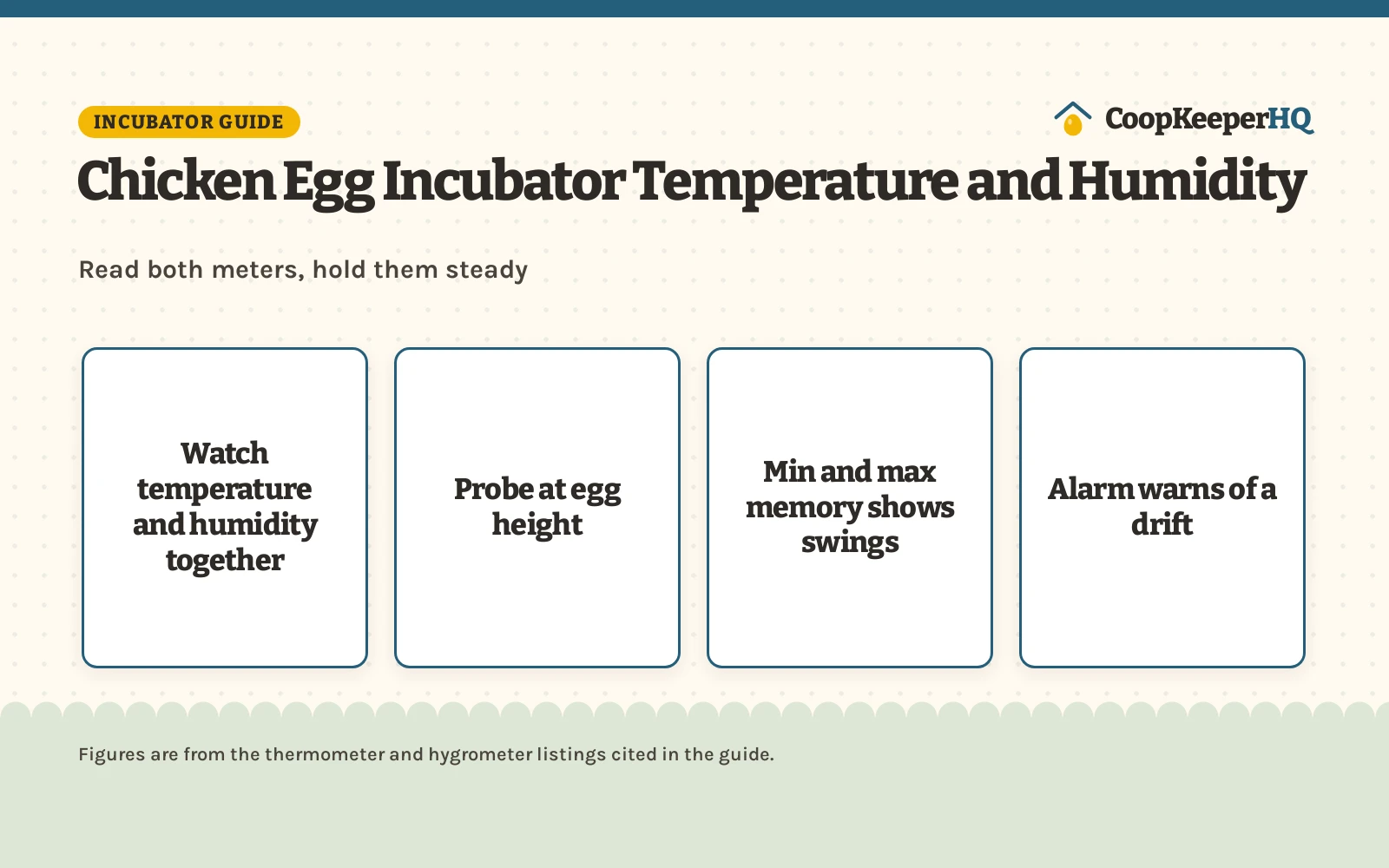
Keeping warmth steady throughout the cycle protects developing embryos. Modern incubators use internal circulation fans to move heated air evenly around every shell. Digital warning systems help alert keepers if conditions shift: ZOZOO features an alarm that triggers if temperatures deviate by ±2°F (or ±1°C) from the set point, and WONEGG sounds an audible alarm and flashes its display if temperatures fluctuate by ±2°F. Learn more about optimal settings in our chicken egg hatching temperature guide.
Maintaining humidity and water reservoir levels
Developing embryos lose moisture through porous eggshells throughout the incubation cycle. If humidity is too low, embryos can lose excess moisture and stick to the inner membrane; if humidity is too high, the air cell will not expand sufficiently, leaving chicks at risk of drowning when attempting to pip. Maintaining the proper moisture level involves adding clean, lukewarm water to the integrated water channels or external refill bottles.
Opening the lid releases warmth and moisture, so features that manage water externally make daily care much easier. WONEGG incorporates a 1500ML bottom water tray with an automatic refill pump to minimize refills, and triggers an alert if humidity shifts by ±10%. ZOZOO incorporates an automatic water refill system with humidity regulation accuracy of up to 1%. Explore specialized models in our chicken egg incubator with humidity control guide, or pair your setup with a dedicated monitor from our hygrometer for egg incubator roundup.
Turning eggs throughout the incubation cycle
In a natural nest, a broody hen turns her eggs frequently each day with her beak and feet. Turning prevents the embryo from sticking to the inner shell membrane and ensures that heat distributes evenly across the egg. Automatic turning trays relieve keepers of the chore of opening the incubator multiple times a day.
Different incubators use distinct mechanical turning methods. Holdwell S uses automatic 90° egg turning to tilt eggs gently from side to side. Sailnovo automatically rotates eggs every 2 hours throughout the incubation period. ZOZOO provides customizable rotation frequencies, allowing keepers to select turning intervals of 60, 90, 120, 150, 180 or 210 Min, with 120 Min set as the default. To compare motorized trays and rocking cradles, consult our automatic egg turner guide and our review of egg turner trays.
Candling eggs to monitor development
Candling involves shining a bright, focused beam of light through the eggshell in a dark room to observe embryonic development. Visible spiderwebs of red blood vessels and a dark embryonic spot indicate fertile, growing life. Eggs that remain completely clear or show a distinct blood ring should be discarded promptly so they do not spoil and contaminate the incubator environment.
Many modern incubator models integrate viewing lights directly into the chassis, while standalone candling lamps also work well. For guidance on identifying healthy veins and monitoring air cell expansion, read our guide explaining what is an egg candler.
Entering lockdown before the hatch
Lockdown marks the transition from incubation to hatching. Holdwell S designs its equipment for a 21-day hatching cycle and supports 21+ days of continuous operation. A few days before expected hatching, automatic turning must stop so that chicks can orient themselves toward the blunt end of the shell and find the internal air cell.
Specific machines vary slightly on lockdown timing: Sailnovo automatically pauses egg turning 3 days before expected hatch date, whereas ZOZOO and WONEGG stop automatic rotation 4 days before hatching. At this stage, remove the turning grid or lay eggs onto the flat bottom mesh tray to give emerging chicks stable footing. Increase humidity levels and close all access vents as directed by the manufacturer. Above all, resist the urge to open the lid once lockdown begins. Opening the incubator releases humidity instantly, which can shrink-wrap chicks inside drying shell membranes.
Chicks hatching and moving to the brooder
Watching the emergence of new life through a clear viewing lid is an unforgettable moment. Chicks peck a small pip hole through the shell, rest, and then slowly cut a circle around the blunt end to push the shell cap open. Once a chick emerges, leave it inside the warm incubator until its down feathers dry into a fluffy coat. Newly hatched chicks survive on absorbed yolk sacs and do not need food or water for their initial hours.
While the hatch finishes, prepare a safe brooder box with clean bedding, chick starter feed, and a fresh drinker. Check our guide on what is a brooder box and explore our brooder heater plate guide to give your chicks a safe, gentle source of warmth that avoids the fire hazards of old heat lamps.
A simple incubator checklist
- Clean and sanitize all incubator surfaces before starting
- Run the machine empty until temperature and humidity stabilize
- Place eggs blunt end upward in the turning tray
- Keep water channels filled to maintain steady humidity
- Verify that the automatic turning system rotates eggs smoothly
- Stop turning 3 days or 4 days before expected hatch date for lockdown
- Keep the incubator lid firmly shut while chicks pip, zip and dry
- Allow newly hatched chicks to dry completely before moving them to the brooder
For more details on setting up brooding equipment before hatch day arrives, see our guide to brooder boxes and our brooder heater plate picks.
Pick a species and a set date for candling days, lockdown and hatch day, with a calendar file to save.
Run the incubator for a day before you set eggs to confirm temperature and humidity, keep it away from direct sun and drafts, and plug it into a protected outlet. Plan the brooder before hatch day. Wash your hands after handling eggs and chicks. See CDC backyard poultry guidance. Read our Safety Disclaimer.
FAQ for the flock
How long does it take for eggs to hatch in an incubator?
Chicken eggs typically hatch after a 21-day hatching cycle, as noted by Holdwell S on its poultry incubators. Other poultry species, including waterfowl and game birds, have different incubation durations. Maintaining stable warmth and humidity throughout the entire cycle ensures that embryos develop at a predictable pace.
When should you stop turning eggs in an incubator?
Automatic turning should cease a few days before the expected hatch date so embryos can position themselves toward the air cell. Sailnovo stops turning 3 days before expected hatch date, while ZOZOO and WONEGG pause rotation 4 days before hatching. Remove the turning dividers so emerging chicks have a flat, safe surface.
Why should you avoid opening the incubator during hatching?
Opening the incubator during the final days lets essential humidity escape within seconds. When dry air enters the warm chamber, the moisture evaporates from the inner shell membrane, causing it to shrink tightly around the chick like plastic wrap. Keeping the lid shut protects the chicks until they fully emerge and dry off.
What should you do if the power goes out while incubating?
Keep the incubator closed to trap existing warmth inside the chamber. VEVOR designs its unit to run on a 110V power supply with a manual switch to a 12V battery power source during outages. Adding an insulating styrofoam cover around the exterior also slows heat loss until electrical power returns.
How often should eggs be turned in an incubator?
Eggs require regular turning to prevent embryos from adhering to shell membranes. Sailnovo automatically turns eggs every 2 hours throughout incubation. ZOZOO provides selectable intervals of 60, 90, 120, 150, 180 or 210 Min, with 120 Min configured as the default setting.
More coop guides
- Best Incubator for Chicken Eggs: Hatch Picks by Size
- Collecting Eggs for Incubation: Step-by-Step Guide for Backyard Flocks
- Best Egg Incubator with Automatic Turner (2026)
See the incubators and hatching category and the brooder guides.