Insulated vs Uninsulated Duck House: Which One Should You Buy?
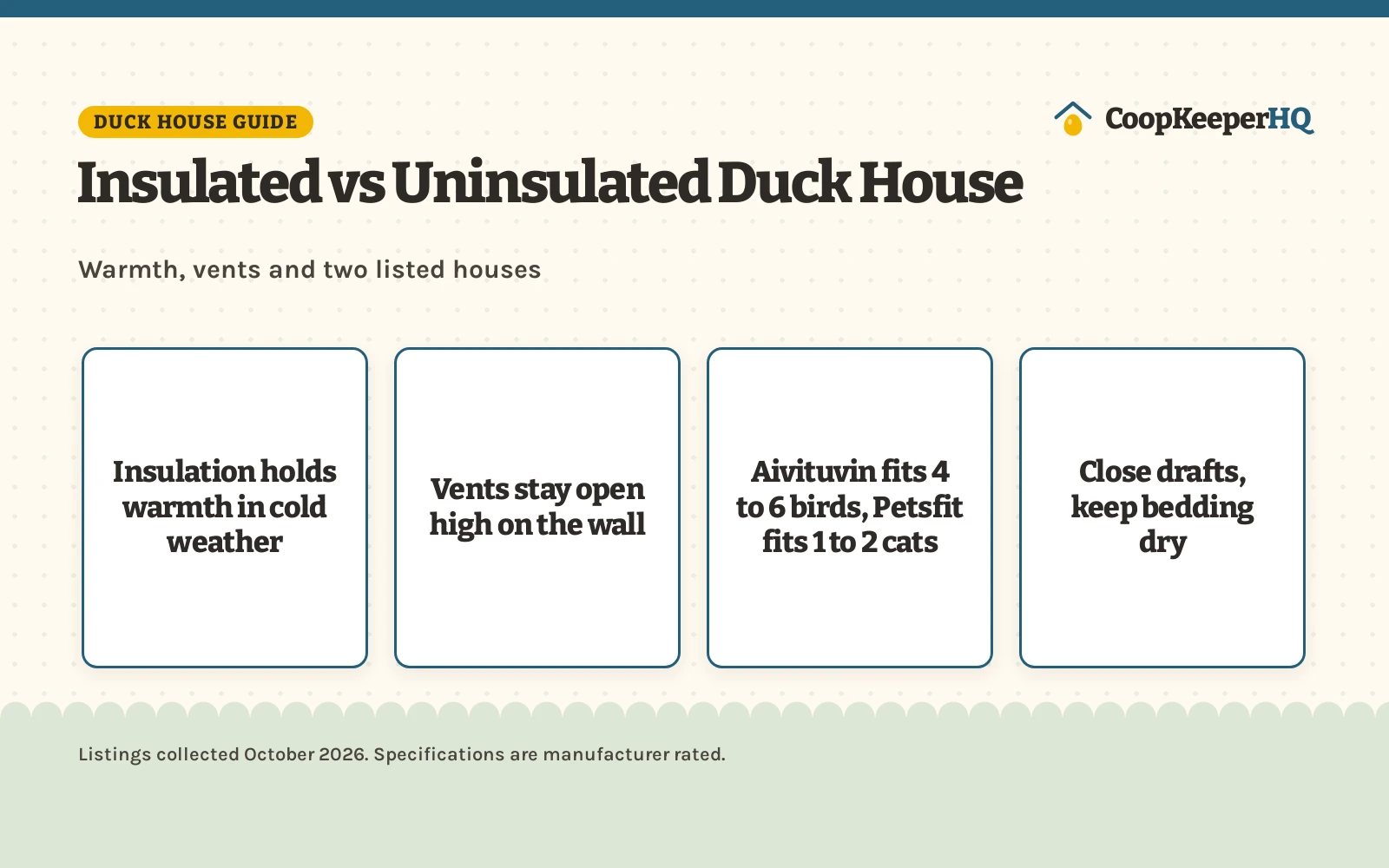
An insulated duck house holds warmth longer in cold weather, while a ventilated uninsulated house suits mild climates, and the right pick depends on your winters and your flock.

On this page
Top picks at a glance
As an Amazon Associate I earn from qualifying purchases.
- 1
 JCs Wildlife Cedar Duck House9.6/10View on Amazon
- 2
 Wildyard Wooden Duck Nesting House for Outside9.6/10View on Amazon
- 3
 Outdoor Duck House9.6/10View on Amazon
- 4
 Aivituvin Chicken Coop Duck House with Dual Nesting Boxes forView on Amazon
- 5
 GUTINNEEN Chicken Coop Outdoor Weatherproof Duck House withView on Amazon
- 6
 GUTINNEEN Chicken Coop Outdoor Chicken House with Nesting BoxView on Amazon
On a cold morning, the walk out to the duck house tells you plenty: the door sticks, the bedding feels damp, and the birds wait for fresh water. The question behind that walk is the insulated vs uninsulated duck house choice, and the short answer is simple: insulation wins where winters bite, while a dry, well-ventilated uninsulated house does fine where winters stay mild.
Other options for the coop
 Aivituvin Chicken Coop Duck House with Dual Nesting Boxes forCheck price on Amazon
 GUTINNEEN Chicken Coop Outdoor Weatherproof Duck House withCheck price on Amazon
 GUTINNEEN Chicken Coop Outdoor Chicken House with Nesting BoxCheck price on Amazon
CoopKeeperHQ earns a commission if you buy through our links, at no added cost to you. Affiliate disclosure.
Insulated vs uninsulated duck house: the short answer
Insulation slows heat loss through the walls and roof, so the house holds the warmth the flock brings in overnight and the bedding stays drier for longer. That matters most where cold weather lasts for weeks and the night chill soaks into every board. In a mild climate, the same insulation matters less, because the house never gets cold enough for the difference to show. The deciding factors are how cold your winters run, how dry you keep the house, and whether the vents stay open. An insulated house with closed vents turns damp, and damp bedding is a bigger problem than cold air alone. An uninsulated house with open vents stays dry but cold, which is fine for a hardy flock in a mild spot and a poor match for a long, hard winter.
What insulation changes inside the house
An insulated wall keeps the inside surface warmer, so moisture in the air is less likely to condense on it and drip into the bedding. That means drier bedding, less morning damp, and a house that warms up faster once the birds settle in for the night. Insulation also slows heat loss through thin boards, which helps on cold nights. It does not seal gaps, so drafts still need closing at bird height. What insulation does not do is replace ventilation. A flock breathes out moisture all night, and that moisture has to leave somewhere. Keep vents high on the wall, above the birds, so damp air escapes without a breeze blowing across them. If the vents close up, even a well-insulated house turns damp, and damp is what makes a winter house hard to live in.
When an uninsulated house works fine
An uninsulated house is a reasonable pick where winters are short and mild, and where the house sits out of the wind. Ducks spend much of the day outside in most weather, and the house is mainly a night shelter, so a simple wooden house with a dry floor and walls that block the wind can serve well. The essentials do not change: a roof that does not leak, bedding kept dry, drafts closed at bird height, and vents left open high up. A windbreak around the run also helps when the cold is brief. If your winters bring long spells of freezing weather, though, the uninsulated house will run colder at night, and that is where insulation earns its keep.
Two listed houses, side by side
The larger of the two listed houses is the Aivituvin chicken coop duck house, which the maker describes as a spacious house with three perches and a floor of 14.15 square feet, made for 4 to 6 chickens or ducks. The title gives its size as 67.3 inches long by 36.8 inches wide by 40.6 inches high, while the spec table lists 67.24 inches long; the title figure is used here. The listing states solid wood construction with sturdy corner brackets, proper ventilation, a removable metal tray and two access doors for cleaning. The title calls for dual nesting boxes, while a bullet heading says four nesting boxes; the bullets describe one box on each side divided into two sections, which matches the dual title. The house is expandable with the maker’s chicken run and connectable with an automatic chicken coop door, both sold separately. The spec table states a 2 Year Manufacturer warranty and a weight of 100 pounds. The maker’s count is 4 to 6 birds, and the floor measures 14.15 square feet. For a duck flock, this is the stronger of the two picks, and our automatic chicken coop door guide covers the add-on door.
The smaller listed shelter is the Petsfit outdoor house, marketed for cats, rabbits, chickens, ducks and other small animals. The bullets give its size as 18 inches long by 26 inches wide by 23 inches high, while the spec table lists 20 inches deep by 16.5 inches wide by 17 inches high; the bullet figures are used here. The listing states a 5.5 inch elevated design, a 16 inch by 7 inch balcony, a waterproof curtain door in front and a one-way escape door in back, and room for a heating pad inside with the cord passing through the escape door. It is described as perfect for 1 to 2 cats or a mother cat with kittens, so it suits a very small group rather than a flock of 4 to 6. The listing states solid wood construction, a weight of 15.7 pounds, and a one-year warranty. As a duck shelter it works best as a small, dry, raised retreat, not as the main house for a flock.
Ventilation still matters in an insulated house
Whether the walls are insulated or not, the vents stay open high on the wall through winter. Closing them traps the moisture the flock breathes out, and wet bedding follows soon after. Check the roof for leaks before the cold sets in, since a drip from above wets bedding faster than any damp air. Keep bedding deep and dry, adding a fresh layer when the surface turns damp, and see our duck coop bedding guide for material choices. Any electrical gear at the house, such as a heating pad or a heater for duck coop, should run from a GFCI outlet with cords kept off the ground and out of reach of beaks. Do not use heat lamps in a coop: a flat radiant panel or heat plate with a stated safety listing is the safer type.
A simple winter checklist
- Drafts closed at bird height and the roof does not leak
- Vents high on the wall left open
- Bedding deep and dry
- Water unfrozen, with cords on a GFCI outlet
- Doors shut at night against predators
Birds, breed size, run time and climate in; coop floor, run space, roost length and nesting boxes out.
Wash your hands after handling birds, eggs or equipment, supervise children around the flock, and check local rules on flock size and roosters before you buy. For sick birds, call a poultry veterinarian or your state extension office. See CDC backyard poultry guidance. Read our Safety Disclaimer.
FAQ for the flock
Do ducks need an insulated house in winter?
It depends on the climate. Insulation helps most where cold weather lasts for weeks, because it holds the flock’s warmth overnight and keeps bedding drier. In a mild climate, a dry, draft-free, well-ventilated uninsulated house serves well. If you are unsure about your flock, ask a poultry vet or your state extension office.
Does insulation make a duck house damp?
Only if the vents close. Insulation itself keeps wall surfaces warmer, which means less condensation, but the moisture the flock breathes out still needs a way out. Leave vents high on the wall open and keep bedding dry, and an insulated house stays drier than a sealed one.
Which listed house fits a small duck flock?
The Aivituvin house is the flock pick: the maker describes it for 4 to 6 chickens or ducks, with a floor of 14.15 square feet, dual nesting boxes and a removable metal tray. The Petsfit shelter suits a very small group, described as perfect for 1 to 2 cats or a mother cat with kittens, so it works as a small retreat rather than a main flock house.
Can I add heat to a duck house safely?
Do not use heat lamps in a coop, since a hot bulb falling into bedding is a known fire risk. A flat radiant panel or heat plate with a stated safety listing is the safer type, run from a GFCI outlet with protected cords. The Petsfit shelter routes a heating pad cord through its escape door, per the listing.
Should the pop door stay shut at night in winter?
Yes, shut the pop door at night against predators, but leave the high vents open so moisture can leave. A sealed house turns damp, and damp bedding is the problem to avoid. An automatic door takes care of the closing if you are out late.
More coop guides
- Best Duck House: Picks for Backyard Ducks
- Duck House vs Chicken Coop: Which One Should You Buy?
- Indoor vs Outdoor Duck Coop: Which One Should You Buy?
- Metal vs Wood Duck House: Which One Should You Buy?
- Best Duck Coop Bedding: 5 Picks for a Clean, Dry Coop (2026)
- Heater for Duck Coop: 5 Safe Options Compared (2026)
- Duck Coop Size: Floor Space, Ventilation, and Setup Guide
- Do Ducks Need a Pool? Backyard Flock Water Guide
See the duck, quail and turkey picks and the duck house guides.