Low vs High Impedance Electric Fence Charger: Which One Should You Buy?
Low and high impedance fence chargers compared on power source, range measures, energy, monitoring and warranty, with Parmak and THILEMON examples.

On this page
Top picks at a glance
As an Amazon Associate I earn from qualifying purchases.
- 1
 Parmak MAG12 Low Impedance Battery Fence Charger9.6/10View on Amazon
- 2
 Parmak SE5 Low Impedance Electric Fence Charger9.6/10View on Amazon
- 3
 THILEMON Electric Fence Charger with LED Display9.5/10View on Amazon
Low vs high impedance electric fence charger verdict: Choose low impedance if the fence needs a mains or battery charger with a built-in performance meter, using the Parmak examples below. Choose the THILEMON example if the fence needs a dual-power energizer with an LED display.
A fence that drops voltage when weeds touch it leaves the run open to predators, and the low vs high impedance electric fence charger choice comes down to power source, range measures and monitoring, not the label alone. This comparison looks at low impedance examples from Parmak and a high-side example from THILEMON, using only what each listing publishes.
CoopKeeperHQ earns a commission if you buy through our links, at no added cost to you. Affiliate disclosure.
Three examples
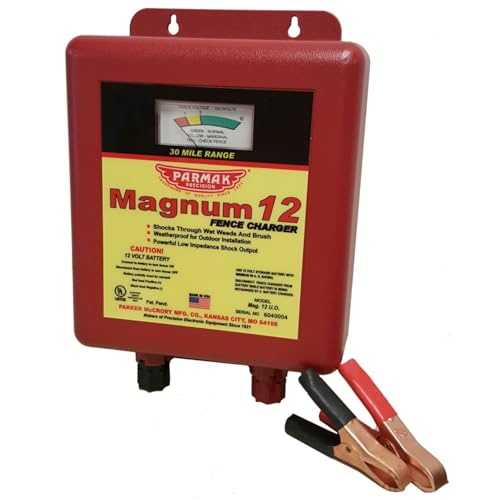
Parmak MAG12 Low Impedance Battery Fence Charger
A 12-volt battery-operated low impedance charger with a 30-mile range, a performance meter and up to three months of operation between charges.
Who it's for: a keeper who wants a portable battery charger with a meter and no mains connection.
Who should skip it: anyone who wants a stated joules figure or a mains-powered charger.
Parmak lists the MAG12 as a 12-volt battery-operated low impedance charger with a 30-mile range and a built-in performance meter. The listing states up to three months of continuous operation between battery charges and describes a weatherproof portable outdoor model. The bullets state a 1 year warranty while the spec table warranty reads Limited; the bullets are trusted here.
Pros
- Battery operation with up to three months between charges
- Built-in performance meter
- Weatherproof portable outdoor model
- 1 year warranty stated
Cons
- No joules figure is stated
- No voltage output figure is stated
- 30-mile range, below the SE5 example's 50 miles
- No battery inclusion is stated
Parmak SE5 Low Impedance Electric Fence Charger
A 110/120 volt low impedance controller with a 50 mile range, a digital performance meter and over 8,000 volts of holding power with a 500 OHM load.
Who it's for: a keeper who wants a mains-powered low impedance charger with a meter for a long fence.
Who should skip it: anyone who wants battery operation or a stated warranty term.
Parmak lists the SE5 as a low impedance 110/120 volt controller with a 50 mile range, a built-in digital performance meter and over 8,000 volts of holding power with a 500 OHM load. The listing states 6.3+ Joules and says it shocks through wet weeds and brush. One line in the listing gives a power source type of Air Powered, which conflicts with the 110/120 volt controller description; the voltage description is trusted here.
Pros
- 50 mile range with a digital performance meter
- Over 8,000 volts of holding power with a 500 OHM load
- Shocks through wet weeds and brush, per the listing
- Color-coded fence and ground terminals
Cons
- No warranty term is stated
- No battery operation is stated
- No weatherproofing is stated
- No mounting hardware is stated
THILEMON Electric Fence Charger with LED Display
A fence energizer with output up to 12 kV, a maximum energy output of 3 Joules and a maximum single-line working distance of up to 8 miles, with an LED display.
Who it's for: a keeper who wants a dual-power energizer with an LED display and included warning signs.
Who should skip it: anyone who wants a stated impedance figure, weight or warranty term.
THILEMON lists this energizer with output up to 12 kV, a maximum single-line working distance of up to 8 miles and a maximum energy output of 3 Joules. The listing describes an LED display with voltage, power and operation indicators, and power from 12V batteries or AC power. The listing states CE certification and includes warning signs, a power adapter and alligator clip leads. The listing states no impedance figure and no weight.
Pros
- Output up to 12 kV with a maximum energy output of 3 Joules
- LED display with voltage and operation indicators
- Runs on 12V batteries or AC power
- CE certification with warning signs included
Cons
- No warranty term is stated
- No weight is stated
- Batteries are not included
- No impedance figure is stated in the listing
Other options for the coop
 15Miles Electric Fence Charger with ON/Off SwitchCheck price on Amazon
 15.5J Electric Fence ChargerCheck price on Amazon
 MARK8 Low Impedance 110/120-Volt 30-Mile Range Electric FenceCheck price on Amazon
 Zareba Solar Powered Low Impedance Electric Fence ChargerCheck price on Amazon
 Multi-Powered 62 Mile Electric Fence Charger for LivestockCheck price on Amazon
 16 Joule Electric Fence ChargerCheck price on Amazon
Low vs high impedance electric fence charger: side by side
| Factor | Low side | High side | Example |
|---|---|---|---|
| Power source | 110/120 volt mains; 12-volt battery | 12V battery or AC 110v | SE5 mains; MAG12 battery; THILEMON dual power |
| Range | 50 miles; 30 miles | Up to 8 miles single-line | SE5 over 50 miles of fence; MAG12 30-mile range; THILEMON up to 8 miles single-line |
| Energy | 6.3+ Joules (SE5); Not stated (MAG12) | Up to 3 Joules | SE5 states 6.3+ Joules; THILEMON states up to 3 Joules |
| Monitoring | Built-in performance meter | LED display | Both sides state a meter or display |
| Warranty | 1 year (MAG12); Not stated (SE5) | Not stated | Only the MAG12 example states a warranty term |
| Weight | 4.2 pounds; 4.6 pounds | Not stated | THILEMON states no weight |
These figures are the coop makers’ own ratings, read from each listing on 29 October 2026.
Power source
Power source is the first real split. The SE5 example is a 110/120 volt controller, the MAG12 example runs on a 12-volt battery with up to three months of continuous operation between charges, and the THILEMON example runs on 12V batteries or AC power from a regular 110v outlet. One line in the SE5 listing gives a power source type of Air Powered, which conflicts with its 110/120 volt controller description; the voltage description is trusted here. A keeper with no mains connection has a battery option on each side, while the SE5 example suits a fence with mains power.
Range and energy
Range figures here use different measures, so they do not crown a side-wide winner. The SE5 example charges over 50 miles of fence, the MAG12 example gives a 30-mile range, and the THILEMON example gives a maximum single-line working distance of up to 8 miles. Miles of fence and single-line working distance are not the same measure, so compare each figure to the fence it will serve. Energy is stated on both sides for 2 examples: the SE5 example states 6.3+ Joules, and the THILEMON example states a maximum energy output of 3 Joules. The MAG12 example states no joules figure, so its energy cannot be placed against the other 2 on that spec.
Monitoring and build
Monitoring is stated on both sides in different forms. Both Parmak examples include a built-in performance meter that tells the condition of the fence, while the THILEMON example gives an LED display with voltage, power and operation indicators. On build, the SE5 example uses steel, the MAG12 example is a weatherproof portable outdoor model, and the THILEMON example states CE certification and includes warning signs. The SE5 example also gives color-coded fence and ground terminals, red to the fence and black to ground. Item weights are 4.2 pounds for the SE5 example and 4.6 pounds for the MAG12 example, while the THILEMON example states no weight. See our best electric fence charger for 1 acre guide and best ground rod for electric fence guide.
Flock fit
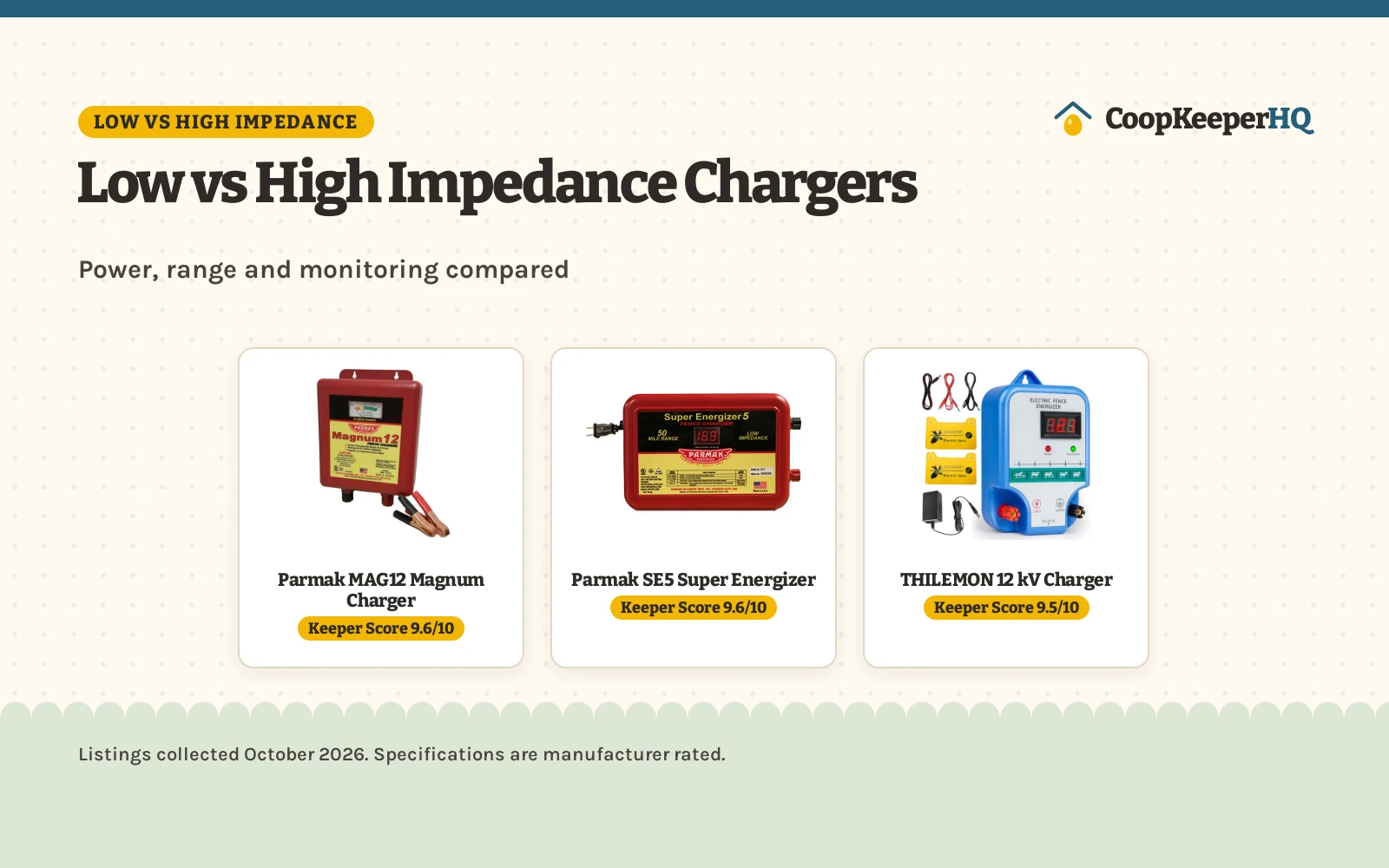
Parmak MAG12 Magnum Charger
Parmak SE5 Super Energizer
THILEMON 12 kV Charger
Fitting It to Your Flock
- For a fence with mains power nearby, the SE5 example runs on 110/120 volt with a 50 mile range.
- For a fence with no mains connection, the MAG12 example runs on a 12-volt battery for up to three months between charges.
- For a fence where voltage must be checked at a glance, the THILEMON example gives an LED display with voltage indicators.
- For a charger that moves between sites, the MAG12 example is a weatherproof portable outdoor model.
FAQ for the flock
What is the difference between low and high impedance fence chargers?
In these examples, the Parmak listings state low impedance, while the THILEMON listing states no impedance figure, so the comparison rests on power source, range measures and monitoring rather than an impedance figure.
Which example covers the longest fence?
The measures differ, so no example wins on range alone: the SE5 example charges over 50 miles of fence, the MAG12 example gives a 30-mile range, and the THILEMON example gives up to 8 miles single-line.
Do these chargers need mains power?
No: the MAG12 example runs on a 12-volt battery, the THILEMON example runs on 12V batteries or AC power, and only the SE5 example is mains-only at 110/120 volt.
Which example states a warranty?
Only the MAG12 example, with a 1 year warranty in its bullets; the SE5 and THILEMON listings state no warranty term.
What does the THILEMON LED display show?
Voltage information, power indicators and operation indicators, per the listing.
How the Coop Score came out
Each example is scored on performance, build, value, safety and warranty, using only what the listing publishes. Only the MAG12 example states a warranty term. The weights are on our How We Pick page.
| Product | Keeper Score | Perf. /35 | Build /25 | Value /25 | Safety /10 | Warranty /5 |
|---|---|---|---|---|---|---|
| Parmak MAG12 Magnum Charger | 9.6 | 29 | 20 | 21 | 3 | 3 |
| Parmak SE5 Super Energizer | 9.6 | 30 | 21 | 21 | 4 | 0 |
| THILEMON 12 kV Charger | 9.5 | 28 | 20 | 19 | 7 | 0 |
Lower point totals read near 9.2 and the strongest near 9.8; because the conversion is proportional, rank by points equals rank by score.
Which should you choose?
Choose low impedance if the fence needs a mains or battery charger with a built-in performance meter.
Choose the THILEMON example if the fence needs a dual-power energizer with an LED display and included warning signs.
Birds, breed size, run time and climate in; coop floor, run space, roost length and nesting boxes out.
Wash your hands after handling birds, eggs or equipment, supervise children around the flock, and check local rules on flock size and roosters before you buy. For sick birds, call a poultry veterinarian or your state extension office. See CDC backyard poultry guidance. Read our Safety Disclaimer.
More coop guides
- Best Electric Fence Charger for 1 Acre (2026): 5 Chargers Compared
- Best Ground Rod for Electric Fence (2026)
- Best Electric Fence Wire: 5 Spools for the Coop
- Aluminum vs Steel Electric Fence Wire: Which One Should You Buy?
See every chicken runs and fencing guide.