Mash vs Pellets Chicken Feed: Which One Should You Buy?
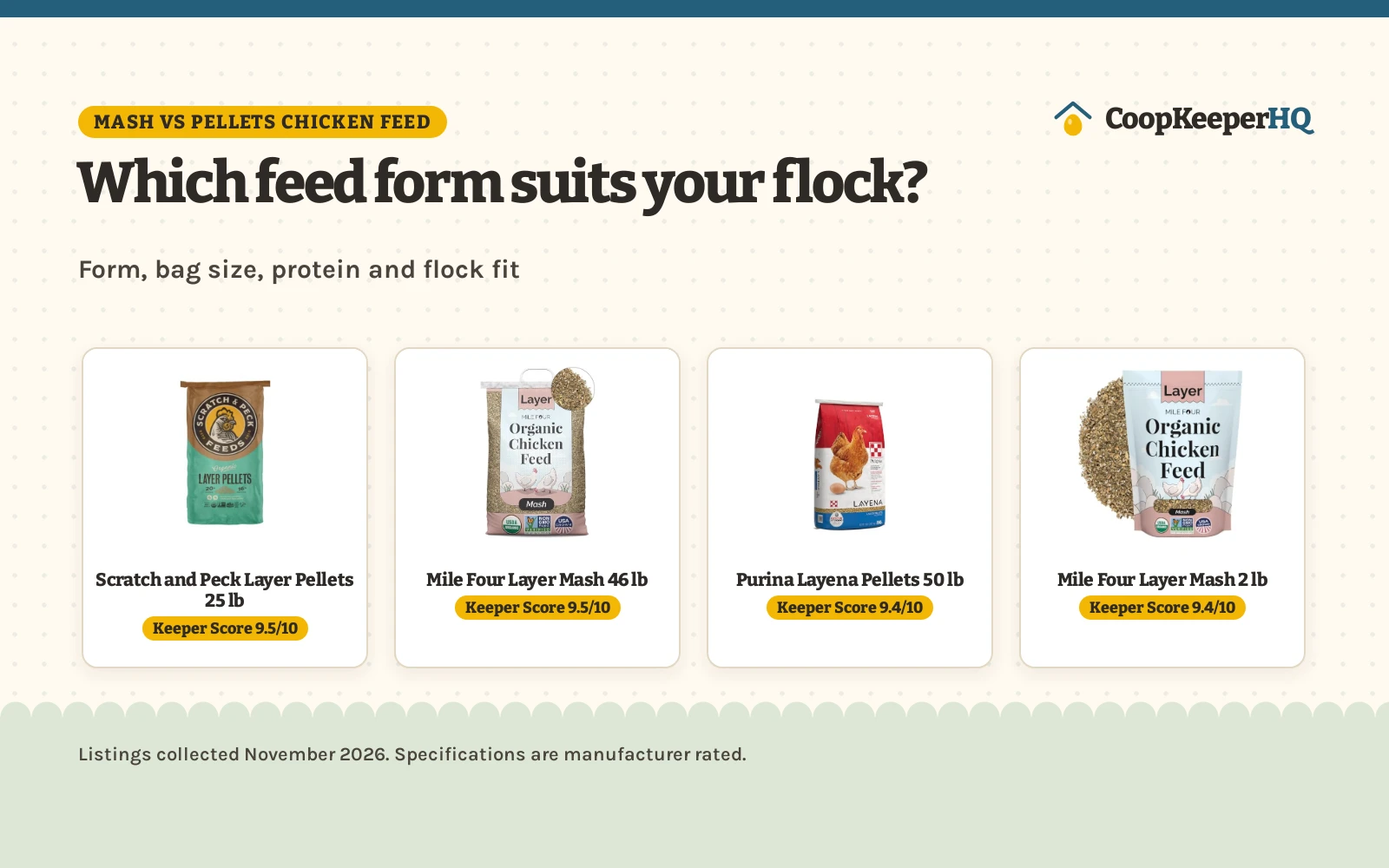
Mash and pellets compared on form, bag size, protein and flock fit, with two examples of each.

On this page
Top picks at a glance
As an Amazon Associate I earn from qualifying purchases.
- 1
 Scratch and Peck Layer Pellets for Chickens9.5/10View on Amazon
- 2
 Mile Four Organic Chicken Feed, Layer Mash9.5/10View on Amazon
- 3
 Purina Layena Pellets, Chicken Feed for Laying9.4/10View on Amazon
- 4
 Mile Four Organic Chicken Feed, Layer Mash9.4/10View on Amazon
Mash vs pellets chicken feed verdict: Choose mash if you keep chicks or ferment feed, with the Mile Four 46 lb bag and the 2 lb trial bag as examples. Choose pellets if you want a uniform feed form, with the Scratch and Peck 25 lb bag for chickens and ducks or the Purina 50 lb bag for a bigger flock.
Morning chores start the same way: the feeder is empty, the hens are waiting at the run door, and the scoop comes out of the feed bin. The choice in the bin is mash vs pellets chicken feed, and the form you pour shapes how much ends up on the ground and how the birds eat it.
This comparison puts mash bags and pellet bags side by side, so you can match the form to your flock and your feed room.
CoopKeeperHQ earns a commission if you buy through our links, at no added cost to you. Affiliate disclosure.
The four examples
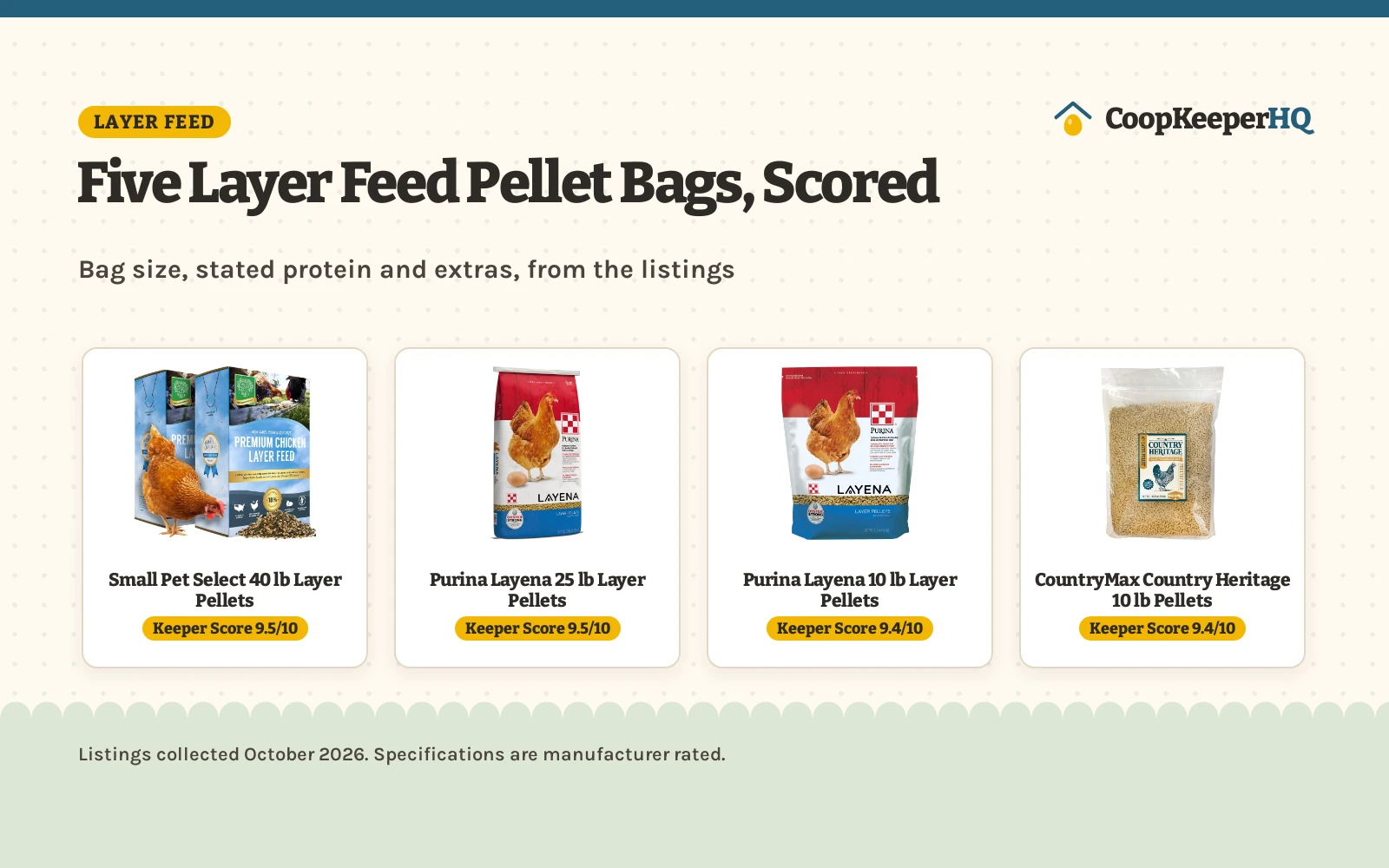
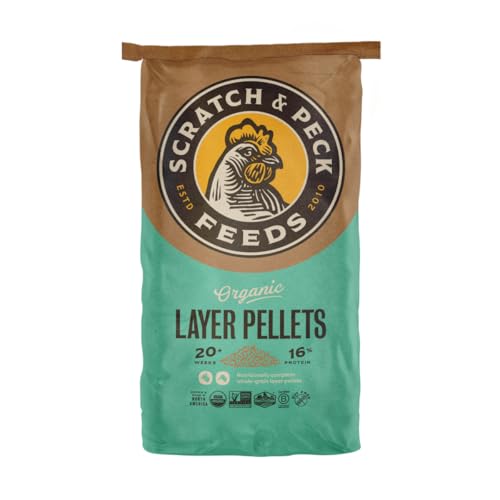
Scratch and Peck Layer Pellets for Chickens
A 25 lb bag of layer pellets with 16% protein stated, for laying chickens and ducks, certified organic and Non-GMO Project Verified, in recyclable and compostable packaging.
Who it's for: a keeper who wants certified organic pellets for a mixed flock of chickens and ducks.
Who should skip it: a keeper who wants mash, or a bag larger than 25 lb.
The Scratch and Peck layer pellets come in a 25 lb bag with 16% protein stated, for laying chickens and ducks. The maker lists cracked grains and whole food ingredients, a corn and soy free formula with no medications or fillers, USDA Organic and Non-GMO Project Verified certifications, and recyclable and compostable packaging. The feed is grown and milled in North America, in the USA and Canada.
Pros
- 16% protein stated for laying chickens and ducks
- Certified organic and Non-GMO Project Verified
- Corn and soy free, with no medications or fillers
- Recyclable and compostable packaging
Cons
- 25 lb bag, the smaller of the two pellet bags here
- No warranty term is stated
- No mash option in the same bag
- No vitamin or mineral figures stated
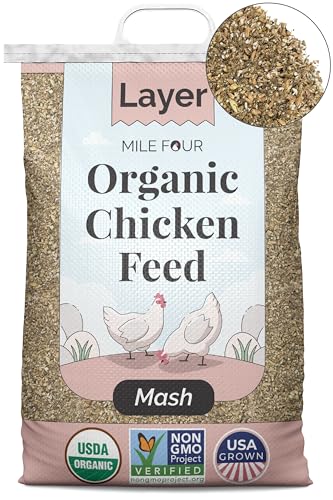
Mile Four Organic Chicken Feed, Layer Mash
A 46 lb bag of organic layer mash with 16% protein stated, corn-free and soy-free, in a compostable bag with a sturdy handle.
Who it's for: a keeper with a laying flock who wants a large bag of organic mash.
Who should skip it: a keeper who wants pellets, or a smaller bag to try first.
The Mile Four layer mash comes in a 46 lb bag with 16% protein stated. The maker lists certified organic, certified non-GMO grains that are corn-free and soy-free, non-medicated, with no fillers or additives, grown on USA family farms and milled fresh. The bag is compostable and has a sturdy handle for carrying and pouring. The maker notes mash suits chicks and fermenting and may lead to messy eating.
Pros
- 16% protein stated
- Certified organic and non-GMO, corn-free and soy-free
- 46 lb bag with a sturdy handle and compostable bag
- Maker notes mash suits chicks and fermenting
Cons
- Mash may lead to messy eating, as the maker notes
- 46 lb bag is the heaviest mash bag here to carry and pour
- No warranty term is stated
- No pellet option in the same bag
Purina Layena Pellets, Chicken Feed for Laying
A 50 lb bag of layer pellets for laying hens, with marigold extract, calcium and trace minerals, and prebiotics, probiotics and yeast listed.
Who it's for: a keeper with a laying flock who wants the largest bag in this article.
Who should skip it: a keeper who wants a stated protein percentage or an organic certification.
The Purina Layena pellets come in a 50 lb bag for laying hens. The maker lists added marigold extract, calcium, manganese and trace minerals, lysine and methionine, vitamins A, D and E, and prebiotics, probiotics and yeast. The bag measures 27.0 x 15.0 x 4.0 inches.
Pros
- 50 lb bag, the largest bag in this article
- Marigold extract listed
- Lysine and methionine listed as essential amino acids
- Prebiotics, probiotics and yeast listed
Cons
- No protein percentage stated
- No organic or non-GMO certification stated
- 50 lb bag is the heaviest bag in this article to carry
- No corn-free or soy-free statement
Mile Four Organic Chicken Feed, Layer Mash
A 2 lb sample bag of organic layer mash with 16% protein stated, corn-free and soy-free, for trying the feed type first.
Who it's for: a keeper who wants to try organic mash before buying a larger bag.
Who should skip it: a keeper feeding a full flock, who needs a larger bag.
The Mile Four layer mash comes in a 2 lb sample bag with 16% protein stated. The maker lists certified organic, certified non-GMO grains that are corn-free and soy-free, non-medicated, with no fillers or additives, grown on USA family farms and milled fresh. The maker notes mash suits chicks and fermenting and may lead to messy eating, and the sample size suits finding the feed type for a flock.
Pros
- 16% protein stated
- Certified organic and non-GMO, corn-free and soy-free
- 2 lb sample size for trying the feed type first
- Maker notes mash suits chicks and fermenting
Cons
- 2 lb sample bag, the smallest bag in this article
- Mash may lead to messy eating, as the maker notes
- No carry handle stated for the 2 lb bag
- No pellet option in the same bag
Other options for the coop
 Mile Four Organic Chicken FeedCheck price on Amazon
 Kalmbach Feeds Hi Omegga Layer Pellets for ChickensCheck price on Amazon
 Pink Rose Organix Layer Pellet FeedCheck price on Amazon
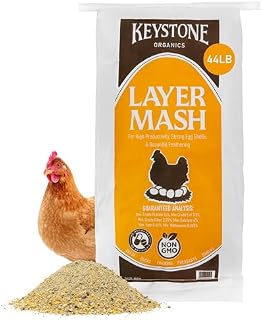 Keystone Organics Layer Mash Chicken FeedCheck price on Amazon
 Scratch and Peck FeedsCheck price on Amazon
 Premium Poultry All Flock Feed PelletsCheck price on Amazon
Mash vs pellets chicken feed: side by side
| Product | Form | Bag | Protein stated | Keeper Score |
|---|---|---|---|---|
| Scratch and Peck Layer Pellets 25 lb | Pellets | 25 lb | 16% | 9.5/10 |
| Mile Four Layer Mash 46 lb | Mash | 46 lb | 16% | 9.5/10 |
| Purina Layena Pellets 50 lb | Pellets | 50 lb | Not stated | 9.4/10 |
| Mile Four Layer Mash 2 lb | Mash | 2 lb | 16% | 9.4/10 |
Specs reflect what the manufacturer lists, not measurements in a backyard flock (gathered 19 November 2026).
Form and waste
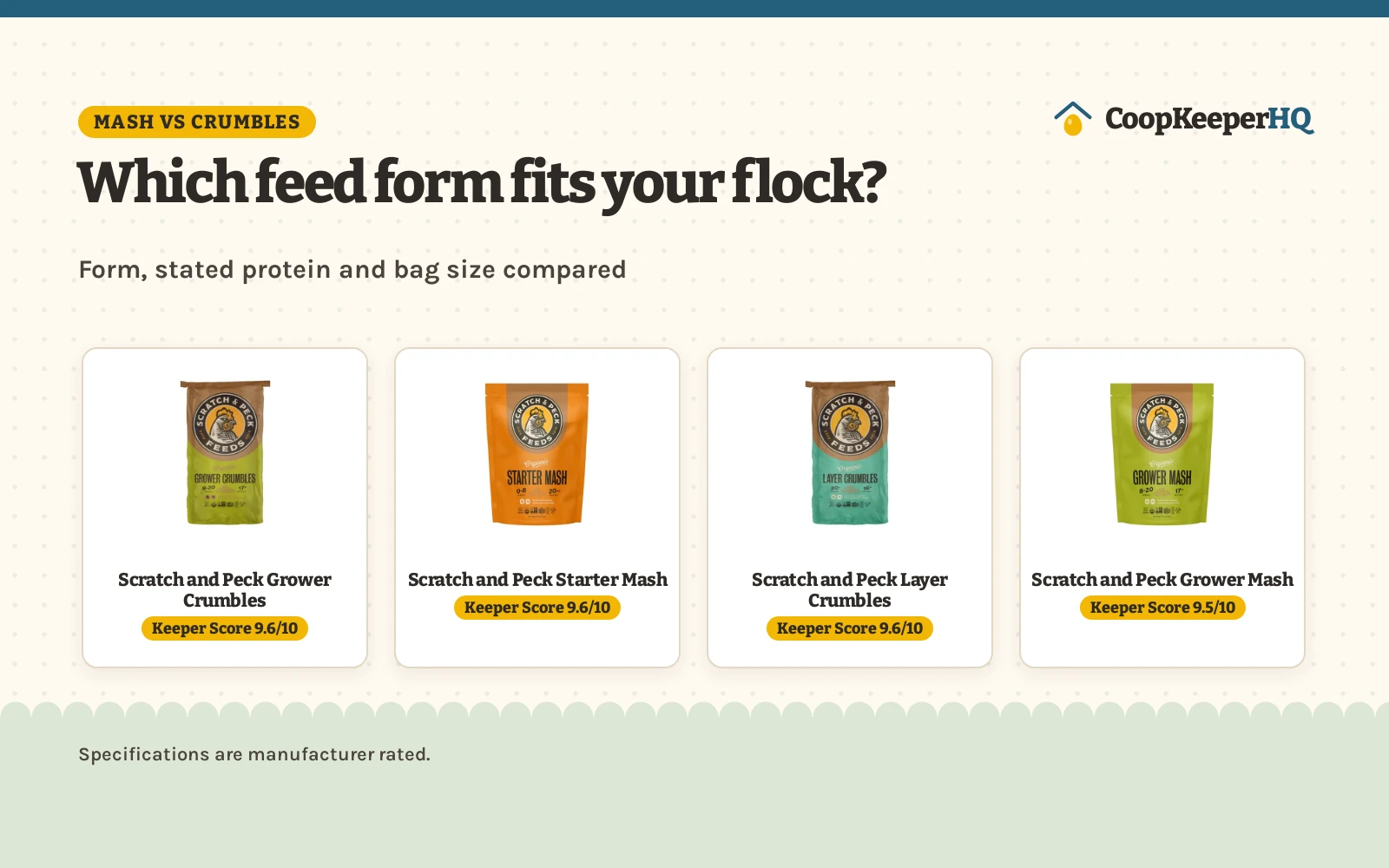
Mash is a loose feed, and the Mile Four maker notes it suits chicks and fermenting and may lead to messy eating. Pellets are uniform pieces, and the same maker notes pellets reduce waste and provide uniformity. That is the core trade: mash suits a keeper who ferments feed or raises chicks, while pellets suit a keeper who wants less scattered feed. Neither form changes the protein figure on the bag: both Mile Four mash bags and the Scratch and Peck pellets state 16% protein, while the Purina pellets state no protein percentage. The mash vs crumbles chicken feed comparison covers a third form.
Bag size and the feed room
The four bags here run from a 2 lb sample to a 50 lb sack. The Mile Four mash comes in a 2 lb sample bag and a 46 lb bag, the Scratch and Peck pellets come in a 25 lb bag, and the Purina pellets come in a 50 lb bag. The 46 lb Mile Four bag has a sturdy handle for carrying and pouring, and its bag is compostable. The Scratch and Peck bag is recyclable and compostable. The 2 lb sample suits trying mash before buying the 46 lb bag, while the 50 lb Purina bag suits a flock that goes through a lot of feed.
Protein and certifications
Three of the four bags state 16% protein: both Mile Four mash bags and the Scratch and Peck pellets. The Purina pellets state no protein percentage, so the protein figure is unclear for that bag. Both Mile Four bags are certified organic and non-GMO, corn-free and soy-free, non-medicated, with no fillers or additives. The Scratch and Peck pellets are certified organic and Non-GMO Project Verified, corn and soy free, with no medications or fillers. The Purina pellets state no organic or non-GMO certification.
Flock fit
Scratch and Peck Layer Pellets 25 lb
Mile Four Layer Mash 46 lb
Purina Layena Pellets 50 lb
Mile Four Layer Mash 2 lb
Fitting It to Your Flock
- A 2 lb sample bag suits trying mash before buying the 46 lb bag.
- The 50 lb Purina bag is the largest bag here.
- Mash suits chicks and fermenting, as the Mile Four maker notes; pellets suit a keeper who wants uniformity.
- The Scratch and Peck pellets are stated for chickens and ducks, so they suit a mixed flock.
FAQ for the flock
Is mash or pellets better for laying hens?
Neither form wins on the bags in this article alone. The mash and pellet bags that state protein both state 16%, and the choice turns on form: mash suits chicks and fermenting and may lead to messy eating, while pellets are noted for uniformity and less waste.
Can chicks eat mash?
The Mile Four maker notes mash suits chicks and fermenting. The 2 lb sample bag is a small way to try mash with a young flock before buying the 46 lb bag.
Do pellets waste less feed than mash?
The Mile Four maker notes pellets reduce waste and provide uniformity, and notes mash may lead to messy eating. No bag in this article states a waste figure, so the answer rests on those form notes.
What bag size should I buy first?
The 2 lb Mile Four mash is a sample size for trying the feed type first. The other bags here are 25 lb, 46 lb and 50 lb, so match the bag to the size of your flock and the space in your feed room.
Can ducks eat layer pellets?
The Scratch and Peck layer pellets are stated for chickens and ducks. The other three bags are stated for chickens and laying hens.
How the Coop Score came out
Each example is scored out of 10 on performance, build, value, safety and warranty, using only what the listing publishes. No listing states a warranty. The weights are on our How We Pick page.
| Product | Keeper Score | Perf. /35 | Build /25 | Value /25 | Safety /10 | Warranty /5 |
|---|---|---|---|---|---|---|
| Scratch and Peck Layer Pellets 25 lb | 9.5 | 30 | 21 | 21 | 0 | 0 |
| Mile Four Layer Mash 46 lb | 9.5 | 29 | 21 | 21 | 0 | 0 |
| Purina Layena Pellets 50 lb | 9.4 | 29 | 20 | 20 | 0 | 0 |
| Mile Four Layer Mash 2 lb | 9.4 | 28 | 20 | 18 | 0 | 0 |
We convert points onto the range from 9.2 up to 9.8 without reshuffling anything: more points, higher number.
Which should you choose?
Choose mash if you keep chicks or ferment feed, and you want the 46 lb Mile Four bag with its handle and compostable bag, or the 2 lb sample to try the form first.
Choose pellets if you want the uniform form, with the 25 lb Scratch and Peck bag for a mixed flock of chickens and ducks or the 50 lb Purina bag for a larger flock.
How much feed your flock eats a day and a month, how long a bag lasts, and what it costs.
Wash your hands after handling birds, eggs or equipment, supervise children around the flock, and check local rules on flock size and roosters before you buy. For sick birds, call a poultry veterinarian or your state extension office. See CDC backyard poultry guidance. Read our Safety Disclaimer.
More coop guides
- Mash vs Crumbles Chicken Feed: Which One Should You Buy?
- Goose Feed vs Chicken Feed: Which One Should You Buy?
- Pigeon Feed vs Chicken Feed: Which One Should You Buy?
- Best Organic Layer Feed (2026): 5 Picks for Laying Hens
- Best Organic Chick Starter Feed (2026): 5 Picks for the Brooder
- Broiler Feed vs Layer Feed: Which One Should You Buy?
- Layer Feed vs Grower Feed: Which One Should You Buy?
- Chick Starter vs Layer Feed: Which One Should You Buy?
- Game Bird Feed vs Chicken Feed: Which One Should You Buy?
- Turkey Feed vs Chicken Feed: Which One Should You Buy?
- Guinea Fowl Feed vs Chicken Feed: Which One Should You Buy?
- Best Feed for Ducks and Geese (2026): Picks for the Pond and the Feeder
- Best Cracked Corn for Chickens (2026): 4 Picks for the Flock
- Best Cracked Corn for Ducks (2026)
- Best Duck Feed for Ducklings (2026): 5 Starter and Grower Picks
- Best Turkey Feed (2026): Picks for Backyard Turkeys
- Dried Mealworms vs Black Soldier Fly Larvae: Which One Should You Buy?
- Does Chicken Feed Go Bad? Storage and Shelf Life
- How to Feed Oyster Shell to Chickens
- Do Chickens Need Grit and Oyster Shell?
See every feed room guide and the egg hatch calendar.