Layer Feed vs Grower Feed: Which One Should You Buy?
Layer mash and grower mash compared on protein, bag size and form, with 16% layer bags and 17% grower bags from the listings we reviewed.

On this page
Top picks at a glance
As an Amazon Associate I earn from qualifying purchases.
- 1
 Scratch and Peck Layer Mash for Chickens9.5/10View on Amazon
- 2
 Scratch and Peck Grower Mash for Chickens9.5/10View on Amazon
- 3
 Scratch and Peck Layer Mash for Chickens9.5/10View on Amazon
- 4Scratch and Peck Grower Mash for Chickens9.4/10View on Amazon
Layer feed vs grower feed verdict: Choose layer feed for laying chickens and ducks: the layer mash here states 16% protein and is sold for birds in lay. Choose grower feed for growing chickens and ducks: the grower mash here states 17% protein and is sold for birds still growing.
The feeder needs filling at chore time, and the bag you reach for depends on what the flock is doing now. Layer feed vs grower feed is the choice between a mash made for birds in lay and a mash made for birds still growing. This comparison walks through the protein figures, the bag sizes and the forms the listings state, with one example of each side from the listings we reviewed.
CoopKeeperHQ earns a commission if you buy through our links, at no added cost to you. Affiliate disclosure.
Four examples
Scratch and Peck Layer Mash for Chickens
A 50 lb bag of layer mash at 16% protein, corn and soy free, fermentable, and certified organic with Non-GMO Project Verified status, for laying chickens and ducks.
The Scratch and Peck layer mash comes in a 50 lb bag at 16% protein, corn and soy free, with fermentable whole grains. The listing states certified organic and Non-GMO Project Verified status, recyclable and compostable packaging, and milling in the USA and Canada. It is sold for laying chickens and ducks.
One oddity: the stated dimensions, 29.0 x 15.5 x 4.0 inches, match the 25 lb bag exactly, so the dimensions read as a copy of the smaller bag rather than a measurement of this one. No warranty term and no daily feeding amount are stated.
Pros
- States 16% protein in the title
- Fermentable whole grains, feed dry or fermented
- Corn and soy free, certified organic and Non-GMO Project Verified
- 50 lb bag, the largest bag in this comparison
Cons
- No warranty term is stated
- No daily feeding amount is stated
- Stated dimensions match the 25 lb bag exactly
- Mash only; no pellet or crumble form is stated
Scratch and Peck Grower Mash for Chickens
A 40 lb bag of grower mash at 17% protein, corn and soy free, fermentable, and certified organic with Non-GMO Project Verified status, for growing chickens and ducks.
The grower mash comes in a 40 lb bag at 17% protein, corn and soy free, with fermentable whole grains. The listing states certified organic and Non-GMO Project Verified status, no fillers or medications, and milling in North America. It is sold for growing chickens and ducks.
Two wording slips sit in this listing: one bullet calls it a starter mash, though the title says grower mash, and no packaging detail is stated, unlike the other three listings. Its stated dimensions, 29.0 x 15.5 x 4.0 inches, match the 25 lb and 50 lb bags exactly. No warranty term and no daily feeding amount are stated.
Pros
- States 17% protein in the title
- Fermentable whole grains
- Corn and soy free, certified organic and Non-GMO Project Verified
- 40 lb bag, between the 25 lb and 50 lb bags here
Cons
- No warranty term is stated
- No daily feeding amount is stated
- No packaging detail is stated, unlike the other three listings
- Stated dimensions match the 25 lb and 50 lb bags exactly
Scratch and Peck Layer Mash for Chickens
A 25 lb bag of layer mash at 16% protein, corn and soy free, fermentable, and certified organic with Non-GMO Project Verified status, for laying chickens and ducks.
The 25 lb layer mash states the same 16% protein, corn and soy free recipe and fermentable whole grains as the 50 lb bag, with certified organic and Non-GMO Project Verified status. The listing adds sustainable grub protein to the protein source, which the 50 lb bag does not mention. It is sold for laying chickens and ducks.
Its stated dimensions, 29.0 x 15.5 x 4.0 inches, match the 50 lb bag exactly. No warranty term and no daily feeding amount are stated.
Pros
- States 16% protein in the title
- Fermentable whole grains, feed dry or fermented
- Corn and soy free, certified organic and Non-GMO Project Verified
- 25 lb bag, the smallest bag in this comparison
Cons
- No warranty term is stated
- No daily feeding amount is stated
- Stated dimensions match the 50 lb bag exactly
- Mash only; no pellet or crumble form is stated
Scratch and Peck Grower Mash for Chickens
A 25 lb bag of grower mash at 17% protein, corn and soy free, fermentable, and certified organic with Non-GMO Project Verified status, for growing chickens and ducks.
The 25 lb grower mash states 17% protein, corn and soy free, fermentable whole grains, and certified organic and Non-GMO Project Verified status. The listing states recyclable and compostable packaging and milling in the USA and Canada.
One bullet reads as a copy slip: it describes the feed as nutrition for laying chickens and ducks, though this is a grower mash, not a layer mash. Its stated dimensions, 29.0 x 15.5 x 4.0 inches, match the 50 lb bag exactly. No warranty term and no daily feeding amount are stated.
Pros
- States 17% protein in the title
- Fermentable whole grains, feed dry or fermented
- Corn and soy free, certified organic and Non-GMO Project Verified
- 25 lb bag, the smallest bag in this comparison
Cons
- No warranty term is stated
- No daily feeding amount is stated
- One bullet describes the feed as nutrition for laying chickens, though this is a grower mash
- Stated dimensions match the 50 lb bag exactly
Other options for the coop
 Scratch and Peck FeedsCheck price on Amazon
 Pink Rose Organix Layer Pellet FeedCheck price on Amazon
 New Country OrganicsCheck price on Amazon
 Prairie's Choice Non-GMO Backyard Chicken FeedCheck price on Amazon
 Wholesome Harvest All Flock FeedCheck price on Amazon
 Mile Four Organic Chicken FeedCheck price on Amazon
Layer feed vs grower feed: side by side
| Factor | Layer feed | Grower feed | Notes |
|---|---|---|---|
| Protein stated | 16% | 17% | Both titles state it |
| Bag sizes here | 25 lb, 50 lb | 25 lb, 40 lb | Sizes overlap |
| Form | Mash | Mash | Both mash |
| Corn and soy | Corn and soy free | Corn and soy free | Both free of corn and soy |
| Fermentable | Yes, stated | Yes, stated | Both fermentable |
| Certification stated | Certified Organic, Non-GMO Project Verified | Certified Organic, Non-GMO Project Verified | Both certified organic |
| Packaging stated | Recyclable and compostable | On the 25 lb bag only | One grower bag omits it |
| Example: Scratch and Peck Layer Mash 50 lb | 16% protein, 50 lb bag | Not applicable | Layer side |
| Example: Scratch and Peck Grower Mash 40 lb | Not applicable | 17% protein, 40 lb bag | Grower side |
Figures are as the listings state; we quote the brand’s rated specs from the product listings (as of 13 November 2026).
Protein: the figure that separates the sides
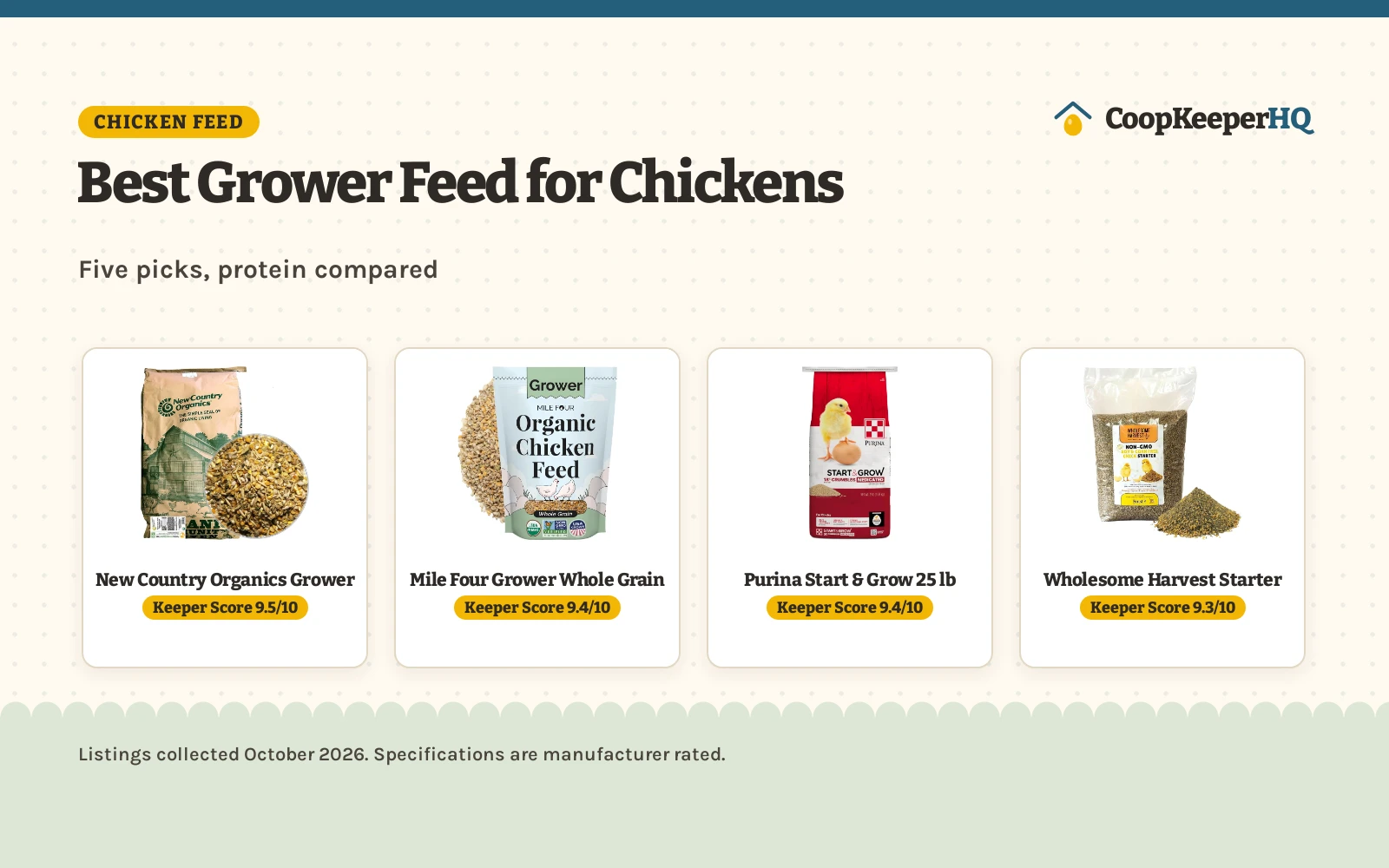
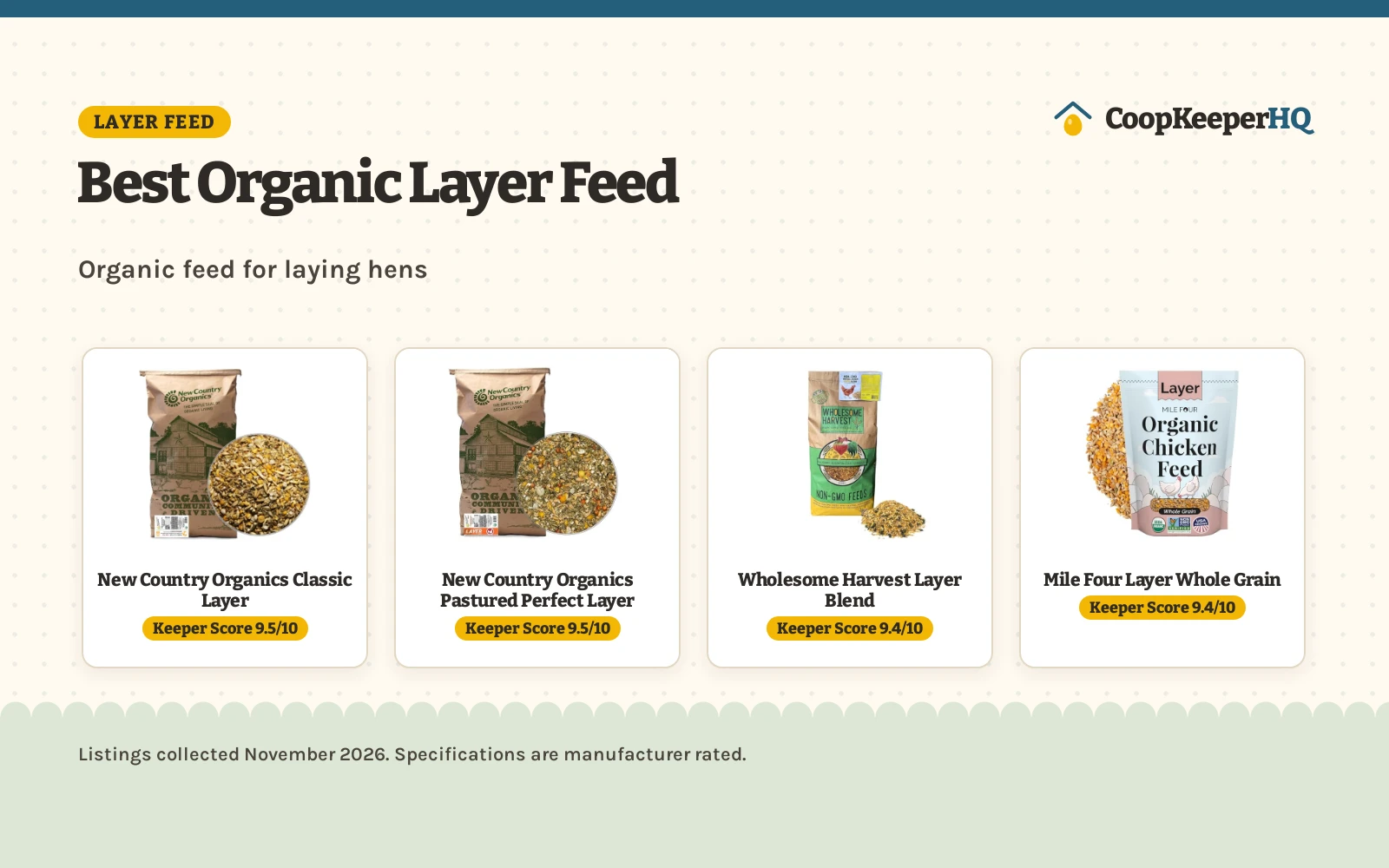
The clearest stated difference sits in the titles. The layer mash states 16% protein and the grower mash states 17% protein, and both sides state the figure the same way, in the title of every bag here. That makes protein the clearest stated difference between the two sides. The layer mash is sold for laying chickens and ducks, and the grower mash is sold for growing chickens and ducks, so the protein figure lines up with the job each mash is sold for. Our best organic layer feed guide lists more layer bags, and our best grower feed for chickens guide lists more grower bags.
Bag sizes and form
Both sides come as mash, a loose mix of whole grains, and every bag here states fermentable grains. The layer mash here comes in 25 lb and 50 lb bags, and the grower mash here comes in 25 lb and 40 lb bags, so the bag sizes overlap and size alone does not pick a side. One oddity runs through all four listings: every bag states the same dimensions, 29.0 x 15.5 x 4.0 inches, even though the bags hold 25 lb, 40 lb and 50 lb. Read the bag weight, not the dimensions, when you pick a size. For the feeder side of the chore, see our fermented vs dry chicken feed guide.
Fermentable and feeding
Fermenting does not separate the sides here. The layer listings and the 25 lb grower listing say to feed dry or fermented, and the 40 lb grower listing states fermentable, so every bag here states it can be fermented; dry feeding is stated on the layer listings and the 25 lb grower listing. The layer listings and the 25 lb grower listing say fermented feeding stops picky eaters from picking out favorites and that the same grains can be fed dry for a mess-free meal; the 40 lb grower listing states fermentable without a feeding routine. Pick the feeding routine that fits your morning chores, then match the mash to the flock: layer for birds in lay, grower for birds still growing.
Flock fit
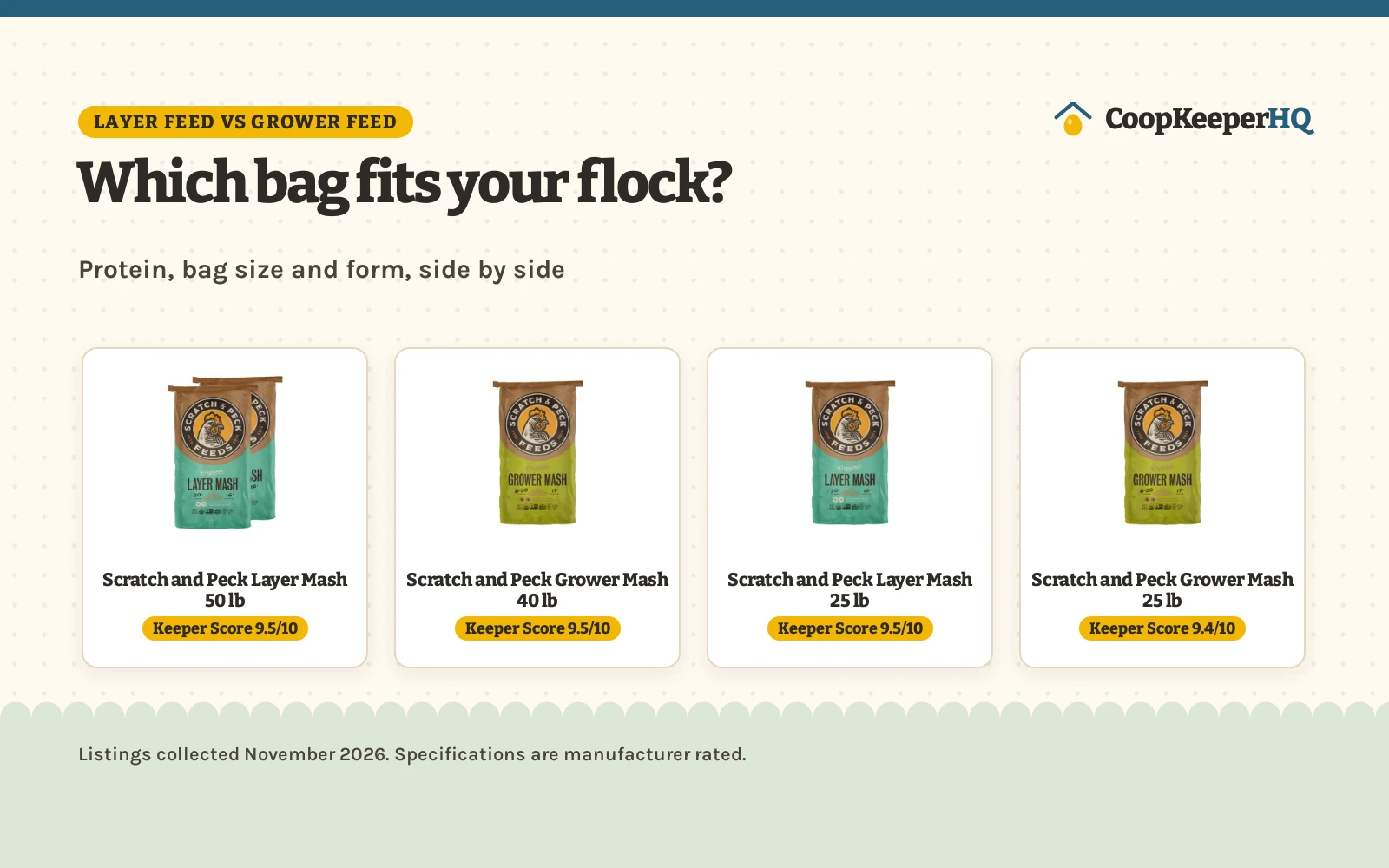
Scratch and Peck Layer Mash 50 lb
Scratch and Peck Grower Mash 40 lb
Scratch and Peck Layer Mash 25 lb
Scratch and Peck Grower Mash 25 lb
Fitting It to Your Flock
- Match the bag to the flock. A 25 lb bag suits a small flock and a short carry from the car to the coop, while a 50 lb bag suits a larger flock with dry storage for the extra feed.
- Check the feeder. Mash is a loose mix, so use a feeder that handles mash without spilling, and check the feeder before you switch from one mash to the other.
- Keep the routine. The layer mash and the grower mash both state fermentable grains, so a fermented feeding routine stays the same when you switch sides.
- Read the bag weight. All four bags state the same dimensions, so the weight on the bag is the figure that tells you how much feed you are carrying home.
FAQ for the flock
Can I feed layer feed to growing birds?
The listings sell layer mash for laying chickens and ducks and grower mash for growing chickens and ducks, so match the mash to what your flock is doing now. If your birds are in lay, the layer mash is the one sold for them; if they are still growing, the grower mash is the one sold for them.
What is the protein difference between the two sides?
The layer mash here states 16% protein and the grower mash here states 17% protein, and both figures come from the listing titles. That is the clearest stated difference between the two sides in this comparison.
Can layer feed and grower feed both be fermented?
Yes, per the listings. The layer mash and the grower mash both state fermentable whole grains, and the layer listings say to feed dry or fermented. The 40 lb grower listing states fermentable as well.
What bag sizes do these feeds come in?
The layer mash here comes in 25 lb and 50 lb bags, and the grower mash here comes in 25 lb and 40 lb bags. All four state the same dimensions, 29.0 x 15.5 x 4.0 inches, so read the bag weight when you pick a size.
Are these feeds organic?
The listings state certified organic and Non-GMO Project Verified status on all four bags. The 40 lb grower listing also states USDA Organic certification.
How the Coop Score came out
Each example is scored out of 10 on performance, build, value, safety and warranty, using only what the listing publishes. No listing states a warranty. The weights are on our How We Pick page.
| Product | Keeper Score | Perf. /35 | Build /25 | Value /25 | Safety /10 | Warranty /5 |
|---|---|---|---|---|---|---|
| Scratch and Peck Layer Mash 50 lb | 9.5 | 30 | 21 | 22 | 0 | 0 |
| Scratch and Peck Grower Mash 40 lb | 9.5 | 30 | 21 | 21 | 0 | 0 |
| Scratch and Peck Layer Mash 25 lb | 9.5 | 29 | 21 | 20 | 0 | 0 |
| Scratch and Peck Grower Mash 25 lb | 9.4 | 28 | 21 | 20 | 0 | 0 |
A product’s weighted total becomes its score on a scale capped at 9.8 and floored at 9.2, in a straight line.
Which should you choose?
Choose layer feed if your chickens or ducks are in lay and you want a mash sold for laying birds, with 16% protein stated in the title and a 25 lb or 50 lb bag.
Choose grower feed if your chickens or ducks are still growing and you want a mash sold for growing birds, with 17% protein stated in the title and a 25 lb or 40 lb bag.
How much feed your flock eats a day and a month, how long a bag lasts, and what it costs.
Wash your hands after handling birds, eggs or equipment, supervise children around the flock, and check local rules on flock size and roosters before you buy. For sick birds, call a poultry veterinarian or your state extension office. See CDC backyard poultry guidance. Read our Safety Disclaimer.
More coop guides
- Starter Feed vs Grower Feed: Which One Should You Buy?
- Chick Starter vs Layer Feed: Which One Should You Buy?
- Best Organic Layer Feed (2026): 5 Picks for Laying Hens
- Best Grower Feed for Chickens (2026): 5 Compared
- Fermented vs Dry Chicken Feed: Which One Should You Buy?
- Organic vs Conventional Chicken Feed: Which One Should You Buy?
- Duck Feed vs Chicken Feed: Which One Should You Buy?
- Best Layer Feed Pellets (2026): 5 Bags Compared
- Oyster Shell vs Layer Feed: Which One Should You Buy?
- Best Organic Chick Starter Feed (2026): 5 Picks for the Brooder
- How to Feed Oyster Shell to Chickens
- Bulk vs Bagged Chicken Feed: Which One Should You Buy?
- Best Duck Feed for Ducklings (2026): 5 Starter and Grower Picks
- Do Chicks Need Grit With Starter Feed
- How to Feed Starter to Chicks: Feed, Water and Brooder Setup
See every ducks, quail and turkeys guide.