Metal vs Wooden Chicken Nesting Box: Which One Should You Buy?
Metal vs wooden chicken nesting box: hygiene, roll-away collection, warmth and maintenance, with concrete figures from the metal listings.

On this page
Top picks at a glance
As an Amazon Associate I earn from qualifying purchases.
- 1
 Gush-Tuss Metal Front/Rear Roll Away Chicken Nesting Box9.7/10View on Amazon
- 2
 TRINFREE Wooden 4-Hole Chicken Nesting Box9.7/10View on Amazon
- 3
 TRINFREE Wooden 2-Pack Chicken Nesting Box9.6/10View on Amazon
- 4
 ZenxyHoC Chicken Nesting Box Red 3 Compartments Metal EggView on Amazon
- 5
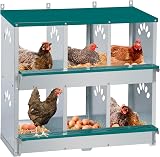 Chicken Nesting BoxView on Amazon
- 6
 Redants Chicken Nesting BoxView on Amazon
- 7
 6 Compartment Chicken Nesting Box with Elevated Metal LegsView on Amazon
- 8
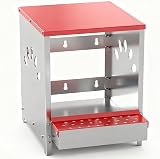 Chicken Nesting Boxes One HoleView on Amazon
- 9
 Chicken Nesting Boxes 3 HoleView on Amazon
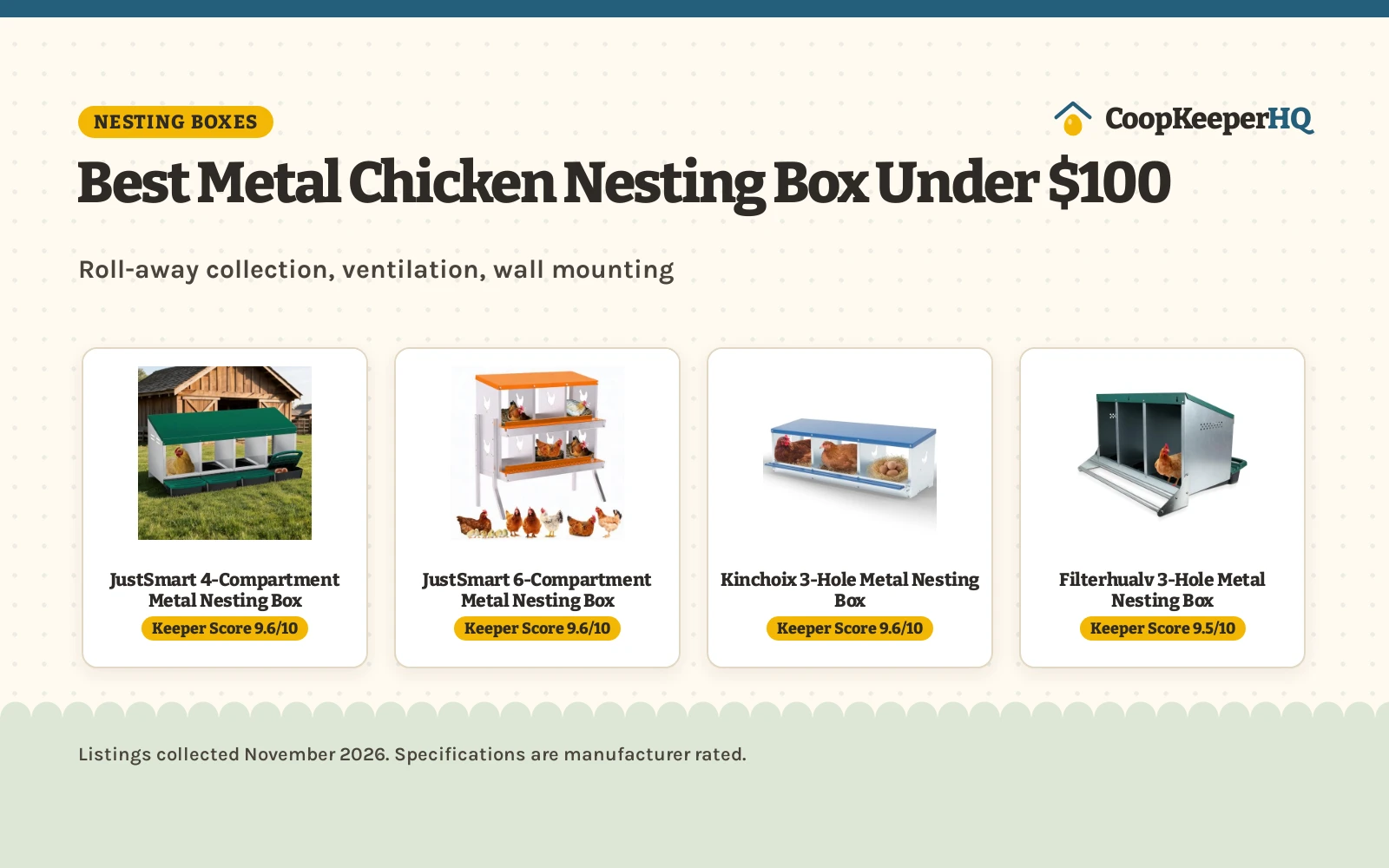
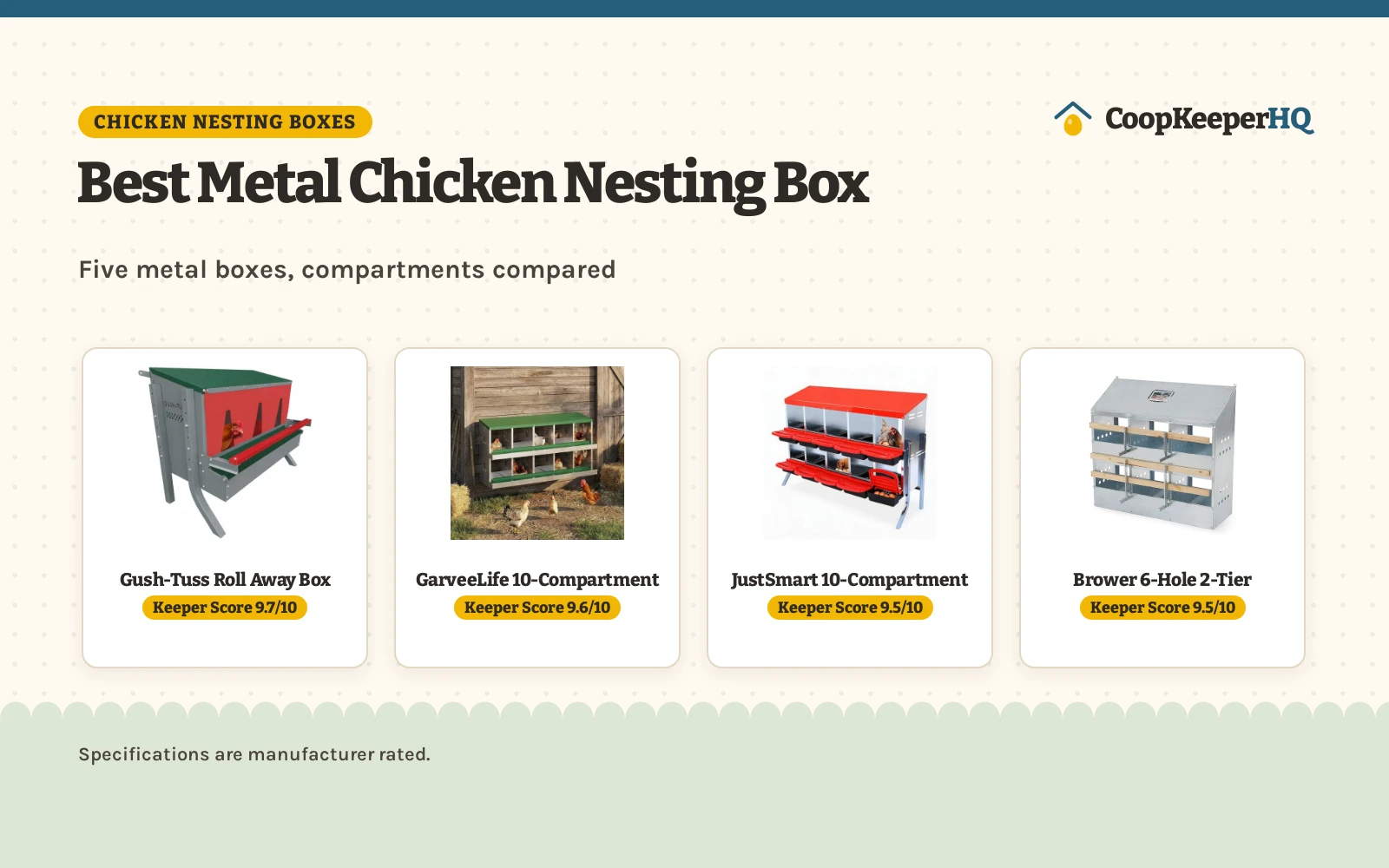
In the metal vs wooden chicken nesting box question, the answer comes down to hygiene against comfort. Metal boxes, usually galvanized steel, wipe clean, resist mites and often include roll-away egg collection; the metal listings we reviewed run from 3-hole boxes to 6-hole 2-tier units for 30-40 hens. Wooden boxes are warmer, quieter and cheaper to build, but they absorb moisture and need more maintenance. If you want low-maintenance and clean eggs, pick metal; if you want warmth and a DIY build, pick wood.
Other options for the coop
 ZenxyHoC Chicken Nesting Box Red 3 Compartments Metal EggCheck price on Amazon
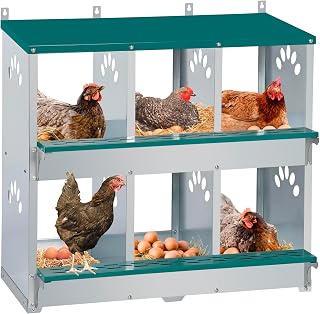 Chicken Nesting BoxCheck price on Amazon
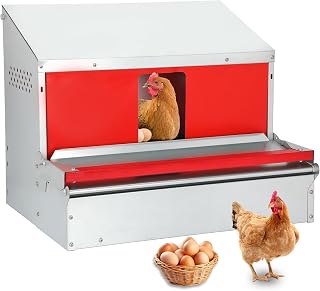 Redants Chicken Nesting BoxCheck price on Amazon
 6 Compartment Chicken Nesting Box with Elevated Metal LegsCheck price on Amazon
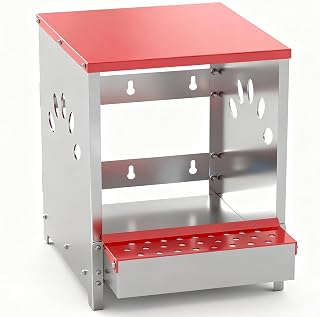 Chicken Nesting Boxes One HoleCheck price on Amazon
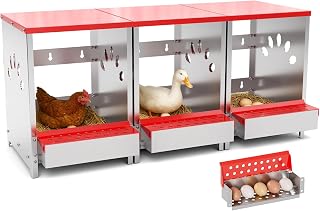 Chicken Nesting Boxes 3 HoleCheck price on Amazon
CoopKeeperHQ earns a commission if you buy through our links, at no added cost to you. Affiliate disclosure.
The difference in one paragraph
A metal nesting box is a manufactured unit: galvanized steel, often with a slanted floor that rolls eggs into a collection tray away from the hens. The metal listings we reviewed include a 3-compartment box with rollout collection, a 6-compartment wall-mountable unit, 4-hole and 2-hole boxes with reverse roll-out so eggs are collected from outside the coop, and Brower galvanized units in 4-hole (20 hen capacity) and 2-tier 6-hole (30-40 hen capacity) sizes. A wooden nesting box is usually built or bought as a simple open-front box: no moving parts, no roll-away, just a dry bedded box the hen sits in. No wooden figures appear in the listings reviewed, so the wood side is described without numbers.
Metal nesting boxes: what the listings show
Metal boxes sell on hygiene and features. The Brower 4-hole listing states removable nest bottoms for easy cleaning and litter replacement, and assembles in 30-45 minutes with a screwdriver and wrench. The ZenxyHoC 3-compartment listing describes a slanted floor that rolls eggs into a protected collection tray, with a recommendation to pad the tray. The Filterhualv 4-hole and 2-hole listings use a reverse roll-out design so eggs are collected from outside the coop, with plastic laying trays. The VEVOR 2-tier 8-compartment unit measures 30-45 in overall with each compartment 10.4 in wide, and the Redants box measures 24 in L x 19.5 in W x 20 in H. See plastic vs metal nesting boxes.
Wooden nesting boxes: what changes
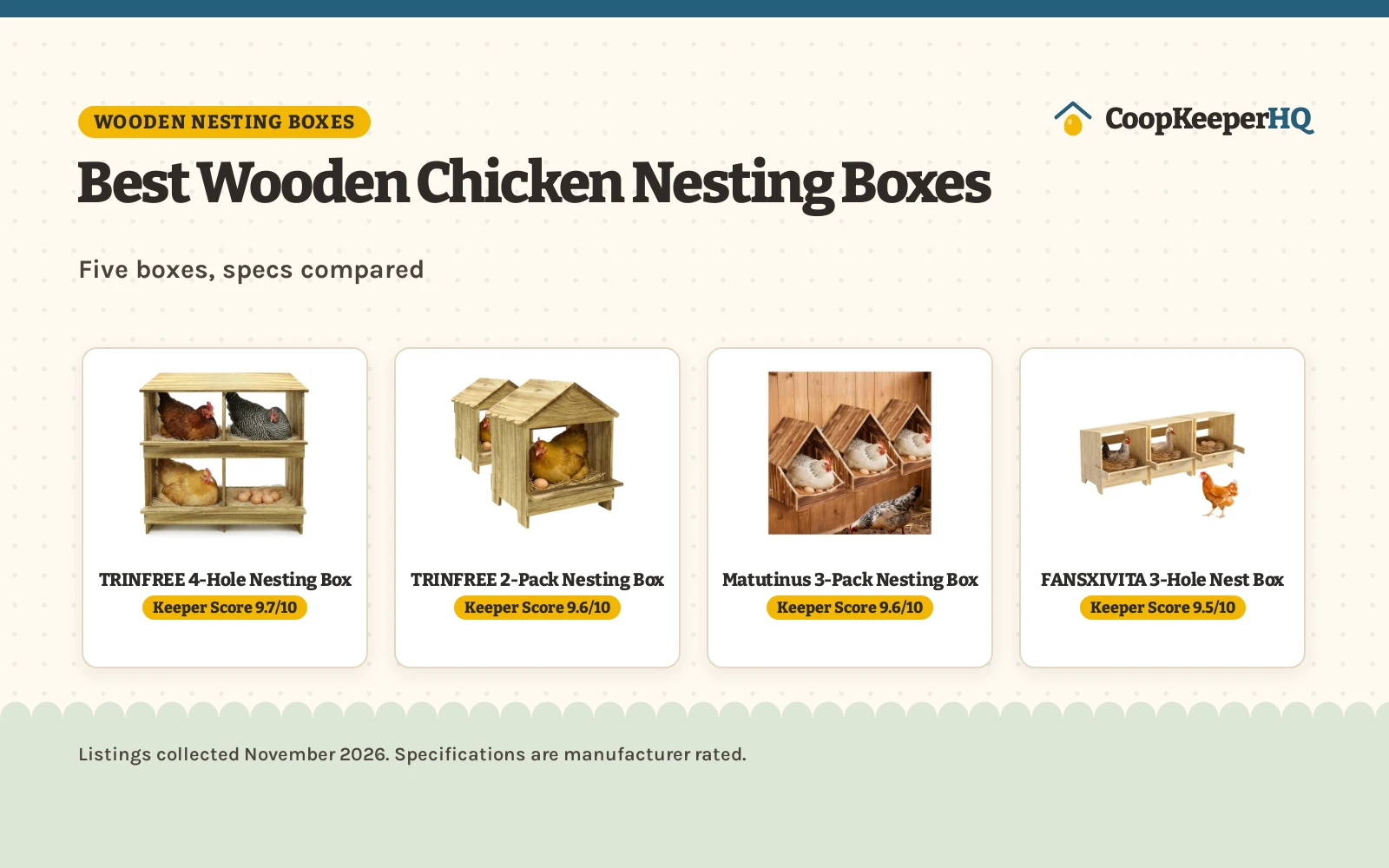
Wood is the traditional choice and it still works. A wooden box is warmer to the touch in winter, quieter when hens move around, and easy to build to any size from scrap lumber. The trade is maintenance: wood absorbs moisture and droppings, it can harbor mites in cracks, and it eventually rots or needs repainting. A wooden box has no roll-away mechanism, so eggs sit in the bedding until you collect them, which means more frequent collection if you want clean eggs.
Hygiene and cleaning
This is where metal wins on paper. Galvanized steel does not absorb moisture, and the Brower listing’s removable nest bottoms exist precisely for cleaning and litter replacement. Mites are the classic wooden-box problem: they hide in cracks and joints that a smooth metal box does not have. On the other hand, a wooden box with fresh bedding changed regularly is perfectly sanitary; the material is not destiny, the cleaning routine is. See rollaway vs standard nesting box.
Metal vs wooden chicken nesting box: which one should you buy?
Choose metal if you want roll-away egg collection, the easiest cleaning, and sizes from 2-hole boxes to 8-compartment 2-tier units for larger flocks. Choose wood if you build your own coop furniture, want the warmest box in winter, or need an odd size no manufactured unit offers. For flock size planning, see how many nesting boxes per chicken. Either way, mount the boxes lower than the roosts: hens sleep on the highest perch, and you do not want them sleeping, and droppings, in the nests.
Buying advice: size, mounting and features
Start with a tape measure, not a brand. The manufactured metal units run from compact 3-hole boxes to big 2-tier units, and the footprints differ a lot: the Brower 2-tier 6-hole measures 37 x 33 x 24.5 in, the Filterhualv 4-hole measures 42 x 25.5 x 18 in, the VEVOR 2-tier 8-compartment measures 41.7 x 20.6 x 31.4 in, and the Redants single-tier box measures 24 x 19.5 x 20 in. Check the wall or floor space in your coop against those figures before you order, and remember the box needs clearance in front for hens to enter and for you to open the collection tray.
Most of these units mount off the floor. The ZenxyHoC box has pre-drilled hanging holes for wall mounting, the Toriexon 6-compartment is described as wall mountable, and the Filterhualv boxes have hanging holes as well. Kinchoix and TOCRETOARE both recommend mounting 18-20 in off the ground, which keeps the box away from floor moisture and bedding. If you wall-mount, confirm your wall can carry the weight: the VEVOR unit lists 35.6 lb and the Redants 28.5 lb before bedding and hens.
Assembly is consistently described as simple: the Brower boxes estimate 30-45 minutes with a screwdriver and wrench, the Filterhualv boxes about 25 minutes, and every listing says hardware is included. What differs is the feature set. Roll-away collection is the headline feature on the ZenxyHoC, Filterhualv, VEVOR and Redants boxes, but note the Brower 4-hole explicitly says it is not a roll-out nest, so read the listing rather than assuming. Look for removable trays or nest bottoms (Brower, ZenxyHoC, Filterhualv, VEVOR), ventilation holes or side vents (Brower, ZenxyHoC, Toriexon, Filterhualv), and a way to keep hens from sleeping in the nests: Brower perches fold back, the ZenxyHoC swing perch doubles as a night gate, and the Redants panels lift on a lever. The Redants box adds double predator locks on the cover plate, and the Toriexon is the only listing here with a stated warranty at 2 years. Kinchoix claims its galvanized boxes last more than 8 years, a maker claim, not a warranty.
Finally, match the compartment to your birds. The Filterhualv compartments measure 9.75 x 13.5 x 14 in, the VEVOR compartments 10.4 in wide, and the Kinchoix holes 9.8 x 11.8 in. The Brower listings recommend their boxes for medium and large breeds. A box that fits your hens gets used; one that does not gets ignored, whatever the material.
Birds, breed size, run time and climate in; coop floor, run space, roost length and nesting boxes out.
Wash your hands after handling birds, eggs or equipment, supervise children around the flock, and check local rules on flock size and roosters before you buy. For sick birds, call a poultry veterinarian or your state extension office. See CDC backyard poultry guidance. Read our Safety Disclaimer.
FAQ for the flock
Are metal nesting boxes too cold for hens?
Metal conducts heat more than wood, but hens bring their own warmth and the boxes are bedded. The listings pitch metal boxes for outdoor use, including the Brower galvanized units. In very cold climates, wood has the edge on warmth.
Do roll-away boxes really keep eggs cleaner?
The mechanism is straightforward: a slanted floor rolls the egg into a covered tray away from the hen, so it is not stepped on or soiled. The ZenxyHoC and Filterhualv listings both describe this design.
How many nesting boxes do I need?
The metal listings give capacities: 20 hens for a Brower 4-hole, 30-40 hens for a Brower 2-tier 6-hole. For planning ratios, see how many nesting boxes per chicken.
Can I mount metal nesting boxes on the wall?
The Toriexon 6-compartment listing describes a wall-mountable metal box. Check the listing for mounting hardware before you buy.
Do hens prefer wood or metal?
No listing measures preference. Hens use dark, quiet, private boxes of either material; bedding and placement matter more than the wall material.
More coop guides
- Rollaway vs Standard Nesting Box: Which One Should You Buy?
- Plastic vs Metal Chicken Nesting Box: What the Listings State
- Single vs Multi-Hole Chicken Nesting Box: Which One Should You Buy?
- Best Chicken Nesting Box for Broody Hens (2026): Low, Quiet Picks
- How Many Nesting Boxes per Chicken? Sizes and Placement