Types of Wire Fence for Chicken Runs
Types of wire fence for chicken runs range from welded wire and woven chicken wire to hardware cloth and plastic mesh, and the right pick depends on whether the fence must keep birds in or predators out.

On this page
Top picks at a glance
As an Amazon Associate I earn from qualifying purchases.
- 1
 TONGMO 24 in x 100 ft Black Chicken Wire Fence9.5/10View on Amazon
- 2
 16 INx50 FT Plastic Chicken Wire Mesh Poultry9.5/10View on Amazon
A run fence has to do a plain job: keep the flock inside and keep predators outside, through wind, rain and digging paws. Types of wire fence for chicken runs differ in how the wires join, how the mesh holds its shape, and what the fence can stop, so the right pick starts with the job, not the roll.
CoopKeeperHQ earns a commission if you buy through our links, at no added cost to you. Affiliate disclosure.
Below: the main kinds of wire fence, how each kind behaves on a run, how to choose for a flock, and the rolls compared in this guide.

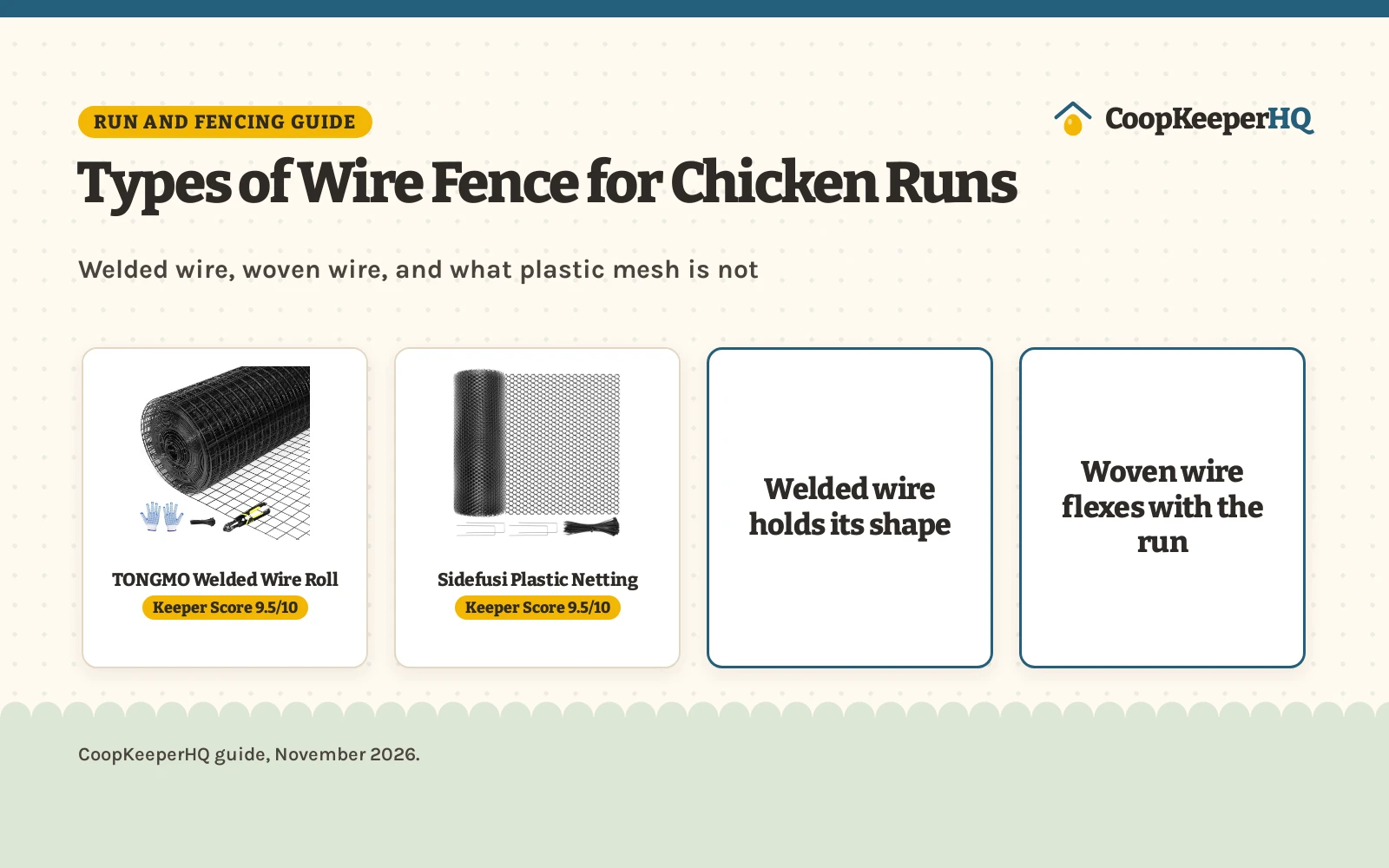
TONGMO 24 in x 100 ft Black Chicken Wire Fence
A 24 in by 100 ft roll of 19-gauge welded steel wire with 1x1 in square openings, vinyl coating, gloves and wire cutters.
Who it's for: keepers wanting a rigid welded steel barrier overhead.
Who should skip it: flocks needing wide roof coverage without fastening multiple 24-inch strips.
TONGMO titles this roll as chicken wire fence, but describes 19-gauge welded wire with 1x1-inch square openings, making it welded hardware cloth rather than twisted netting. The title states 24 in by 100 ft, while the spec table lists 24 in by 600 in. The listing names vinyl-coated steel for rust resistance, animal cages, and includes gloves and wire cutters. Underlying galvanizing is not stated.
Pros
- Stiff 19-gauge welded steel wire resists pushing and sagging
- Full 100 ft roll length provides extensive linear run coverage
- Includes a pair of protective gloves and wire cutters
- Black vinyl coating protects steel and reduces visibility
Cons
- Underlying galvanizing is not stated beneath the vinyl coating
- Narrow 24 in width requires joining multiple seams across roof spans
- No warranty term is stated
16 INx50 FT Plastic Chicken Wire Mesh Poultry
A 16 in x 50 ft roll of black plastic chicken wire mesh with ground stakes and nylon ties, lighter and rust-proof compared with metal wire.
Who it's for: a keeper who wants a light, rust-proof mesh for a low run or garden barrier.
Who should skip it: anyone who needs a tall metal fence against digging animals.
The Sidefusi roll is the only fence material in this guide: a 16 in x 50 ft roll of black plastic chicken wire mesh with ground stakes and nylon ties. The listing states it is lighter and rust-proof compared with metal chicken wire, easy to cut and install, and sized to allow ventilation while preventing predator intrusion.
Pros
- 16 in x 50 ft roll, cut to the length the run needs
- Plastic mesh, lighter and rust-proof compared with metal chicken wire
- Ground stakes and nylon ties included in the box
- Mesh sizing allows ventilation while the listing states it prevents predator intrusion
Cons
- Plastic mesh, lighter duty than metal wire
- Only 16 in tall, so it suits a low barrier rather than a tall run fence
- No warranty term stated in the listing
- No safety certification stated in the listing
Other options for the coop
 Green PVC Coated Welded Wire Fence 36" x 50' RollCheck price on Amazon
 Black PVC Coated Welded Wire Fence 36" x 25' RollCheck price on Amazon
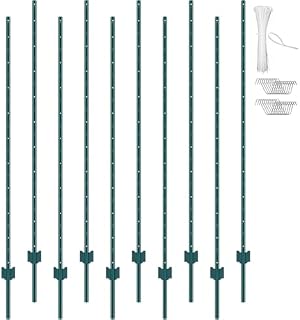 VEVOR 6 ft Fence PostCheck price on Amazon
 Metal Fence Posts Heavy Duty U-Post Stakes for Wire FencingCheck price on Amazon
 Metal Garden Fence PostsCheck price on Amazon
 Green PVC Coated Welded Wire Fence 24" x 25' RollCheck price on Amazon
Types of wire fence for chicken runs
Welded wire is wire joined at each crossing, so the mesh holds its shape under pressure and is harder to push apart than woven wire. It suits the walls of a run where strength matters, and it stays flat and square when fastened to posts. Woven chicken wire is wire twisted into a hexagonal pattern, so it flexes and bends around corners and uneven ground. It suits keeping birds inside a garden area, and it is the classic look on a coop run, but it gives way under a determined predator and it is not predator proof on its own.
Hardware cloth is a stiff welded mesh with small openings, and it is the usual pick where predators are the main worry: around the base of a run, over vents, and across any opening a small animal could slip through. It is harder to work with than woven wire, since it does not bend as easily, and it needs firm fastening at the edges so nothing can lift it. Electric netting is a different kind again: a fence that carries a charge, used as a movable barrier around a ranging area, and it needs a charger and clear ground to work. Plastic mesh in a chicken wire pattern is not wire at all. It is light garden netting for keeping birds inside a planted area, and it will not stop a predator.
| Fence type | What it is | Suits | Watch out for |
|---|---|---|---|
| Welded wire | Wire joined at each crossing | Run walls that need strength | Needs firm fastening at the edges |
| Woven chicken wire | Twisted hexagonal wire | Keeping birds inside a garden area | Not predator proof on its own |
| Hardware cloth | Stiff welded mesh, small openings | Run bases, vents and small openings | Stiff to bend and cut |
| Electric netting | Fence that carries a charge | Movable barriers for ranging birds | Needs a charger and clear ground |
| Plastic mesh | Plastic netting, not wire | Light garden fencing | Will not stop a predator |
For the strongest run walls, see the welded wire fence comparison and the predator proof fencing with hardware cloth guides, and for woven wire see the woven wire fence picks.
How to choose wire fence for a run
Start with the predators around the run. Where raccoons, foxes and dogs work at night, the fence has to be wire that holds its shape, fastened tight, with no gaps at the base. Where the job is only keeping birds out of a garden bed in daylight, a light mesh can serve, and the fence can be moved when the season changes. Match the mesh to the smallest animal that must stay out, and match the wire to the strength of the push it will meet.
Measure the run before ordering, including the gate openings and the corners, so the roll covers the whole perimeter with room to fasten the ends. Plan the posts and the fasteners with the fence, since a strong mesh on weak posts still sags, and a mesh fastened only at the top can be lifted at the bottom. Check the coating on the wire, since a coated wire resists rust in wet weather, and check the listing for the mesh, the gauge and the roll size before ordering. Our poultry netting for predators guide compares netting where predator pressure is high, and the chicken wire run picks cover runs built around chicken wire.
The gear: wire fence for chicken runs
The fence for a run has to match the mesh and the gauge to the job, and the rolls below show the opposite ends of that choice: real welded wire, and plastic mesh in a chicken wire pattern.
Birds, breed size, run time and climate in; coop floor, run space, roost length and nesting boxes out.
Use a charger rated for the length of netting you run, ground it as the manual describes and post warning signs where neighbors or children can reach the fence. Keep grass and weeds off the bottom strands, and never leave netting unpowered, because birds and wildlife can tangle in it. Read our Safety Disclaimer.
FAQ for the flock
What type of wire fence is best for a chicken run?
Welded wire or hardware cloth, fastened tight to solid posts, is the usual pick where predators work at night. Woven chicken wire keeps birds inside, but it is not predator proof on its own, so use it where the job is containment in daylight, not night protection.
Is chicken wire enough to keep predators out?
No. Chicken wire is made to keep birds in, and a determined predator can push through it or pull it apart. For predator protection, use welded wire or hardware cloth on the run walls and around the base, and fasten the edges so nothing can lift them.
What is the difference between welded wire and woven chicken wire?
Welded wire is joined at each crossing, so the mesh holds its shape under pressure. Woven chicken wire is twisted into a hexagonal pattern, so it flexes and bends around corners and uneven ground, but it gives way more easily when pushed.
Can I use plastic chicken wire mesh for a run?
Plastic mesh suits light garden fencing, where the job is keeping birds inside a planted area. It is not wire, and it will not stop a predator, so do not use it as the only fence on a run where predators work at night. The Sidefusi roll below is plastic mesh in a chicken wire pattern, sized 16 in by 50 ft.
How do I attach wire fence to a run?
Fasten the mesh to posts and rails along the whole edge, not only at the top, and close the gaps at corners and gates. Bury the bottom edge or add an apron of mesh flat on the ground outside the run, so a digging animal meets wire instead of an open edge.
More coop guides
- Best Woven Wire Fence (2026): 4 Rolls Compared
- Best Poultry Netting for Predators (2026): 4 Picks Compared
- Best Hardware Cloth for Chicken Coop Runs and Aprons
- Best Chicken Wire Wood Fence (2026)
- Best Chicken Wire Run (2026): 5 Picks for Flocks and Gardens
See the chicken runs and fencing picks and the chicken coop guides.