Chicken Wire Alternative: Which One Should You Buy?
Hardware cloth, heavy welded wire mesh, and electric poultry netting offer stronger predator protection and longer outdoor life than standard hexagonal chicken wire.

On this page
Top picks at a glance
As an Amazon Associate I earn from qualifying purchases.
- 1
 Zevemomo 36 in x 50 ft 1/4 inch PVC Coated Hardware Cloth9.7/10View on Amazon
- 2
 48in x 200ft Hardware Cloth 1/2 inch Chicken Wire Fencing9.6/10View on Amazon
- 3
 AggFencer 8inch x 25ft Hardware Cloth 1/4 inch Chicken Wire9.6/10View on Amazon
The most reliable chicken wire alternative for securing a poultry coop or run against predators is galvanized welded wire hardware cloth. While traditional hexagonal chicken wire keeps birds contained, it is too thin to stop chewing or reaching predators like raccoons, foxes, and rats. Upgrading to welded hardware cloth, heavy wire mesh, or electric poultry netting provides durable perimeter defense that keeps your flock safe.
CoopKeeperHQ earns a commission if you buy through our links, at no added cost to you. Affiliate disclosure.
Chicken wire alternative: why hardware cloth is the top choice
Backyard keepers quickly discover that standard chicken wire was designed to keep chickens inside an area, not to keep hungry predators out. Hexagonal wire netting is woven from thin wire that bends easily. For example, TOYPOPOR lists a hexagonal wire netting with a 0.6mm wire diameter, and Moyios lists a roll with that same 0.6mm wire diameter. While this wire is flexible and simple to shape by hand, adult raccoons can pull the twists apart, and dogs or coyotes can bite through the thin strands. Rats and weasels can also squeeze directly through the flexible hexagonal openings to access coop feed and eggs.
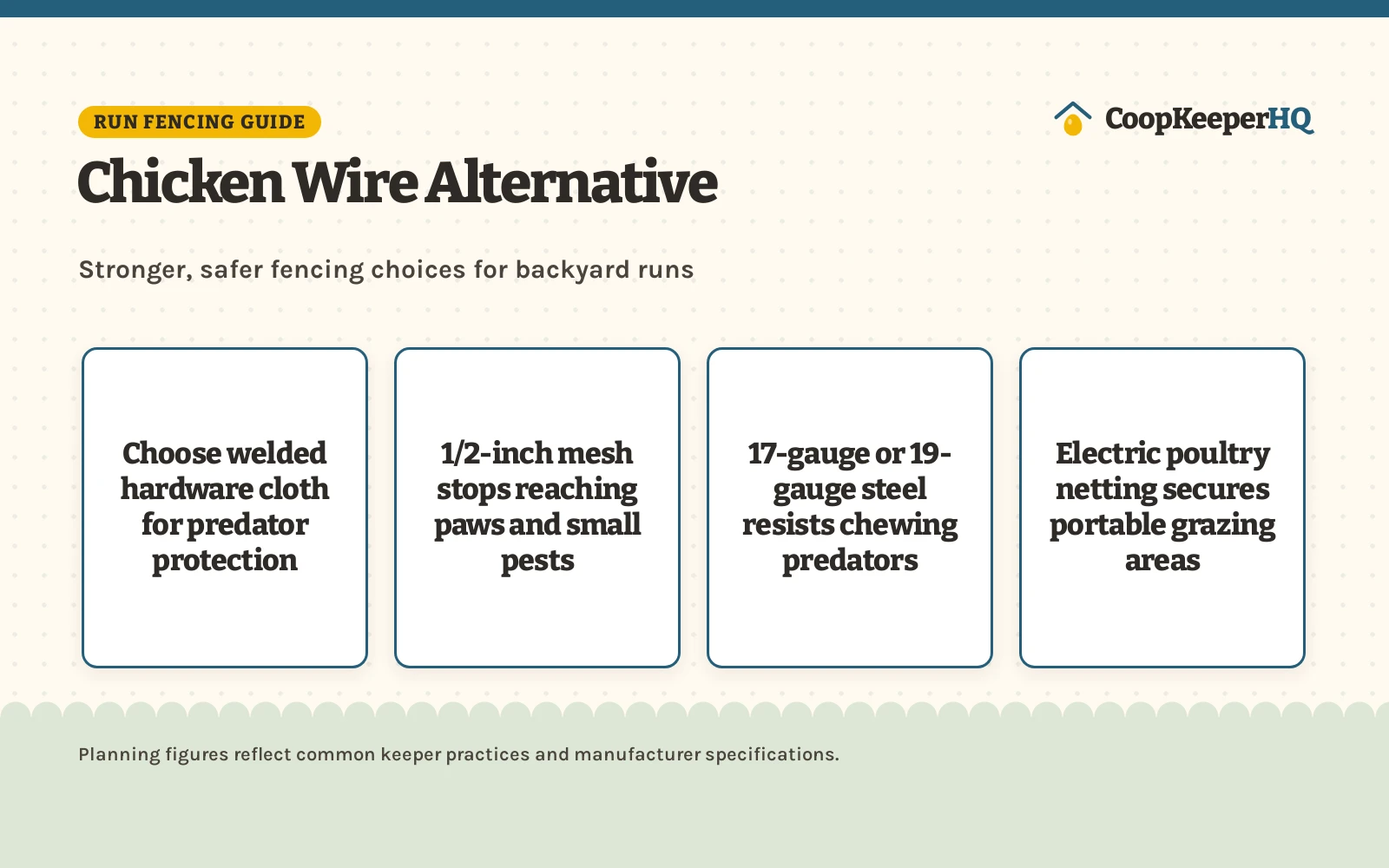
Welded wire hardware cloth solves these problems because every wire intersection is welded into a rigid grid. Instead of twisting under tension, the welded joints hold their shape against pulling paws and blunt impact. HANWRAPS lists a welded wire hardware cloth with a 1/2-inch mesh opening made from hot-dip galvanized steel, which prevents raccoons from reaching their paws through the fence. If you want a full comparison of rolls, our hardware cloth guide covers the top options for coops and run perimeters.
Choose the right mesh opening for predator protection
Hexagonal chicken wire is sold in several mesh sizes, but even smaller hexagonal weaves fail against agile predators. For instance, HOSTIC lists hexagonal wire with a 2-inch mesh opening, measuring two inches across. Gaps of two inches allow snakes, weasels, rats, and wild mice to slip straight through into the coop to steal eggs or feed. vensovo lists a hexagonal netting with a 1-inch mesh opening, and Moyios lists a roll with approximately 1 inch hexagonal openings. While a 1-inch opening prevents chickens from pushing their heads through, it still leaves enough space for reaching paws or slender snakes to penetrate.
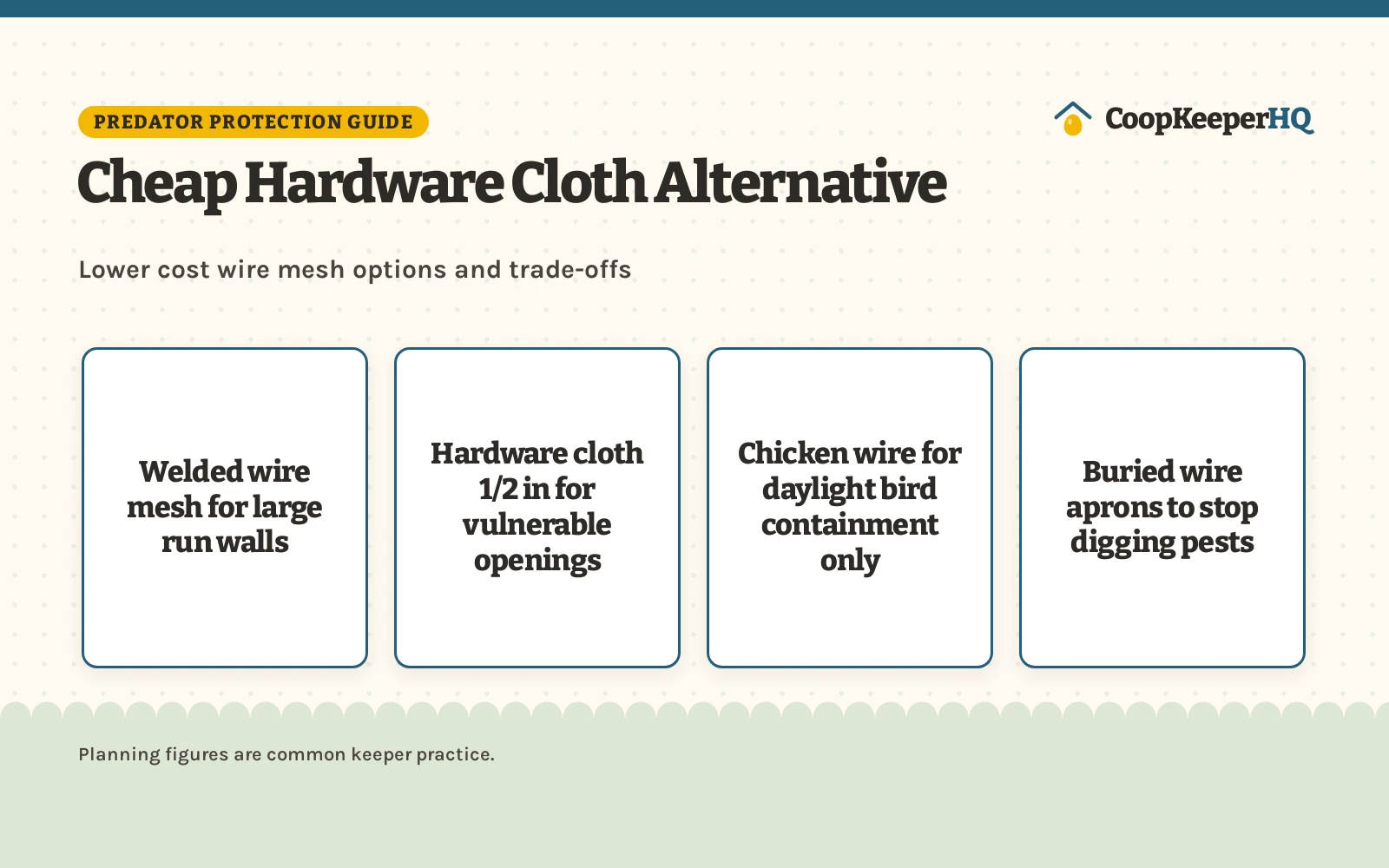
For maximum safety around the lower parts of a run and over coop windows, a 1/2-inch grid is the standard choice among experienced keepers. HORCH lists a welded wire mesh roll with a 1/2-inch opening, which blocks snakes, rats, and reaching raccoon paws. On upper run sections well above ground level and roost height, a 1-inch welded mesh offers good structural strength while saving weight. Yardbliss lists a welded wire roll with a 1-inch mesh opening in a 17-gauge thickness, which stops climbing predators from forcing their way into the run. However, anywhere chickens roost within reach of the exterior wire, a 1/2-inch mesh remains necessary to prevent raccoons from reaching inside. Our hardware cloth vs welded wire comparison details how grid spacing affects run strength.
Select heavier wire gauges and rust coatings
Wire thickness is measured by gauge or millimeter diameter, and lower gauge numbers mean thicker, stronger wire. Standard hexagonal netting uses very light wire. TOYPOPOR lists wire with a 0.6mm wire diameter, while vensovo lists a 0.5mm wire diameter. Even upgraded hexagonal wire remains relatively thin: Mklsit lists a floral chicken wire with a 0.9mm wire diameter, and HOSTIC lists a 20-gauge hexagonal wire netting that also uses a 0.9mm wire diameter. While a 0.9mm wire diameter is sturdier than a 0.5mm wire diameter, it lacks the structural stiffness needed to withstand determined predators.
Welded hardware cloth offers heavier options, such as 17-gauge wire, and welded construction prevents strands from unraveling under pressure. HORCH lists a welded wire roll made with 19-gauge steel wire, and Yardbliss lists a welded wire roll featuring 17-gauge steel. The heavier 17-gauge and 19-gauge welded steel wires resist the chewing and clawing of persistent predators far better than light hexagonal wire. Outdoor lifespan also depends heavily on corrosion protection. HANWRAPS and HORCH both list hot-dip galvanized finishes applied after welding, which seals every joint against rain and moisture. For damp soils or coastal regions, vinyl coated welded wire adds another barrier against rust. Yardbliss lists a black vinyl coating over galvanized steel wire, and Mklsit lists a green PVC coating over galvanized wire to resist corrosion from wet weather.
Electric poultry netting for pastures and large yards
When you need to enclose a large yard, mobile chicken tractor, or pasture grazing area, buying rolls of welded hardware cloth can become heavy and cumbersome. Electric poultry netting is an effective alternative for open ground. Electric netting combines flexible horizontal and vertical conductive strands supported by built-in step-in fiberglass posts. An energizer sends brief, high-voltage pulses along the strands that teach predators to keep their distance.
Electric netting is particularly effective for open pastures and large perimeters where building a framed wooden run is impractical, or in areas facing large predators like black bears that can physically crush standard fence posts. Because the fence is lightweight and portable, you can relocate it across your yard to provide fresh pasture while keeping your flock protected. Our guide to electric netting for chickens explains how to pair portable fences with suitable energizers. Keep in mind that electric netting requires regular perimeter checks to keep tall grass and weeds from grounding out the bottom strand.
Plastic poultry mesh for temporary garden barriers
Plastic poultry netting is another alternative frequently considered by backyard keepers. Plastic mesh rolls are lightweight, rustproof, and easy to cut with household scissors. However, plastic fencing should never be used as a primary predator barrier around a permanent coop or run. Rodents like rats and squirrels can gnaw through plastic mesh in minutes, and raccoons can tear it apart with their claws.
Plastic wire mesh works well for specific low-risk tasks. Keepers use plastic netting primarily as an overhead deterrent against aerial predators like hawks and owls over daytime runs. However, because climbing predators like raccoons can scale run walls and chew through lightweight plastic, overhead plastic netting is not a substitute for a solid roof or heavy wire cover on runs where birds remain unsupervised overnight. Plastic mesh also works well for keeping chickens out of garden vegetable beds during the day or dividing a flock inside an already secure, predator-proof enclosure.
Add an anti-dig predator apron
Securing the walls of your run is only half the job. Many common predators, including foxes, dogs, coyotes, and skunks, attempt to dig beneath run walls rather than climb over them. If your fence stops at ground level, a predator can dig a tunnel underneath the framing in a single night.
Installing an anti-dig apron provides reliable underground defense. Lay a strip of welded wire flat on the ground outside the run perimeter, attaching the top edge firmly to the baseboard of the run wall. Fasten the wire down with sod staples or cover it with dirt, gravel, or paving stones. When a digging animal approaches the run wall and begins scratching at the soil, its paws hit the metal wire barrier, preventing it from tunneling underneath. Our guide to building a cheap predator proof chicken run outlines step-by-step methods for building secure aprons on a budget.
Secure mesh with heavy-duty fasteners
A strong wire mesh alternative is only as secure as the fasteners holding it to your coop framing. Light desk staples or thin wire ties will pop loose when a heavy dog or raccoon throws its weight against the fence. While 24 Rifny lists a roll package that includes 100 zip ties, plastic ties become brittle in sunlight and should only be used to hold mesh in place temporarily while you drive permanent fasteners.
For wooden coop and run frames, attach hardware cloth using exterior screws paired with wide galvanized fender washers. The washer clamps a wide section of wire firmly against the wood, preventing the mesh from pulling through the screw head. Heavy galvanized U-nails or fencing staples driven deep into hardwood framing also provide strong holding power. For the cleanest installation, sandwich the mesh between your structural post and a solid wooden trim board secured with exterior screws. When cutting heavy wire, use dedicated aviation snips; our review of chicken wire cutters shows tools that handle heavy steel without dulling.
Plan roll sizes and dimensions for your build
Matching your fencing roll dimensions to your coop framework minimizes waste and cuts down on splicing seams. Manufacturers offer welded wire and poultry netting in various roll widths and lengths. For narrow runs, small enclosures, or raised garden beds, compact rolls are easy to handle. HANWRAPS lists a welded wire roll measuring 15.7 inches wide by 6 feet long, while Moyios lists a roll measuring 16 inches wide by 50 feet long. 24 Rifny lists a roll measuring 16.5 inches wide by 60 feet long, and TOYPOPOR lists a roll measuring 16 inches wide by 82 feet long.
For low coops or the critical lower sections of walk-in runs, wider rolls reduce horizontal seams. Yardbliss lists a welded wire roll measuring 36 inches wide by 100 feet long, and vensovo lists a roll measuring 36 inches wide by 150 feet long. For greater height coverage, HORCH lists a welded wire roll measuring 48 inches wide by 100 feet long, and HOSTIC lists a wire roll measuring 4 feet wide by 150 feet long. On a 48 inches wide run wall, a 48 inches wide roll spans from the baseboard to the roofline in a continuous piece, eliminating mid-wall seams where predators could attempt to pull wire loose.
A simple run fencing checklist
- Use 1/2-inch welded wire hardware cloth on coop windows, ventilation openings, and lower run walls
- Select 17-gauge or 19-gauge steel wire to prevent chewing predators from breaking strands
- Verify hot-dip galvanization or vinyl coating to protect against rust and weather
- Install an anti-dig wire apron extending along the ground outside the run perimeter
- Fasten mesh with exterior screws and wide galvanized washers rather than lightweight staples
- Cover open run tops with heavy wire or predator netting to prevent aerial attacks
For planning coop and run dimensions suited to your flock size, use our sizing tools before ordering materials.
Birds, breed size, run time and climate in; coop floor, run space, roost length and nesting boxes out.
Use a charger rated for the length of netting you run, ground it as the manual describes and post warning signs where neighbors or children can reach the fence. Keep grass and weeds off the bottom strands, and never leave netting unpowered, because birds and wildlife can tangle in it. Read our Safety Disclaimer.
FAQ for the flock
Is chicken wire predator proof?
Standard hexagonal chicken wire is not predator proof. While it keeps chickens from wandering away, raccoons can reach through the wide gaps, and dogs, coyotes, or foxes can tear through the thin wire strands. Welded wire hardware cloth is the recommended predator-proof alternative.
What is the strongest alternative to chicken wire?
The strongest alternative for backyard chicken runs is heavy-gauge welded wire hardware cloth. A 17-gauge or 19-gauge welded steel mesh with a hot-dip galvanized coating provides rigid, chew-proof defense against large and small predators alike.
What size mesh openings should you choose?
A 1/2-inch mesh opening is ideal for coop vents, windows, and lower run walls because it blocks small pests like mice, rats, and snakes while keeping raccoons from reaching inside. A 1-inch mesh opening works well for upper run walls and roofs.
How do you secure hardware cloth to a wooden frame?
Attach hardware cloth to wooden framing using exterior screws fitted with wide galvanized washers. The washers clamp the wire securely against the wood so it cannot pull loose under pressure. You can also sandwich the mesh under wooden trim boards.
Can rats and mice get through chicken wire?
Rats and wild mice easily slip through the wide hexagonal openings of standard chicken wire to consume poultry feed and contaminate coops. Upgrading to a 1/2-inch welded wire hardware cloth prevents rodents from entering.
More coop guides
- Hardware Cloth vs Welded Wire: Which One Should You Buy?
- Best Hardware Cloth for Chicken Coop Runs and Aprons
- Electric Netting for Chickens: 5 Portable Fences Compared (2026)
See the chicken runs and fencing guides and the predator protection picks.