24 vs 48 Egg Incubator: Which One Should You Buy?
A 24 vs 48 egg incubator comparison: two machines from each side compared on capacity, turning, humidity control and warranty, with a verdict for small and large hatches.


On this page
Top picks at a glance
As an Amazon Associate I earn from qualifying purchases.
- 1
 Brinsea Maxi 24 Advance Incubator with Auto9.6/10View on Amazon
- 2
 GleeGearNex Gen IV 48 Egg Fully Automatic9.6/10View on Amazon
- 3
 Sailnovo 24 Egg Incubator with 4 Modes9.5/10View on Amazon
- 4
 WONEGG 48 Egg Incubator with Automatic Egg Turning9.3/10View on Amazon
24 vs 48 egg incubator verdict: Choose a 24-egg incubator if you hatch one batch at a time from a backyard flock and want a smaller footprint with simpler setup. Choose a 48-egg incubator if you set full trays, stagger batches or hatch for a larger flock and want the extra capacity and automation.
Spring chores decide this one. The hens start laying more than the nest boxes can hold, the counter fills with collected eggs, and you have to choose between setting what you have in a small machine or waiting to fill a bigger one. This 24 vs 48 egg incubator comparison walks through two examples of each size, scored on what their listings state about capacity, turning, humidity control and warranty.
CoopKeeperHQ earns a commission if you buy through our links, at no added cost to you.
Two examples

Brinsea Maxi 24 Advance Incubator with Auto
A 24-egg incubator with a clear dome, quadrant egg inserts, automatic turning and a stated 3-year warranty, on the 24-egg side.
The Brinsea Maxi 24 Advance is the established-brand example on the 24-egg side. The listing states a clear dome, quadrant inserts holding 24 standard chicken eggs or 12 large eggs, customizable automatic turning with auto-stop, fan assisted airflow, and an external water top-up that adds water without opening the lid. The maker backs it with a 3-year limited manufacturer warranty subject to registration, the strongest stated term here.
The interface is fully digital with temperature alarms, real-time temperature in F or C, and a countdown timer to hatch day. At 4 lb and 12 x 12 x 8 inches it needs a real chunk of counter space. No egg candler and no humidity display are stated.
Pros
- States a 3-year limited manufacturer warranty, subject to registration
- Clear dome for monitoring eggs and chicks without opening the lid
- Quadrant insert system handles 24 standard chicken eggs or 12 large eggs
- Customizable automatic egg turning with auto-stop, plus external water top-up
Cons
- At 4 lb and 12 x 12 inches, it needs a real chunk of counter space
- No egg candler is stated
- No humidity display is stated, unlike the other 24-egg example
- Plastic construction with no stated insulation cover for cold rooms
GleeGearNex Gen IV 48 Egg Fully Automatic
A 48-egg incubator with sensor-based humidity control, selectable turning intervals and auto lockdown, on the 48-egg side.
The GleeGearNex Gen IV is the feature-heavy example on the 48-egg side: 48 chicken eggs or 96 quail eggs with movable dividers, sensor-based humidity control across 20 to 75 percent RH, and a 68 to 104 F temperature range. Turning intervals can be set to 60/90/120/150/210-minute, with auto lockdown for the final 3 days. A chick separator, built-in LED candler, vent switches, audible alarms and a foam insulation box are all stated.
The housing is thick, flame-retardant ABS with a locking lid, and the fan runs under 30 dB. The listing includes a 1-year limited warranty and lifetime technical support. Higher humidity needs a manual boost, and the chick separator ships flat for bending by hand.
Pros
- Holds 48 chicken eggs or 96 quail eggs, with movable spacing dividers
- Sensor-based humidity control with a stated 20 to 75 percent RH range
- Turning intervals selectable at 60/90/120/150/210-minute, with auto lockdown for the final 3 days
- Built-in LED candler, chick separator, audible alarms and a locking lid
Cons
- Presettable ranges of 68 to 104 F and 20 to 75 percent RH need the keeper to set and check them
- Humidity boost beyond 75 percent RH is manual
- Chick separator must be bent and shaped by hand before use
- 1-year warranty is shorter than the Brinsea term on the other side
Sailnovo 24 Egg Incubator with 4 Modes
A 24-egg incubator with 4 preset hatching modes, a built-in candler and memory backup after power loss, on the 24-egg side.
The Sailnovo is the beginner-friendly example on the 24-egg side: 4 smart hatching modes (3 auto presets for chicken, duck and quail plus manual), auto turning every 2 hours that stops 3 days before hatching, and a built-in egg candler. Humidity goes through external A and B ports with a vent slide, plus a humidity alarm, and a styrofoam cover is included for cold environments.
The standout is memory backup: after a power outage the incubator resumes where it left off. The base lifts out for rinsing, and the listing includes a 1-year warranty for quality issue. At 8.08 lb and 14.7 inches square it takes the most shelf space here.
Pros
- 4 hatching modes: preset for chicken, duck and quail, plus a manual mode
- Built-in egg candler for checking development without extra tools
- Memory backup resumes incubation where it left off after a power outage
- Humidity adjusted through external A and B ports, with a stated humidity alarm
Cons
- At 8.08 lb and 14.7 x 14.7 x 8.07 inches, the heaviest of the 24-egg examples
- Turning every 2 hours is the stated schedule; no selectable intervals are stated
- Styrofoam cover included for cold environments rather than built-in insulation
- 1-year warranty is shorter than the Brinsea term on the same side

WONEGG 48 Egg Incubator with Automatic Egg Turning
A 48-egg incubator with a dual air duct, chick protective wall and a stated 2-inch wall, on the 48-egg side, with no stated warranty.
The WONEGG is the least-specified example on the 48-egg side: 48 chicken eggs, digital temperature and humidity control, and a humidification system drawing water from a cup with controllable humidity. A dual circulating air duct, anti-slip mat and 2-inch protective wall are stated for chick safety, and parts can be wiped or washed after incubation.
The listing never states a warranty term, temperature range or turning intervals. At 19 x 18.25 x 7.75 inches and 11 lb it is the biggest and heaviest example here. An egg candle holder is included for observing embryos.
Pros
- Holds 48 chicken eggs for larger hatches
- Dual circulating air duct stated for even temperature and humidity
- Anti-slip mat and a 2-inch protective wall for chick safety
- Humidity system draws water from a cup with controllable, adjustable humidity
Cons
- No warranty term is stated anywhere in the listing
- Package dimensions of 19 x 18.25 x 7.75 inches and 11 lb make it the bulkiest here
- Turning intervals and temperature range are not stated
- Listing copy is marketing heavy, with few checkable figures beyond capacity
Other options for the coop
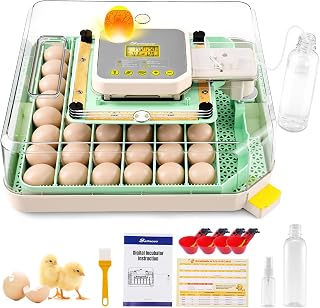 Sailnovo 48 Egg Incubator for Hatching EggsCheck price on Amazon
 48 Incubators for Hatching EggsCheck price on Amazon
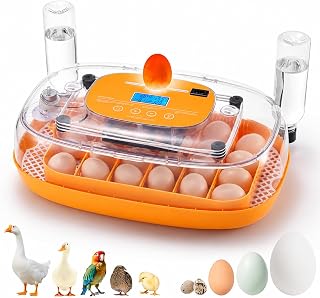 TURBRO Incubator for Hatching EggsCheck price on Amazon
 Syluris Incubators for Hatching EggsCheck price on Amazon
 Egg Incubator 48 Eggs Automatic Egg Turning ChickenCheck price on Amazon
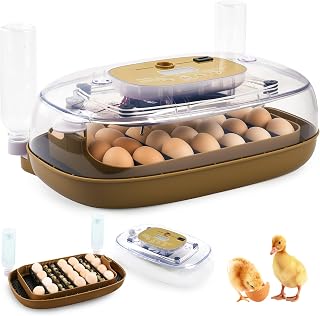 24 Eggs Incubator with Auto Water Refill & Humidity ControlCheck price on Amazon
24 vs 48 egg incubator: side by side
| Model | Keeper Score | Capacity | Turning | Humidity control | Weight | Warranty |
|---|---|---|---|---|---|---|
| Brinsea Maxi 24 Advance | 9.6/10 | 24 standard chicken eggs or 12 large eggs | Automatic, customizable, with auto-stop | External water top-up | 4 lb | 3 year limited |
| GleeGearNex Gen IV 48 | 9.6/10 | 48 chicken eggs or 96 quail eggs | 60/90/120/150/210-minute intervals, auto lockdown | Sensor-based, 20 to 75 percent RH | 4.4 lb | 1 year limited |
| Sailnovo 24-Egg Incubator | 9.5/10 | 24 eggs | Automatic every 2 hours | External A and B ports, humidity alarm | 8.08 lb | 1 year |
| WONEGG 48-Egg Incubator | 9.3/10 | 48 chicken eggs | Automatic, intervals not stated | Draws from a cup, controllable | 11 lb | Not stated |
These are common ranges across the poultry listings we read; we quote the brand’s rated specs from the product listings (as of 22 October 2026).
Capacity: what each side holds
Capacity is the one spec both sides state clearly. On the 24-egg side, the Brinsea holds 24 standard chicken eggs or 12 large eggs, and the Sailnovo holds 24 eggs. On the 48-egg side, the GleeGearNex holds 48 chicken eggs or 96 quail eggs, and the WONEGG holds 48 chicken eggs. Double the tray, double the eggs; if you hatch quail, the GleeGearNex is the only example here that states a quail capacity.
Turning and hatch automation
All four listings state automatic egg turning. The Brinsea states customizable turning with auto-stop, the Sailnovo turns every 2 hours and stops 3 days before hatching, and the GleeGearNex offers 60/90/120/150/210-minute intervals with auto lockdown for the final 3 days. The WONEGG gives no intervals. On humidity, the 24-egg examples use manual water ports while the 48-egg examples go further: sensor-based control with a pump on the GleeGearNex and a humidification cup on the WONEGG.
Size, weight and counter space
The Brinsea is 12 x 12 x 8 inches at 4 lb, and the Sailnovo is 14.7 x 14.7 x 8.07 inches at 8.08 lb. The GleeGearNex states only 4.4 lb, while the WONEGG lists package dimensions of 19 x 18.25 x 7.75 inches and 11 lb. Measure your shelf before you order.
Warranty behind each pick
The Brinsea states a 3 year limited manufacturer warranty subject to registration, the longest term here. The Sailnovo states a 1-year warranty for quality issue, and the GleeGearNex includes a 1-year limited warranty with lifetime technical support. The WONEGG states no warranty term and scores zero on that criterion.
Flock fit
Brinsea Maxi 24 Advance
GleeGearNex Gen IV 48
Sailnovo 24-Egg Incubator
WONEGG 48-Egg Incubator
Fitting It to Your Flock
- Match the tray to the laying flock: a small flock fills a 24-egg tray over a few days, while a larger flock can fill 48 before the first eggs wait too long.
- Measure the shelf first: the Sailnovo needs 14.7 inches square and the WONEGG package is 19 x 18.25 inches, so bring a tape measure before you order.
- If the power blinks in your area, the Sailnovo states memory backup that resumes where the cycle left off; none of the other three state that.
- For mixed poultry in one run, the GleeGearNex states movable dividers and holds 48 chicken eggs or 96 quail eggs.
FAQ for the flock
How many eggs should my first incubator hold?
Start from your laying flock. A small flock fills a 24-egg tray in a reasonable window, while a bigger flock can fill 48. Both sizes here state automatic turning, so the choice is about batch size, not features.
Do I need automatic egg turning?
All four examples here state automatic turning: customizable with auto-stop on the Brinsea, every 2 hours on the Sailnovo, and selectable intervals plus auto lockdown on the GleeGearNex. Manual turning is not stated as an option on any of them.
Can one incubator hatch chicken, duck and quail eggs?
All four state multi-species support: 4 preset modes on the Sailnovo, quadrant inserts on the Brinsea, movable dividers on the GleeGearNex, and chicken, ducks, goose and quail in the WONEGG title. Check the stated capacity for each species before you plan a mixed hatch.
How do I keep humidity steady through the hatch?
Follow the listing’s stated system: external top-up on the Brinsea, A and B ports on the Sailnovo, sensor-based control with a 20 to 75 percent RH range on the GleeGearNex, and a humidification cup on the WONEGG. Keep the lid closed and the vents as the listing describes.
How the Coop Score came out
Each example is scored on performance, build, value, safety and warranty, using only what the listing publishes. The weights are on the How We Pick page, linked in the site header.
| Product | Keeper Score | Perf. /35 | Build /25 | Value /25 | Safety /10 | Warranty /5 |
|---|---|---|---|---|---|---|
| Brinsea Maxi 24 Advance | 9.6 | 30 | 21 | 20 | 4 | 3 |
| GleeGearNex Gen IV 48 | 9.6 | 29 | 20 | 20 | 5 | 2 |
| Sailnovo 24-Egg Incubator | 9.5 | 27 | 19 | 20 | 3 | 2 |
| WONEGG 48-Egg Incubator | 9.3 | 24 | 18 | 19 | 3 | 0 |
A product’s weighted total becomes its score on a scale capped at 9.8 and floored at 9.2, in a straight line.
Which should you choose?
Choose a 24-egg incubator if you hatch one batch at a time from a backyard flock and want a smaller footprint with simpler setup.
Choose a 48-egg incubator if you set full trays or stagger batches and want movable dividers, selectable turning and automated humidity control.
Pick a species and a set date for candling days, lockdown and hatch day, with a calendar file to save.
Run the incubator for a day before you set eggs to confirm temperature and humidity, keep it away from direct sun and drafts, and plug it into a protected outlet. Plan the brooder before hatch day. Wash your hands after handling eggs and chicks. See CDC backyard poultry guidance. Read our Safety Disclaimer.
More coop guides
- Best Incubator for 24 Eggs (2026): 5 Picks
- Best Incubator for 48 Eggs (2026): 5 Compared
- 12 vs 24 Egg Incubator: Which One Should You Buy?
- Small vs Large Egg Incubator: Which One Should You Buy?
- Incubator vs Brooder: Which One Should You Buy?
- Chicken Egg Incubation Chart: Day-by-Day Stages and Guide
- Best Incubator for Chicken Eggs: Hatch Picks by Size
- Best Incubator for Cold Climates (2026): 4 Compared
See every incubators and hatching guide, and the brooders hub for what comes after the hatch.