Cheap Hardware Cloth Alternative: Which One Should You Buy?
Compare welded wire fencing, poultry netting, and plastic mesh options to build a predator-safe chicken run on a lower budget.

On this page
Top picks at a glance
As an Amazon Associate I earn from qualifying purchases.
- 1
 TUOKS Black PVC Coated Hardware Cloth9.8/10View on Amazon
- 2
 TUOKS Hot-Dip Galvanized Hardware Cloth9.8/10View on Amazon
- 3
 Hardware Cloth 1/2 inch Mesh 72" x 50' 19 Gauge Chicken Wire9.7/10View on Amazon
When you head out at dusk to lock the coop, you want to know that the wire surrounding your flock will hold against hungry visitors before morning. Hardware cloth is the standard wire mesh that backyard keepers rely on for dependable predator protection, but wrapping an entire walk-in run gets expensive quickly. If you need a cheap hardware cloth alternative, the practical solution is not abandoning heavy wire entirely, but using budget fencing higher up on walls and roofs while keeping sturdy wire along the lower perimeter and coop openings.
CoopKeeperHQ earns a commission if you buy through our links, at no added cost to you. Affiliate disclosure.
Cheap hardware cloth alternative: where you can save and where you cannot
Every keeper building a run faces the cost of wire. Hardware cloth 1/2 in mesh provides dependable protection against raccoons, foxes, weasels, and adult rats, while preventing reach-in attacks. However, buying enough rolls to cover tall walls and roof trusses can quickly strain a homestead budget. Finding a cheap hardware cloth alternative requires separating high-risk areas from low-risk areas rather than buying weak wire for the entire build.
Ground-level openings, ventilation windows, and pop doors are high-risk zones where predators concentrate their efforts. Swapping out wire in those vulnerable spots invites trouble, because raccoons easily reach through wide gaps and rodents squeeze into feed bins. On the other hand, the upper sections of tall walls and fully covered run ceilings do not face the same direct gnawing or prying pressure. For an in-depth breakdown of wire types, our hardware cloth vs welded wire comparison details how different mesh openings hold up.
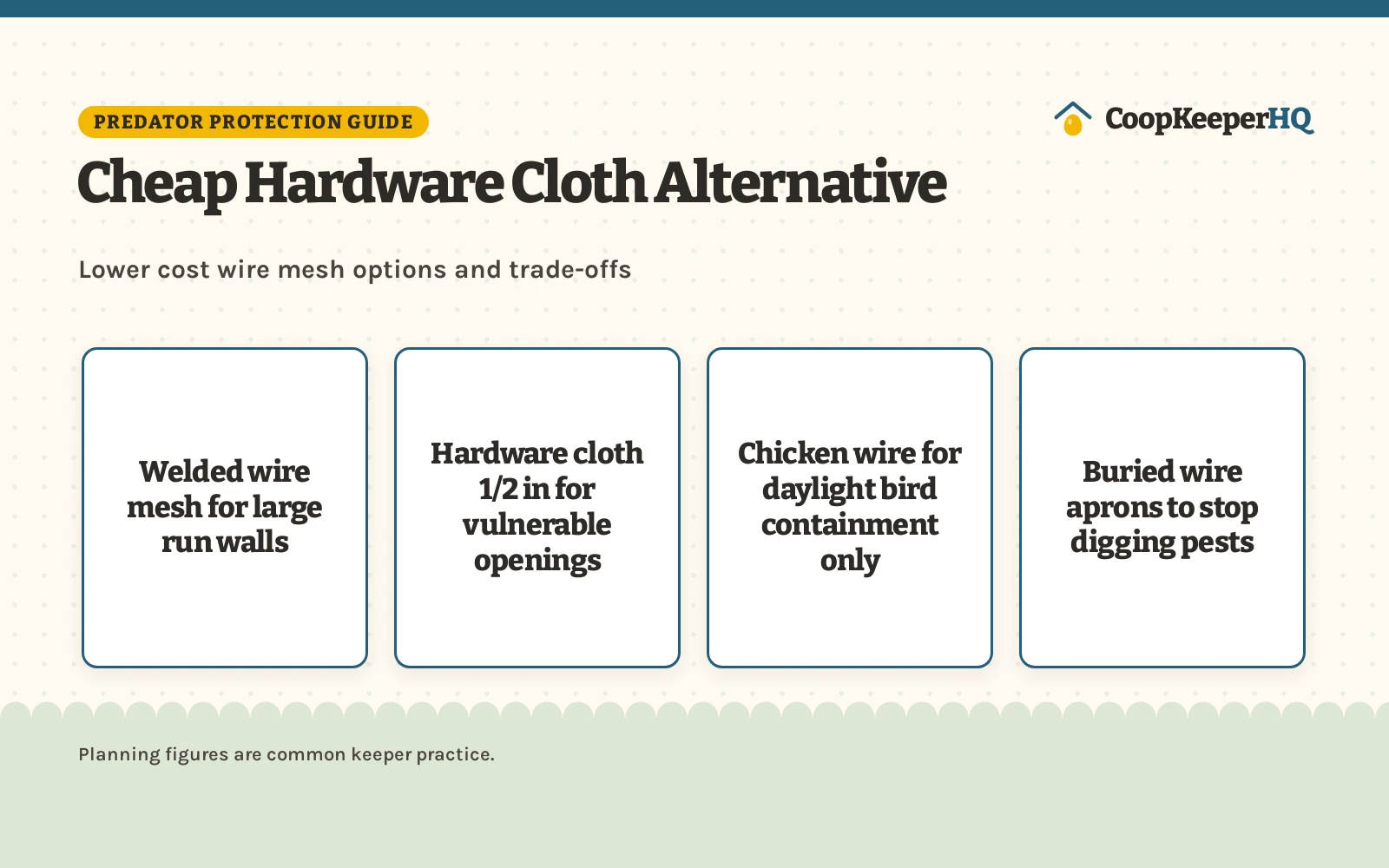
Welded wire fencing for large run walls
Welded utility wire fencing is the most common and effective alternative for fencing large outdoor enclosures. Made from galvanized steel with welded joints, this fencing comes in rectangular or square patterns that provide substantial physical strength. It stops heavy digging and climbing predators such as dogs, coyotes, and foxes from pushing into the run.
Because welded utility fencing uses less steel per square foot than dense mesh, purchasing a 100 ft roll costs significantly less than an equivalent length of tightly woven wire. This makes it an attractive choice when enclosing a spacious run where birds spend their daylight hours. The main compromise is opening size: while dogs cannot break welded steel strands, raccoons can reach their paws through wider openings to grab curious birds standing near the fence at ground level, and small rats can slip right inside. For that reason, keepers install dense hardware cloth along the lower perimeter and use wider welded wire on upper walls and framing.
Why chicken wire is not a full predator barrier
Hexagonal poultry netting, commonly known as chicken wire, is often the first material beginners look at because of its low upfront price. While chicken wire is inexpensive and flexible, it was designed specifically to keep chickens in, not to keep hungry predators out. The thin, twisted wire strands lack the tensile strength needed to withstand determined attacks.
Raccoons, neighborhood dogs, coyotes, and foxes can bend, stretch, and tear light hexagonal wire with their teeth and claws. Over time, outdoor weathering weakens the twist joints, creating gaps that weasels and rats navigate with ease. Chicken wire has a sensible place on the homestead as an overhead run cover to deter hawks and owls, or as an interior divider to separate growing pullets, but it should never serve as primary perimeter defense. Our guide on chicken wire for predators highlights where poultry netting works and where it fails, while our overview of chicken wire alternative materials explores sturdier boundary fencing.
The limits of plastic hardware cloth and netting
Hardware cloth plastic rolls have gained attention among backyard keepers looking for a lightweight, rust-free material that is easy to cut and hang. Plastic mesh will not rust in damp coastal air or soil contact, and handling it leaves far fewer scratched knuckles than working with galvanized steel. For temporary setups, seasonal shade cloth backing, or keeping wild songbirds out of feed hoppers, plastic mesh performs smoothly.
As a perimeter barrier, however, plastic netting has severe shortcomings. Rodents, rats, squirrels, and raccoons can chew through plastic strands in moments. Once a single strand is gnawed through, the entire structural integrity unravels rapidly under claw pressure. Standard plastic mesh also degrades under continuous sunlight over several seasons, becoming brittle and prone to snapping. If you choose plastic netting to cut costs, reserve it strictly for interior pen partitions, garden protection, or aerial covers where teeth and claws cannot reach.
Chain link panels as a durable alternative
Chain link fencing panels, often repurposed from dog runs or residential yard boundaries, offer another sturdy route for homesteaders on a budget. Finding used chain link panels on local classifieds can yield heavy-duty galvanized steel framing at a fraction of retail wire costs. The thick steel links stop large dogs and coyotes from pushing through or collapsing the fence line.
The drawback of chain link lies entirely in its diamond openings. The gaps are spacious enough for raccoons to reach their arms through and snatch passing birds, and weasels, rats, and snakes move through them without hesitation. If you use chain link as your run perimeter, pair it with a lower band of smaller mesh around the base. This gives you the rigid structural support of steel chain link while sealing off entry for smaller pests.
Use a layered approach to cut project costs
The most reliable strategy for building an affordable, secure run is a hybrid layout. Instead of covering an entire structure in dense mesh, experienced keepers concentrate heavy-duty hardware cloth 1/2 in wire along the bottom 3 ft of the run walls. This lower band stops raccoons from reaching inside and prevents rodents and weasels from slipping through near the ground.
Above that lower band, you can transition to cheaper welded wire fencing up to 6 ft on the run walls, or even across the roof structure. Because predators rarely make sustained clawing or chewing attacks high above the ground, wider welded wire saves significant money without compromising bird safety. For complete run planning, our guide to building a cheap predator proof chicken run explains how to combine materials for maximum protection at minimum expense.
Protect vulnerable coop openings first
While you can economize on large run walls, you should never substitute cheap materials on the coop itself. The coop is where your flock sleeps, defenseless in the dark. Ventilation windows, soffit gaps, clean-out doors, and pop door entries require hardware cloth 1/2 in mesh without exception.
Raccoons use their dexterous paws to pry open loose wire corners, and weasels can squeeze through openings surprisingly small. Fasten wire securely over every window and vent using mechanical fasteners rather than light staples that can pull free under pressure. Investing in small rolls of heavy wire for these critical coop openings protects your birds when they are most vulnerable, allowing you to use budget fencing for the spacious daytime run. Explore our predator protection section for additional tips on fortifying coop weak points.
Install a buried wire apron to stop diggers
Digging predators like foxes, coyotes, dogs, and skunks quickly locate the perimeter of an outdoor run. If your fencing stops right at the surface of the soil, animals will dig beneath the bottom rail in a single night. Digging a deep vertical trench around a large run is exhausting work, especially in rocky or root-filled soil.
An outward wire apron solves this problem while keeping labor and material expenses low. Lay a roll of hardware cloth 3 ft wide flat along the ground outside the run perimeter, either shallowly buried under the turf or pinned flat against the soil with landscape staples. Grass grows through the mesh within weeks, concealing it completely. When a predator approaches the fence and attempts to dig at the base, its claws hit the horizontal wire apron, halting the digging attempt immediately.
Fasteners and framing on a budget
Even the strongest wire mesh fails if it is attached with weak fasteners. Light staples from a hand staple gun pull out easily when a heavy dog or raccoon throws its weight against the fence. Spending money on wire only to have it ripped away from the wooden posts is a painful waste of resources.
To fasten wire securely on a budget, use exterior wood screws paired with galvanized fender washers. The wide washer clamps the wire strands tightly against the wooden framing, distributing tension across multiple joints. Heavy galvanized poultry staples driven deep with a hammer also provide lasting holding power. Sturdy framing built from sound lumber ensures your fencing stays taut and secure across changing seasons.
A practical run fencing checklist
- Hardware cloth 1/2 in mesh seals all coop windows, vents, and pop doors
- Lower run walls up to 3 ft use dense wire mesh to prevent reach-in attacks
- Upper run walls and overhead trusses use welded utility wire to reduce costs
- An outward wire apron extends along the perimeter ground to prevent digging
- Wire is secured with screws and washers or heavy fence staples rather than light hand-tacker staples
- Gates and pop doors feature positive-locking latches that raccoons cannot open
For more details on selecting quality wire mesh for your setup, consult our comprehensive hardware cloth guide.
Birds, breed size, run time and climate in; coop floor, run space, roost length and nesting boxes out.
Wash your hands after handling birds, eggs or equipment, supervise children around the flock, and check local rules on flock size and roosters before you buy. For sick birds, call a poultry veterinarian or your state extension office. See CDC backyard poultry guidance. Read our Safety Disclaimer.
FAQ for the flock
What size hardware cloth to keep rats out?
Hardware cloth 1/2 in mesh is the standard size used to keep adult rats out of chicken coops and feed storage bins. Rats can squeeze through surprisingly narrow openings, so larger utility fencing or standard chicken wire allows them easy access. Sealing gaps with tight wire mesh and securing feed containers prevents rodent infestations before they start.
What size hardware cloth for quail floor?
Hardware cloth 1/2 in mesh is widely used for adult coturnix quail cage floors because it allows droppings to fall through cleanly while supporting the birds’ feet. For younger quail chicks, tender feet can slip or get injured on open mesh, so solid flooring lined with textured shelf liner or paper towel is recommended until they grow larger.
Will hardware cloth keep raccoons out?
Hardware cloth 1/2 in mesh successfully keeps raccoons out when it is properly fastened to sturdy framing. Raccoons are notorious for reaching through wider wire openings to grab birds, or prying loose wire corners with their hands. Using tight wire mesh fastened with heavy screws and washers stops them from reaching through or tearing the barrier open.
What is the cheapest alternative to hardware cloth for an outdoor run?
Welded utility wire fencing is generally the cheapest practical alternative for large outdoor runs. It provides the steel strength needed to resist dogs and coyotes at a fraction of the cost per foot. To maintain safety against smaller predators, keepers pair it with hardware cloth along the bottom perimeter and coop openings.
Can plastic hardware cloth keep predators out of a chicken coop?
Plastic hardware cloth cannot reliably keep predators out of a chicken coop. Rodents, rats, raccoons, and foxes can chew or tear through plastic mesh with little effort. Plastic netting is suitable for aerial hawk deterrents, seasonal garden covers, or internal flock dividers, but outdoor perimeter security requires galvanized steel wire.
More coop guides
- Best Hardware Cloth (2026): Welded Wire Rolls for Predator Protection
- Best Chicken Wire for Predators (2026): 5 Wire Rolls Compared
- Cheap Predator Proof Chicken Run: 5 Budget Backyard Picks (2026)
See the predator protection picks and the chicken runs and fencing guides.