Chicken Coop Latches Types: Predator-Proof Hardware Guide
A guide to barrel bolts, swivel safety hasps, gravity levers and spring latches for keeping predators out of your backyard chicken coop.

On this page
Top picks at a glance
As an Amazon Associate I earn from qualifying purchases.
- 1
 BTEOBFY Shed Door Latch T-Handle Lock Kit with 5 Keys for9.6/10View on Amazon
- 2
 Oacdiel Shed Door Latch T-Handle Lock Kit with 4 Keys for9.5/10View on Amazon
- 3
 Alise Flip Latch Gate Latch 2 Pack Stainless Steel Door Lock9.5/10View on Amazon
Common chicken coop latches types include slide barrel bolts, spring-loaded latch pins, swivel staple safety hasps, gravity levers, toggle clamps and locking exterior handles. Keeping a flock secure against predators requires hardware that resists dexterity from raccoons and force from dogs or coyotes. Choosing hardware with a dual-action mechanism or adding a padlock provides reliable protection for exterior coop doors, nesting box lids and run gates.
CoopKeeperHQ earns a commission if you buy through our links, at no added cost to you. Affiliate disclosure.
Chicken coop latches types: hardware choices for predator security
Backyard flocks face threats from raccoons, opossums, foxes, coyotes and neighborhood dogs. Among common predators, raccoons present the most serious mechanical challenge for coop builders. Raccoons possess dexterous front paws capable of exploring gaps, lifting simple latches, pulling slide bolts and untying wire ties. Standard hardware that keeps a door closed against the wind often proves completely inadequate against a determined predator. Building the safest chicken coop for backyard birds requires choosing latches engineered around predator behavior.
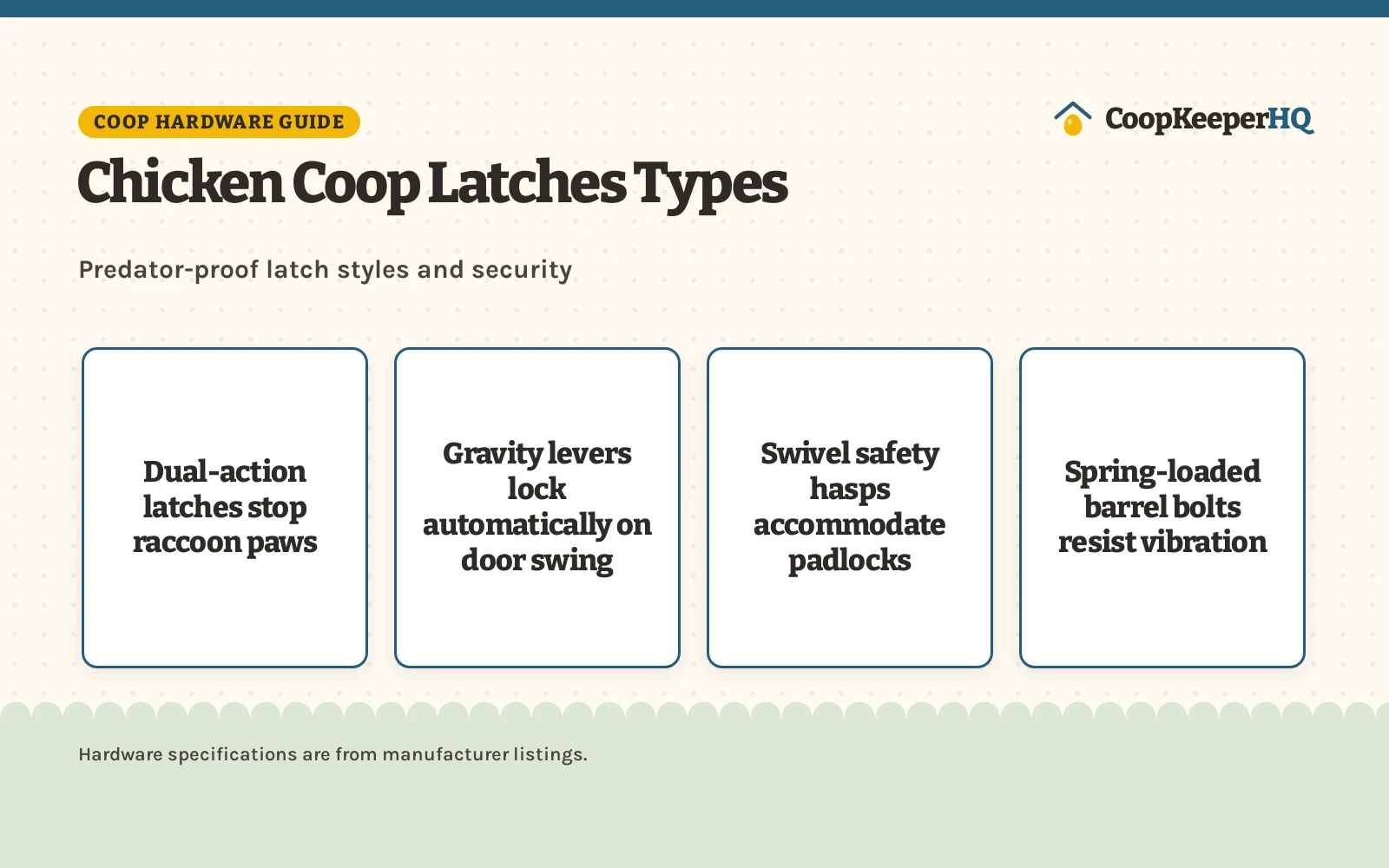
In backyard coop security, simple single-motion fasteners present significant risks. Latches that open with a single motion are often breached by dexterous predators. Effective predator-proof hardware requires complex motion or secondary locking, such as pulling a spring pin against internal tension, using over-center toggle leverage, or inserting a secondary locking pin or padlock through the assembly. Reviewing our guide to locks for chicken coops helps keepers identify hardware designs that incorporate these safeguards.
Slide bolts and spring-loaded barrel pins
Straight slide barrel bolts remain common on farm outbuildings, but basic models pose serious risks on chicken coops. A standard slide bolt without a locking feature can easily be jiggled open by animal claws or shaken loose as birds bump against the door. To secure a coop door with a slide bolt, keepers should select hardware that incorporates a locking hole for a secondary pin or padlock. For example, LUDACOO lists a slide bolt gate latch with a padlock hole and 1.5-inch (38 mm) mounting screws for wood doors.
Spring-loaded latch pins offer enhanced security compared to loose manual barrel bolts. An internal coil spring maintains constant pressure on the bolt pin, keeping the shaft firmly seated in the strike plate even during heavy vibration. The listing for JQK specifies a spring-loaded latch pin made from 304 stainless steel with a thickened 2 mm door plate, a 5-inch overall length and a 10 mm diameter solid bolt that operates in 4 directions. Pulling the pin back against internal spring resistance creates the dual-action resistance needed to stop predators from simply sliding a bolt open. While spring pins resist vibration and casual manipulation, keepers using them on exterior coop doors often pair them with a secondary hasp and padlock for complete nocturnal security.
Swivel staple safety hasps
Hinged hasps are popular for coop human doors and exterior nesting box lids. However, a plain utility hasp that simply folds over an open staple allows raccoons to flip the strap open with their claws. A swivel staple safety hasp adds a rotatable knob mounted directly on the staple. Once the hinged leaf folds over the staple, turning the knob across the slot keeps the latch from falling open.
SANKINS lists a 4.5-inch swivel staple safety hasp made with 1/16-inch plate thickness, a 4-3/8-inch hasp piece, a 9/16-inch lock base, and a 300-degree swing suitable for 90-degree or 180-degree installations. While the swivel knob keeps the door closed during daytime routines without a padlock, dexterous predators can manipulate unpinned knobs. The integrated padlock eye allows keepers to insert a carabiner or padlock through the staple at night, ensuring dependable predator protection after dusk.
Gravity levers and self-closing latches
Gravity gate latches are standard hardware on walk-in runs and poultry pens. As the gate swings closed, the striker bar trips a weighted lever that drops down behind it under its own gravity. HILLMASTER lists a carbon steel gravity latch measuring 4.7 by 1.5 inches with a weight of 0.75 pound and 1.26-inch screws, featuring a fingertip release lever and a steel spring cable pull. For smaller doors and wooden windows, self-closing latches can also use a spring mechanism rather than gravity; the maker INIRET lists an aluminum alloy spring bolt latch with a length of 2.31 inch and a width of 1.70 inch, specifying a 5 to 10 mm gap between the lock body and seat so the retractable bolt slides smoothly into the catch.
Automatic latches keep birds from slipping out when keepers enter with feed, but unmodified gravity levers can be lifted by clever predators. The HILLMASTER latch (on Amazon) includes a hole for an ordinary padlock, which blocks the lever from pivoting upward when locked. Adding a padlock or spring clip through the locking hole prevents predators from tripping the lever or pulling the release cable. Mounting hardware as a top of door latch also keeps the fastener positioned high on the frame, preventing large animals from forcing the top corner of the gate open.
Keyed locking handles for walk-in coops
Walk-in coops and full-size shed conversions benefit from keyed handle hardware. Exterior T-handles or L-handles incorporate an internal key cylinder that locks the spindle, preventing the exterior handle from turning. Hurrikom lists a locking handle kit with a 5-1/2-inch stem suited for door thickness of 3-1/2 inches or less, providing 5 keys and requiring a 3/8-inch drill bit for installation.
Keyed handles prevent raccoons from manipulating external levers because the exterior handle will not rotate without the key. Quality shed handle kits include an interior safety release handle, ensuring that keepers can open the door from inside the coop if it swings shut behind them. Keyed handles work best on rigid, framed doors that remain plumb throughout seasonal weather shifts.
Adjustable toggle clamps for nesting boxes and clean-out doors
Exterior access doors on nesting boxes and removable clean-out trays require hardware that pulls panels tightly against the coop frame. Loose gaps around nesting box lids invite predators to wedge their claws into openings and pry panels loose. Adjustable pull-action toggle clamps provide high clamping force and positive latching for these horizontal and vertical seams.
Vicuna R lists a toggle latch clamp model 4001 with a 330-pound holding capacity and an adjustable lock-up range from 3-1/2 to 4-1/8 inches. The over-center locking linkage locks down firmly when pressed, resisting outward leverage from raccoons attempting to lift lids. Keepers can adjust the threaded hook to maintain tight weather seals as wood panels swell in damp weather or shrink in summer heat.
Two-way latches for pasture and run gates
Large poultry runs, rotational pastures and perimeter fences frequently use round metal tube gates. Standard wire hooks or loose chains on pasture gates leave dangerous play that dogs and coyotes can exploit. Heavy-duty two-way gate latches allow round pipe gates to swing freely in both directions while latching securely into a central receiver.
Makers size these latches around specific pipe diameters and post spacings. MustGood lists a heavy-duty two-way farm gate latch designed for 1.62 to 2 inch round tube gates that requires 3 to 4 inches of clearance between post and gate. For installations needing integrated locking options, KINJOUZ specifies a two-way metal tube gate latch fitting 1-5/8 to 2 inch pipe that needs 2 to 2-3/4 inches of post clearance, featuring a quick thumb release and a 3/8-inch padlock slot. Adding a padlock through the slot on compatible models secures perimeter runs against predators on a cheap predator proof chicken run.
Predator dexterity and common hardware failures
Understanding predator behavior reveals why ordinary barn hardware fails on chicken coops. Raccoons possess remarkable problem-solving skills and hand-like paws. Experienced keepers know that raccoons easily lift simple hook-and-eye latches, slide horizontal bolts that lack retention springs, and loosen wing nuts or unpinned twist catches. Magnetic cabinet catches and light friction catches provide very little resistance against an animal pulling with body weight.
Larger predators such as coyotes, foxes and stray dogs rely on brute force, biting and clawing. If a coop door flexes when pulled, large predators will tear at the corners until screws pull loose. Securing the door frame with sturdy wire mesh is equally critical; our guides on what is hardware cloth and the best hardware cloth for chicken coop perimeter installations explain how heavy wire prevents predators from reaching through gaps to unhook internal latches.
Secondary locks, clips and automated door security
Relying on an isolated, unpinned latch on an exterior coop door creates a vulnerable point of failure. Experienced poultry keepers use secondary fasteners on exterior doors. Simple spring-loaded carabiners, quick-release clips and brass padlocks inserted through latch staple holes provide dependable secondary security on standard latches. Even if a raccoon manages to shift an exterior latch, the secondary clip keeps the mechanism from disengaging.
For birds entering and exiting the coop between the roost and the outdoor run, an automatic chicken coop door provides automated scheduling. High-quality automated doors feature integrated mechanical gear drives or locking wings that clamp the door panel down when closed. This locking mechanism prevents raccoons from sliding their claws under the pop door edge and lifting the panel upward at night.
Coop latch installation and maintenance checklist
Proper installation ensures that high-quality latches perform reliably through changing seasons:
- Choose corrosion-resistant hardware made from stainless steel or zinc-plated carbon steel.
- Install long mounting screws that penetrate deep into solid structural wall studs rather than thin siding.
- Add a secondary carabiner, spring link or padlock to every exterior latch accessible from ground level.
- Check door alignment periodically so latch pins slide smoothly into strike plates without binding.
- Clear ice, snow and dirt from spring mechanisms and lubricate moving parts with dry graphite spray.
For more hardware advice, explore our guide to locks for chicken coops.
Birds, breed size, run time and climate in; coop floor, run space, roost length and nesting boxes out.
Wash your hands after handling birds, eggs or equipment, supervise children around the flock, and check local rules on flock size and roosters before you buy. For sick birds, call a poultry veterinarian or your state extension office. See CDC backyard poultry guidance. Read our Safety Disclaimer.
FAQ for the flock
What type of latch is most secure against raccoons?
Latches that require dual-action movement or secondary locking hardware provide the highest security against raccoons. Spring-loaded barrel pins, heavy-duty toggle clamps, keyed shed handles, and slide bolts or swivel safety hasps secured with a carabiner or padlock prevent raccoons from opening doors with their paws.
Can raccoons open standard hook-and-eye latches?
Yes. Raccoons easily flip standard hook-and-eye latches out of their eyelets. A simple hook should never serve as the primary latch on any exterior coop door, chicken run gate or nesting box lid.
Should nesting box lids have locking latches?
Yes. Exterior nesting box lids require locking hasps or adjustable toggle clamps. Raccoons and opossums frequently lift unlatched hinged lids to steal eggs and attack roosting hens.
How do I prevent chicken coop latches from freezing in winter?
Mount latches beneath roof overhangs to shield them from blowing rain and melting snow. Avoid grease or wet oils that collect dust and congeal in freezing temperatures; use dry powdered graphite lubricant instead.
Do automatic chicken coop doors need extra manual latches?
Automated doors equipped with internal gear motors or locking wing mechanisms resist lifting without extra latches. However, traditional manual pop doors require a locking pin or slide bolt secured every evening at dusk.
More coop guides
- Locks for Chicken Coops: 5 Secure Latches and Padlocks (2026)
- Top of Door Latch: 5 Secure Picks for Coops and Gates
- Best Hardware Cloth for Chicken Coop Runs and Aprons
See the predator protection picks and the chicken coop guides.