Chicken Coop vs Chicken Tractor: Which Fits Your Yard?
Learn whether a stationary coop or a mobile chicken tractor suits your backyard layout, flock routine and pasture management goals.

On this page
Top picks at a glance
As an Amazon Associate I earn from qualifying purchases.
- 1
 PawHut 137" Chicken Coop with Extra Large Run9.7/10View on Amazon
- 2
 Chicken Coop with Wheels9.6/10View on Amazon
- 3
 Wooden Chicken Coop9.5/10View on Amazon
- 4
 Petsfit Outdoor Chicken Coop with Run for 4-6 ChickensView on Amazon
- 5
 55ft² Extra Large Chicken Coop with RunView on Amazon
- 6
 RUNSHED 80" Large Wooden Chicken Coop with RunView on Amazon
- 7
 TIMHAKA 95'' Chicken Coop for 4-8 Chickens w/ 2 Nesting BoxView on Amazon
- 8
 55ft² Chicken CoopView on Amazon
- 9
 Omlet Eglu Cube Large Chicken CoopView on Amazon
Stepping out into the yard every morning to open the coop door, refill water founts and check the run is a familiar chore for every flock owner. When planning your backyard setup, deciding between a chicken coop vs chicken tractor comes down to whether you want a permanent shelter anchored in a fixed spot or a mobile pen that rolls across fresh grass. A stationary chicken coop works best if you need maximum predator defense and an easy daily routine in a fixed area, while a chicken tractor suits keepers with level pasture who want birds to graze fresh ground and fertilize the lawn.
Other options for the coop
 Petsfit Outdoor Chicken Coop with Run for 4-6 ChickensCheck price on Amazon
 55ft² Extra Large Chicken Coop with RunCheck price on Amazon
 RUNSHED 80" Large Wooden Chicken Coop with RunCheck price on Amazon
 TIMHAKA 95'' Chicken Coop for 4-8 Chickens w/ 2 Nesting BoxCheck price on Amazon
 55ft² Chicken CoopCheck price on Amazon
 Omlet Eglu Cube Large Chicken CoopCheck price on Amazon
CoopKeeperHQ earns a commission if you buy through our links, at no added cost to you. Affiliate disclosure.
Chicken coop vs chicken tractor: how these setups differ
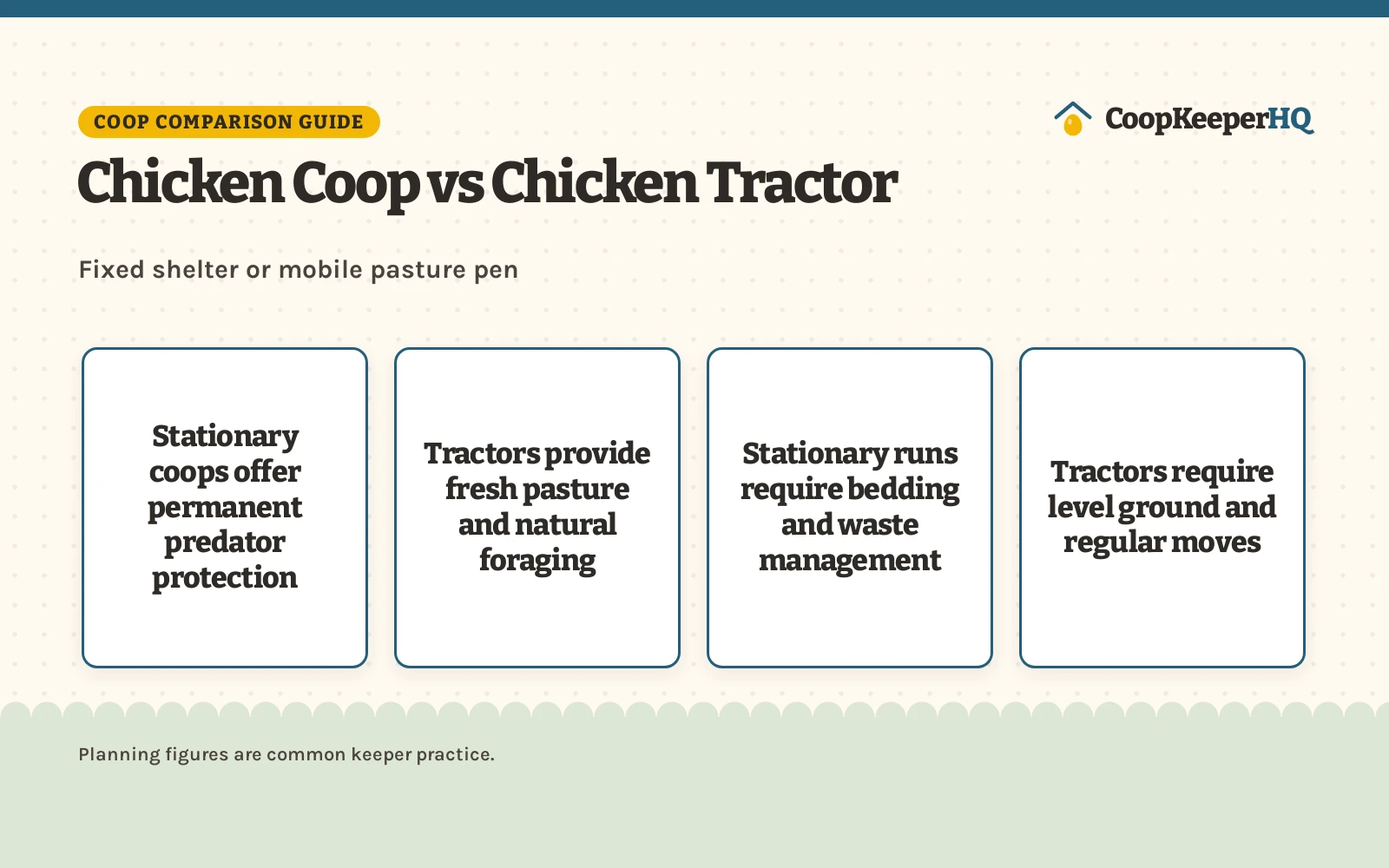
A stationary chicken coop is a permanent home built to stay in a fixed spot throughout the seasons, featuring an enclosed hen house and an attached run. Because it never moves, you can reinforce the perimeter against burrowing predators, install heavy roofing and build walk-in doors that make daily chores comfortable. In contrast, a chicken tractor is a mobile coop and run unit on wheels or skids. Its floorless run rests directly on turf, giving birds immediate access to fresh pasture while naturally distributing manure as you move it across the yard.
Predator protection and structural strength
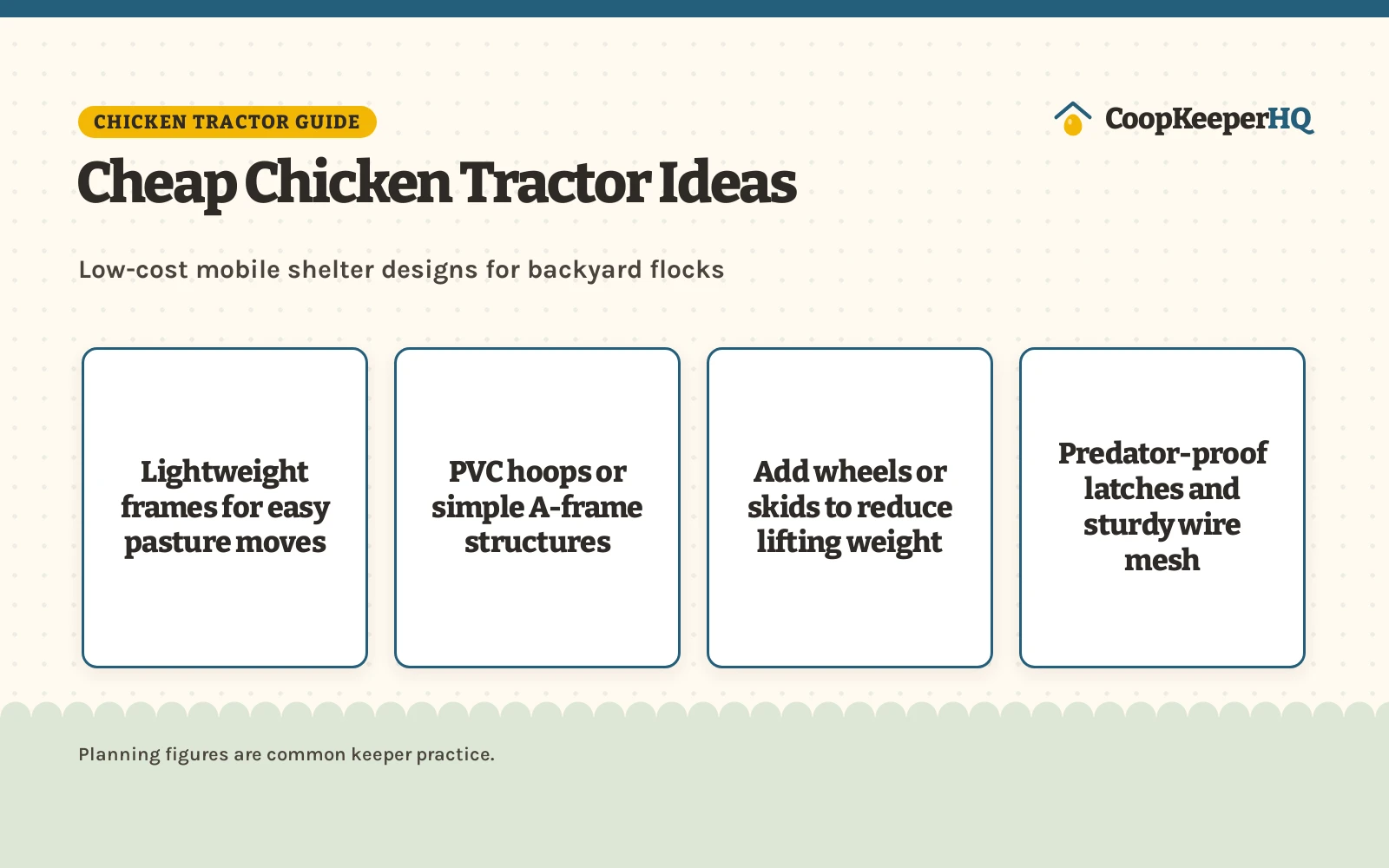
Stationary coops offer the highest level of predator defense because weight and portability do not restrict construction. Keepers can sink posts, frame with heavy timber and bury wire mesh skirts around the perimeter to stop burrowing foxes, dogs and raccoons. Our guide on how to predator proof a chicken coop details skirt and latch designs. A chicken tractor requires vigilance because the bottom rails rest on uneven turf, where gaps can allow predators to squeeze underneath. Keepers often fold down wire mesh skirts or surround the tractor with electric poultry netting to protect grazing birds.
Ground management and pasture rotation
A stationary coop confines all scratching and droppings to a dedicated run footprint. Without deep bedding, hens quickly scratch an enclosed run down to bare soil, which requires imported bedding like wood chips or coarse sand to manage moisture and manure. Our overview of a chicken coop vs chicken run explains how stationary shelter and exercise areas work together. A chicken tractor uses grazing to improve lawn quality: hens eat weeds, scratch thatch and spread manure before moving to fresh ground. However, successful pasture rotation requires sufficient open lawn to move the shelter continuously so the grazed grass can recover.
Yard terrain and mobility requirements
Property layout strongly dictates which housing style works. A stationary coop fits almost any backyard, including steep slopes, rocky soil, tight property lines or shaded spots under mature trees. Chicken tractors demand smooth, relatively flat ground. Moving a mobile pen across slopes, tree roots or soft mud is exhausting and can twist lightweight wood frames out of square. Keepers with mobile setups often add specialized hardware, and our guide on wheels for chicken coop designs covers wheel kits and levers that make pasture rolling easier.
Weather protection across seasons
Stationary coops provide dependable protection against deep winter freezes, summer heat and heavy snow loads. Thick walls, solid roofing and high ridge vents protect roosting birds from damp drafts while keeping electrical connections for water heaters safe. Chicken tractors need to stay lightweight, which limits wall thickness and insulation. While tractors perform well during mild seasons with excellent ventilation, cold winter weather brings practical hurdles. Waterers freeze quickly without fixed power lines, wind drafts blow under bottom rails, and dragging a tractor through snow drifts is difficult. Where winters are severe, keepers generally move tractor flocks into a winterized stationary coop or sheltered outbuilding.
Flock capacity and space considerations
Flock size influences shelter design. For larger backyard flocks, a stationary walk-in coop is often simpler to manage because scaling up a mobile tractor increases frame weight and makes manual rolling difficult.
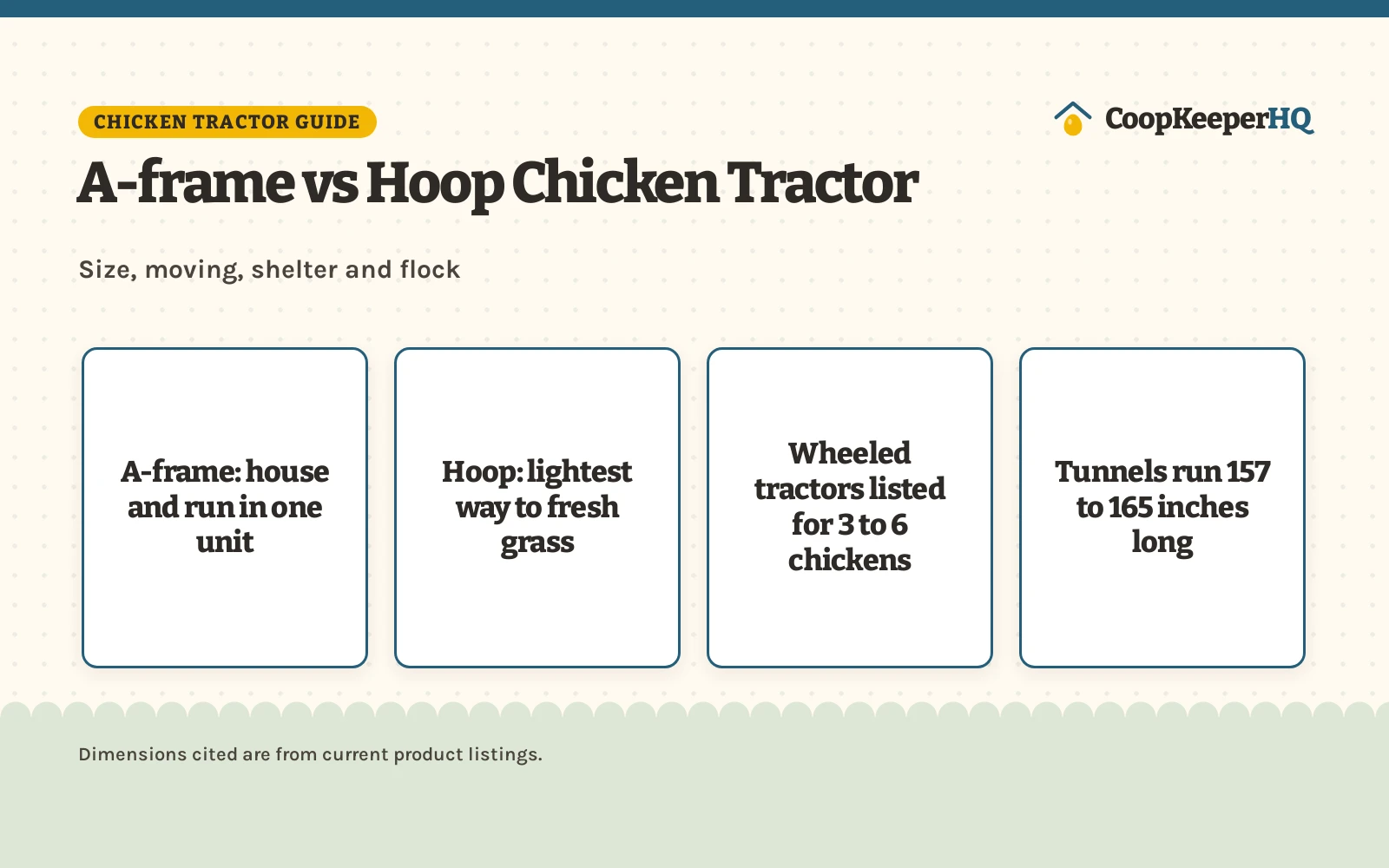
For small flocks, keepers evaluate both designs using stated manufacturer specs. For example, the Petsfit stationary chicken coop listing states dimensions of 71 x 42 x 45 inches with a manufacturer-rated capacity of 4 to 6 small hens or bantam chickens, providing a 6.07 sq ft elevated inner nesting area and a 12.56 sq ft outdoor wire run anchored by 6 ground anchors with 3 nesting boxes. Meanwhile, compact mobile units prioritize portability alongside enclosure space. As an example, the Magazoopet chicken tractor listing states dimensions of 95 x 32 x 45 inches with 34 sq ft of total living space across 2 levels, a manufacturer-rated capacity of 3 to 6 chickens, 3 nesting boxes, and a total weight of 55 pounds with built-in wheels. Neither model defines its entire category: stationary coops range from compact coops to expansive walk-in buildings, while mobile tractors span from lightweight bantam arks to heavy pasture shelters. If you decide a mobile pen matches your pasture routine, our best chicken tractor guide compares top mobile models by usable space and frame design.
Cleaning and bedding maintenance
In a stationary coop, droppings accumulate under roosting bars and across the run floor. Keepers scoop waste, refresh nesting box shavings and turn run litter regularly to compost manure and control moisture. With a chicken tractor, run cleaning is handled by the regular move because droppings fall directly onto pasture turf and decompose naturally. Maintenance on a tractor is mostly limited to scraping the pull-out roost tray and refreshing nesting boxes, though you trade bedding shoveling for the routine physical chore of moving the pen to fresh grass.
Which setup fits your backyard?
Choose a stationary coop if you have a smaller yard, sloped ground, high predator pressure from neighborhood dogs and burrowing wildlife, or severe winter freezes. Fixed coops also suit keepers who want automated doors and low-effort daily management in a permanent location. Choose a chicken tractor if you have a flat, grassy lawn with ample acreage to rotate, keep a small foraging flock, and want to incorporate poultry into lawn or garden care. If you have time for regular pen moves and want fresh foraging without managing deep run bedding, a tractor offers an active, productive system.
A quick comparison checklist
- Stationary coops offer permanent predator barriers with buried perimeter wire skirts
- Chicken tractors provide fresh grass grazing and natural manure distribution
- Stationary coops handle severe winter weather and snow loads with heavier insulation
- Chicken tractors require flat, obstacle-free ground for easy rolling
- Stationary setups need imported run bedding like wood chips or sand
- Chicken tractors eliminate run bedding clean-outs but demand regular moves
Birds, breed size, run time and climate in; coop floor, run space, roost length and nesting boxes out.
Wash your hands after handling birds, eggs or equipment, supervise children around the flock, and check local rules on flock size and roosters before you buy. For sick birds, call a poultry veterinarian or your state extension office. See CDC backyard poultry guidance. Read our Safety Disclaimer.
FAQ for the flock
Is a chicken tractor better than a stationary coop?
Neither shelter is objectively better for every keeper. A chicken tractor excels at pasture grazing, natural pest control and eliminating run bedding cleanup on flat lawns. A stationary coop excels at predator defense, winter weather protection, larger flock management and yards with sloped or rocky ground.
Is a chicken tractor worth it for a small yard?
In most small yards, a chicken tractor is not practical. Regular rotation requires sufficient open turf for grass to regrow before the pen returns to the same spot. In a confined yard, moving a mobile pen quickly wears the lawn down to bare dirt and concentrated manure. For limited spaces, a stationary coop with a dedicated run and deep bedding provides a cleaner, more manageable setup.
How often do you need to move a chicken tractor?
Most keepers move a mobile tractor daily or every other day depending on flock size and grass thickness. Moving the shelter frequently ensures birds enjoy fresh forage while preventing them from scratching the turf down to bare soil or concentrating droppings excessively.
Can a chicken tractor protect against digging predators?
A mobile tractor resting directly on uneven soil is vulnerable to digging predators like foxes, raccoons and dogs. To keep birds secure, keepers often install fold-down wire mesh skirts around the base or park the tractor inside an electric poultry netting enclosure overnight.
Can chickens stay in a chicken tractor during winter?
While chickens can stay in a mobile tractor through mild winter weather with adequate draft protection, heavy freezes and snow make tractor care difficult. Unheated waterers freeze rapidly in the field, and snow accumulation prevents smooth rolling. In cold northern climates, moving birds to a permanent, insulated coop before deep winter arrives is the standard practice.
More coop guides
- Best Chicken Tractor: Mobile Coops Compared by Real Space
- Chicken Coop vs Chicken Run: What Each One Does
- Best Chicken Coop With Run: Combos With Room to Scratch
See the chicken coop picks and the chicken tractor guides.