Chicken Tractor Size for 25 Meat Birds: Space and Shelter Guide
Plan the right chicken tractor size for 25 meat birds with pasture space guidelines, shelter airflow, predator wire and daily moving routines.

On this page
Top picks at a glance
As an Amazon Associate I earn from qualifying purchases.
- 1
 Chicken Coop with Wheels9.6/10View on Amazon
- 2
 Wooden Chicken Coop9.5/10View on Amazon
- 3
 Aivituvin Mobile Chicken Coop with Wheels for 4-6 Chickens9.5/10View on Amazon
- 4
 55ft² Chicken CoopView on Amazon
- 5
 Super Large Chicken CoopView on Amazon
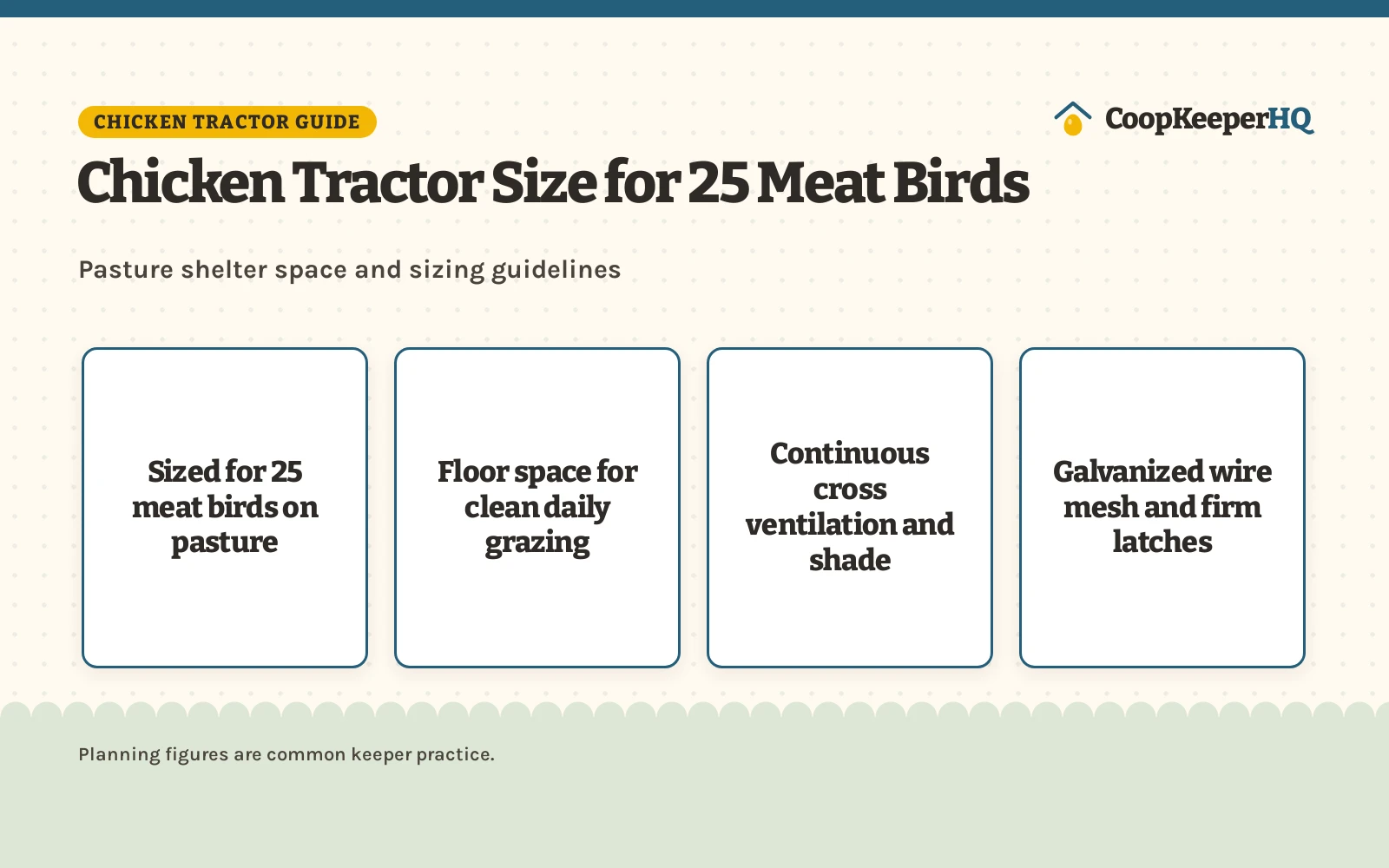
Rolling a mobile shelter out across morning pasture grass is a familiar daily routine for backyard keepers, but discovering your flock crowded together creates immediate concerns. Sizing the right chicken tractor size for 25 meat birds requires matching ground shelter space to the birds’ growth so they have room to forage, rest and feed cleanly. While commercial coops vary in footprint, a large shelter such as the 55 square feet listed for the MEDEHOO mobile tractor provides generous pasture area for 25 meat birds to remain active and thrive.
Other options for the coop
 55ft² Chicken CoopCheck price on Amazon
 Super Large Chicken CoopCheck price on Amazon
CoopKeeperHQ earns a commission if you buy through our links, at no added cost to you. Affiliate disclosure.
Chicken tractor size for 25 meat birds: pasture space requirements
Meat birds have distinct physical needs compared to standard laying hens. Broilers spend nearly all their hours resting on the ground, eating from suspended feeders and foraging across pasture turf rather than perching high on roosts. Because they grow rapidly and produce heavy manure loads, a cramped shelter quickly turns damp, soiled and hazardous. An undersized mobile pen forces birds to sit in manure, which can soil feathers and cause leg issues.
To keep 25 meat birds comfortable through their pasture rotation, the mobile shelter must provide enough ground footprint for the birds to spread out without crowding. While space needs depend on pasture growth and daily moves, commercial coops demonstrate the contrast in available space. For example, the MEDEHOO mobile tractor listing provides 55 square feet of floor shelter, which gives a flock of 25 meat birds generous room. In contrast, smaller commercial coops offer far less ground area: GUTINNEEN lists a mobile tractor with 19 square feet of living area for 6 to 8 chickens, and Magazoopet lists a mobile tractor with 34 square feet across 2 levels for 3 to 6 chickens. Housing 25 meat birds inside a 19 square foot or 34 square foot pen would cause severe crowding. To understand how pasture pens differ from stationary setups, our guide on what is a chicken tractor covers mobile grazing basics.
Mobile shelter dimensions and frame layout
Floor footprint matters, but practical dimensions determine how easily you can manage chores and reach your flock. A shelter providing 55 square feet of ground area works well as an extended rectangle. For example, MEDEHOO lists exterior dimensions of 137 inches long, 63 inches wide and 62 inches high, with alternative product details showing 134.5 inches long, 59 inches wide and 62.4 inches high. A width around 59 to 63 inches allows a keeper to reach the center from access doors on both sides without crawling inside, while the length gives the flock room to move.
The framing material must balance structural rigidity with manageable pulling weight. Commercial listings show different framing approaches: GUTINNEEN combines a rust-resistant U-shaped steel frame with solid fir wood panels to resist weathering and warping, while Joyqinchen incorporates a reinforced iron frame. A sturdy frame prevents the tractor from twisting when rolling across uneven turf. For keepers planning a custom pasture build, our chicken coop on wheels plans outline practical mobile framing methods.
Mobility, wheels and moving weight
Pasture tractors rely on daily moves to keep birds clean and allow grass recovery. When housing 25 meat birds, the shelter carries substantial size and weight, making reliable running gear essential. In data listings, GUTINNEEN and MEDEHOO both equip mobile tractors with 5.3-inch metal caster wheels mounted directly to the frame, while Magazoopet and Lovinhut feature dual wheels paired with a pull handle.
Weight directly impacts how smoothly you can relocate the shelter every morning. Magazoopet lists a unit weight of 55 pounds, while Lovinhut lists a shipping weight of 69.89 pounds. A larger tractor delivering 55 square feet of ground area will be heavier, meaning larger wheels help prevent the running gear from sinking into soft ground or catching in tall grass. You can compare mobile wheel hardware in our guide to wheels for chicken coop designs.
Ventilation and weather protection on pasture
Because meat birds generate significant body warmth and moisture, poor airflow quickly leads to high humidity and respiratory distress. Pasture shelters must provide continuous air exchange while protecting the flock from blowing rain and baking sun. Listing specifications demonstrate effective ventilation designs: MEDEHOO incorporates 3 ventilation windows in its sleeping area along with 3 sliding vents, while Lovinhut features dual side ventilation windows that slide open for flexible airflow.
Weather protection requires durable roofing materials. Listing details show waterproof asphalt roofing across multiple brands: MEDEHOO, GUTINNEEN, Lovinhut and PetsCosset all utilize waterproof asphalt roofs to shield birds from rain, wind and sun. Covering a portion of the tractor with asphalt roofing provides dry shade, while open mesh sides allow continuous breezes to carry moisture away. To explore protective roofing covers, see our review of chicken coop cover options.
Predator protection and wire mesh defense
Pasture-raised poultry face constant attention from ground predators such as raccoons, foxes and dogs, as well as aerial predators like hawks and owls. A pasture tractor must form an impenetrable enclosure day and night. Listings in data show heavy-duty galvanized wire mesh and firm latches across all models: PHONDIKO features galvanized metal wire mesh with locking latches, and Lovinhut incorporates a fully enclosed galvanized wire run with a reinforced frame.
Standard light chicken wire can stretch or tear under predator pressure. Heavy-duty galvanized wire mesh or welded hardware cloth attached firmly to the frame keeps predators out while maintaining optimal ventilation. Sturdy door locks and spring latches prevent clever raccoons from opening access points. For detailed comparisons of protective wire materials, check our best hardware cloth for chicken coop guide and our comparison of hardware cloth vs welded wire.
Feeder and waterer layout for meat birds
A flock of 25 meat birds consumes large quantities of clean water and feed daily. In any mobile pasture tractor, placing feeders and drinkers directly on pasture turf can quickly lead to spilled grain, mud and fouled water. Suspending drinkers and feeders from overhead framing keeps water clear of dirt and preserves usable pasture space for birds to rest.
Using high-capacity watering systems ensures the flock never runs dry during warm afternoons. Drinker nipples or automatic cups connected to a reservoir supply steady hydration without creating soggy ground beneath the birds. Long trough feeders allow multiple chickens to feed side by side without jostling. For large flock drinkers, browse our picks for the best chicken waterer for large flock setups and our review of a chicken feeder for 20 chickens.
Daily pasture rotation routine
Consistent daily movement is the foundation of keeping meat birds in a mobile shelter. Moving the tractor onto fresh grass every morning provides fresh forage, scatters manure naturally so pasture soil absorbs nutrients, and removes birds from damp ground. Developing an efficient morning chore routine makes this quick and stress-free.
Before rolling the tractor forward, check that all birds are standing alert and clear of the rear frame. Slowly pull the tractor forward across the lawn to avoid bumping birds or trapping feet under trailing skids. Refill drinkers with fresh water, replenish feed troughs, and verify that roof panels and latches remain firm. If any bird appears sluggish, weak or shows breathing changes, consult a poultry vet or your state extension office promptly.
Comparing commercial mobile coops to pasture needs
Many keepers ask whether commercial backyard coops can house a flock of 25 meat birds. While commercial coops offer sturdy construction, manufacturer ratings are designed around laying hens rather than meat chickens. For example, MEDEHOO rates its 55 square foot coop for 10 to 15 chickens and includes 6 nesting boxes and 6 perches. Magazoopet rates its 34 square foot coop for 3 to 6 chickens with 3 nesting boxes. GUTINNEEN rates its 19 square foot tractor for 6 to 8 chickens with 6 nesting boxes. Joyqinchen lists a 76-inch long coop for 5 to 7 chickens, and Lovinhut lists a coop for 4 standard chickens or up to 6 bantams.
Meat birds do not lay eggs during their pasture cycle, and heavy broilers avoid climbing steep ramps or roosting on elevated perches. Built-in nesting compartments, perches and multi-level dividers consume valuable footprint inside commercial coops. While a keeper could adapt a large coop like the 55 square foot MEDEHOO by removing interior nest dividers, multi-level layouts with ramps remain awkward for heavy meat chickens. For 25 meat birds, a single-level pasture tractor built flat to the ground offers cleaner pasture access, or keepers can divide the flock between multiple mobile pens. To evaluate manufactured models, see our best chicken tractor guide.
A simple chicken tractor checklist
- Plan generous pasture ground space so 25 meat birds have room to forage and rest
- Equip the frame with heavy-duty caster wheels or skids for daily moves
- Use waterproof asphalt roofing over resting zones for shade and rain protection
- Maintain open wire walls and vents for continuous cross ventilation
- Wrap the perimeter with galvanized wire mesh and install locking door latches
- Suspend waterers and feeders to protect pasture floor space and keep feed dry
For additional details on building and framing mobile pastured poultry shelters, explore our chicken coop on wheels plans.
Birds, breed size, run time and climate in; coop floor, run space, roost length and nesting boxes out.
Wash your hands after handling birds, eggs or equipment, supervise children around the flock, and check local rules on flock size and roosters before you buy. For sick birds, call a poultry veterinarian or your state extension office. See CDC backyard poultry guidance. Read our Safety Disclaimer.
FAQ for the flock
How much space do 25 meat birds need in a chicken tractor?
A mobile pasture tractor for 25 meat birds must provide enough ground space for the flock to feed, drink and rest without crowding or sitting in manure. While pasture conditions and move schedules influence exact sizing, commercial models like the MEDEHOO listing show that a large shelter offering 55 square feet provides generous space, whereas compact retail coops become overcrowded quickly.
Can you raise 25 meat birds in a commercial pre-built coop?
Most commercial coops are designed for small laying flocks of 3 to 6 chickens or 6 to 8 chickens, offering only 19 square feet to 34 square feet of space. While a larger unit offering 55 square feet, like the MEDEHOO model, provides greater total area, commercial designs often feature ramps and nesting boxes that suit layers rather than heavy meat birds. Single-level pasture shelters without ramps provide far better ground access for meat birds.
Do meat birds in a chicken tractor need perches or nesting boxes?
Meat birds do not require nesting boxes because they are raised for meat rather than egg production. Heavy meat birds also prefer resting on flat pasture turf rather than climbing onto elevated roosting bars.
How often should you move a chicken tractor with 25 meat birds?
Move the chicken tractor to fresh pasture ground daily. Daily movement prevents manure accumulation, keeps birds clean and dry, and allows the flock to graze on fresh grass, seeds and insects.
What wire mesh is recommended for a mobile meat bird tractor?
Galvanized wire mesh or heavy-duty welded hardware cloth is recommended over light chicken wire. Galvanized mesh provides rigid defense against persistent digging and climbing predators while maintaining open airflow across the flock.
More coop guides
- What Is a Chicken Tractor?
- Best Chicken Tractor: Mobile Coops Compared by Real Space
- Chicken Coop on Wheels Plans: Mobile Tractor Sizing and Build Guide
See the chicken tractor guides and the chicken coop picks.