Chicken Tunnel Ideas: Backyard Layouts, Sizing and Setup Guide
Modular wire layouts, garden perimeter paths, ground anchoring and predator protection for building a safe chicken tunnel for your backyard flock.


On this page
Top picks at a glance
As an Amazon Associate I earn from qualifying purchases.
- 1
 Threekia Knotted Poultry Netting for Chicken Run9.7/10View on Amazon
- 2
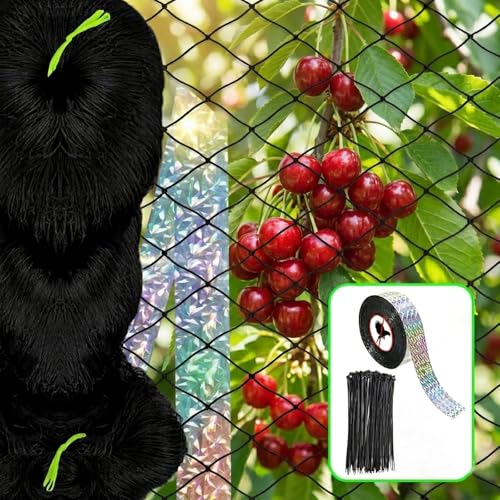 Fvellix Bird Netting for Chicken Coop9.6/10View on Amazon
- 3
 Hogarjal Foldable Chicken Tunnel for Yard9.5/10View on Amazon
Watching your flock scratch through fresh mulch or head straight for garden beds is a familiar morning headache for backyard keepers. Practical chicken tunnel ideas solve that struggle by giving birds safe, enclosed pathways to forage on grass and eat garden pests while keeping delicate vegetables untouched. A chicken tunnel connects your coop or run to remote parts of the yard through modular wire corridors, rotating grazing spots and giving hens fresh ground without the risks of free-ranging.
CoopKeeperHQ earns a commission if you buy through our links, at no added cost to you. Affiliate disclosure.
Chicken tunnel ideas: perimeter runs around garden beds
A practical way to use a chicken tunnel is routing it along the outside perimeter of your garden beds. Chickens naturally spend their days hunting for beetles, slugs, grasshoppers and weed seeds. When left loose in an open garden, they quickly scratch up seedlings, dig dust baths in loose compost and peck ripe tomatoes. A perimeter tunnel gives your birds direct access to garden pests right at the fence line without letting them step inside the growing rows.
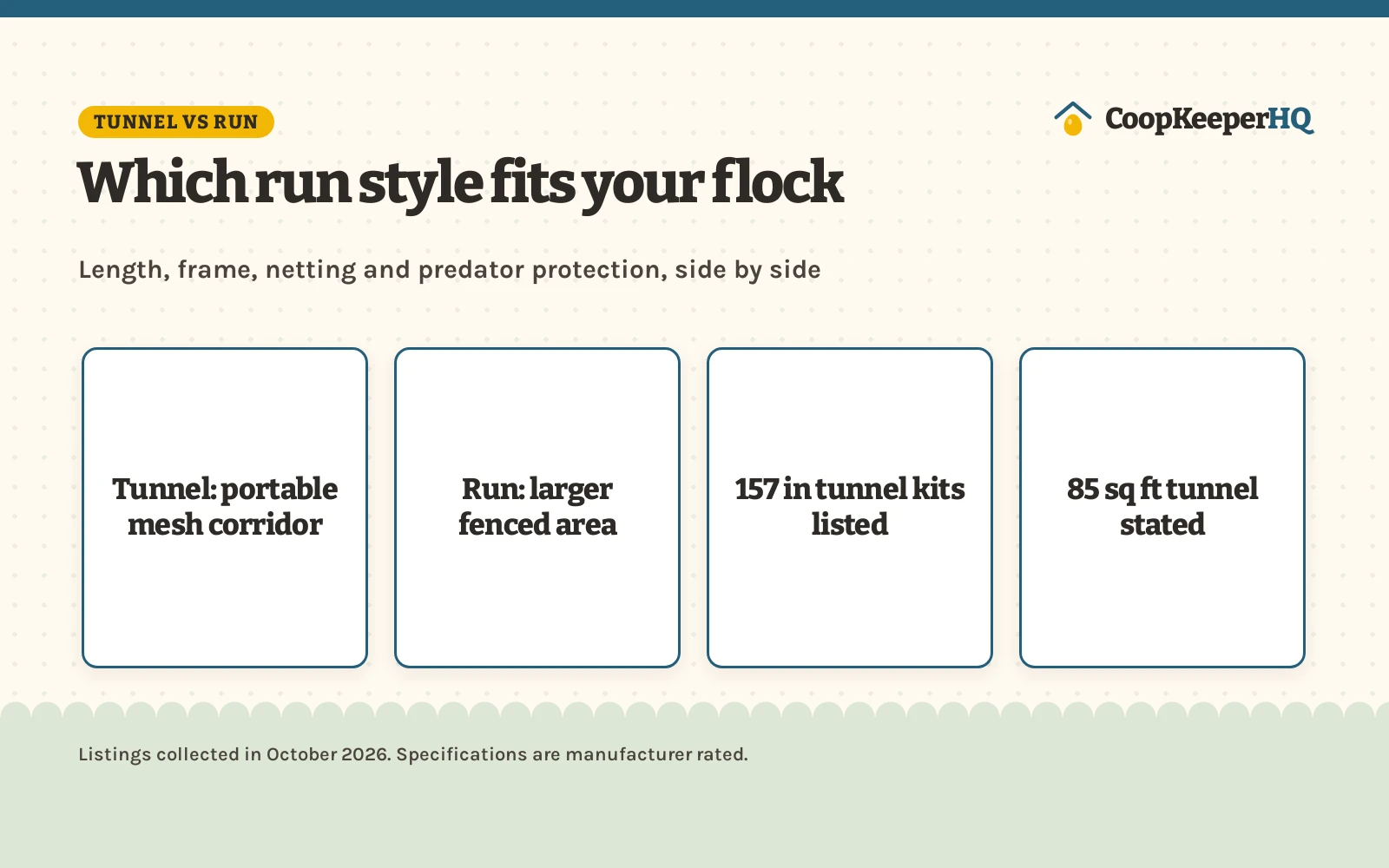
Layout options depend on the available space between your planting beds and boundary fences. For wide yard perimeters, the VEVOR listing specifies an activity width of 39.37 inches and a height of 24.2 inches across a length of 157.5 inches, giving larger breeds plenty of turning room. Where garden pathways are narrow, the Zovida listing provides a narrower profile measuring 21 inches wide and 32 inches high across a 157-inch run. This vertical clearance gives hens room to walk upright while the narrow footprint preserves walkway space between your raised beds.
Are chicken tunnels a good idea for your flock?
Backyard keepers often ask whether adding tunnels makes sense compared to expanding a permanent run. Chicken tunnels are an excellent choice if you want to give your flock fresh pasture without building permanent fences across your lawn. They allow you to practice rotational grazing in a small backyard, moving the run from one patch of turf to another so grass has time to recover. Tunnels also help reduce boredom and coop stress by adding new territory for hens to explore throughout the day.
At the same time, tunnels require thoughtful management. Lightweight wire corridors do not replace a sturdy, predator-proof coop for night roosting, and they must be anchored firmly to the turf so predators cannot lift the edges. If your flock spends long hours foraging in modular tunnels, calculating adequate run space remains important. Our chicken run size calculator helps you determine how much total roaming ground your specific flock needs.
Connecting your tunnel to the coop pop door
A seamless connection between your coop and tunnel system keeps daily chores simple and prevents escape gaps. If your coop already features an exterior pop door, you can butt the tunnel directly against the framing. The Hogarjal listing specifies a removable door with a zipper closure designed to attach directly to an existing coop entrance. This setup allows your birds to walk straight from the coop into the grazing corridor as soon as you open the door in the morning.
An automatic coop door provides reliable evening security by shutting the coop pop door at dusk once all hens have returned from the tunnel to roost. In the morning, however, it is best to check the outdoor tunnel in person before releasing the flock, confirming that stakes are secure and that overnight wildlife has not disturbed the run. Ensure the connection point between the wooden coop wall and the wire tunnel has no escape gaps, using heavy-duty hardware cloth collars if necessary to prevent sneaky raccoons or weasels from slipping through the joint.
Modular sections and 90-degree corner layouts
Backyards are rarely straight rectangles, and routing a run often means steering around compost bins, garden sheds, patios and fruit trees. Modular tunnel kits let you configure turns and extensions without custom metal fabrication. The LANEVAN listing specifies modular rectangular runway sections measuring 144 inches long, 24 inches wide, and 24 inches high, incorporating a 90-degree corner designed to steer runways around yard obstacles. This rectangular profile avoids triangular crowding, giving multiple hens room to pass each other comfortably.
For complex layouts along zigzag garden fences, spliced metal panels offer flexible configurations. The WGOHOSE listing includes a modular 90-degree corner layout combining 2 straight tunnels, 1 curved tunnel, and 2 doors, with an assembled size of 142 inches in length, 24 inches in width, and an inner height of 21 inches. Linking curved sections with right-angle corners allows you to build an enclosed loop entirely around a vegetable garden, letting birds circulate continuously.
Choosing wire mesh, metal panels, or netting
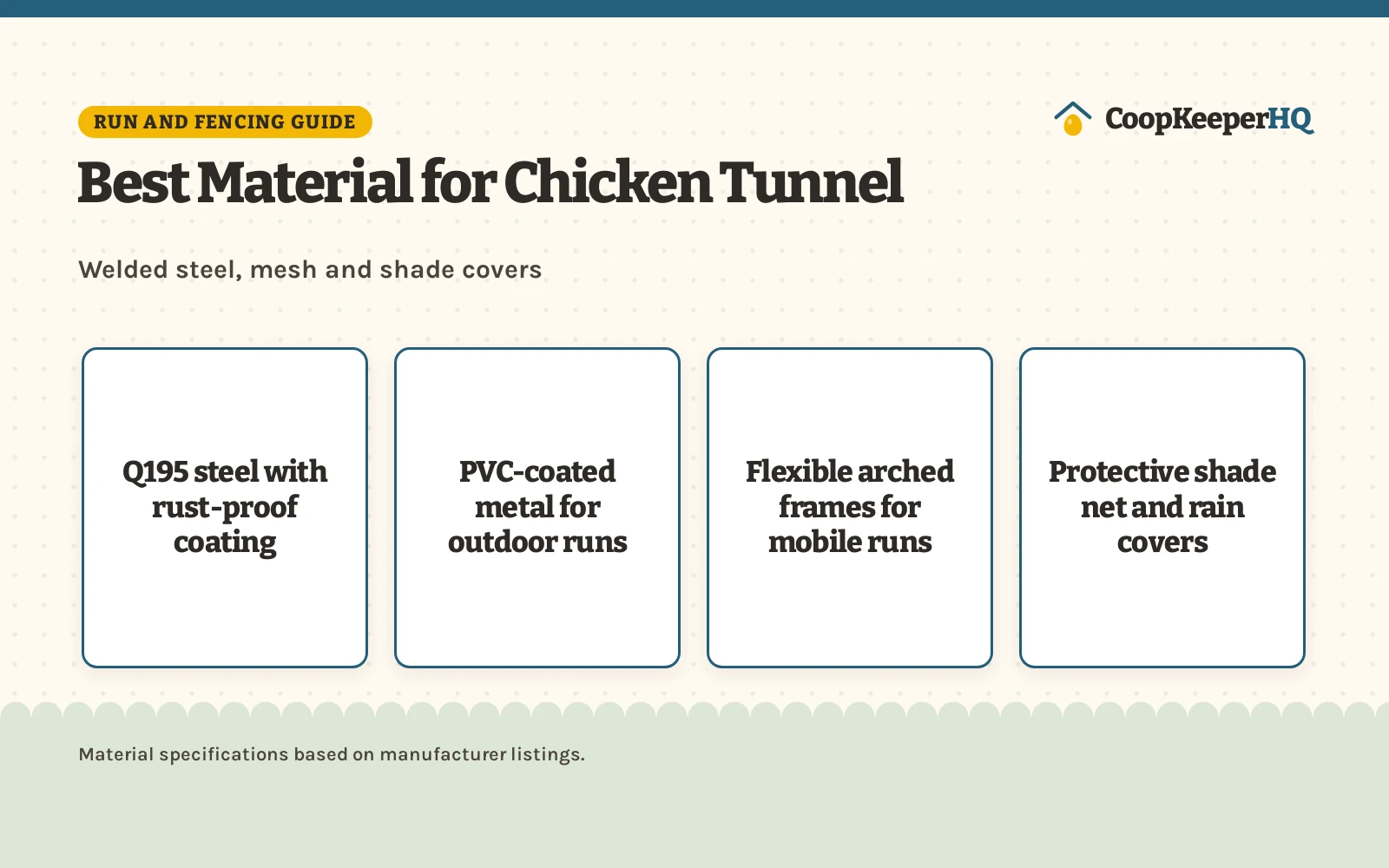
The materials you select determine how durable, portable and predator-resistant your tunnels will be. Welded steel panels offer maximum rigidity and predator defense against large dogs and coyotes. The VEVOR listing specifies Q195 steel with a spray rust-proof coating, providing a stiff frame that resists bending when placed on uneven ground. For additional reinforcement on custom builds, our hardware cloth guide covers heavy-duty wire mesh options that keep small paws out.
If you plan to move tunnels daily, lightweight accordion frames reduce the strain on your back. The Hogarjal listing specifies nylon mesh wrapped over a steel-reinforced plastic frame, bringing the total weight to 3.81 pounds for a 157-inch run. Another Hogarjal listing specifies a 1.9-inch steel wire frame with a protective PVC coating, balancing rust resistance with easy mobility. For a complete comparison of mesh gauges and structural choices, read our guide on the best material for chicken tunnel setups.
Ground anchoring and predator security
Predator security is the most critical factor when planning backyard tunnels. Ground predators such as domestic dogs, coyotes, raccoons and foxes quickly notice poultry moving along lawn corridors. Because chickens panic and flap when startled, flimsy tunnels that are not pinned down can shift or flip, exposing birds to danger. Aerial predators like hawks also scan open yards from power lines and trees, watching for exposed movement.
Firm ground anchoring prevents predators from nudging, lifting or shifting the tunnel edges. The WGOHOSE listing includes 16 ground anchors and 30 zip ties to pin the frame directly into the lawn. Driving heavy-duty U-shaped ground stakes through the bottom runner wire secures the tunnel firmly against the turf. However, surface stakes alone do not stop predators from digging into loose soil underneath the run. In areas with persistent burrowing predators, laying an apron of wire flat along the outside grass line provides essential barrier protection, as outlined in our review of chicken wire for predators.
Sun protection and weather covers
Chickens cannot sweat and are vulnerable to heat exhaustion during warm summer afternoons. When confined to an open lawn tunnel without tree cover, birds need shade and airflow to remain comfortable. Heavy canvas or dark plastic tarps can trap rising heat like an oven, while flimsy fabric blows away in high winds.
Look for tunnels that include breathable covers designed for outdoor elements. The VEVOR listing specifies an included silver waterproof cloth that reflects ultraviolet rays and sheds rain while preserving side ventilation. Netting tunnels from Hogarjal and Zovida specify integrated sun protection nets that shield foraging birds from intense midday sun while preserving an open view of the sky. For additional shade canopy ideas, explore our guide to shade cloth for chicken run additions and our favorite covered chicken run ideas.
Moving tunnels for rotational grazing
When placed over lawn, a flock can wear down turf quickly if left in one spot. While stationary perimeter tunnels work well for keeping garden borders clear of weeds, mobile lawn setups benefit from regular shifting across different zones of your yard. Moving the corridor gives your birds fresh clover, dandelions and insects while allowing previously grazed grass time to recover.
Weight determines how practical this daily relocation chore will be. Compact accordion-style models, such as the Hogarjal 79-inch long, 24-inch wide, and 30-inch high tunnel, list an item weight of 4.25 pounds, allowing a single keeper to fold and carry the unit across the lawn in seconds. Larger steel playpen enclosures, like the VEVOR 118.1-inch by 28-inch model with a listed weight of 26 pounds, take more effort to move but provide greater structural stability for multi-day placements on rough pasture.
Daily management and evening return routines
Establishing a predictable daily routine makes operating chicken tunnels trouble-free. In the morning, inspect the tunnel run to confirm the framing is intact and ensure fresh, cool water is accessible either along the corridor or inside the connected coop. Even with overhead shade cloth in place, active daytime foraging increases hydration needs, so birds should never be enclosed in a tunnel without water.
Chickens possess a strong homing instinct and will naturally head back into their main coop as dusk approaches to find their roosts. Once every bird is accounted for inside the coop, securely latch the pop door. Never leave chickens inside a lawn tunnel after dark, as nighttime predators like raccoons, opossums and coyotes can exploit small gaps or pry at fasteners when given hours of uninterrupted darkness.
A practical chicken tunnel checklist
- Tunnel sections are pinned securely to the turf with heavy-duty ground stakes
- Connections between the coop pop door and the tunnel have zero escape gaps
- Corners and turns use dedicated 90-degree modular frames without pinch points
- Overhead shade nets or weather covers protect the flock from direct sun and rain
- Clean water is accessible at all times during foraging hours
- All birds return to the predator-proof coop before dark and the pop door is locked
For more enclosure planning and fencing setups, explore our guide to chicken runs and fencing.
Birds, breed size, run time and climate in; coop floor, run space, roost length and nesting boxes out.
Wash your hands after handling birds, eggs or equipment, supervise children around the flock, and check local rules on flock size and roosters before you buy. For sick birds, call a poultry veterinarian or your state extension office. See CDC backyard poultry guidance. Read our Safety Disclaimer.
FAQ for the flock
Are chicken tunnels a good idea for small backyards?
Yes, chicken tunnels are especially useful in small suburban yards where a large permanent run would consume the entire lawn. Tunnels allow your flock to graze along property fences and garden borders while keeping your central lawn open for family use.
Can chickens stay inside a chicken tunnel overnight?
No, chickens should never sleep inside a lawn tunnel overnight. Tunnels are daytime foraging corridors and lack the heavy predator-proof latches, solid walls and elevated roosting bars needed to protect birds from nocturnal predators like raccoons and foxes.
How wide should a chicken tunnel be?
There is no single required width, but a tunnel should give your hens room to walk upright and pass each other without feather damage. Maker listings show various widths depending on the design, from narrow 21-inch paths suited for garden borders up to 39.37-inch wide playpens, with 24-inch and 28-inch widths also common. Match the width to your yard space and breed size.
How do you anchor a chicken tunnel against wind and predators?
Drive heavy-duty metal U-shaped ground stakes through the bottom wire runner along both sides of the tunnel to prevent wind lift and stop predators from nudging the frame up. In sandy soil, longer stakes provide better hold. If burrowing predators are present, add an exterior wire apron flat on the turf along the edges.
Do chicken tunnels protect chickens from hawks and dogs?
Enclosed tunnels protect birds from aerial predators like hawks by blocking swooping attacks from above. Ground predator defense depends on the construction: rigid steel wire panels help resist dogs when firmly staked, but lightweight nylon mesh tunnels can be torn by dogs, coyotes or raccoons. Always supervise flocks in lightweight netting runs.
More coop guides
- Best Material for Chicken Tunnel (2026)
- Covered Chicken Run Ideas: Shelter, Tarps, and Roofing Options
- Shade Cloth for Chicken Run: 5 Top Picks Compared (2026)
See the chicken runs and fencing picks and the predator protection guides.