Heat Lamp Temperature Control for Brooders
A plug-in thermostat switches a brooder heat lamp on and off from a probe reading, keeping the brooder steady without a lamp running around the clock.

On this page
Top picks at a glance
As an Amazon Associate I earn from qualifying purchases.
- 1
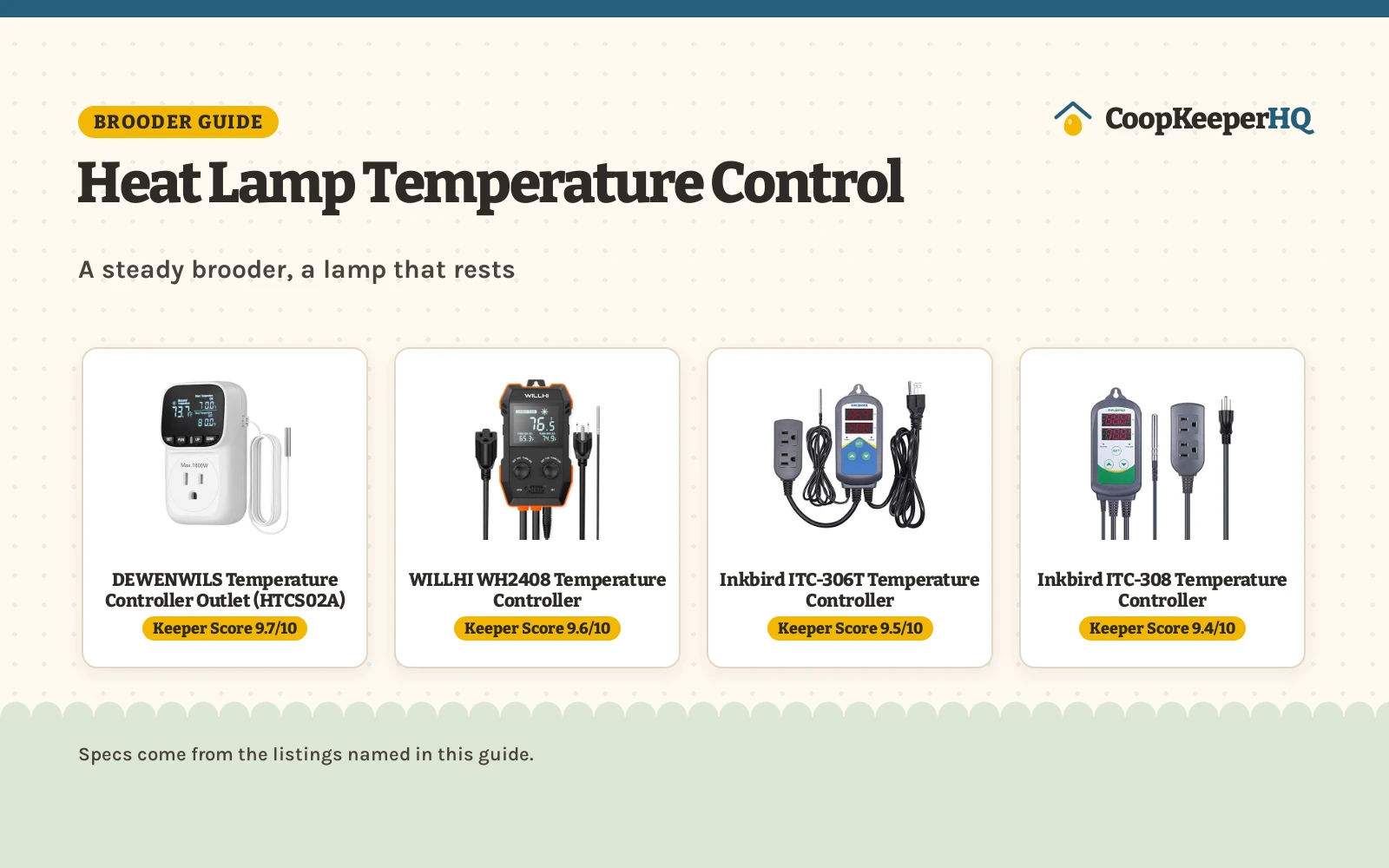
 DEWENWILS Temperature Controller Outlet9.7/10View on Amazon
- 2
 WILLHI WH2408 Temperature Controller, 10A 1200W9.6/10View on Amazon
- 3
 Inkbird ITC-306T Heating Thermostat with 24-Hour9.5/10View on Amazon
- 4
 Inkbird ITC-308 Freezer Thermostat9.4/10View on Amazon
Morning chores in the brooder start the same way: fresh water, a look at the chicks, and a hand held near the lamp to feel whether the warm spot is right. Heat lamp temperature control takes the guesswork out of that check, because a plug-in thermostat watches the brooder and switches the lamp on and off for you.
CoopKeeperHQ earns a commission if you buy through our links, at no added cost to you. Affiliate disclosure.
DEWENWILS Temperature Controller Outlet
The strongest plug here: 15 A, 1800 W, a -40 to 210°F range and a 1 year manufacturer warranty.
Who it's for: a keeper running a large lamp who wants the highest load here.
Who should skip it: anyone who wants a stated safety listing or a longer warranty, or who prefers knob controls.
DEWENWILS lists the HTCS02A at 15 A and 1800 W, the highest load in this guide, with a control range of -40 to 210°F and 0.1°F precision. The listing names heating and cooling modes, a VA display, power memory that restores settings after an outage, temperature calibration and cyclic timing with countdown modes. The unit measures 1.53 x 2.26 x 4.14 in and weighs 0.33 lb, with a 1 year manufacturer warranty stated.
Pros
- 15 A output and 1800 W capacity, the highest here
- Wide -40 to 210°F range with 0.1°F precision
- Heating and cooling modes with cyclic timing
- Power memory restores settings after an outage
Cons
- No UL or ETL listing is stated
- No probe length or cord length is stated
- Cyclic timing adds setup steps a plain plug avoids
- Only 1 pack, so each brooder needs its own unit
WILLHI WH2408 Temperature Controller, 10A 1200W
A 10 A, 1200 W plug with an ETL-certified cord, a resettable fuse and a -58 to 230°F probe.
Who it's for: a keeper who wants the strongest stated safety hardware here and simple knob controls.
Who should skip it: anyone who needs a stated warranty.
WILLHI lists the WH2408 at 10 A and 1200 W, with two knobs for on and off temperatures. The probe measures -58 to 230°F, while the controller body itself is rated for -4 to 140°F ambient, so the body needs a cooler spot than the probe. The listing names a food-grade probe with a tip of about 1-1/2 in, heating and cooling modes, settings memory through power outages and a 0.1°F control resolution. The unit measures 5.0 x 3.0 x 1.3 in, and the package measures 6.6 x 3.6 x 3.6 in.
Pros
- ETL-certified power cord with a resettable fuse
- Fire-retardant ABS shell with built-in power isolation
- Probe reads -58 to 230°F with 0.1°F resolution
- Two knobs set on and off temperatures with no menus
Cons
- No warranty term is stated
- The shell is not water resistant, so the body must stay dry
- The listing warns it is a control only, not a safety device
- Only 1200 W, below the 1800 W top pick
Inkbird ITC-306T Heating Thermostat with 24-Hour
A heating-only controller with a day and night cycle, a dual display and an alarm that switches the outputs off.
Who it's for: a keeper who wants day and night temperatures on a schedule, with an alarm as a backstop.
Who should skip it: anyone who also needs cooling, or who wants a stated warranty.
Inkbird lists the ITC-306T as a heating-only controller with a 24-hour day and night cycle, so day and night temperatures can differ. The maximum output load is 10 A, 1200 W at 120 V or 1100 W at 110 V, with both outlets for heating under that one limit. The dual display shows measured and set temperature together, and the over-temperature alarm covers -58 to 210°F: out of range, it turns off all outputs, sounds the buzzer and displays HL.
Pros
- Day and night cycle sets different temperatures
- Over-temperature alarm turns off all outputs and sounds the buzzer
- Dual display shows measured and set temperature together
- Both outlets are for heating, under one 10 A limit
Cons
- Heating only, so it cannot run a fan or cooler
- No warranty term is stated
- No UL or ETL listing is stated
- The alarm setting is fixed and cannot be adjusted
Inkbird ITC-308 Freezer Thermostat
A simple plug-in controller that runs heating and cooling at the same time.
Who it's for: a keeper who wants one plug to run a lamp and a cooler together.
Who should skip it: anyone who needs a stated range, a warranty or a safety listing.
Inkbird lists the ITC-308 as a plug-in controller for heating and cooling at the same time, with marked outlets for the heater and the cooler and one probe. The listing states 110 V and 1200 W, a display in Centigrade or Fahrenheit and calibration support, and the unit measures 1.3 x 2.68 x 1.3 in and weighs 0.9 lb. The listing states no temperature range at all, which makes it the thinnest spec sheet in this guide.
Pros
- Runs heating and cooling equipment at the same time
- Simple plug-in setup with a probe and marked outlets
- Displays in Centigrade or Fahrenheit
- Calibration is supported for fine tuning
Cons
- No temperature range is stated in the listing
- No warranty term is stated
- No UL or ETL listing is stated
- No probe length or cord length is stated
Other options for the coop
 Chicken Coop Heater Inside Coop with Remote ControlCheck price on Amazon
 SakerPlus Livestock Heating LampCheck price on Amazon
 1500W Chicken Coop Heater W/ Remote Control & TimerCheck price on Amazon
 Egg Incubators for Hatching EggsCheck price on Amazon
 Chick Brooder Heater Plate with Digital Temperature ControlCheck price on Amazon
 OBI-12 Egg IncubatorCheck price on Amazon
Heat lamp temperature control: how a plug-in thermostat runs the lamp
A thermostat controller is a plug with a probe and a dial. You plug the lamp into the controller, set the temperature you want, and place the probe where the chicks rest. When the probe reads below the set point, the controller switches the lamp on; when the brooder warms past it, the controller switches the lamp off. The lamp still gives the warmth, but the controller decides when it runs.
A lamp left on around the clock has one problem: at midday it can push the warm end of the brooder too warm. A controller switches the lamp off before the warm end overheats, and back on when the brooder cools, so the temperature holds steady instead of swinging with the time of day.
Set the probe where the chicks sleep
The probe does the measuring, so its spot matters more than the dial setting. Hang it at chick height, near the middle of the warm area but out of the direct beam of the bulb, and keep it clear of water and bedding that can bury it. A probe under the bulb reads the lamp, not the brooder, and a probe buried in bedding reads the bedding. Check the reading at morning chores and again at dusk, and move it if the chicks crowd one end.
Match the controller to the lamp
Check the load before you plug anything in. Every controller in this guide states a maximum load in watts, and the lamp must sit under it. A controller that only heats cannot run a fan, and a heating-only plug with two outlets still shares one load limit across both. The four picks below are ranked highest first, and each one says which part of the job it handles.
Controllers that run a heat lamp
Setting the probe and matching the load are the two steps that need gear: each controller below plugs between the wall and the lamp, reads the brooder through its probe, and switches the lamp to hold the temperature you set.
What to check before you plug in
Run every brooder plug from a GFCI outlet, keep cords off the floor and out of reach of beaks, and keep the controller body clear of bedding. A heat lamp is a known fire risk in a coop full of dust and dry bedding, so hang the lamp from a chain or a fixed mount, never from its cord alone, and keep the hot bulb clear of bedding, wood and feathers. If the lamp falls or the bulb breaks, unplug the controller before you touch anything. Our heat plate guide covers the safer alternative, and the heat plate vs heat lamp comparison explains the fire risk.
Birds, breed size, run time and climate in; coop floor, run space, roost length and nesting boxes out.
Heat lamps are a common cause of coop and barn fires. If you use one, secure it with more than the clamp (a chain or wire to a fixed point), keep it well away from bedding, walls and cardboard, and plug it into an outlet or a cord rated for the load. Radiant heat plates run cooler and remove most of that risk. Check chicks often in the first days: huddling under the heat means too cold, spreading to the edges means too warm. Read our Safety Disclaimer.
FAQ for the flock
Can a thermostat run a heat lamp in a brooder?
Yes. Plug the lamp into the controller outlet, set the temperature and place the probe where the chicks rest. The four controllers in this guide are all plug-in models built for that job.
Where should the probe sit in a brooder?
At chick height, near the middle of the warm area and out of the direct beam of the bulb. A probe under the bulb reads the lamp instead of the brooder, and a probe buried in bedding reads the bedding.
Do I still need a heat plate if I use a thermostat?
A thermostat makes a lamp steadier, but it does not remove the fire risk of a hot bulb near bedding. The site recommends a heat plate over a lamp for that reason.
What happens if the power goes out?
Two of the controllers in this guide state power memory, so they restore their settings when the power returns. The other two state no memory, so check the dial and the display after any outage and reset them if they went blank.
Can one controller run a lamp and a fan?
Only a controller with heating and cooling modes can do both, and only one pick here runs them at the same time: the Inkbird ITC-308. The ITC-306T is heating only, and the other two plugs switch one device between modes.
More coop guides
- Best Brooder Heat Plate: Safer Heat for Chicks
- Heat Plate vs Heat Lamp for Chicks: Which Is Safer?
- Best Heat Lamp Bulb for Brooder (2026)
- Chick Brooder Temperature: How to Set It and Read the Chicks
- Brooder Heater vs Heat Lamp: Which One Should You Buy?
- Best Brooder Thermometer for Baby Chicks (2026)
See the brooder picks and the heat plate guide.