Heat Plate vs Heat Lamp for Chicks: Which Is Safer?
Heat plates and heat lamps compared on fire risk, energy use, capacity, cold rooms and upkeep, with one example of each from the listings we reviewed.

On this page
Top picks at a glance
As an Amazon Associate I earn from qualifying purchases.
- 1
 RentACoop 12x12 Adjustable Heating Plate9.5/10View on Amazon
- 2
 Premier 1 Prima Heat Lamp9.5/10View on Amazon
Heat plate vs heat lamp verdict: Choose a heat plate for a home brooder of up to 20 chicks in a draft-free room: it uses about 22 W, has no hot bulb and gives chicks a dark night. Choose a heat lamp only for a large or cold space that a plate cannot warm, with a guarded fixture, a secure mount and a GFCI outlet.
Both give chicks the warmth a hen would, but they do it differently. A plate warms by contact from above, like a mother hen, and a lamp warms the air and everything under it with infrared light. This heat plate vs heat lamp comparison covers the two types, then one example of each from the listings we reviewed.
CoopKeeperHQ earns a commission if you buy through our links, at no added cost to you. Affiliate disclosure.
Two examples

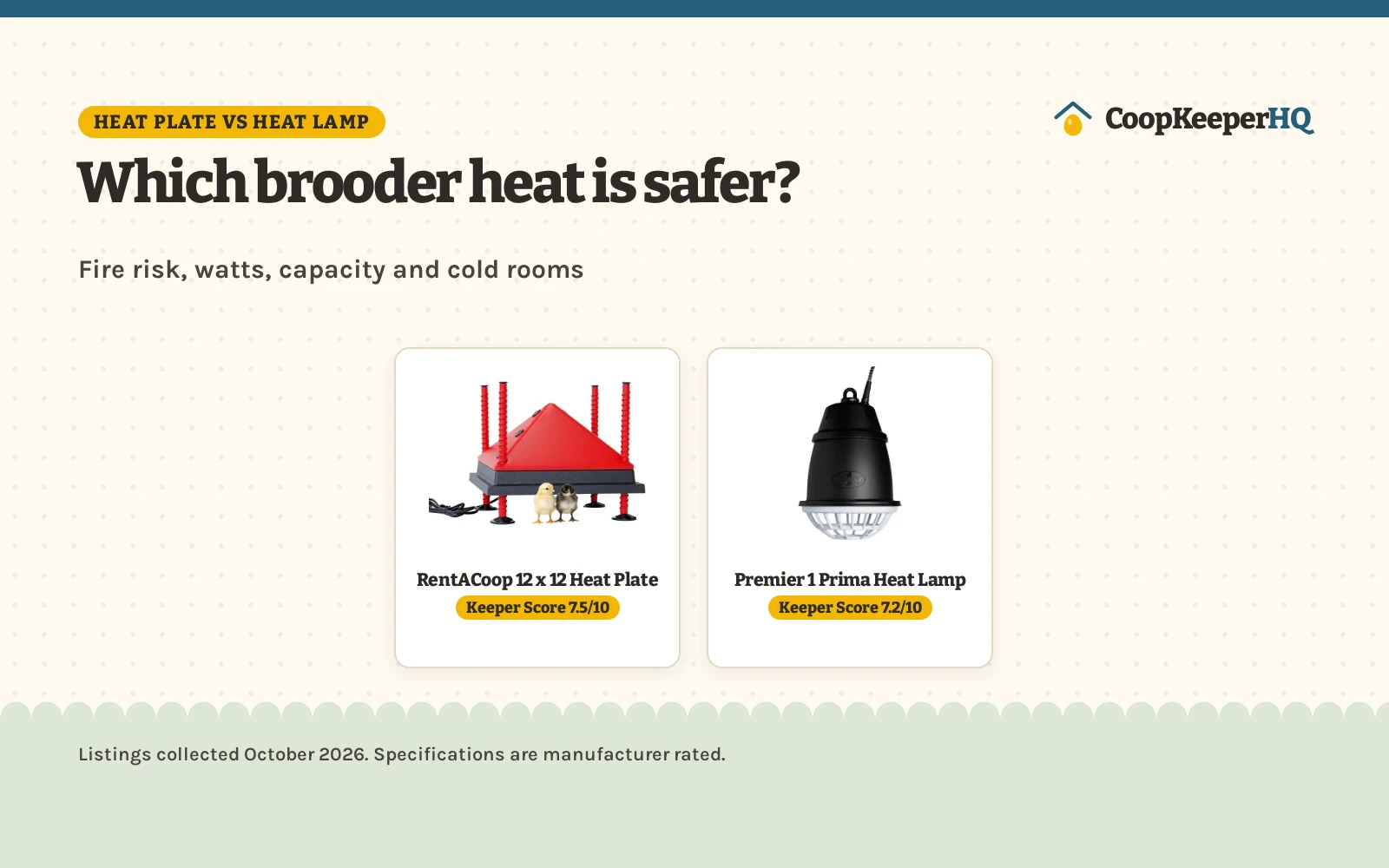
RentACoop 12x12 Adjustable Heating Plate
A 22 W radiant plate, 12 x 12 inches, rated by the maker for up to 20 chicks, with 25 height settings from 1 to 9 inches and a foldable anti-roost cone.
Who it's for: a first brood of up to 20 chicks in a draft-free brooder indoors.
Who should skip it: anyone brooding in a cold garage or barn, where the plate may not keep up.
The RentACoop plate is 12 x 12 inches, draws 22 W at 110 V and is rated by the maker for up to 20 chicks. The listing gives 25 height settings from 1 to 9 inches, says the center underside reaches about 107 F and includes a foldable anti-roost cone. It states no thermostat is needed because the temperature is fixed.
Pros
- Only 22 W, a fraction of a heat lamp bulb
- 25 height settings from 1 to 9 inches
- Foldable anti-roost cone keeps the top cleaner
- Also listed for ducklings, poults and quail
Cons
- No warranty stated in the listing
- No safety listing such as UL or ETL stated
- Fixed temperature, about 107 F under the center, with no dial
- Listed for indoor use only
Premier 1 Prima Heat Lamp
A ceramic fixture that takes a standard BR40 or infrared bulb up to 250 W, with a tilt shut-off switch, a plastic guard and a 16 ft chew-resistant cord.
Who it's for: keepers who already use heat lamps and want a sturdier fixture than a clamp lamp.
Who should skip it: anyone brooding in a small box, where a plate is the safer choice.
The Premier 1 Prima is a hanging fixture, 9-3/8 inches across and 15 inches tall, that accepts bulbs up to 250 W. The listing states a ceramic socket, a glass-reinforced plastic body, a guard, an integrated safety switch that cuts power if the lamp is tilted, and a 16 ft cord with anti-chew spring wire. The bulb is sold separately.
Pros
- Integrated switch shuts it off if the lamp tilts
- Heavy plastic guard around the bulb
- 16 ft cord with anti-chew spring wire
- Ceramic fixture takes standard BR40 or infrared bulbs
Cons
- Bulb not included
- Up to 250 W, about eleven times the plate’s draw
- No warranty or safety listing stated
- Hot bulb still needs a secure mount away from bedding
Other options for the coop
 RentACoop 10x10” Adjustable Heating Plate with FoldableCheck price on Amazon
 RentACoop 10x10” Heating Plate with Hard Anti-Roost Cone SetCheck price on Amazon
 RentACoop 12x12” Adjustable Heating Plate with HardCheck price on Amazon
 Tetuga Brooder Heat Plate 12 X 16” Chick Heating Plate WarmCheck price on Amazon
 K&H Brooder PlateCheck price on Amazon
 Heat Plate for ChicksCheck price on Amazon
Heat plate vs heat lamp: side by side
| Factor | Heat plate | Heat lamp |
|---|---|---|
| Typical power | 12 to 30 W | 175 to 250 W |
| Daily energy | 0.3 to 0.7 kWh | Up to 6 kWh |
| Hot bulb | None | Yes, glass bulb |
| Light at night | None | Yes, unless red or infrared |
| Warms | Chicks underneath by contact | Air and floor under the lamp |
| Capacity | About 15 to 40 chicks per plate (maker) | Larger area per lamp |
| Cold room | May not keep up | Better, with drafts blocked |
| Example: RentACoop 12 x 12 | 22 W, up to 20 chicks, 1 to 9 in height | Not applicable |
| Example: Premier 1 Prima | Not applicable | Bulbs up to 250 W, tilt switch, guard |
These are common ranges across the poultry listings we read; capacities and sizes are manufacturer ratings, quoted as the listing words them, collected 8 October 2026.
Fire risk
This is the biggest difference. A heat lamp is a hot glass bulb on a cord, and the usual accident is the lamp dropping into bedding or a clamp letting go. A plate has no bulb and a far lower wattage, so there is no hot point to start a fire. A guarded fixture with a tilt switch, like the Premier 1, lowers the risk but does not remove it. Plug either one into a GFCI outlet, and keep cords out of the bedding.
Energy use
| Heat source | Watts | kWh per day |
|---|---|---|
| RentACoop 12 x 12 plate | 22 W | 0.53 |
| Typical heat lamp bulb | 250 W | 6.0 |
Daily energy is wattage x 24 hours. A lamp that runs all day uses about eleven times what a 22 W plate does.
Behavior and light
Under a plate, chicks can duck in to warm up and step out to cool off, and the plate casts no light, so they keep a normal day and night. A lamp is bright all night unless you use a red or infrared bulb, and it heats a patch of floor rather than a single spot. Watch the chicks either way: huddled and loud means too cold, and spread out far from the heat means too warm.
Capacity and cold rooms
A plate warms only the chicks underneath it. The RentACoop is rated for up to 20, so a bigger brood needs a second plate or a bigger one. In a cold garage or barn a low-wattage plate may not keep up, and this is where keepers reach for a lamp. If you do, block drafts first, and consider an insulated brooder box. Our best brooder heat plate guide lists models by capacity.
Cost and upkeep
A plate lasts through many batches and needs only a wipe. A lamp fixture needs a bulb, which burns out and has to be replaced, and a lamp running all day uses far more power. Over a few batches a plate usually costs less to run, even if the plate costs more to buy.
Flock fit
RentACoop 12 x 12 Heat Plate
Premier 1 Prima Heat Lamp
FAQ for the flock
Is a heat plate better than a heat lamp?
For a small to medium brood in a draft-free room, usually yes. A plate draws far less power and has no hot bulb that can fall into bedding. A lamp can suit a large batch in a cold space, if it is guarded and well mounted.
How many chicks can one heat plate warm?
Follow the maker’s rating for newly hatched chicks, such as up to 20 for the RentACoop 12 x 12, and expect it to drop as they grow. Add a second plate for a bigger brood.
Are heat lamps safe for chicks?
They carry a real fire risk because the bulb is hot and the fixture can fall into bedding. If you use one, choose a guarded fixture with a secure hanging system, keep it well clear of bedding and use a GFCI outlet.
Can a heat plate work in a cold garage?
It can, but low-wattage plates are designed for rooms that are not freezing. In a cold space, use an insulated brooder box, block drafts and watch the chicks’ behavior closely.
How long do chicks need extra heat?
Typically until they are fully feathered, often around six weeks, but it depends on room temperature. Ask your extension office or a poultry vet if you are unsure about your conditions.
How the Coop Score came out
Each example is scored out of 10 on performance, build, value, safety and warranty, using only what the listing publishes. Neither listing states a warranty. The weights are on our How We Pick page.
| Product | Keeper Score | Perf. /35 | Build /25 | Value /25 | Safety /10 | Warranty /5 |
|---|---|---|---|---|---|---|
| RentACoop 12 x 12 Heat Plate | 9.5 | 33 | 20 | 20 | 3 | 0 |
| Premier 1 Prima Heat Lamp | 9.5 | 29 | 21 | 18 | 4 | 0 |
Keeper Scores run between 9.2 and 9.8. We spread weighted point totals across that window proportionally, so a product with more points always lands higher.
Which should you choose?
Choose a heat plate if you brood up to about 20 chicks in a garage corner, spare room or basement, you want the lowest fire risk and you want chicks to get a dark night.
Choose a heat lamp if you brood a large batch in a barn or a cold space, you can hang it from a solid support above a guarded area and you use a GFCI outlet.
Pick a species and a set date for candling days, lockdown and hatch day, with a calendar file to save.
Heat lamps are a common cause of coop and barn fires. If you use one, secure it with more than the clamp (a chain or wire to a fixed point), keep it well away from bedding, walls and cardboard, and plug it into an outlet or a cord rated for the load. Radiant heat plates run cooler and remove most of that risk. Check chicks often in the first days: huddling under the heat means too cold, spreading to the edges means too warm. Read our Safety Disclaimer.
More coop guides
- Best Organic Chick Starter Feed Under $50 (2026)
- Best Brooder Bedding for Chicks (2026): 5 Picks for the Brooder
- How Long Do Chicks Need a Heat Plate
- Are Brooder Plates Safe for Chicks
- How to Keep Duck Brooder Dry
- Do Chicks Need Heat Lamp in Summer? A Keeper Guide
- Duck Brooder Temperature Guide
- How to Hang a Heat Lamp for Chicks
- How Hot Is a Heat Lamp for Chicks
- How Many Watts Is a Heat Lamp? A Brooder Guide
- Brooder Box vs Brooder Tent: Which One Should You Buy?
- Best Organic Chick Starter Feed (2026): 5 Picks for the Brooder
- Heat Lamp Temperature Control for Brooders
- Duckling Brooder Setup: Heat, Bedding and Supplies
- Chick Brooder Temperature: How to Set It and Read the Chicks
- Brooder Box vs Chicken Coop: Which One Should You Buy?
- Best Heat Lamp Bulb for Brooder (2026)
- Best Chick Brooder Under $100 (2026): 5 Compared
- Best Brooder Under $80 (2026): 5 Picks Compared
- Heating Pad vs Heat Lamp for Chicks: Which One Should You Buy?
- Turkey Brooder vs Chick Brooder: Which One Should You Buy?
- Starter Feed vs Grower Feed: Which One Should You Buy?
- Best Heat Lamp for Turkey Poults Under $25 (2026): 5 Compared
- Wood vs Metal Chick Brooder: Which One Should You Buy?
- Best Heat Lamp for Turkey Poults (2026): 5 Compared
- Best Chicken Brooder Toys (2026)
- Best Red Heat Lamp Bulb for Chicks (2026): 4 Picks
- Paper Towels vs Pine Shavings Brooder: Which One Should You Buy?
- Metal vs Plastic Chick Brooder: Which One Should You Buy?
- Ceramic Heat Lamp vs Light Bulb: Which One Should You Buy?
- Plastic Tote vs Brooder Box: Which One Should You Buy?
- Best Chick Perch for Brooder Under $15 (2026): 5 Picks
- Best Thermometer for Brooder Box (2026): 4 Picks
- Best Ceramic Heat Emitter for Brooder (2026): 4 Picks Compared
- Incubator vs Brooder: Which One Should You Buy?
- Digital vs Analog Brooder Thermometer: Which One Should You Buy?
- Indoor vs Outdoor Chicken Brooder: Which One Should You Buy?
- Plastic vs Wooden Chick Brooder (2026): 4 Compared
- Best Brooder Thermometer Under 20: 4 Picks
- Small vs Large Chick Brooder: Which One Should You Buy?
- Best Brooder for 25 Chicks (2026): 5 Setups Compared
- Propane vs Electric Brooder: Which One Should You Buy?
- Pine Shavings vs Aspen Shavings: Which One Should You Buy?
- Pawaboo Large Chick Brooder Review: Pros, Cons and Who It Suits
- Woods Clamp Lamp Review: Pros, Cons & Who It’s For
- How Often to Clean Chicken Brooder
- Best Brooder Heat Plate for Quail Chicks (2026)
- Red Heat Lamp vs Clear Heat Lamp: Which One Should You Buy?
- Best Brooder Box for Quail Under $80 (2026)
- Best Brooder Thermometer for Baby Chicks (2026)
- Heat Plate vs Ceramic Heat Emitter: Which One Should You Buy?
- Requirements for a Chick Brooder: Setup, Heat and Sizing Guide (2026)
- Chicken Brooder Ideas: Setups and Enclosures for Backyard Chicks
- Chicken Brooder Size: Space Guide for Backyard Chicks
- Best Chick Brooder Design (2026)
- Best Brooder Heater Plate (2026): 5 Top Picks Compared
- Chicken Brooder with Tray: 5 Top Picks Compared (2026)
- Chick Perch for Brooder (2026): 5 Top Roosting Bars Compared
- Best Thermometer for Chick Brooder: 5 Brooder Picks Compared (2026)
- Best Flooring for Chick Brooder (2026)
- How to Keep Duck Brooder Clean: Dry Setup and Daily Care Guide
- Water Feeder for Chicks: 5 Brooder Sets Compared (2026)
- What Is a Brooder Box?
- What Is a Duck Brooder?
- Alternative to Heat Lamp for Chickens: Which One Should You Buy?
- Brooder Heater vs Heat Lamp: Which One Should You Buy?
- Best Waterer for Baby Chicks (2026): 5 Top Picks Compared
- Chicken Brooder for 15 Chicks (2026): 5 Top Picks Compared
- Cheap Chick Brooder: 5 Budget Picks for Chicks (2026)
- Chick Brooders for Backyard: 5 Starter Kits Compared (2026)
- Best Brooder Heat Plate: Safer Heat for Chicks
- Best Incubator for Chicken Eggs: Hatch Picks by Size
- Best Chicken Coop Heater: Safer Panels for Winter
See every brooder guide and the egg hatch calendar.