How to Use Staple Gun on Poultry Netting
A staple gun fastens poultry netting to wood frames fast, and the difference between a tight run and a sagging run is the right staple size, the right driving force and a steady hand.

On this page
Top picks at a glance
As an Amazon Associate I earn from qualifying purchases.
- 1
 Arrow T55BL Heavy Duty Staple Gun Kit with 37509.5/10View on Amazon
- 2
 GRENPRO 6-in-1 Heavy Duty Staple Gun with 50009.5/10View on Amazon
The run netting sags where the staples pulled loose, and the hens notice the gap before you do. Knowing how to use staple gun on poultry netting turns that repair into a short chore: load the right staples, set the driving force, and seat each staple flat against the wood. This guide walks through the steps in order, then looks at the staple guns that suit run work.
CoopKeeperHQ earns a commission if you buy through our links, at no added cost to you. Affiliate disclosure.
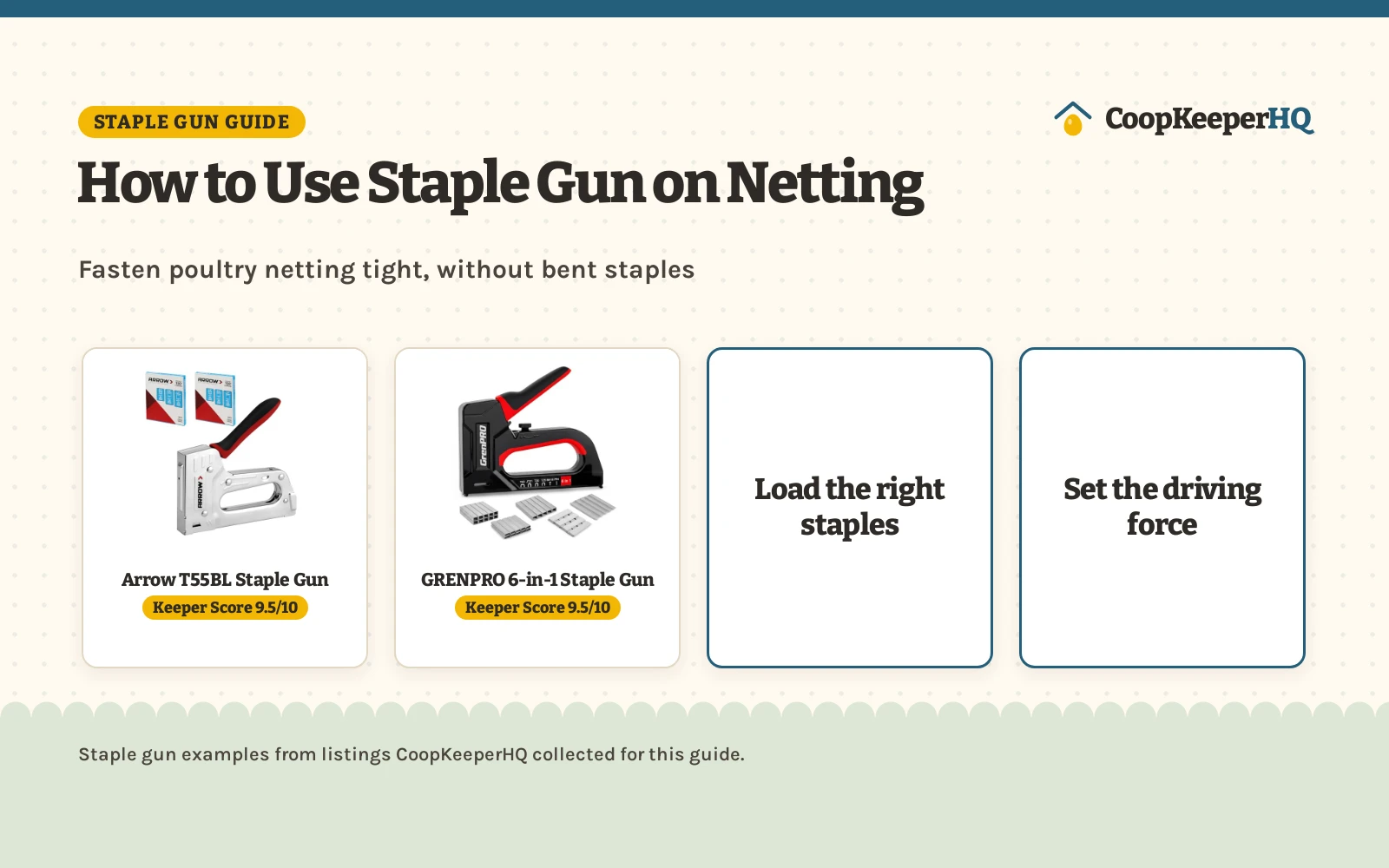
Arrow T55BL Heavy Duty Staple Gun Kit with 3750
A chromed-steel manual staple gun with a rear-load magazine, a staple-viewing window and 3750 T50 staples in 1/4, 3/8 and 1/2 inch sizes.
Who it's for: keepers fastening poultry netting and hardware cloth to wood frames who want to see the staple supply at a glance.
Who should skip it: anyone who needs brad nails or a stated warranty, or who wants adjustable driving force.
The Arrow T55BL is the straightforward pick for run work: a chromed-steel housing with steel parts hardened in a 1,500-degree furnace, a rear-load magazine with a jam-resistant mechanism, and a staple-viewing window that shows when to reload. It comes with 3750 T50 staples, 1250 pieces each of 1/4, 3/8 and 1/2 inch, so the size choice is yours at the bench.
Pros
- 3750 T50 staples in 1/4, 3/8 and 1/2 inch sizes
- Staple-viewing window shows when to reload
- Jam-resistant rear-load magazine
- Chromed-steel housing with hardened steel parts
Cons
- No warranty term is stated
- No adjustable driving force stated
- No weight is stated
- T50 staples only, so other fastener types need another tool
GRENPRO 6-in-1 Heavy Duty Staple Gun with 5000
A 6-in-1 all-steel manual staple gun with adjustable driving force and 5000 staples included, at 1.0 lb.
Who it's for: keepers who want the same gun for netting, upholstery and light carpentry, with brads in the same tool.
Who should skip it: anyone who wants to know the exact staple sizes up front, since the listing does not name them, or who wants a stated warranty.
The GRENPRO is the versatile pick: a 6-in-1 manual gun that works with six staple and brad nail types, with adjustable driving force to suit different materials and staple sizes, and 5000 staples in the box. The all-steel body and spring-loaded mechanism with a red-black rubberized grip keep it comfortable over a long run of staples, and at 1.0 lb it is light in the hand.
Pros
- Works with six staple and brad nail types
- 5000 staples included, ready to use
- Adjustable driving force for different materials
- All-steel construction at 1.0 lb
Cons
- No warranty term is stated
- No staple sizes are stated
- No viewing window to check the staple supply
- No jam-resistant mechanism stated
How to use staple gun on poultry netting
A staple gun drives a staple through netting and into a wood frame with a squeeze, with the staple crown holding the mesh flat. The job has a few parts: pick the staple, load the gun, set the force, and work along the frame. Get those right and the netting stays taut through wind and weather.
Before you start
Walk the run before you start and look at the frame the netting fastens to. Pull off loose staples, brush away dirt where the netting meets the wood, and check that the frame is sound enough to hold a staple. Unroll the netting and let it relax flat before you fasten it, and keep the staple box open beside you so reloading does not break your rhythm. If you have not picked a gun yet, the types of staple guns guide compares the kinds that fit wire fencing.
- Pick the staple. The Arrow kit here includes 1/4, 3/8 and 1/2 inch T50 staples, 1250 pieces of each, so match the staple to the wood: longer legs for thicker battens, shorter legs for thin trim. The GRENPRO takes six staple and brad nail types but does not name the sizes, so check what it takes before you load it.
- Load the magazine. Slide the staples in points down, close the magazine, and check the Arrow viewing window to see the supply. A full magazine keeps the rhythm steady along a long run of netting.
- Set the driving force. The GRENPRO dials the force up or down for different materials and staple sizes. Start low and raise it until the staple seats flat, with the crown tight on the netting and the legs sunk in the wood.
- Hold the gun flat and squeeze. Press the nose flat on the wood over the netting, keep fingers clear of the nose, and squeeze the handle in a firm motion. Wear eye protection: a staple can glance off a knot.
- Work along the frame. Pull the netting taut, staple along the frame, and check each staple as you go. A staple that stands proud needs a tap with a hammer to seat it, or a fresh staple beside it.
- Clear a jam. If the gun stops feeding, open the rear-load magazine and lift the stuck staple out. The Arrow rear-load magazine is jam-resistant.
That is the whole job. A tight run starts with the netting pulled taut and ends with every staple crown flat on the mesh.
How to check your work
Walk the run when you finish and tug the netting at each section. It should feel drum tight, with no slack to flap in the wind and no gap at the corners where a hen could push through. Look along the frame for staples standing proud or bent over, and replace any that did not seat. A staple that bent on a knot goes in beside the old spot, not on top of it. Check the run again after a hard rain, since wet wood and wind find the weak staples fast.
The staple guns for run work
The steps above need the right staples and a gun that seats them flat, and these two manual guns cover run work between them.
Common mistakes
- Staples too short for the wood. A staple that cannot bite holds nothing. Match the leg to the batten.
- Holding the gun at an angle. A crooked nose seats the staple crooked. Keep the nose flat on the wood.
- Leaving the netting slack. Slack netting sags and gives predators a gap. Pull it taut before each staple.
- Forcing a jammed gun. Open the magazine and lift the stuck staple out instead.
- Skipping eye protection. A staple can glance off a knot, so glasses stay on for the whole job.
Wash your hands after handling birds, eggs or equipment, supervise children around the flock, and check local rules on flock size and roosters before you buy. For sick birds, call a poultry veterinarian or your state extension office. See CDC backyard poultry guidance. Read our Safety Disclaimer.
FAQ for the flock
What size staples should I use for poultry netting?
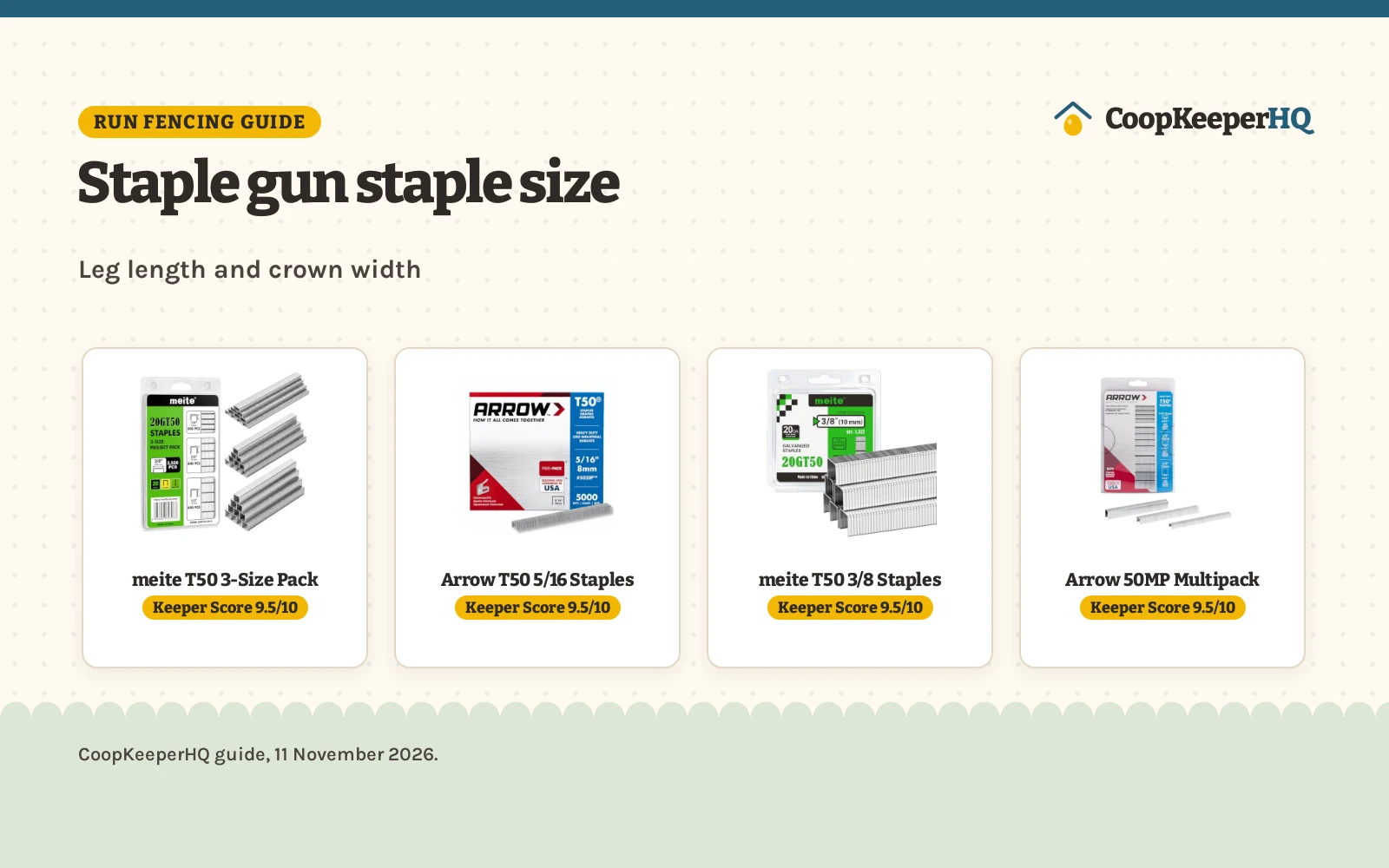
The Arrow kit here includes 1/4, 3/8 and 1/2 inch T50 staples, 1250 pieces of each, so you can match the staple to the wood. The GRENPRO does not name its staple sizes, so check the sizes it takes before ordering. The staple gun staple size guide covers leg length and crown width for the run.
Can a staple gun fasten hardware cloth as well as netting?
Yes. Both guns here are manual staple guns for wood, and hardware cloth fastens the same way: flat against the frame with the staple crown holding the mesh. The hardware cloth guide covers what to buy.
Why do my staples bend instead of seating flat?
The gun may be held at an angle, the force may be set too low, or the staple may have hit a knot. Press the nose flat, raise the force on the GRENPRO dial where the gun has one, and put a bent staple beside the old spot, not on top of it.
How do I clear a jammed staple gun?
Open the rear-load magazine and lift the stuck staple out, then reload. The Arrow has a jam-resistant rear-load magazine and a staple-viewing window that shows the staple supply.
Do I need a staple gun, or will a hammer and staples do?
A staple gun seats each staple flat with the nose on the wood while you hold the netting taut. A hammer works for a few staples, but a run of netting goes faster with the gun.
More coop guides
- Types of Staple Guns: Which One Fits Wire Fencing
- Staple Gun Staple Size: Leg Length and Crown Width for the Run
- Staple Gun Manual: Fasten Wire and Fabric by Hand
- How to Predator Proof a Chicken Run
- Chicken Coop Fencing Ideas: Netting and Panels
- Best Hardware Cloth for Chicken Coop Runs and Aprons
See the chicken runs and fencing picks and the coop supply guides.