Indoor vs Outdoor Quail Cage: Which One Should You Buy?
Indoor and outdoor quail cages compared on shelter, ventilation, cleaning and flock capacity, with 2 indoor cages as examples.

On this page
Top picks at a glance
As an Amazon Associate I earn from qualifying purchases.
- 1
 Lukovee Foldable Small Animal Playpen with Detachable Bottom9.6/10View on Amazon
- 2
 Hatching Time Quail Breeding Cage Indoor9.6/10View on Amazon
- 3
 GDLF Wooden Quail Cage IndoorView on Amazon
- 4
 Hatching Time Quail Breeding Cage IndoorView on Amazon
- 5
 1 Additional Layer for Quail Breeding CageView on Amazon
- 6
 Hatching Time Quail Cage Grow Out PenView on Amazon
On a quiet morning, the quail are already scratching in bedding and waiting at the feeder while the day warms up. For indoor vs outdoor quail cage placement, the short answer is that an indoor cage suits a keeper who wants shelter, easy cleaning and close watching, while an outdoor setup suits a keeper with an enclosed shelter and room to spare. The rest of this guide walks through shelter, air, cleaning and flock size so the choice fits the setup at hand.
Other options for the coop
 GDLF Wooden Quail Cage IndoorCheck price on Amazon
 Hatching Time Quail Breeding Cage IndoorCheck price on Amazon
 1 Additional Layer for Quail Breeding CageCheck price on Amazon
 Hatching Time Quail Cage Grow Out PenCheck price on Amazon
CoopKeeperHQ earns a commission if you buy through our links, at no added cost to you. Affiliate disclosure.
indoor vs outdoor quail cage: start with shelter
Shelter decides the placement. The GDLF cage is built for indoor quail housing, and its listing names a shed, barn, garage, porch or covered area as the spot for it. The Hatching Time cage carries a clear warning: use it indoors or inside an enclosed shelter because the cage is not predator-proof. An outdoor setup for a cage like this one therefore needs an enclosed shelter around it, not just open ground. For size comparisons, see the quail cage size guide.
Airflow
Air moves differently indoors and out. The GDLF cage uses large wire mesh panels that allow airflow through the cage and make it easy to check on quail at a glance. The Hatching Time cage uses polypropylene components that will not rust like metal cage panels and can be power-washed for routine maintenance. Outdoors, wind and rain reach the cage directly, so a covered area matters more; indoors, wire mesh panels keep air moving for easy checking.
Cleaning and daily chores
Cleaning is where an indoor cage shows its advantage. The GDLF cage gives each tier a removable cleaning tray that slides out for routine cleanup, plus a bottom shelf for feed, bedding and tools. The Hatching Time cage gives removable waste trays below each layer, sloped flooring that guides laid eggs toward the front collection area, and gravity-fed watering for both layers. Its waste trays extend 3 inches farther beneath the cage to improve coverage around the feeding area. For watering choices, see the hanging vs ground quail waterer comparison.
Flock size and cage size
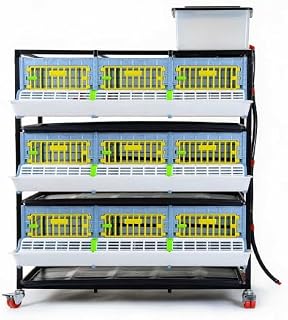
Flock size pulls the two cages apart. The Hatching Time cage houses up to 30 standard quail across 2 stacked layers with 3 sections per layer. Each section accommodates up to 5 smaller quail, and for larger birds the maker recommends 3 per section. Removable middle walls let keepers maintain separate breeding groups or open sections into larger hutch-style spaces, for 6 configurable sections across the full system. The GDLF cage takes a different shape: a double-level layout with two separate cage areas, sized 35.4 x 18.9 x 65.0 inches and weighing 44.75 pounds. The Hatching Time cage measures 38.6 x 24 x 35.8 inches with a layer floor space of 35.8 x 17.3 inches and a weight of 40 lb, and it carries a 1-year warranty.
Indoor cages as examples
The Hatching Time cage fits a keeper who wants capacity and built-in watering in an indoor or enclosed-shelter setup. Its gravity-fed watering covers both layers, its sloped flooring guides eggs to the front collection area, and its removable walls allow 6 configurable sections. The GDLF cage fits a keeper who wants a wooden indoor cage with open shelving and a storage shelf for supplies. Its solid wood frame and wire mesh panels give a natural look, its pull-out trays simplify routine cleanup, and its multiple doors make feeding, cleaning and handling easier. For cage material choices, see the wood vs wire quail cage comparison, and for floor choices, the solid vs wire bottom quail cage comparison.
A short placement checklist
- Put the GDLF cage in a shed, barn, garage, porch or covered area when indoor placement is the plan.
- Use an enclosed shelter for the Hatching Time cage, since it is not predator-proof.
- Check airflow indoors and wind cover outdoors.
- Plan cleaning around pull-out trays or removable waste trays.
- Match the cage to flock size: up to 30 standard quail in the Hatching Time system, with sections for smaller groups.
Birds, breed size, run time and climate in; coop floor, run space, roost length and nesting boxes out.
Wash your hands after handling birds, eggs or equipment, supervise children around the flock, and check local rules on flock size and roosters before you buy. For sick birds, call a poultry veterinarian or your state extension office. See CDC backyard poultry guidance. Read our Safety Disclaimer.
FAQ for the flock
Can a quail cage go outside?
Yes, with shelter and predator protection. The Hatching Time cage is not predator-proof, so it needs an enclosed shelter outdoors. The GDLF cage is built for indoor housing in a shed, barn, garage, porch or covered area.
How many quail fit in the Hatching Time cage?
Up to 30 standard quail across 2 stacked layers with 3 sections per layer. Each section accommodates up to 5 smaller quail, and the maker recommends 3 per section for larger birds.
What makes cleaning easier in these cages?
The GDLF cage has a pull-out tray on each tier that slides out for routine cleanup. The Hatching Time cage has removable waste trays below each layer and sloped flooring that guides eggs toward the front collection area.
Do these cages include watering?
The Hatching Time system includes gravity-fed watering for both layers. Watering is Not stated for the GDLF cage.
Which cage suits a small indoor space?
The GDLF cage uses a double-level layout that reduces floor space, at 35.4 x 18.9 x 65.0 inches. The Hatching Time cage has a compact footprint at 38.6 x 24 x 35.8 inches with a layer floor space of 35.8 x 17.3 inches.
More coop guides
- Small vs Large Quail Cage: Which One Should You Buy?
- Wood vs Wire Quail Cage (2026): Which Should You Buy?
- Solid vs Wire Bottom Quail Cage: Which One Should You Buy?
- Quail Cage Size: Space, Dimensions and Setup Guide
- Quail Cage vs Quail Hutch: Which One Should You Buy?
- Hanging vs Ground Quail Waterer: Which One Should You Buy?
See every ducks, quail and turkeys guide, and for flock size comparisons, the small vs large quail cage comparison.